
Large-scale masonry projects often face delays and budget overruns due to the slow pace of traditional hand-stacking. Finding a way to maintain the aesthetic of natural stone while reducing labor hours is a priority for commercial developers and architects. Using a modular 6×24 ledger system allows teams to install stone up to 10 times faster than loose pieces, providing a path to finish facades on schedule without losing material authenticity.
This guide explores the engineering behind 6×24 stacked stone panels, comparing cement-backed and mesh-backed systems for 2026 building code compliance. We analyze the cost differences between modular units and traditional methods, where panels can reduce labor from 64 hours down to 36 for a standard 150-square-foot project. You will also find technical specifications for ASTM C1670 standards, CNC-mitered corner alignment, and the reinforced packing systems required to deliver 30,000-lb loads safely to the job site.
Engineering Behind 6″x24″ لوحات الحجر المكدسة
Standard 6″x24″ stacked stone panels use a modular veneer system where natural stone pieces, typically 0.4″ to 1″ thick, are bonded into 1-square-foot units. This engineering allows for a lightweight 5.5 lb per piece profile that meets TCNA standards for rapid, grout-free installation.
Modular Geometry and Material Composition
The technical design of these panels centers on a standardized 6-inch by 24-inch dimension, which creates exactly one square foot of surface coverage per unit. This geometric precision simplifies material estimation and layout planning for large-scale architectural projects. Manufacturers select natural stone varieties such as slate, quartzite, marble, and travertine to ensure material authenticity while meeting specific density requirements.
Each panel features a calibrated thickness ranging from 0.4 to 1 inch. This variation provides the desired three-dimensional split-face texture without the excessive weight of traditional masonry. By maintaining a low profile, the system achieves an average weight of 5.5 lbs per panel. This engineering choice reduces the structural load on wall assemblies and allows for installation on standard substrates without the need for additional footings or heavy-duty wall ties.
Bonding Integrity and Performance Standards
Individual stone pieces are permanently secured into a modular unit using high-strength epoxy resin or cement-backed mortar systems. These industrial adhesives ensure that the panel remains intact during transport and throughout its service life on the wall. The manufacturing process adheres to Tile Council of North America (TCNA) methods, providing a reliable framework for adhesion in both interior and exterior applications.
The material properties are tested to meet 2026 climate-resilient building standards, specifically regarding freeze-thaw resistance and fireproof ratings. These panels function effectively in wet environments and extreme temperature cycles. To improve the visual outcome, the panels often utilize Z-shape or interlocking edge designs. This engineering detail hides vertical seams and eliminates the requirement for traditional grout, resulting in a continuous stone surface that mimics hand-set masonry with significantly less labor.
Panel Backing: Cement-Backed vs. Mesh-Backed Systems
Cement-backed panels meet rigorous ASTM C1670 and ICC-ES AC51 standards for adhered veneer, offering superior bond strength and impact resistance. While mesh-backed systems provide flexibility for tight curves, they lack the codified engineering support required for 2026 large-scale exterior facades.
Structural Integrity of Cementitious Backed Assemblies
Cement-backed systems utilize high-strength epoxy resins to bond natural stone to a rigid substrate, preventing individual stone fallout. These rigid backings ensure the assembly remains under the 15 lb/sqft saturated weight limit mandated by IBC and IRC for adhered veneers. Most natural stone panels using this method average approximately 9.5 lb/sqft, keeping them well within safety margins for standard residential and commercial wall designs.
The system supports a compressive strength exceeding 2100 psi per ASTM C1670 requirements for manufactured and natural stone units. This durability protects the facade from impact and environmental stress. Thermal resistance provides an approximate R-value of 0.62 at a 1.5-inch thickness, contributing to building envelope efficiency while maintaining a slim profile of 0.3 to 1.25 inches depending on the specific stone cut.
Compliance Standards and Installation Requirements
Installation follows ASTM T1780 and ICC-ES AC51, requiring a scratch coat over metal lath for framed walls. This lath must be 2.5 or 3.4 lb/yd² galvanized expanded metal to resist corrosion in exterior or wet environments. Fasteners are typically spaced 6 inches apart vertically and 16 inches horizontally to secure the lath to the underlying studs or masonry, creating a stable foundation for the heavy veneer.
Substrate deflection must be limited to L/600 of the span under veneer load to maintain bond integrity per TMS 402/602 standards. This stiffness prevents the rigid stone panels from cracking as the building settles or moves. Polymer-modified thinset mortars meeting ANSI A118.4 and A118.11 are necessary for permanent adhesion to cementitious surfaces. While mesh-backed sheets offer easier installation for interior decorative accents, they often lack specific recognition under primary adhered veneer codes for exterior load-bearing facades.
Labor Cost Reduction: Panels vs. Hand-Stacking
Stacked stone panels cut installation time by 50% to 60% compared to loose stones. While panel materials may have a higher upfront cost, they reduce total project expenses by lowering labor hours from 64 hours to approximately 36 hours for a standard 150-square-foot project, as of 2026 data.
| Installation Metric | Traditional Hand-Stacking | Modular Stone Panels |
|---|---|---|
| Daily Productivity | 10 – 15 Sq. Ft. / Person | 40 – 50 Sq. Ft. / Person |
| Labor Cost Ratio | 55% – 70% of Total Budget | 25% – 40% of Total Budget |
| Skilled Labor Need | Expert Mason ($70-$110/hr) | Tile Installer or General Crew |
Installation Speed and Skilled Labor Efficiency
Panels install up to 10 times faster than hand-stacked loose stone, enabling a single installer to cover 40 to 50 square feet per day. The interlocking Z-clad design minimizes the need for specialized masonry skills, allowing tile installers to achieve professional results without the years of training required for traditional stone setting. By eliminating individual piece placement and on-site stone shaping, crews cut labor hours by 35% to 50% depending on the project complexity.
Modular 24×6-inch formats significantly reduce set time on larger commercial applications. On a 1,200-square-foot commercial facade, these systems save approximately 28 hours of active labor. Because the panels fit together predictably, builders avoid the time-consuming process of sorting through loose stone crates to find matching depths and shapes, ensuring the project moves forward without the typical bottlenecks of hand-stacking.
Total Project Cost and Masonry Rate Comparison
Labor accounts for 55% to 70% of the total installed price for traditional stone veneer, with expert masons averaging $68 to $110 per hour. While loose stone materials may appear cheaper per unit, the total installed costs range from $20 to $23 per square foot due to the slow pace of hand-selection. Panels lower the labor component to between $800 and $1,200 for a 100-square-foot wall, often making the total bill more competitive despite higher material prices.
Lightweight panels weighing between 8 and 13 pounds per square foot remove the need for expensive structural footings or wall ties. This weight reduction simplifies the preparation phase and lowers ancillary labor costs associated with wall reinforcement. In major metro areas where regional labor premiums can increase hand-stacking costs by 30% to 40%, modular panels offer a more stable and predictable budgeting option for 2026 developments.
Premium Stacked Stone for Architectural Excellence
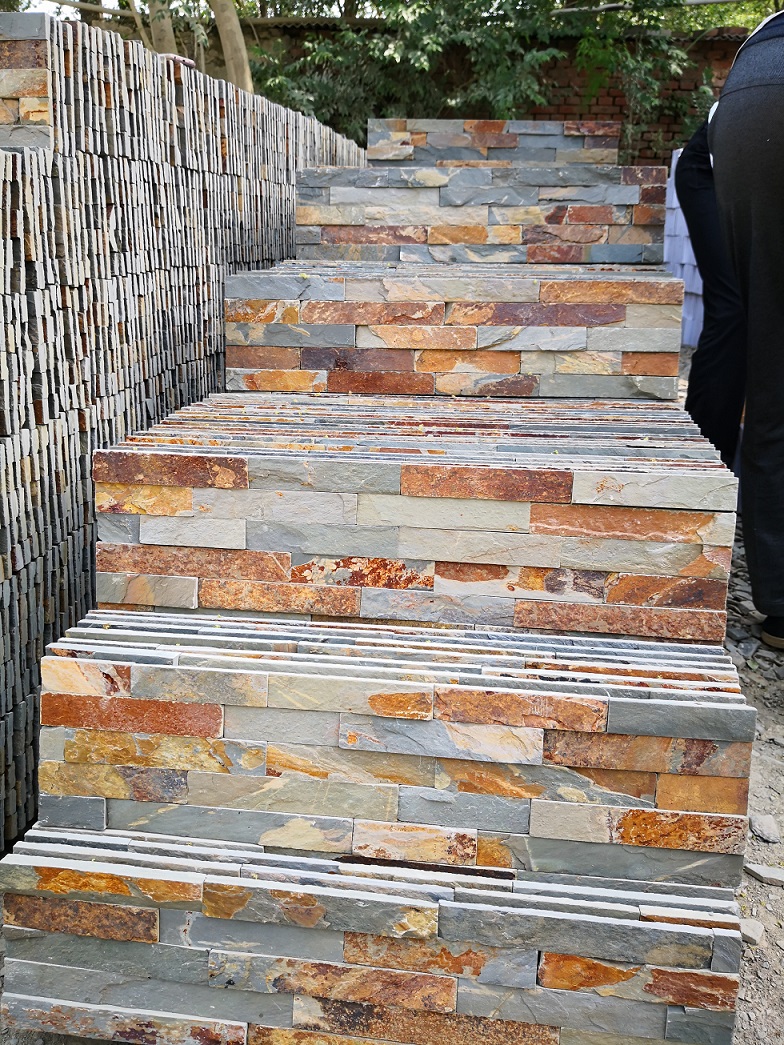
Achieving Visual Consistency in Large-Scale Facades
Achieving a uniform facade involves using staggered Z-shaped interlocking panels and alternating corner lengths to hide vertical seams. Maintaining tight tolerances through infrared-cut precision and batch-matching stone from the same quarry cycle ensures color and texture harmony across large square footage.
| Technical Metric | Specification Standard | Installation Requirement |
|---|---|---|
| Material Weight | 8-13 lbs per sq. ft. | Adhered application without footings |
| ASTM Compliance | C616 (Quartzite) / C629 (Slate) | Exterior weather resistance stability |
| Fastener Spacing | ASTM C1063 Compliance | 6″ vertical / 16″ horizontal O.C. |
| Mortar Bed | ANSI 118.4 & 118.11 | 0.25″ to 0.375″ thickness |
Staggered Joint Layout and Interlocking Geometry
Z-shaped interlocking 6×24 panels eliminate visible grout lines by nesting together, which creates a continuous stone flow across expansive surfaces. Installers prevent grid-like patterns by implementing a staggered layout, intentionally alternating long and short corner ends to break up vertical joint lines. This technique mimics the natural layering found in traditional hand-laid masonry while utilizing the speed of modular systems.
Proper substrate preparation ensures the panels remain level on tall vertical elevations. Installers apply the stone over cement board or concrete using metal lath fastened at 6 inches vertically and 16 inches horizontally. For high-profile walls, 2×4 ledger boards or starter strips provide a stable base that prevents panel slippage during the mortar curing process. Extending metal lath 4 inches around corners further reinforces the structural integrity of the facade transition.
Technical Material Grading and Calibration for Scale
Manufacturing standards dictate the success of large-scale stone applications. Maintaining panel weights between 8 and 13 pounds per square foot allows for uniform load distribution, removing the need for costly structural footings or wall ties. Engineering specifications for 2026 projects prioritize ASTM C616 and C629 compliance for quartzite and slate to guarantee color stability and resistance to freeze-thaw cycles in exterior environments.
Precision in edge alignment comes from infrared cutting technology, which ensures each 6×24 panel fits tightly against its neighbor. Project managers maintain aesthetic harmony by sourcing the entire inventory from a single quarry run, minimizing the natural color variance inherent in stone. Controlling the mortar bed thickness between 0.25 and 0.375 inches maintains a consistent depth profile, preventing shadows or protrusions that could disrupt the visual plane of the elevation.
Precision Cutting for Seamless Corner Alignment
Achieving seamless stone corners in 2026 relies on CNC-controlled 45° miter cuts and infrared-guided saws. By maintaining tolerances within ±0.05mm and using specific spindle speeds like 6,000 RPM, manufacturers create panels that interlock perfectly, removing the need for complex manual site adjustments.
CNC Miter Cutting and Axis Coordination
Modern stone fabrication utilizes CNC saws equipped with 0.1° increment adjustments to execute 45° miter cuts with absolute consistency. This mechanical precision ensures that corner joints meet without visible gaps or overlapping edges. By coordinating the X, Y, and Z axes within a tight window of ±0.001 inches, the system guarantees that every panel edge aligns perfectly with its counterpart during the final assembly.
To eliminate cumulative errors in large-scale facades, these cutting systems implement 0.001mm encoders that track real-time positioning. This level of tracking prevents the small deviations that often occur during repetitive cycles. Furthermore, the use of ball-nose end mills allows for the production of internal radii as small as 0.2mm, which results in sharp, clean transitions that maintain the geometric integrity of the stone structure.
Technical Calibration for Edge Sharpness
High-quality stone finishes require strict regulation of spindle speeds, typically maintained between 6,000 and 7,500 RPM. This range balances efficient material removal with thermal control, preventing heat-induced micro-fractures on the stone edges. Feed rates are optimized at 15 to 20 inches per minute to keep tool deflection below 0.01mm, ensuring the cutting tool stays true to the programmed path without bowing under pressure.
Quality control protocols target edge sharpness tolerances of less than 0.05mm. These hair-line joints are essential for creating the illusion of a single, solid block of stone. To achieve a surface finish standard of less than 0.8 Ra, manufacturers utilize iterative refinement and rigid clamping setups. This stability during the cutting phase prevents vibration and movement, allowing for a refined finish that simplifies the installation process for on-site teams.
Inventory Safety: Our Reinforced Crate Packing System
Our system utilizes 1/2-inch to 3/4-inch AC fir plywood reinforced with 1×4 solid wooden battens and zinc-plated steel hardware. Using PSI-based dynamic cushioning with Volara® foam and Marvelseal® barriers, we ensure shipments meet MIL-C-104C standards for loads up to 30,000 lbs.
Structural Integrity and Plywood Sheathing Standards
Protecting heavy stone panels requires a rigid exterior shell capable of withstanding the mechanical stresses of international shipping. We construct our crates using exterior-grade AC fir plywood in 1/2-inch or 3/4-inch thicknesses, depending on the specific weight of the cargo. This sheathing is reinforced with 1×4-inch solid wooden battens that are bonded with polyvinyl-acetate or aliphatic-resin adhesives. This chemical bonding, paired with 3-inch screw shank nails, provides superior grip and prevents joint separation during frequent crane or forklift handling.
The lid security system employs cold-rolled steel bolt plates, 1/8-inch thick, which are zinc-plated to resist corrosion. These plates work in tandem with 4-prong Tee nuts to ensure the crate remains sealed under high-vibration environments. Our build protocols adhere strictly to MIL-C-104C military-grade specifications, allowing the units to support net loads of 20,000 lbs and gross loads reaching 30,000 lbs, providing a massive safety margin for heavy architectural materials.
Dynamic Cushioning and Atmospheric Protection
To prevent internal fractures or surface abrasions, we calculate cushioning needs based on the PSI dynamic curve of the specific shipment. We use Volara® irradiated cross-linked closed-cell polyolefin foam to absorb transit vibrations that would otherwise transfer directly to the stone panels. We further protect the stone surfaces with Tyvek spun-bonded polyethylene and Marvelseal® aluminized barrier films, which prevent scratching and chemical interaction between the packaging materials and the stone finish.
Environmental control is managed through an atmospheric shield using SS-R-501 roofing felt with a 45 lb minimum weight to block moisture ingress during sea transit. By maintaining a wood framing modulus of elasticity between 2.0 and 4.0, the crates possess the structural stiffness required for stable vertical stacking. In 2026 shipping configurations, these units safely stack up to 5 units high, maximizing container volume without compromising the integrity of the bottom crates or the safety of the inventory inside.
Custom Material Selection for Architectural Branding
Architectural branding uses Custom Material Selection to achieve precise visual identities through selected aggregates like Spanish Dolomite or Granite. By utilizing ASTM C979 compliant pigments and specialized finishes such as acid-etching, designers can ensure color consistency and texture depth across large-scale 2026 commercial projects.
Aggregate Selection and Pigment Control for Brand Identity
Material sourcing serves as the foundation for achieving specific brand colors and textures in stacked stone facades. Selection of premium aggregates including Limestone, Granite, Basalt, and Spanish Dolomite defines the base tone and structural character of the panel. These raw materials undergo rigorous sampling to ensure the mineral properties align with the desired aesthetic, particularly when mimicking natural stone formations.
To maintain color stability across expansive surfaces, engineers integrate ASTM C979 compliant pigments. These additives minimize color shifts often caused by variations in the cement paste, providing a controlled palette for corporate identity requirements. While standard ranges cover 80% of applications, specialized laboratory development supports the remaining 20% of projects that demand bespoke visual profiles beyond off-the-shelf options.
Surface treatment plays a critical role in final appearance. Technicians implement deep finishes and acid-etching at light, medium, or heavy levels to expose internal aggregates. This process reduces piece-to-piece visual discrepancies and creates a more uniform texture that hides seams and joints more effectively than smooth finishes. Other options like grit-blasting or polished surfaces offer additional ways to manipulate light reflection and depth.
Technical Performance and Compliance Standards for Custom Mixes
Engineering benchmarks ensure that customized aesthetics do not compromise structural integrity. Every mix design undergoes verification through concrete cube strength testing, comparing results against project-specific load requirements. This data-driven approach allows for the creation of panels that meet high-strength epoxy bonding needs while maintaining precise dimensional stability throughout the curing cycle.
Adherence to ACI and APA standards governs the production environment, specifically regarding mix tolerances, temperature control, and curing procedures. These protocols prevent common defects like honeycombing in exposed aggregate applications. Consistent batching and moisture management ensure that the architectural precast panels perform reliably in diverse climates without fading or structural degradation over time.
Sustainability goals often influence modern mix designs, where low-cement formulations and Supplementary Cementitious Materials (SCMs) help projects align with LEED certification. Quality control involves three-stage inspections to monitor the integration of these materials. By balancing environmental impact with technical durability, these custom mixes provide a scalable solution for high-end commercial developments requiring both high performance and a distinct brand presence.
Final Thoughts
The 6×24 ledger system balances architectural weight requirements with the visual depth of natural masonry. By shifting from individual stone placement to modular units, teams reduce labor hours while maintaining the technical standards needed for exterior facades. These panels provide a predictable installation path, ensuring that material density, adhesive strength, and thermal resistance align with 2026 building codes.
Using cement-backed systems and precise CNC-mitered corners solves common challenges related to structural load and aesthetic gaps. Builders who implement these standards achieve a high-performance stone finish that resists environmental stress and simplifies project budgeting. Choosing materials that meet specific ASTM and TCNA benchmarks ensures the finished wall remains secure and visually consistent for the long term.
أسئلة مكررة
Do stacked stone panels require grout during installation?
No. These panels are for dry-stacked applications where stones fit tightly together. You only use grout if you want a specific mortar joint finish, typically requiring a 0.25-inch to 0.375-inch mortar bed behind each stone.
How many panels are included in a standard shipping crate?
While counts vary by manufacturer, the 2026 industry standard for 6″x24″ panels is 192 pieces per large crate. This volume covers approximately 192 square feet of wall space.
What tools are needed to cut natural stone veneer panels?
You can use a standard table-style wet saw equipped with a 7–10 inch continuous-rim diamond blade. This setup handles straight cuts for panels under 0.75 inches thick, while an angle grinder helps with detailed corner notches.
Which substrates are safe for ledger panel installation?
Install panels over concrete, cement block, or 0.5-inch cement backer board. For interior projects under 10 feet tall, you can use interior-grade plywood or drywall, but exterior or high-rise applications require masonry or cement board according to ASTM C1063 standards.
How do you ensure seams remain invisible on large walls?
Offset vertical joints by at least 2 to 8 inches between rows to prevent visible lines. We recommend achieving 95% thinset coverage by back-buttering each panel with a 0.5-inch square-notched trowel to ensure a flush, seamless fit.
Are these stone systems safe for high-rise architectural projects?
Yes. Stone panels meet safety standards for high-rise use when they maintain a safety factor between 4.3 and 5.0 on flexural strength. They comply with IBC 1404.7 codes for anchored veneers up to 10 inches thick.
SEO
Title: Stacked Stone Panels Efficiency: The 6×24 Ledger System Guide
Description: Stacked stone panels reduce labor hours and meet 2026 building codes for commercial facades using cement-backed modular veneer systems.
URL: 6×24-stacked-stone-panels-engineering-labor-costs
Keywords: stacked stone panels
