

Inconsistent dimensional tolerance in natural stone sourcing triggers a cascade of on-site labor costs. If panels deviate from a true square, installation crews face a 30% increase in billable hours for manual trimming, which destroys contractor margins and architectural timelines.
We resolve this through CNC diamond-blade precision, holding a strict ±1/16 inch tolerance on every 6×24 inch panel. This mechanical accuracy ensures our interlocking Z-shape systems fit tightly from the crate, camouflaging substrate joints without the need for skilled masonry corrections.
What is Dimensional Tolerance in Natural Stone Manufacturing?
Dimensional tolerance defines the allowable deviation in stone size, ensuring natural material variations don’t compromise the precision required for professional architectural installation grids.
Defining Fabrication Limits and Tolerance Types
Fabrication limits dictate how much a finished stone piece can vary from the architectural blueprint. These standards provide a baseline for quality control and protect B2B buyers from receiving inconsistent inventory that complicates on-site labor.
- Bilateral Tolerances: These allow symmetrical deviation, typically ±1.5 mm (1/16 inch) for face dimensions on panels up to 2 meters long.
- Unilateral and Limit Tolerances: These restrict deviation to a single direction, often required for back anchor depths or specific grout joint alignment.
- Flatness Tolerances: Smooth surfaces require ±1.5 mm accuracy, while rough-cut finishes allow up to ±25 mm over a 1.2-meter span.
- Industry Standards: Established metrics serve as a protection mechanism, defining the acceptable range for all cut-to-size dimension stone.
Adhering to these limits ensures that even though the raw material is 100% natural, the finished product performs with the predictability of an engineered component.
CNC Diamond-Blade Precision for Interlocking Panels
Top Source Stone utilizes CNC diamond-blade edges to maintain strict tolerances across our stacked stone production. This mechanical precision is vital for our 6-inch x 24-inch panels, where tight fitment is the priority for high-end masonry.
- Interlocking Connection: Our Z-shape and S-shape models use a “male-female” system that relies on high-precision cutting to camouflage vertical joints.
- Thickness Consistency: We maintain standard panel thickness between 1 cm and 2.5 cm to prevent “stepped” gaps during large-scale wall installations.
- Structural Alignment: Automated precision achieves 95% hue uniformity and tighter alignment compared to traditional manual hand-assembled alternatives.
By controlling the supply chain from the quarry vein to the final CNC cut, we eliminate the structural stress and unpredictable failure points often found in lower-tier stone products.

How Infrared Cutting Technology Improves Panel Precision?
Infrared cutting hits sub-0.05 mm accuracy while eliminating thermal stress, ensuring natural stone panels interlock perfectly without the chipping or micro-cracks found in traditional mechanical cutting.
Achieving Micron-Level Accuracy with Minimal Thermal Stress
Standard mechanical cutting often leaves micro-cracks that weaken thin quartzite or slate layers. Infrared technology solves this by using ultra-short energy pulses to create fracture lines without traditional heat. We use this precision to maintain the structural integrity of every panel before it reaches the crate.
- Positioning Accuracy: Levels reach below 0.05 mm, far exceeding the results of traditional CNC or waterjet cutting.
- Thermal Management: Ultra-short pulses create negligible heat-affected zones (HAZ), preventing the thermal stress that causes stone to crack during fabrication.
- Edge Quality: The process produces clean, smooth edges that eliminate the chipping common in hand-assembled natural stone.
CNC Precision for Seamless Interlocking Z-Shape Joints
For B2B distributors and contractors, the financial value of precision lies in reduced installation time. At Top-Quellstein, we apply these advanced cutting standards to our interlocking series to ensure a modular fit. This precision allows our Z-shape and S-shape models to camouflage vertical joints effectively.
- Male-Female Connection: High-precision edges ensure the interlocking system fits with absolute consistency across every batch.
- Substrate Camouflage: Tight-fitting joints hide the installation wall completely, creating a seamless architectural finish.
- Cost Reduction: Consistent 6×24 inch panel dimensions eliminate the need for manual edge grinding or trimming on the job site.
- Batch Uniformity: We source from the same quarry vein and use precision cutting to maintain 95% hue uniformity and exact sizing within a single order.
Premium Stacked Stone for High-Value Projects
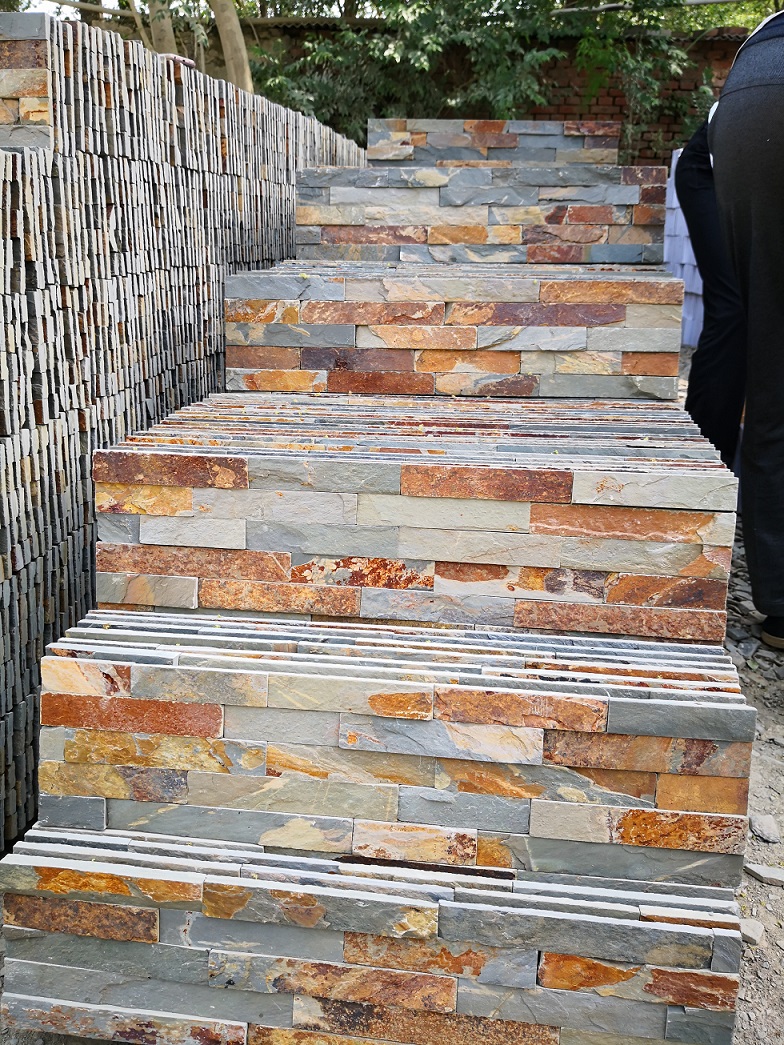
The Hidden Cost of “Out-of-Square” Stone Panels on Your Labor Bill
Out-of-square panels increase labor time by up to 30% through manual trimming. Precision-cut stone ensures a seamless fit directly from the crate, protecting project margins and installation schedules.
| Performance Metric | Budget-Grade Panels | TSS Precision Panels |
|---|---|---|
| Dimensional Tolerance | ±1/8″ to 1/4″ deviation | Strict ±1/16″ (CNC Cut) |
| Labor Overhead | 15-30% time increase | Zero correction required |
| Edge Quality | Visible “stepped” Lücken | Interlocking Seamless finish |
| Corner Transitions | Manual on-site mitering | Pre-fabricated L-Corners |
Labor Drain from Manual Squaring and Shimming
Standard budget stone often lacks true 90-degree corners. When panels deviate even slightly, the error compounds across the wall, creating “stepped” gaps that break the visual line. Installers waste hours manually grinding edges to force a tight fit, turning a modular installation into a custom masonry job.
- On-site Correction: Trimming 100% natural slate or quartzite requires specialized diamond-blade saws and dedicated dust management setups.
- Cumulative Error: Vertical misalignment forces crews to shim individual rows to maintain a level horizontal plane.
- Billable Hours: Contractors report a 15-20% increase in labor costs when dealing with dimensionally inconsistent materials.
Precision CNC Edge Cutting for Modular Efficiency
Top Source Stone utilizes CNC diamond-blade cutting to eliminate these field adjustments. Our manufacturing process ensures that every 6″ x24″ panel meets strict dimensional tolerances, allowing the stone to lock together immediately. This precision moves the project faster and reduces the need for highly skilled master masons for basic wall coverage.
- Seamless Technology: Our Z-Shape and S-Shape models use male-female connections to camouflage vertical joints and hide the substrate.
- Factory L-Corners: Pre-fabricated 90-degree corners remove the need for complex on-site miter cuts, ensuring texture synchronization.
- Installer Velocity: Interlocking designs allow a single installer to cover 25-30% more surface area per shift compared to standard rectangles.
- Tolerance Standard: We maintain a ±1/16″ face dimension tolerance, far exceeding the industry’s looser bilateral standards.

Thickness Consistency: Why it Matters for High-Rise Safety?
Uniform thickness ensures even load distribution and maintains predictable fire resistance ratings required for high-rise safety and 2026 building code compliance.
Structural Load Balance and Fire Safety Compliance
High-rise facades face extreme vertical pressure and lateral wind forces. If stone panels vary in thickness, the gravity and wind loads do not distribute evenly. This creates stress concentrations on lower levels that lead to stone failure, delamination, or buckling. Precision in manufacturing ensures the facade acts as a single, stable unit.
Safety codes specifically target thickness because it dictates fire protection. High-rise buildings typically require Type I noncombustible construction. Inconsistent panel depth makes it impossible to guarantee the fire resistance ratings required for occupancy. A single thin spot in the Steinverkleidung can compromise the thermal barrier during an emergency.
- Load Distribution: Uniform thickness prevents compressive stress concentrations that cause stone delamination on lower levels.
- Fire Ratings: Predictable panel depth ensures exterior walls meet mandatory fire resistance ratings for high-rise occupancy types.
- Barrier Integrity: Consistent natural stone thickness maintains the protection layers and moisture barriers behind the cladding.
CNC Diamond-Blade Precision and Thickness Standards
We use CNC diamond-blade edges to eliminate the irregularities found in manual cutting. This precision is vital for Z-Shape and S-Shape interlocking systems, where a tight fit is necessary to camouflage substrate joints. For architectural facades, this ensures a flush finish across thousands of square feet without visible “stepping” between panels.
Dimensional stability also depends on the source. We source stone from the same quarry vein for each batch to maintain uniform mineral density. This ensures every panel reacts identically to environmental stressors like thermal expansion or heavy moisture, preventing structural non-compliance on the job site.
- Thickness Specs: Standard range of 1cm to 2.5cm ensures a flush finish across large architectural facades.
- Manufacturing Method: CNC diamond-blade cutting provides clean lines and tight modular interlocking.
- Source Control: Utilizing the same quarry vein maintains uniform density and performance under environmental stress.
- Validation: Three-stage quality inspections verify dimensional tolerances before shipping to ensure site safety compliance.

How to Measure and Verify Stone Panel Accuracy at the Factory?
Factory technicians use calibrated tools and ambient-temperature measurements to maintain ±1/16″ tolerances, ensuring modular stone panels interlock perfectly without visible gaps during site installation.
Calibrated Measurement Tools and Tolerance Standards
Precision in natural stone manufacturing requires more than a standard tape measure. Our factory protocols mandate the use of high-degree accuracy instruments to meet B2B quality expectations for modular ledgestone.
- Calibrated Instrumentation: Technicians utilize vernier scales and calipers that undergo professional calibration from certified laboratories annually to ensure every reading is accurate to the micron.
- Strict Dimensional Tolerances: We maintain a ±1/16″ (1.5mm) standard for face dimensions, which is critical for Z-shape and S-shape interlocking panels to fit tightly without revealing the substrate.
- Thermal Expansion Correction: Blade friction generates heat that expands stone by 0.003-0.005 inches per foot. We only measure panels after they return to ambient temperature to prevent size discrepancies in the field.
- Structural Benchmarking: QC teams conduct ASTM C170 compressive strength and ASTM C97 absorption tests to correlate material density with dimensional stability across the production batch.
CNC Precision Cutting and Three-Stage Inspection Workflows
We use advanced machinery and systematic human oversight to eliminate the “stepped” joint issues that often plague lower-grade stone veneers. This process ensures that 95% of a single batch maintains hue and shape uniformity.
- CNC Diamond-Blade Precision: Our CNC equipment achieves perfectly square edges, specifically for our interlocking series, creating a male-female connection that camouflages vertical joints effectively.
- Three-Stage Quality Control: Inspection occurs at three critical points: immediately after the primary cut, following resin assembly of the ledgestone pieces, and just before final crating.
- Edge Squareness Verification: Technicians check for no more than 2mm of deviation over a 600mm span, guaranteeing a professional architectural finish that reduces on-site labor adjustments.
- Pre-Shipment Visual Verification: To protect the margins of our B2B partners, we provide high-definition photos and videos of finished crates before the balance payment, ensuring batch consistency.
Häufig gestellte Fragen
What are the allowable dimensional tolerances for stacked stone panels in 2026 projects?
Industry standards for stone panels up to 2 meters allow face dimension variances of ±1.5 mm (±1/16″). Thickness tolerances generally range from ±3 mm for standard 30-50 mm panels to ±6 mm for thicker blocks. Top Source Stone maintains tight consistency by sourcing from the same quarry vein per order, ensuring modular pieces fit without gaps.
Why do some stacked stone panels appear uneven after installation?
Unevenness often stems from an unlevel substrate or inconsistent mortar application. We eliminate this risk using CNC diamond-blade edges and Z-shape interlocking designs. This “male-female” connection system camouflages vertical joints and compensates for slight wall irregularities, preventing the “stepped” gaps common in lower-tier rectangular panels.
How does stone thickness impact the structural load of a building facade?
Thickness determines the weight burden. Thin veneers under 2 inches typically weigh 8–15 lbs/sq.ft and require no foundational footers. Full-thickness stones weighing 40–60 lbs/sq.ft demand structural reinforcements or separate support ledges. Our standard panels average 30-40kg/m² (8-12 lbs/sq.ft), allowing for high-rise application without excessive structural stress.
How can I verify the precision of stone panels before they leave the factory?
Quality control teams use calibrated calipers and laser scanners to check flatness and perpendicularity. For B2B transparency, we provide pre-shipment visual verification. Wholesalers receive high-definition photos and videos of the actual finished crates and batch measurements, allowing for confirmation of quality before the balance payment.
What are the advantages of using infrared cutting for natural stone production?
Infrared bridge saws offer cutting precision up to 0.2mm, far surpassing manual methods. This technology ensures that interlocking “male-female” connections fit tightly together. It eliminates visible substrate exposure and creates a seamless architectural finish on large-scale walls, reducing the need for on-site adjustments by installers.
