

Currency fluctuations act as a hidden transaction cost that can quickly turn a profitable import deal into a net loss. A minor 2% shift in the exchange rate on a $1,000,000 shipment triggers a $20,000 profit swing without any change in the supplier’s unit price. For B2B businesses operating on thin margins, these market movements turn landed costs into a moving target and often erase gains between the initial order and final delivery.
This guide explores five practical strategies to stabilize your budget and protect your margins from market volatility. We look at the trade-offs between USD and local currency invoicing—standard USD contracts currently cover 95% of consumer goods imports—and how tools like forward contracts lock in exchange rates for future payments. You will also see how switching from traditional banks to FX specialists can reduce total transfer costs by over 80% on high-value settlements.
How Exchange Rate Volatility Can Kill Your Import Profits
Currency fluctuations function as a hidden transaction cost that can transform a profitable stone import into a net loss. A minor 2% shift in the exchange rate on a $1,000,000 shipment triggers a $20,000 profit swing without any change in the supplier’s unit price. For businesses operating on thin margins, this volatility erases gains between the order date and final delivery, turning landed costs into a moving target.
Direct Impact on Profit Margins and Net Gains
Profitability for stone importers depends heavily on the stability of the exchange rate between the initial order and the final settlement. A 2% fluctuation on a $1,000,000 shipment of stone panels results in a $20,000 swing in local-currency costs. Firms that rely on today’s spot rate for pricing inventory intended for 2026 delivery often find their margins destroyed by the time the cargo lands. Empirical data confirms that currency volatility functions as an additional transaction cost, distorting price signals and lowering net gains across the supply chain for import-dependent businesses.
Importers who fail to account for these shifts essentially gamble on the currency market rather than focusing on material procurement. When the domestic currency weakens, the cost of goods sold (COGS) increases immediately, which directly reduces earnings per share and credit metrics. Veterans manage this by treating exchange risk as a core component of their financial planning, whereas novices frequently ignore the risk until the adverse movement appears on their profit and loss statement.
Unstable Landed Costs and Budgeting Challenges
Currency depreciation after signing a purchase order increases the domestic cost of inventory, leaving the importer with difficult choices. They must either absorb the higher costs, which squeezes net margins, or implement abrupt price hikes that can damage relationships with distributors and contractors. Research indicates that roughly 20–30% of currency movements pass through into final import prices. This partial pass-through makes it nearly impossible to maintain a consistent price list in volatile markets, especially for long-term construction projects with fixed budgets.
High volatility also disrupts cash-flow forecasting and prevents firms from accurately calculating the total landed cost of natural stone until the final payment clears the bank. This uncertainty forces companies to maintain higher cash buffers, tying up working capital that could otherwise fund growth. Without a strategy to lock in rates, such as using forward contracts or multi-currency accounts, the unpredictability of the exchange rate prevents reliable financial planning and can destabilize investment plans for capital-intensive stone operations.
Paying in USD vs. Local Currency: Pros and Cons for the Importer
For most importers, paying in USD offers the highest price stability because it shields profit margins from foreign exchange volatility. While veteran buyers sometimes use local currency to negotiate better base prices, this approach demands active monitoring and hedging tools to prevent sudden cost spikes.
Cost Predictability Through USD Invoicing
USD invoicing remains the standard for approximately 95% of consumer goods imports, providing high price stability for the buyer. Importers use dollar-denominated contracts to shield their profit margins from foreign exchange volatility and eliminate conversion surprises. Choosing USD allows novice importers to fix landed costs at the time of the order, simplifying budget management and retail pricing strategies.
Navigating the Volatility of Local Currency Transactions
Paying in local currency shifts the exchange rate risk entirely to the importer, where a 10% appreciation in the supplier’s currency can raise costs by 10%. Veteran importers sometimes opt for local currency to negotiate better base prices from suppliers who prefer local liquidity. This approach requires active monitoring of FX trends and often necessitates the use of hedging tools to prevent sudden margin erosion.
The Impact of Exchange Rate Pass-Through on Landed Costs
Research indicates that only about 30% of a strengthening USD typically translates into lower import prices due to the dominance of dollar invoicing. Global trade data shows that even significant currency fluctuations often result in modest price adjustments of only 0.2% to 0.3% at the factory level. Current market conditions in 2026 suggest that importers must account for these limited pass-through effects when forecasting annual procurement savings.
Forward Contracts: Locking in an Exchange Rate for 6 Months
Forward contracts allow stone importers to secure a fixed exchange rate for future deliveries, eliminating the risk of rising costs between the order date and the final payment. By locking in rates for up to six months, businesses maintain stable profit margins on long-lead projects like commercial facades or multi-unit residential builds.
| Feature | Forward Contract | Spot Market Purchase |
|---|---|---|
| Rate Certainty | Guaranteed for a future date | Subject to daily volatility |
| Upfront Cash | Zero (settlement at maturity) | 100% principal required today |
| Project Budgeting | Fixed landed costs | Estimated costs with margin risk |
How Forward Contracts Stabilize Landed Costs
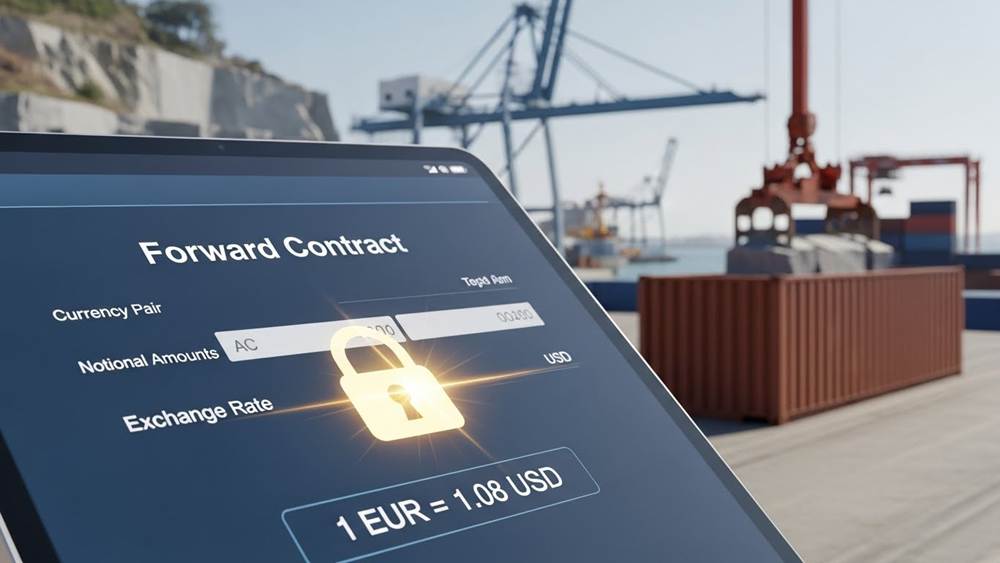
Importers use these agreements to lock in rates for high-value orders, such as large-scale commercial facades, providing budget certainty through 2026. These contracts fix the exchange rate for a specific future date, such as six months ahead, ensuring businesses know their exact costs regardless of market shifts. Terms remain highly customizable, allowing companies to specify exact currency pairs, total amounts, and maturity dates that align with production schedules. This precision prevents currency swings from eroding the thin margins often found in competitive bidding environments.
The Mechanics of Rate Calculation and Settlement
The forward rate starts with the current spot rate and adjusts using points that reflect interest rate differentials between the two currencies. Unlike currency options, forward contracts require no upfront premium payment. The exchange of funds occurs only on the agreed maturity date, preserving working capital during the manufacturing and shipping phases. Standard settlement happens via bank transfer, though non-deliverable forwards (NDFs) can settle the net difference in USD if physical currency delivery faces local restrictions in the supplier’s country.
Managing Opportunity Costs and Cancellation Risks
The primary risk involves opportunity cost, as the importer remains committed to the locked rate even if the spot market moves in a more favorable direction. Unwinding or canceling a contract before the maturity date often incurs mark-to-market costs based on current market volatility and bank credit limits. For recurring inventory flows, importers often use average-rate forwards to smooth out volatility rather than locking a single bullet payment. Veterans in the stone industry balance these contracts by hedging only a portion of their total exposure, leaving some room to take advantage of favorable spot market trends.
Premium Stacked Stone for Architectural Excellence

Managing Payment Timing: Deposit vs. Balance Exchange Risks
Payment timing dictates how currency and counterparty risks are distributed throughout a contract. Front-loading deposits locks in exchange rates for a portion of the deal, while back-loading balances preserves liquidity but exposes the remaining funds to market volatility. Veteran importers mitigate these shocks by using milestone structures and forward contracts to stabilize landed costs.
Front-Loaded Deposits and Fixed Currency Exposure
Paying a 30% to 50% deposit at order confirmation locks in the exchange rate for that portion of the contract. This tactic protects the buyer from future volatility during the months-long production cycle. By securing the rate early, the importer eliminates uncertainty for half of their capital outlay.
High upfront payments increase counterparty risk. Buyers face higher loss severity if a supplier fails to meet quality standards or defaults during the 2026 production cycle. Large deposits also tie up working capital for the entire lead time, which often requires businesses to use revolving credit lines to maintain liquidity.
Back-Loaded Balances and Mid-Production Volatility
Deferring the majority of payment until shipment or arrival preserves cash flow yet leaves 70% to 90% of the total cost exposed to currency swings. A 5% to 10% currency depreciation during a three-month manufacturing window directly increases the landed cost of goods on the unpaid balance. This exposure can quickly erase projected profit margins if the domestic currency weakens unexpectedly.
Standard 20/80 or 10/90 terms shift more non-performance risk to the supplier. The importer retains the bulk of the funds until they verify the delivery, providing leverage in case of disputes. This structure suits buyers in volatile currency markets who prioritize cash retention over fixed pricing.
Milestone Payment Strategies to Mitigate FX Shocks
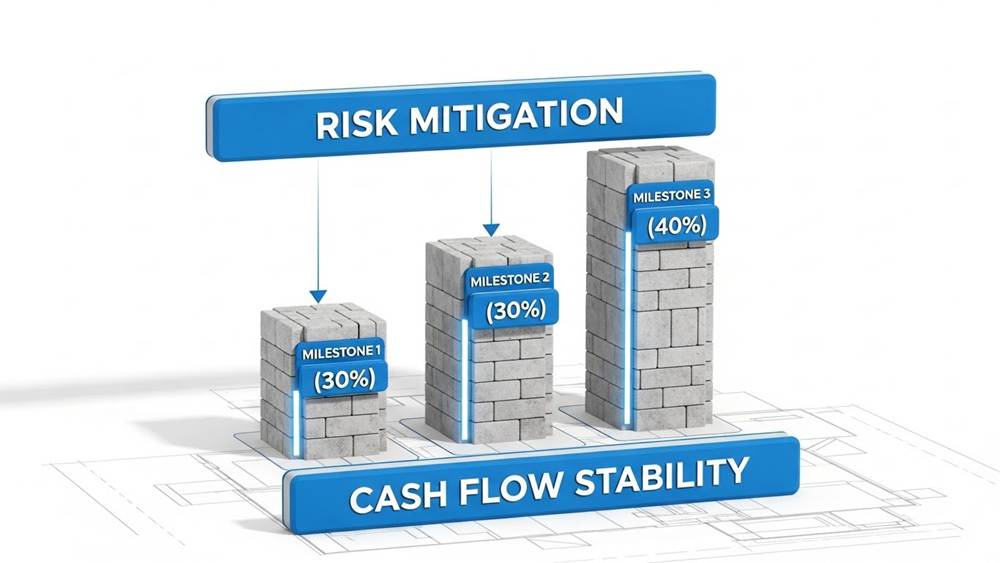
Experienced importers use 30/30/40 milestone structures to spread out currency risk rather than relying on two large payments. This staggered approach ensures that the total cost reflects an average of exchange rates over the production period, reducing the impact of a single poorly timed transaction.
Pairing payment dates with FX forward contracts allows businesses to convert uncertain future liabilities into predictable home-currency costs. Importers use these tools to fix the rate for the final 70% balance at the time the purchase order is signed. Transitioning from spot buying to structured procurement involves modeling the forecast exchange rate range against margin tolerance to determine the ideal deposit percentage.
Using “Currency Adjustment Clauses” in Long-Term Sourcing Contracts
A currency adjustment clause protects the financial integrity of long-term contracts by automatically revising prices when exchange rates fluctuate beyond a set range. This mechanism shares foreign exchange risk between buyers and suppliers, ensuring that neither party suffers from extreme currency volatility during multi-year projects or large-scale capital procurements.
Establishing Baseline Rates and Trigger Thresholds
Parties establish a baseline exchange rate at the time of contract signing to serve as the benchmark for all future transactions. Using an objective reference source, such as a central bank or a published market rate, ensures both the buyer and supplier rely on the same data for calculations. This transparency prevents mispricing and simplifies the audit process during periodic reviews.
Contracts often include a threshold band, typically around ±5%, where the party bearing the risk absorbs normal market volatility without altering the price. This “neutral zone” prevents frequent, minor price adjustments that would create administrative burdens. Codifying specific data sources directly in the contract text ensures that both parties use identical references, eliminating disputes over which market rate applies when the threshold is breached.
Implementing Adjustment Formulas and Risk Caps
Defining explicit mathematical formulas determines how much of a currency movement passes into the final contract price. These formulas specify whether the adjustment applies to the total unit price or only to specific cost components impacted by foreign exchange. Procurement teams schedule regular review intervals, such as quarterly or semi-annual assessments, to recalculate costs based on the latest data and communicate adjustments to stakeholders.
To protect against extreme macroeconomic shocks, experienced negotiators apply numerical caps and floors, often set at ±15%. These limits prevent the contract from becoming economically unviable if a currency collapses or spikes unexpectedly. If exchange rates move beyond these boundaries, the clause typically provides a right to exit the agreement or triggers a formal renegotiation process to realign the deal with current market realities.
Coordinating with Inflation and Escalation Clauses
Integrating currency clauses with broader price adjustment provisions allows the contract to track changes in labor and raw material costs simultaneously. This holistic approach ensures that the total price reflects the true cost of production in the supplier’s home market while accounting for the buyer’s purchasing power. Managers must specify which price components respond to exchange rate shifts versus domestic inflation indices to avoid double-counting costs.
Aligning these mechanisms within framework agreements for multi-year infrastructure or OEM projects maintains predictable landed costs. By structuring the contract this way, organizations stabilize their supply chain expenses despite volatile global markets. This coordination provides the financial stability necessary for long-term planning and investment in complex international sourcing relationships.
Bank Fees vs. FX Specialist Fees: Where to Save on Transfers
Traditional banks typically charge median fees of $44 for outgoing wires plus an exchange rate markup of up to 3%. FX specialist providers offer more competitive pricing by using transparent, percentage-based fees—often ranging from 0.1% to 1%—which can reduce total transfer costs by over 80% on high-value payments exceeding $5,000.
Typical Bank Wire Fees and Hidden Exchange Rate Spreads
Major banks maintain a flat fee structure for international wires, typically charging a median of $44–$45 for outgoing transfers and $14–$15 for incoming funds. These visible costs only represent a portion of the total expense, as banks frequently include an additional layer of cost through the exchange rate itself.
Beyond the flat transaction fees, institutions often embed a currency conversion margin of up to 3% above the mid-market rate. This markup is often not explicitly disclosed as a fee but functions as a significant cost driver for businesses converting large sums of capital.
Total costs for business accounts frequently escalate when banks offer “zero-fee” transfers. In these scenarios, the institution typically widens the FX spread to compensate for the absent transaction fee, resulting in an all-in cost that remains higher than specialist alternatives.
Transparent Pricing Models of FX Specialists and Fintech Platforms
Specialist providers like Wise Business and Statrys offer transparent, percentage-based fees that align closely with real-time interbank rates. This model allows importers to calculate the exact cost of a transfer without accounting for hidden markups often found in traditional banking systems.
Fee benchmarks for 2026 show Wise Business averaging 0.33% of the principal, while Statrys starts as low as 0.1% plus a minimal flat fee. These providers decouple the service fee from the currency conversion, providing a clearer view of the total transaction cost.
Multi-currency platforms such as Airwallex typically maintain spreads between 0.5% and 1%. These platforms provide a middle ground for high-frequency SME payments, offering a balance between the lowest possible FX rates and integrated financial management tools.

Comparing Total Savings on High-Value Import Settlements
The percentage-based FX margin dominates the total cost on large transfers, making specialists significantly cheaper for payments exceeding $5,000. When the principal amount increases, the fixed wire fee becomes negligible compared to the impact of the exchange rate spread.
Moving $50,000 through a bank can cost $1,500 in hidden margins based on a 3% spread, whereas an FX specialist might charge only $50 to $250 for the same transaction. This price gap widens proportionally with the volume of the transfer, directly impacting the net profit margins of import-dependent businesses.
Switching to specialist providers saves importers roughly $20–$40 on fixed transaction fees alone. When combined with the substantial savings on the currency spread, the total reduction in overhead contributes to a more predictable and lower landed cost for inventory.
Final Thoughts
Importers who actively manage currency risk protect their bottom line from unpredictable market swings. Using a mix of forward contracts and specific contract clauses ensures landed costs stay stable through 2026. Shifting away from traditional bank transfers to specialist providers further cuts down on hidden fees that otherwise eat into net gains.
Establishing these financial safeguards lets companies focus on sourcing quality materials instead of worrying about daily exchange rate shifts. High-value projects need this level of financial precision to stay competitive. Businesses that integrate these strategies into their procurement process build a more resilient supply chain that handles global economic shifts without sacrificing profit.
