
Scaling stone panel production requires equipment that balances high output with the exact tolerances needed for seamless installation. Many facilities struggle with manual inspection bottlenecks and material waste, which drive up costs and slow down delivery for high-volume architectural projects. Shifting to automated workflows helps manufacturers maintain consistency while reducing the labor costs associated with traditional masonry fabrication.
This article examines the technical standards driving modern fabrication, from multi-blade rip saws that handle 4–6 simultaneous cuts to automated inspection systems capable of scanning 720 units per hour. We analyze the operational differences between epoxy resin and cementitious bonding systems, and look at how precise calibration maintains the ±0.25 mm baseline tolerance required for interlocking Z-shaped panels.
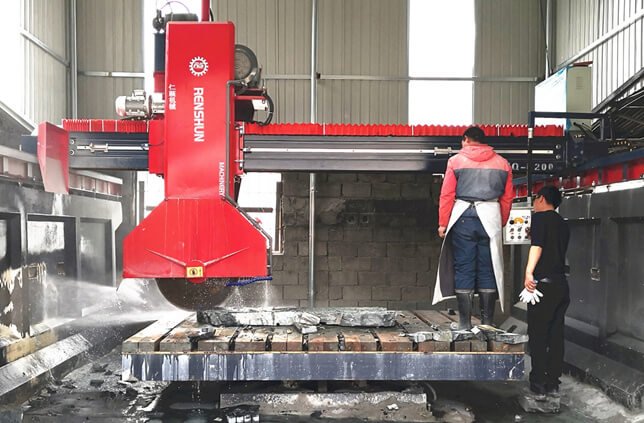
Core Equipment: Multi-Blade Saw and Infrared Bridge Cutting Machines
Multi-blade saws and infrared bridge cutters drive production efficiency by combining synchronized multi-cut technology with laser-guided precision. These systems allow for 4-6 simultaneous cuts per pass while maintaining tight dimensional tolerances, effectively multiplying throughput and reducing material waste during the stone shaping process.
Multi-Blade Rip Saws for Synchronized Material Processing
Parallel circular saw blades ranging from 205mm to 650mm enable 4–6 simultaneous cuts per pass. This configuration significantly increases 2026 production volume and reduces kerf waste compared to traditional single-blade methods. Synchronous upper and lower drive shafts prevent stone binding and ensure bidirectional feeding for irregular raw materials.
Anti-kickback protection systems including four mechanical finger barriers ensure operator safety during high-speed processing. Precision-ground arbors with Ø70mm diameters and Ø90mm bores maintain stability during heavy industrial loads. These mechanical components work together to provide consistent thickness across all processed stone panels.
Technical Performance Standards and Infrared Positioning Systems
Spindle speeds between 2600 and 3980 RPM provide clean, sharp edges required for seamless interlocking stone panels. Infrared reference beams allow operators to align irregular stone slabs accurately, extracting maximum usable material and avoiding natural fissures. This laser-guided system supports rapid positioning without the constraints of traditional fences.
Adjustable feeding speeds of 6–48 m/min accommodate different stone densities, from soft slate to hard quartzite. Industrial power systems up to 114.1 kW support a throughput capacity of 2–12 m³/h for large-scale architectural projects. Operators can tune these settings to match the specific mineral hardness of the raw material, ensuring optimal cut quality and motor longevity.

Automation Lines: Efficiency and Quality Control
Automated production lines integrate 3D laser scanning and real-time feedback loops to eliminate manual inspection bottlenecks. These systems reduce inspection time by 90% while achieving 99% defect detection accuracy, ensuring that every stone panel complies with ISO 10360-13 standards for dimensional precision.
| Performance Metric | Measurement Technology | Operational Impact |
|---|---|---|
| Scan Rate | High-speed 3D Sensors | 720 units per hour |
| Inspection Time | Real-time Feedback Loops | 90% reduction |
| Defect Detection | 3D Laser Profile CMM | 99% accuracy rate |
Throughput Optimization via High-Speed Automated Inspection
Automated systems scan up to 720 products per hour. This capability allows manufacturing facilities to scale production volumes without adding to labor costs. Real-time feedback loops identify variations in upstream processes, which cuts inspection time by 90% compared to traditional manual methods. Closed-loop automation adjusts machinery parameters instantly to prevent defective parts from moving through the assembly line, maintaining high flow rates across the factory floor.
Precision Measurement Standards and 3D Laser Accuracy
3D Laser Line Profile Coordinate Measuring Machines (CMMs) deliver 99% accuracy when detecting defects on complex stone surfaces. Compliance with ISO 10360-13 ensures these non-contact probing systems meet global requirements for measurement verification. High-speed sensors analyze panel dimensions from 10mm to 300mm in seconds. This speed helps maintain the strict tolerances required for interlocking stone systems, ensuring that every part fits perfectly during installation.
Bonding Technology: Performance Differences in Gluing vs. Cement-Based Mixing Equipment
By 2026, ledger stone manufacturing utilizes high-strength epoxy gluing for instant, permanent panel assembly and cement-based mixing for structural masonry bonds. Gluing systems prioritize precision for 8-13 lbs/sqft panels, and cement mixing equipment focuses on aggregate homogeneity and batch consistency for heavy-duty applications.
| Bonding System | Core Equipment | Technical Benefit |
|---|---|---|
| Epoxy Resin Gluing | Precision Application Tools | Instant set for Z-shaped interlocking panels |
| Cementitious Mixing | Paddle and Drum Mixers | Scalable batches for commercial facades |
| Modified Admixtures | Consistency Sensors | Superior tensile strength in new-to-old bonds |
Epoxy Resin Systems and Precision Glue Application
High-strength epoxy resins create permanent chemical bonds between natural stone strips and panel substrates under controlled pressure. These synthetic rubber-based adhesives offer instant set times that prevent stone shifting in 6×24 inch Z-shaped interlocking systems. This immediate bond allows manufacturers to move panels through the assembly line without waiting for traditional drying cycles.
Precision application tools manage adhesive volumes for stone thicknesses between 0.75 and 1.75 inches to minimize material waste. Epoxy bonds provide superior resistance to moisture and thermal expansion, which provides more stability than standard contact adhesives. These rigid systems handle structural loads effectively in demanding environments where repositionable adhesives might fail.
Cementitious Mixing Machinery and Batch Consistency
Mortar mixers use specialized paddle designs to create smooth, uniform pastes from Portland cement and fine sand. Operators integrate modified PVA admixtures into 2026 mixing cycles to increase tensile strength and improve the bond between new panels and existing concrete. These liquid admixtures bind ingredients together more effectively than dry mixes alone, creating a more cohesive structural unit.
Drum-based mixing equipment handles high-volume aggregate loads to ensure structural durability for large-scale commercial facades. Consistency sensors in modern mixing units maintain specific water-to-cement ratios to prevent voids and structural failure. This mechanical consistency ensures that the final product meets high-stress load requirements for heavy-duty masonry projects.
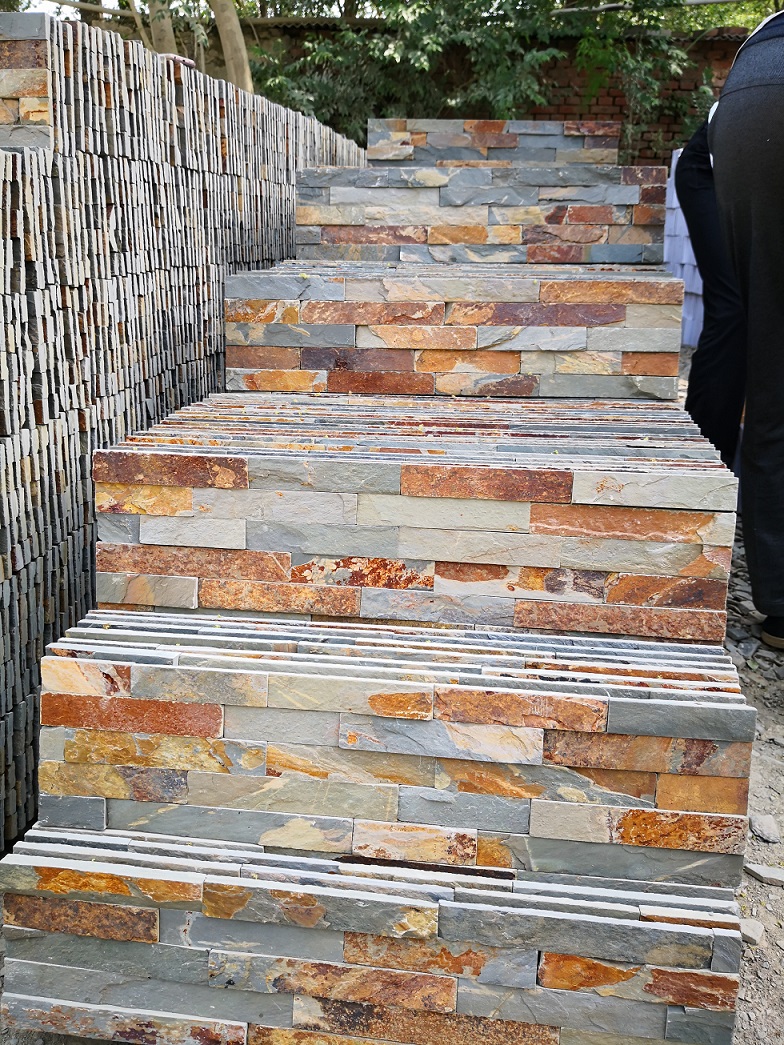
Premium Natural Stacked Stone for Modern Architecture
Drying and Curing: Critical Steps for Ensuring Stacked Stone Bond Strength
Proper bonding requires maintaining temperatures above 32°F and allowing 24 to 48 hours for mortar hydration. In 2026, industry standards emphasize ASTM C 91 compliance and specific scratch coat depths of 0.125 inches to prevent bond failure from environmental stress or premature sealing.
Temperature Thresholds and Hydration Requirements for Adhesion
Maintaining air temperatures above 32°F and stone surface temperatures at 45°F or higher during the initial 48-hour cure cycle prevents ice crystals from disrupting the mortar matrix. Installers should provide a 12 to 24-hour window at 70°F before starting the grouting process to stabilize the initial bond. Chemical accelerants often weaken the final bond strength, so using heated enclosures or warm sand and water provides a safer alternative in cold climates. The scratch coat typically transitions to a light gray color within 2 to 24 hours, signaling sufficient moisture loss and readiness for stone application.
Technical Specifications for Scratch Coats and Long-Term Curing
Scoring horizontal grooves at a depth of 0.125 inches into the scratch coat while the mortar remains pliable maximizes the mechanical bond between the substrate and the stone veneer. Using Type N or Type S mortars that meet ASTM C 91 standards ensures the assembly exceeds minimum code requirements for bond strength. Manufactured stone requires a 30-day curing period before the application of sealers to prevent moisture entrapment, which can lead to efflorescence and surface spalling. For installations requiring high vertical slip resistance, polymer-modified thinsets offer thermal resistance between -30°F and 220°F, protecting the assembly against extreme environmental shifts.
Impact of Machinery Maintenance and Calibration on Dimensional Tolerance
By 2026, manufacturers rely on calibrated machinery to maintain a ±0.25 mm baseline tolerance. Regular maintenance prevents dimensional drift caused by tool wear and thermal expansion, ensuring every stone panel follows ISO 2768 standards. This process reduces rework and maintains the interlocking integrity of the Z-shape panel system.
Mitigating Dimensional Drift and Tool Wear
Calibration keeps machines within the ±0.25 mm baseline required for precise stone cutting. Routine maintenance manages setup repeatability to within ±0.025 mm, and these tight controls prevent loose fits in interlocking joints. Technicians adjust for thermal expansion caused by 3°C shop temperature shifts to stop panels from exceeding size limits. Active monitoring of tool wear ensures that blades do not degrade the edge quality of piedra natural over time.
Precision Standards and Economic Adherence
Production teams use ISO 2768 and ISO 286 frameworks to define general and hole-fit tolerances for custom stone orders. High-performance equipment sustains tight ±0.005 mm specs for critical functional fits without increasing production time. Adherence to ASME Y14.5 GD&T standards ensures that complex 3D stone surfaces remain interchangeable. Consistent calibration prevents high costs from over-tolerancing non-critical features like back-panel texture by focusing precision where it is necessary.
Capacity Increase: ROI of Investing in Automated Equipment
Automation drives a 10-12% productivity rise and boosts machine utilization to 85%. By operating 24/7/365 and using real-time analytics, manufacturers realize performance gains of up to 25%, effectively scaling capacity while reducing material waste and scrap rates.
Volume Scaling via 24/7 Operational Continuity
Automated systems maintain 24/7/365 operation, removing the biological fatigue and shift-change downtime inherent in manual stone masonry. These continuous manufacturing cycles establish predictable lead times and consistent throughput required for high-volume 2026 architectural contracts. Constant machine uptime provides a measurable increase in annual capacity by maximizing the output per square foot of factory space, allowing a $10 million operation to generate an additional $2 million in annual capacity through utilization improvements alone.
Yield Optimization and Analytical Efficiency Benchmarks
Integrating real-time analytics improves manufacturing performance by 10% to 25% through dynamic scheduling and immediate bottleneck detection. Optimized equipment scheduling raises machine utilization from a standard 70% to 85%, representing a 21% gain in productive output. Enhanced quality tolerances from automated cutting reduce scrap rates and rework costs, while smart forecasting tools free up $200,000 in working capital for every $2 million of raw material inventory. This precision creates a compounding return mechanism where initial efficiency gains provide the capital necessary for market expansion and technical innovation.
Final Thoughts
High-precision manufacturing transforms raw stone into consistent architectural panels by syncing mechanical cutting with digital inspection. Modern facilities use multi-blade saws and infrared alignment to keep dimensional tolerances tight across every batch. This technical foundation supports faster production cycles and ensures that Z-shaped interlocking systems fit together without gaps on the job site.
Investing in automated lines and specific bonding technologies directly impacts long-term project success. Efficient curing processes and regular equipment calibration prevent the structural failures and dimensional drift that often plague manual production. As demand for durable, large-scale stone facades grows, these specialized systems provide the scale and reliability needed to meet strict building codes and global standards.
Preguntas frecuentes
Which machines most impact the dimensional precision of stacked stone panels?
CNC cutting and waterjet machines primarily determine precision. These tools maintain strict tolerances of ±1.5 mm on panel faces and ±0.8 mm on thickness, ensuring panels interlock correctly for 2026 construction projects.
What is the typical daily output for an automated production line?
Standard automated lines produce between 800 and 1,200 m² during an 8-hour shift. Integrated industrial systems operating 24 hours can reach capacities of 5,000 to 8,000 m² by utilizing automated stacking and dosing.
How do equipment maintenance logs reflect a factory’s quality control?
Maintenance records prove that machinery operates within specific tolerances. Factories adhering to ISO 9001:2015 use these logs to track preventive care, which minimizes production defects and reduces unplanned downtime.
What are the operational differences between epoxy resin and cement-based bonding?
Epoxy resin creates a high-strength chemical bond that cures in hours and resists industrial chemicals. Cement-based materials rely on hydration, setting more slowly and remaining porous, which makes them better suited for damp environments but prone to shrinkage.
How much can automation lower manufacturing costs for wholesale buyers?
Automated production lines reduce operational costs by 15% to 30%. Most facilities see a full return on investment within 18 to 36 months through lower labor requirements and increased efficiency.
How do production facilities handle stone dust and cutting waste?
Factories use wet washing and filtration systems to control dust. They also recycle stone sludge and scrap material into manufactured sand or other building products, following NSC/ANSI 373 environmental standards.
