

Implementing 8. Lighting for Stone correctly prevents flat, lifeless surfaces from devaluing high-end masonry projects. When light highlights irregular joints or mismatched stone batches, it exposes installation flaws that lead to costly warranty claims and damaged reputations for professional dealers and designers.
Pierre de source supérieure addresses these risks through CNC diamond-blade precision and same-batch quarry consistency. Our Z-shape interlocking panels eliminate visible gaps, while 3.5cm thickness profiles provide the required canvas for dramatic shadow play and 95% hue uniformity across large-scale walls.
Why Lighting is the Secret to a Great Stone Wall?
Lighting acts as the final architectural layer, using directional shadows to turn flat surfaces into dynamic focal points by emphasizing natural clefts and mineral textures.
Revealing Texture Through Dimensional Shadows
Natural stone requires directional light to reveal its geological character. Without specific light angles, even premium split-face surfaces appear one-dimensional under standard ambient overheads. Grazing—positioning light at a steep side angle—reflects off the uneven mineral facets in natural quartzite and slate to produce structural depth.
- Surface Geometry: Light brings out the natural grain and split-face character by interacting with the stone’s irregular topography.
- Contrast: Strategic shadow patterns provide the necessary contrast to prevent a “washed-out” look in large-scale architectural designs.
- Mineral Highlights: Side-angle illumination catches the reflective crystals and mineral veins inherent in 100% natural materials.
Maximizing Depth in Rough Series and Premium Thickness Panels
For commercial projects using heavy-profile materials, lighting becomes a functional tool to justify the investment in premium thicknesses. The Pierre de source supérieure Rough Series panels, which reach up to 3.5cm in depth, provide the maximum possible canvas for dramatic shadow play when paired with base-mounted uplighting.
- Precision Engineering: CNC diamond-blade edges in our Z-Shape systems ensure light highlights the stone face rather than catching on vertical installation joints.
- Profile Performance: Rough Series panels (approx. 55kg/m²) create deeper, more pronounced shadows than standard 1cm-2cm thin veneers.
- Dynamic Visuals: Natural cleft finishes in the Big 10 inventory offer varied reflectivity, allowing the wall to change appearance as the lighting shifts throughout the night.

Using “Grazing” Light to Highlight Split-Face Textures
Wall grazing places directional lights within 12 inches of split-face stone at steep angles, using long shadows to maximize 3D depth and architectural character.
Standard wall washing floods a surface with light to hide imperfections. Grazing does the opposite. By positioning the light source nearly parallel to the stone, you intentionally catch every protrusion and cleft. This physics-based approach turns the natural irregularities of the stone into a high-contrast visual asset.
The Mechanics of Shadow Play on Natural Stone
Successful grazing requires precise control over the beam’s direction and intensity. If the light sits too far from the wall, the shadows disappear and the texture flattens. We recommend these specific technical parameters to maintain the 3D effect:
- Fixture Placement: Install lights within 1 foot (30cm) of the wall base or header.
- Beam Spread: Use narrow 36-degree spreads to concentrate light along the vertical plane.
- Lumen Output: Calibrate between 100 and 350 lumens to prevent “blowout” on lighter stones while accounting for absorption in darker minerals.
- Technique Goal: Exaggerate surface relief rather than providing uniform illumination.
Enhancing the Rough Series for Dramatic Depth
For B2B projects involving our “Rough Series” panels, the increased thickness offers a unique opportunity for extreme shadow casting. Because these panels feature up to 3.5cm of depth, the “peak and valley” effect of the split-face finish becomes significantly more pronounced under LED grazing.
- Panel Specs: Designed for Rough Series panels with thicknesses up to 3.5cm.
- Color Temperature: Use 2700K–3000K LEDs to enrich the iron and earth tones in models like California Gold or Golden Honey.
- Joint Integration: Align fixtures to maintain shadow consistency across Z-Shape interlocking joints, ensuring the “male-female” connections remain invisible.
- Material Finish: Best applied to Natural Cleft and Split-Face finishes to capture light on fractured mineral planes.
Dealers and installers should note that darker inventory, such as Carbon Black, requires higher lumen density. Darker stone absorbs more light, so the grazing effect needs more “punch” to achieve the same visual depth seen on lighter quartzite models.
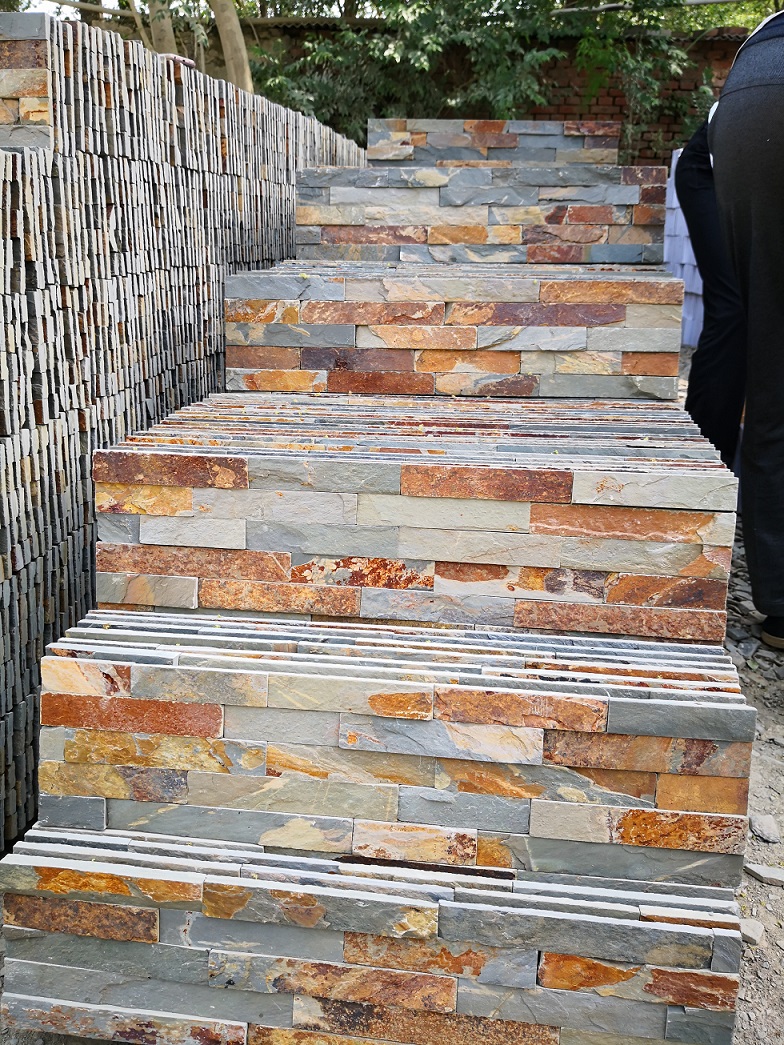
Premium Factory-Direct Stacked Stone Ledger Panels
Recessed Lighting vs. Wall Sconces: Which is Better for Stone?
Recessed lighting provides a seamless, uniform wash for large stone surfaces, while wall sconces act as decorative accents that create dramatic up-and-down shadows on specific textured sections.
| Feature | Recessed (Grazing) | Wall Sconces |
|---|---|---|
| Light Distribution | Wide, continuous wash | Localized focal points |
| Visual Profile | Hidden/Minimalist | Visible/Decorative |
| Installation | Integrated into wall/ceiling core | Surface-mounted flexibility |
| Texture Impact | High (exaggerates relief) | Moderate (creates directional shadows) |
Comparing Illumination Patterns and Visual Impact
Recessed lighting remains hidden within the ceiling or wall core, offering a minimalist aesthetic that keeps the focus entirely on the stone surface. This setup is ideal for designers who want the light to be felt but not seen. By positioning fixtures close to the wall, you achieve a grazing effect that highlights every ridge in the natural stone.
Wall sconces provide localized, bi-directional light that emphasizes the character and color variations of specific stone panels. Unlike the broad wash of recessed lights, sconces introduce decorative elements that break up large vertical spaces. They act as architectural jewelry, adding a layer of style that complements the stone’s ruggedness.
- Recessed Grazing: Creates a continuous light wash across expansive walls.
- Sconces: Add focal points and decorative interest to specific sections.
- Installation Requirements: Recessed housing demands early-stage planning in the wall structure, while surface-mounted sconces offer more flexibility for existing features.
Maximizing the Depth of Split-Face and CNC-Cut Panels
The precision of the stone panels determines how well the lighting performs. CNC diamond-blade precision ensures that the Z-Shape and S-Shape interlocking systems fit tightly. This tight fit is critical under bright grazing light because it prevents unwanted shadows or “hot spots” at the panel joints, ensuring the wall looks like a single piece of natural rock rather than a series of blocks.
Natural cleft and split-face textures in the Big 10 inventory react differently to light. Rougher surfaces, like those found in Golden Honey or Copper Canyon models, produce more dramatic highlights and lowlights. Using warm LED color temperatures (2700K-3000K) enhances the natural earthy hues of quartzite and slate, while sharp lighting angles emphasize the 3D relief of the stone.
- Seamless Technology: Top Source Stone panels eliminate visible “stepped” gaps, allowing recessed lights to create a professional finish.
- Material Reaction: Textured finishes like quartzite catch and reflect light from multiple angles, creating significant visual depth.
- Color Rendering: Warm tones are preferred for residential settings to showcase the stone’s natural character and mineral veins.

Selecting the Right Color Temperature (Warm vs. Cool LEDS)
Color temperature transforms stone. Warm 2700K LEDs enrich earthy slate tones, while 5000K cool white sharpens quartzite textures for modern architectural contrast.
Light acts as the final finishing layer for any natural stone installation. The Kelvin rating of your LEDs determines whether the minerals in the stone appear vibrant and deep or flat and washed out. Choosing the wrong temperature can clash with the natural veins of the material, turning a premium feature wall into an eyesore.
Contrasting Warm and Cool Kelvin Tones on Natural Stone
Warm lighting between 2700K and 3000K pulls out the gold, amber, and brown minerals within the rock. This spectrum creates an inviting, intimate atmosphere that suits residential living spaces. Conversely, cooler light in the 4000K to 5000K range provides a crisp bluish-white tone that mimics daylight, highlighting sharp edges and modern profiles.
- Warm White (2700K–3000K): Accentuates iron-rich minerals in models like California Gold and Golden Honey.
- Cool White (4000K–5000K): Sharpens the high-contrast lines of Glacier White and Alaska Gray quartzite.
- Neutral White (3500K): Serves transitional spaces where stone spans both indoor and outdoor environments.
- High CRI LEDs: Ensure natural mineral variations remain visible rather than appearing as a single gray mass.
Maintaining Visual Integrity with Same-Batch Quarry Consistency
Lighting is the ultimate test of material quality. High-output LEDs will immediately reveal inconsistencies in stone color if the product comes from mixed sources. Top Source Stone addresses this by sourcing from the same quarry vein per order, preventing the patchy color shifts that often plague low-tier stone supplies.
Our CNC diamond-blade precision ensures that Z-shape and S-shape panels fit with tight tolerances. When light grazes these surfaces, the interlocking system camouflages the vertical joints, creating a continuous architectural plane. This precision is vital for grazing light techniques, where even a millimeter of misalignment creates unwanted shadows.
- Hue Uniformity: We guarantee 95% consistency within a single batch to ensure color stability under bright lights.
- Interlocking Precision: Z-shape and S-shape designs hide installation substrates when illuminated from steep angles.
- UV Stability: Natural minerals in our Big 10 Inventory resist fading, keeping the chosen color temperature consistent for years.
- Mineral Detail: Same-batch sourcing ensures veins and deposits align across the entire wall surface.
Installing Electrical Boxes and Switches into Stone Walls
Mounting electrical boxes in natural stone requires hammer drills, masonry anchors, and box extenders to compensate for varying panel thicknesses between 1cm and 3.5cm for a flush finish.
Standard drywall methods fail when working with dense materials like quartzite or slate. The primary challenge is securing a junction box that remains immobile against a heavy, textured surface while ensuring the wiring stays protected behind the masonry layer.

Drilling and Securing Metal Boxes in Masonry
Dense natural stone requires professional-grade equipment to prevent cracking during installation. You must create a stable foundation for the electrical hardware before the stacked stone panels are applied to the substrate.
- Tooling: Use a hammer drill with masonry-specific bits to sink pilot holes into the wall core.
- Fasteners: Secure metal handy boxes using Tapcon anchors or masonry screws to prevent shifting under the weight of the stone.
- Code Compliance: Protect all wiring with EMT (Electrical Metallic Tubing) conduit and concrete-tight fittings to meet safety standards.
Adjusting for Panel Thickness with Box Extenders
Stacked stone is never perfectly flat. Top Source Stone panels range from a standard 1cm thickness to 3.5cm for rough-cut premium series. This variation means standard electrical boxes will sit too deep within the wall once the stone is installed.
- Depth Management: Install adjustable box extenders to bring the outlet or switch forward so the faceplate sits flush against the stone surface.
- Precision Cutting: Use CNC diamond-blade edges for tight cutouts. This allows the stone to maintain its Z-shape interlock without leaving visible gaps around the electrical box.
- Corner Transitions: Align outlets with matching pre-fabricated L-corners at wall edges to ensure texture and color remain synchronized at every transition.
For the cleanest aesthetic, have one stone panel terminate at the side of the box and use a grinder to notch the adjoining piece. This avoids the need to cut holes in the middle of a panel, preserving the structural integrity of the natural stone.
Foire aux questions
Strategic lighting and proper electrical integration turn standard natural ledgestone into a high-value architectural feature while ensuring long-term code compliance and safety.
What are the most effective techniques for lighting stacked stone walls?
Wall grazing and uplighting are the most efficient methods for modern architectural designs. Grazing places fixtures 6 to 12 inches from the wall at sharp angles to create dramatic shadows on split-face textures. Uplighting sculpts the stone from the ground up, emphasizing the depth of Z-shape interlocking panels without modifying the wall structure.
How should I light a natural stone fireplace surround?
Uplighting allows light to crawl up the textured surface, highlighting intricate details of materials like Alaska Gray or Copper Canyon. Downlighting from recessed can lights creates a soft, moonlight effect. For quartzite slab surrounds, backlighting is an effective way to create a warm, ambient glow throughout the room.
Can I install electrical outlets and switches into a stacked stone wall?
Yes, outlets can be installed using electrical box extenders to account for stone thickness, which typically ranges from 1cm to 3.5cm. The most effective strategy involves cutting the outlet opening out of a single stone panel while the adjoining piece butts against the side, ensuring the cover plate sits flush against the finished surface.
Do stone wall fixtures require specialized mounting boxes?
Specialized stone light boxes are recommended to maintain aesthetic continuity and ensure a professional fit. While standard masonry boxes support fixtures up to 6 lbs, purpose-built boxes provide better material compatibility and often carry an IP65 rating for high salinity or humidity resistance in outdoor environments.
Should I use warm or cool LED color temperatures for stone?
Warm lighting (2700K-3000K) is ideal for enhancing the earthy reds and yellows found in slate and gold quartzite. Cool lighting (above 4000K) is better suited for modern designs or functional areas like driveways and commercial entrances where visibility and safety are the primary goals.
Final Thoughts
Poor lighting immediately exposes thin veneers and sloppy joints, turning a premium project into a costly liability. Our CNC diamond-blade precision and same-batch quarry consistency ensure that your installations withstand high-output LED grazing without showing gaps or “patchy” color shifts. Selecting the 3.5cm Rough Series provides the necessary structural depth to justify high-end architectural lighting budgets and satisfy demanding clients.
Secure your margins by sourcing directly from the quarry level to eliminate middleman markups and ensure supply chain stability. We recommend requesting a physical sample kit from our Big 10 inventory to verify mineral reflectivity and interlocking fitment under your specific lighting parameters. Contact our team to initiate a 300-square-meter trial order and lock in project-ready pricing for your next development.
