

High-ceiling design requires precise material selection to avoid the hidden costs of structural reinforcement and visible joint failure on 20-foot spans. Using heavy full-bed masonry for large-scale fireplaces often forces expensive frame modifications that eat into developer margins and homeowner budgets.
This technical overview benchmarks natural stone panel systems weighing only 8-12 lbs/sq.ft against traditional masonry standards. We evaluate how Z-shape CNC precision and same-batch quarry consistency ensure a monolithic appearance without the structural penalty of conventional stone.
The Visual Impact of Floor-to-Ceiling Stone Installations
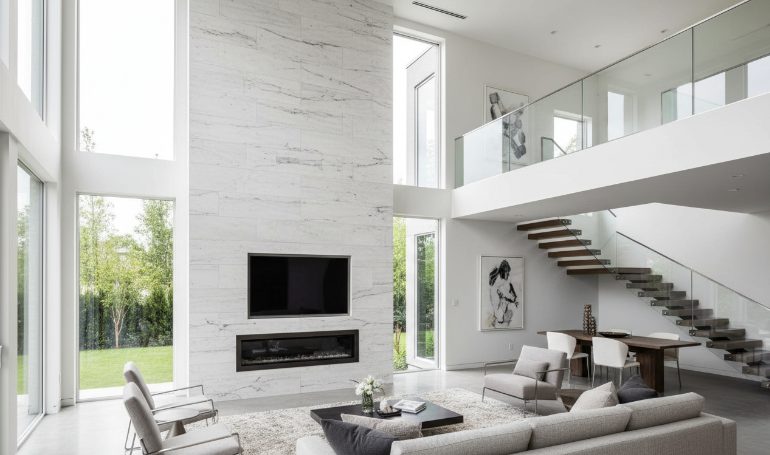
Large-scale stone walls create dominant architectural focal points. Precision Z-shape panels ensure a seamless, monolithic appearance across vertical surfaces, drawing the eye upward to emphasize room volume.
Maximizing Room Height Through Natural Vertical Textures
Vertical stone installations redefine the scale of a room. By extending the material to the ceiling, the eye follows the natural texture upward, making standard spaces feel like custom architectural builds. This height-oriented design establishes a permanent centerpiece that often removes the need for traditional decorative elements or expensive artwork.
Top Source Stone utilizes 100% natural stone, which provides inherent UV stability. Unlike “faux” or resin-based alternatives, these natural minerals maintain their visual depth and color integrity even in sunlit lobbies or high-ceiling residential Great Rooms. The choice of material directly influences the room’s color temperature and mood.
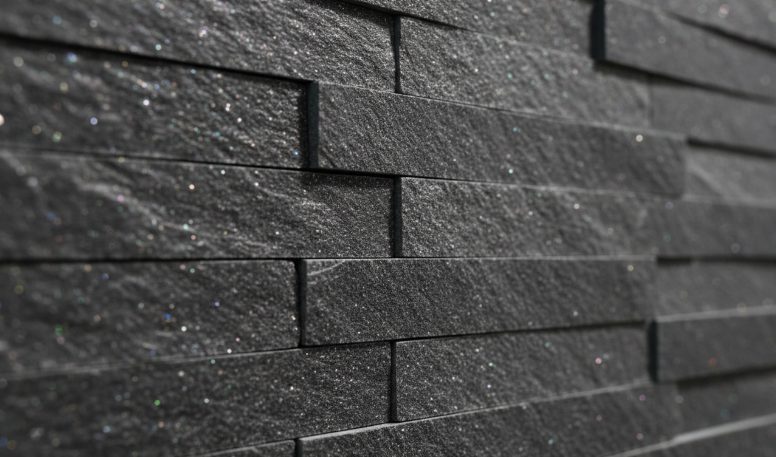
- Carbon Black Slate: Deep, matte tones used to ground large spaces and create high-contrast modern aesthetics.
- Glacier White Quartzite: Bright, reflective surfaces that maximize natural light in expansive vertical planes.
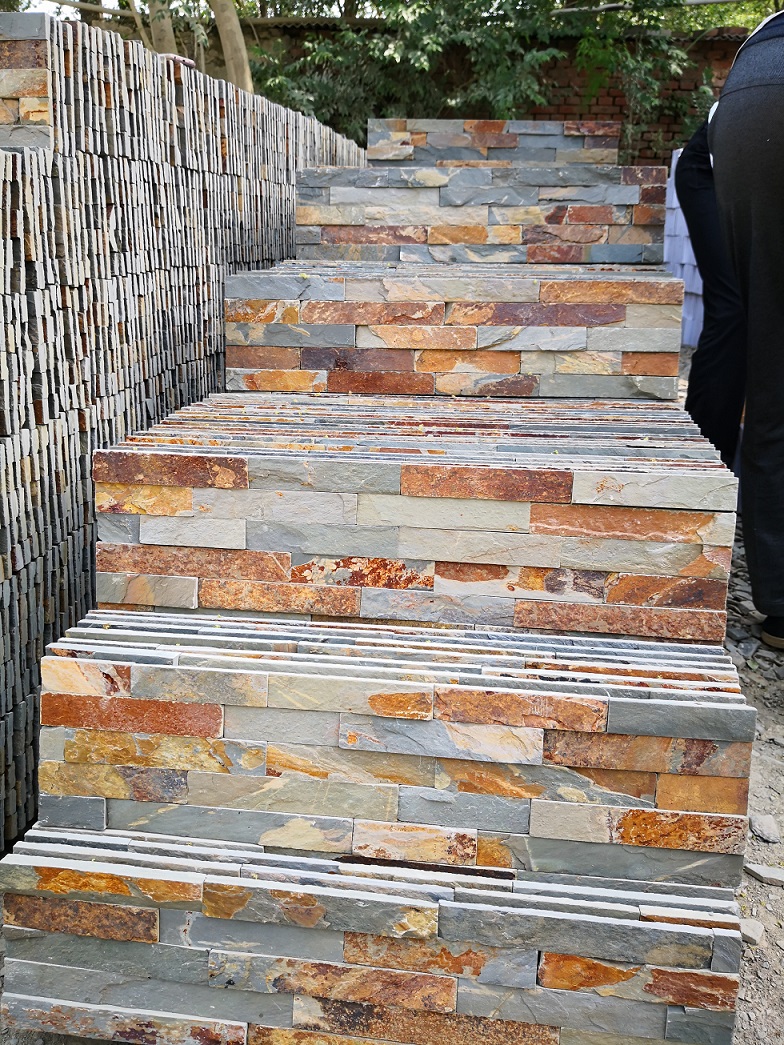
- California Gold Slate: Rich, earthy variations that add warmth to tall, cold architectural shells.
Ensuring Surface Continuity with CNC-Cut Interlocking Systems
A 20-foot wall only succeeds if the surface appears as a single, continuous mass. Standard rectangular panels often leave visible “stepped” gaps or grid lines that ruin the illusion of a solid stone structure. We eliminate these visual breaks through precision engineering and specific interlocking geometries.
Our Z-shape and S-shape panels utilize a “male-female” connection system. These pieces fit tightly together to camouflage the installation substrate and hide vertical joints. To maintain professional standards on large-scale projects, we follow strict technical parameters:
- Hue Uniformity: We achieve 95% color consistency by sourcing stone from the same quarry vein for every production batch.
- CNC Precision: Diamond-blade edges ensure a modular fit that removes the need for manual on-site adjustments.
- L-Corner Synchronization: Pre-fabricated 90-degree corners maintain the texture and color flow at wall transitions, avoiding awkward exposed edges.
- Weight Efficiency: Standard panels weigh between 8-12 lbs/sq.ft, allowing for high-reach installations without excessive structural modification.
For B2B distributors and contractors, these interlocking systems reduce labor time while guaranteeing a high-end finish. The tight fit ensures that even under harsh grazing light or track lighting, the wall looks like a hand-carved monolithic slab rather than a series of individual tiles.
Structural Check: Is Your Wall Rated for 20-Foot Stone Heights?
Standard 3-inch stone reaches 25 feet, but weight creates risk. Our 8-12 lbs/sq.ft panels reduce load-bearing stress, making high-reach masonry safer and more cost-effective for commercial elevations.
| Structural Metric | Standard 3″ Limestone | Pierre de source supérieure Panels |
|---|---|---|
| Weight Load | 35–50+ lbs/sq.ft | 8–12 lbs/sq.ft |
| Height Limit (Standard) | Up to 25 Feet | Engineered for High-Reach |
| Joint System | Traditional Mortar | Z-Shape Interlocking |
| Compacity Req. | 4,000 PSI Minimum | Standard Substrate Ready |
Industry Standards for 20-Foot Vertical Stone Stacks
Engineers prioritize compressive strength and backup support when walls exceed the 10-foot mark. For traditional masonry, the Indiana Limestone Institute provides the baseline for safe vertical loads. These standards ensure the structure handles gravitational and environmental forces without buckling.
- Height Limits: 3-inch stone can reach 20–25 feet, while 4-inch stone supports heights up to 30 feet.
- Compressive Strength: Natural stone masonry must maintain a minimum of 4,000 psi.
- Anchoring Systems: High-reach installations require specific mechanical anchors to manage wind and seismic loads.
- Base Prep: Installers must use a concrete leveling pad or a properly compacted granular base to prevent vertical shifting.
Structural Benefits of Lightweight 8–12 lbs/sq.ft Panels
Heavy stone forces expensive upgrades to the building’s skeletal frame. We solve this by engineering natural stone into a lightweight format that maintains visual mass without the structural penalty. This allows wholesalers to supply high-reach projects that would otherwise require massive steel reinforcements.
- Weight Efficiency: Panels weigh only 30–40kg/m² (8–12 lbs/sq.ft), significantly reducing the dead load on high elevations.
- CNC Precision: We use CNC diamond-blade cutting to ensure “male-female” interlocking fits that prevent joint separation at height.
- L-Corner Support: Pre-fabricated matching corners maintain structural integrity and visual continuity at 90-degree transitions.
- Quarry Consistency: We source from the same quarry vein to guarantee 95% hue uniformity, ensuring even load distribution across large surfaces.
Choosing the right material thickness directly impacts your project’s insurance and engineering costs. Top Source Stone provides a project-ready solution that combines the durability of natural quartzite or slate with a weight profile manageable for 2-story and 20-foot applications.
High-Margin Stacked Stone for Professional Distributors
Scaffolding and Safety Tips for High-Reach Interior Masonry
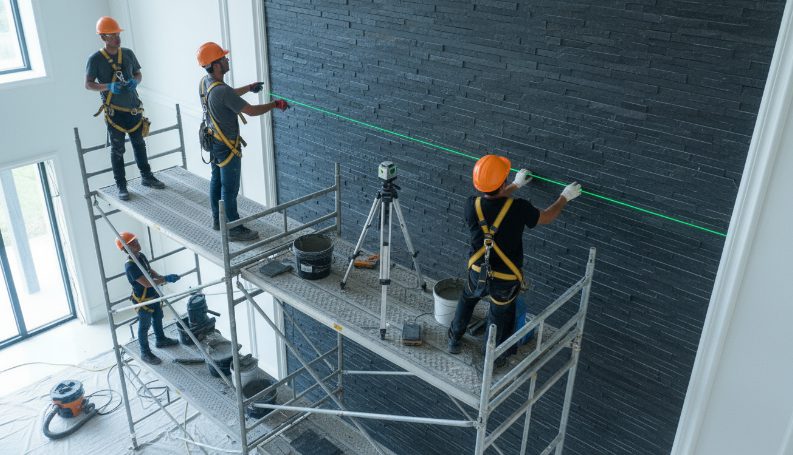
Safety for high-reach projects requires strict fall protection and load verification. Using pre-fabricated L-corners and interlocking panels minimizes time at height and on-site cutting risks.
Fall Protection and Scaffolding Load Requirements
Installing stone on 20-foot interior walls demands a heavy-duty approach to platform stability. Standard interior scaffolding often fails to account for the cumulative weight of natural stone, leading to structural sagging or platform failure during the installation process.
- Fall Arrest Systems: Mandatory harnesses and secure anchor points are required for any masonry work performed 10 feet or more above the floor.
- Load Capacity: Scaffolding structures must support four times the maximum intended load, specifically accounting for the 30-40kg/m² (8-12 lbs/sq.ft) weight of Top Source Stone natural panels.
- Essential PPE: Workers must use hard hats, non-slip footwear, and tool-tether lanyards to eliminate the risk of dropping heavy stone or tools onto the floor below.
- Daily Inspections: A competent person must verify that platforms are fully decked and guardrails are secure before every shift starts.
Optimizing Site Safety with Project-Ready Stone Components
Traditional masonry involves dangerous on-site cutting and mitering while standing on elevated platforms. Shifting the technical work from the scaffold to the factory floor significantly reduces the physical strain and duration of high-reach installations.
- L-Corner Integration: Top Source Stone matching L-corners remove the need for complex mitering at height, ensuring a safe and professional wrap-around finish.
- Precision Interlocking: Z-shape or S-shape panels featuring CNC diamond-blade precision create a “male-female” fit that slides into place, cutting labor time on the scaffold.
- Weight Management: Staging materials by weight prevents over-exertion; the lightweight 8-12 lbs/sq.ft profile of these panels makes them easier to handle on narrow platforms.
- Spatial Clearance: Maintain a 10-foot clearance from interior machinery or architectural obstacles to prevent scaffold collisions while maneuvering stone crates.
Minimizing the time spent on a scaffold is the most effective way to reduce project risk. By using factory-engineered stone systems, crews spend less time balancing on narrow decks and more time completing the vertical installation with consistent, repeatable results.
Maintaining Pattern Consistency Across Large Vertical Surfaces
Achieve uniform 20-foot spans by blending multi-crate inventory and utilizing CNC-cut interlocking panels sourced from a single quarry vein to eliminate visible joints and color patches.
Principles of Visual Flow and Compositional Balance
Tall walls amplify installation errors. If installers align joints vertically, the wall develops “rivers” or distracting linear gaps that ruin the organic stone aesthetic. Successful projects rely on breaking up these lines through aggressive staggering and multi-angle visual checks.
The most common mistake on large spans is pulling stone from a single crate. Natural stone varies. Blending material from different crates during the installation process ensures that color shifts look intentional and gradual rather than appearing as distinct blocks of mismatched hue.
- Stagger panel joints across the vertical plane to prevent the formation of accidental linear gaps.
- Mix panels from at least three different crates simultaneously to distribute natural color variations evenly.
- Verify visual transitions from 15–20 feet away to ensure the pattern remains balanced under varying light conditions.
- Distribute high-texture motifs throughout the surface to maintain a consistent shadow profile across the entire wall height.
Same-Batch Quarry Sourcing and CNC Interlocking Precision
Consistency on a 20-foot span starts at the factory. We control hue uniformity by sourcing material from the same quarry vein for every order. This technical oversight minimizes the risk of the “patchy” look that occurs when mixing different production runs or geological layers.
Mechanical precision eliminates the visible “stepped” gaps found in lower-quality stone. We use CNC diamond-blade edges for our Z-Shape and S-Shape interlocking series. These precision cuts create a male-female connection that camouflages vertical joints, making the entire installation appear as a single, continuous stone face.
- Same-Batch Consistency: Sourcing from the same quarry vein per order ensures 95% hue uniformity across the entire project.
- CNC Diamond-Blade Edges: Precision-cut interlocking systems create a tight connection that hides vertical joints and the underlying substrate.
- Seamless Technology: Modular Z-Shape and S-Shape pieces fit together to prevent visible gaps on tall vertical runs.
- Texture Synchronization: Matching L-Corners provide a continuous wrap-around finish that maintains the stone pattern across 90-degree corner transitions.
Lighting a 2-Story Stone Wall: Recessed vs. Track Lighting
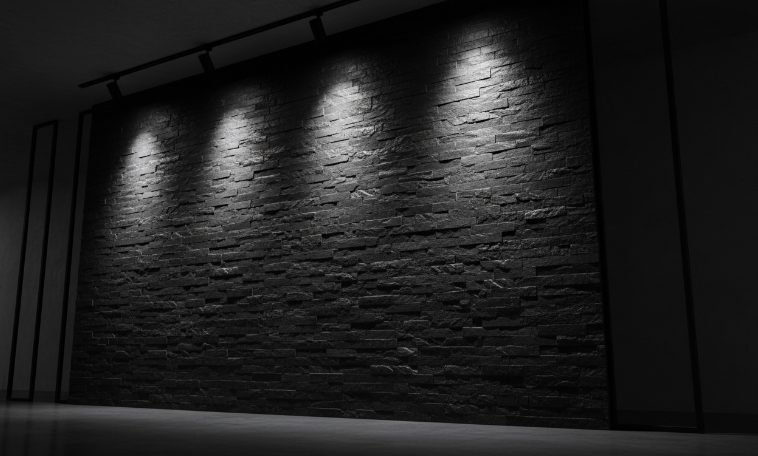
Track lighting provides the directional control needed for 2-story walls, emphasizing stone texture more effectively than recessed fixtures. Layering both ensures ambient brightness while creating dramatic architectural shadows.
Directional Versatility for Tall Vertical Surfaces
Track lighting systems offer a major advantage for 20-foot vertical spans because you can adjust the beam angles after the installation. Recessed cans are fixed in place, which often leads to “hot spots” at the top of the wall while the lower sections remain in shadow.
Surface mounting these systems on high or sloped ceilings is simpler than installing invasive recessed housings. This avoids complex structural modifications to roof rafters or floor joists. Designers often use track heads with varying beam spreads to ensure the light reaches the floor-level stone without losing intensity.
- Precision Aiming: Individual heads can be directed at specific architectural features to eliminate dark zones on the stone face.
- Glare Management: Controlled angles prevent harsh reflections on quartzite materials like Alaska Gray or Glacier White.
- Ease of Maintenance: Track systems allow for easier fixture replacement or upgrades compared to ceiling-integrated recessed units.
Highlighting Rough Series Depth and Shadow Detail
The Top Source Stone Rough Series features a premium 3.5cm profile. This depth creates significant visual interest, but it requires grazing light to reveal the three-dimensional “cliff” textures of the natural stone. Light positioned close to the wall face casts long shadows that define the unique ridges of each panel.
Point sources from track lighting emphasize the minerals found in individual quarry layers. While flat ambient light can make high-end stone look like a printed image, directional spotting proves the material is 100% natural. The tight fit of the modular pieces ensures the aesthetic remains consistent from the floor to the 20-foot peak.
- 3.5cm Profile Depth: This thickness responds best to steep light angles that capture the natural cleft and split-face finish.
- Seamless Jointing: Our Z-shape interlocking technology hides vertical joints, so even intense grazing light won’t reveal the panel edges.
- High-CRI LED Usage: Using high Color Rendering Index bulbs ensures the natural gold, gray, and blue hues in the stone stay vivid.
Foire aux questions
High-ceiling stone installations require precise weight management and interlocking CNC technology to ensure structural integrity and a seamless architectural finish across large vertical spans.
What is the typical cost for a floor-to-ceiling stone fireplace installation in 2026?
Professional installation for large-scale vertical stone projects generally ranges from $10,000 to $25,000. Total investment depends on the material—such as natural quartzite versus slate—and the specialized labor required for scaffolding and high-reach masonry work. Sourcing directly from a quarry factory helps mitigate these costs by removing middleman markups on premium materials.
Is a 2-story stone wall too heavy for a standard home foundation?
Modern natural stone panels weigh between 8 and 12 lbs/sq.ft, which is significantly lighter than traditional full-bed masonry. While these panels rarely require extra footings, you must ensure the wall utilizes cement board and a structural substrate rated for the total vertical load. Engineering the wall thickness and tapering the base can also assist in proper weight distribution for 20-foot heights.
How do you prevent visible seams and joints on tall vertical surfaces?
Using Z-shape or S-shape interlocking panels ensures a professional finish. These panels utilize CNC diamond-blade precision edges to create a male-female connection. This system effectively camouflages vertical joints and hides the underlying substrate even on 20-foot walls, preventing the “stepped” look common with lower-quality products.
What lighting techniques best highlight the texture of a high-ceiling stone wall?
Grazing light is the most effective method for textured stone. By placing track lighting or recessed downlights near the wall surface, the light hits the natural cleft at a sharp angle. This emphasizes the shadows and three-dimensional depth of the stone. Track systems are often preferred for 2-story walls because they provide the directional precision needed to highlight different heights.
Can I install stacked stone directly over interior drywall on high walls?
Drywall is not a suitable substrate for the weight and moisture of stone mortar. For high-reach installations, you must install cement board over the studs or apply a metal lath and scratch coat. This provides a secure bonding surface for the polymer-modified thin-set, ensuring the stone remains anchored despite its vertical load.
Does a large interior stone wall improve room insulation?
Stone acts as thermal mass rather than an insulator. It does not stop heat transfer on its own, but an interior stone wall can absorb heat from a fireplace or sunlight and release it slowly. This regulates room temperature effectively when the wall is paired with external insulation, helping to reduce the heating and cooling load on the building.
Final Thoughts
High-reach installations fail when panels show visible seams or exceed structural load limits. Choosing CNC-precision interlocking panels eliminates expensive on-site labor and the structural reinforcements required by heavier, non-engineered stone. Our same-batch quarry sourcing safeguards your project reputation by preventing the patchy, mismatched appearance found in standard bulk shipments.
Verify our seamless fit and natural texture by requesting a sample kit from the Big 10 inventory. We protect dealer margins by selling exclusively to wholesalers and providing high-definition pre-shipment verification for every order. Contact our team to discuss trial volumes or custom private label packaging for your region.
