
Specifying a split face texture is a calculated risk for commercial projects where inconsistent quarrying often leads to patchy walls and expensive client callbacks. For contractors managing tight deadlines, the financial consequence of using non-standardized stone is often measured in excessive on-site chipping and wasted labor hours.
We eliminate these sourcing risks by ensuring 95% hue uniformity through single-vein extraction for every order. Our Rough Series panels integrate CNC diamond-blade precision with an interlocking Z-shape system, allowing 100% natural slate and quartzite to achieve deep architectural shadows without the structural gaps common in low-tier masonry.
Defining the Split Face Finish in Modern Stone Masonry
A split face finish is a rugged stone surface created by fracturing material along natural cleavage lines, exposing raw mineral textures and deep shadows for architectural depth.
Mechanical Cleaving and Natural Surface Integrity
We create a split face surface by mechanically fracturing the stone along its inherent grain structure. This process avoids the flat, sanitized look of sawn or honed finishes. Instead, it exploits the rock’s natural propensity to split, revealing the authentic mineral aggregates and color variations hidden inside the block. Because the fracture follows the stone’s internal fabric, no two panels are ever identical, providing a non-uniform aesthetic that mimics a raw quarry cliff.
For B2B buyers managing large-scale developments, consistency remains the primary challenge with natural textures. We mitigate this by sourcing raw material from the same quarry vein per order. This strategy ensures that while the surface remains rugged and irregular, the overall hue uniformity stays within a 95% range, preventing the “patchy” appearance common in mixed-source inventory.
- Cleaving Process: Mechanical and hydraulic splitting that preserves natural mineral character.
- Visual Profile: High-relief textures with visible peaks and valleys for significant light diffusion.
- Durabilité: 100% natural stone minerals offering inherent UV stability and freeze-thaw resistance.
Dimensional Depth in the Rough Series Panels
The visual impact of a split face finish depends entirely on its dimensional depth. Our Rough Series panels increase this variation, allowing for shadows that shift throughout the day. This depth is particularly effective for exterior facades where ambient light can emphasize the stone’s rugged profile. By utilizing 100% natural Slate and Quartzite, we provide a material that maintains its structural integrity even with aggressive surface protrusions.
Precision engineering is required to make these rugged textures functional for quick installation. We use CNC diamond-blade edges on the back and sides of every panel. This ensures that even though the face of the stone is uneven and “rough,” the modular units fit together with a tight interlock. For wholesalers and contractors, this means a professional finish that hides the installation substrate without the need for on-site chipping or heavy sorting.
- Thickness Range: Standard 1cm to 2.5cm, with Rough Series reaching up to 3.5cm.
- Interlocking Design: Z-Shape and S-Shape panels utilize a male-female connection to camouflage vertical joints.
- Edge Precision: CNC-cut sides allow for a seamless fit despite the heavy surface texture.
- Weight Specs: Standard panels average 30-40kg/m², while Rough Series average 55kg/m².
Choosing this finish allows architects to introduce organic elements into modern environments. While the texture is traditionally associated with rustic styles, the use of sharp-edged, interlocking panels makes it a preferred choice for contemporary feature walls and commercial exteriors where dimensional interest is the priority.

How Does the Natural Cleaving Process Create Such Unique Textures?
Natural cleaving follows geological planes of weakness to expose internal grain, using controlled stress to ensure authentic, high-dimension textures that machine milling cannot replicate.
Geological Planes and Controlled Fracture Lines
Authentic stone texture relies on how a fracture moves through the material. Instead of forcing a cut, we apply tensile stress that encourages the stone to split along its organic fabric. This reveals the crystalline structure hidden since the rock formed.
- Crack Propagation: Fractures follow inherent planes of weakness during hydraulic or manual splitting, ensuring no two surfaces are identical.
- Material Anisotropy: Foliated rocks like slate and schist create distinct layered textures based on their specific mineral layers.
- Granite Dynamics: Fine-grained stones produce more predictable paths, resulting in rugged but cleaner surface variations.
- Feather and Wedge Method: This traditional technique guides fractures along predetermined lines to maintain the geological character of the block.
Texture Specifications for Split-Face Rough Panels
At Pierre de source supérieure, we bridge the gap between raw geological character and architectural precision. Our processing standards ensure that while the face remains rugged, the technical parameters meet the requirements of high-end commercial projects.
- Thickness Variance: Our Rough Series panels utilize deep-cleft processing to achieve depths ranging from 1cm to 3.5cm.
- Hue Uniformity: We source from the same quarry vein per batch to maintain 95% color consistency across varied textures.
- Dimensional Depth: Natural cleft finishes maximize shadow play, creating high-impact visual interest on feature walls.
- CNC Precision: Diamond-blade edges provide a precision perimeter, allowing rugged panels to fit together without visible “stepped” gaps.
Premium Stacked Stone for Architectural Needs
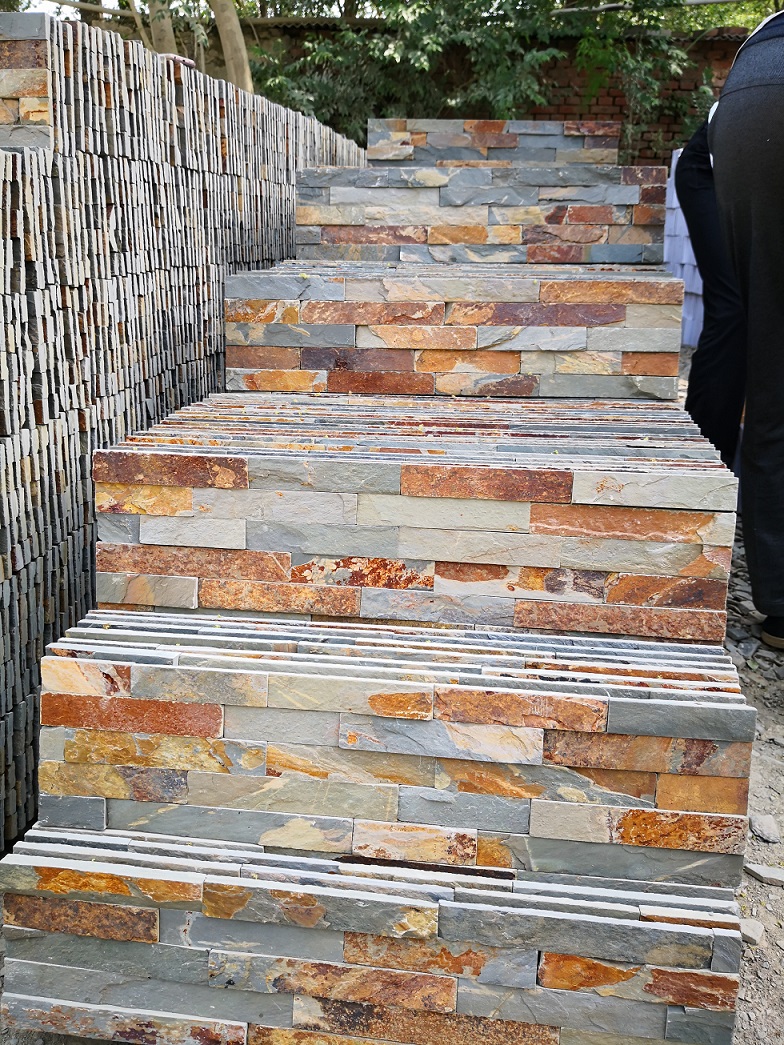
Split Face vs. Honed Finish: Choosing the Best Look for Your Design
Visage fendu creates rugged, natural depth for high-impact walls. Honed finishes provide smooth, matte surfaces for modern, low-maintenance interiors and high-traffic commercial zones.
| Feature | Split Face (Rough Series) | Honed Finish (Flat Series) |
|---|---|---|
| Texture | Rough, uneven, natural cleft | Smooth, matte, satin-like |
| Visual Style | Rustic, high-relief shadows | Modern, minimalist, clean lines |
| Maintenance | Debris traps; requires power washing | Easier to wipe and seal |
| Slip Resistance | High; superior grip for exteriors | Lower; can be slick when wet |
Dimensional Depth vs. Modern Minimalist Surfaces
Split face surfaces rely on mechanical fracturing to expose the stone’s natural cleft. This process creates deep shadows and varied heights across the wall. The resulting texture highlights the mineral aggregates and organic variations inherent in the material. Architects often specify this finish to add architectural drama to large-scale facades or high-impact feature walls.
Honed finishes involve grinding the stone to a precise, gauged thickness. This removes the natural irregularities to produce a satin-like, non-reflective appearance. While split face styles usually feature earth tones like greys and browns, honed finishes support a broader palette. This includes the high-contrast blacks and whites found in premium marble. This finish promotes a sense of open, quiet sophistication in modern interior projects.

Optimizing Projects with Flat and Rough Series Engineering
Choosing the right series depends on the technical demands of the environment. Our Rough Series delivers the high-dimension split face look using natural slate and quartzite. These materials offer superior UV stability, preventing color fade in exterior applications. For 2026 commercial environments, split face offers the necessary grip for exterior accents and landscape walls.
The Flat Series provides a clean-lined alternative similar to a honed finish. These panels work best for contemporary kitchen backsplashes and retail facades where hygiene and easy maintenance are mandatory. Because the surface is flatter, these panels are significantly easier to seal and clean compared to their rugged counterparts. We apply CNC diamond-blade precision to both series. This ensures that even the most rugged panels maintain tight, interlocking seams, eliminating visible vertical joints during installation.
- Rough Series Thickness: Up to 3.5cm for maximum relief.
- Flat Series Thickness: 1cm – 2.5cm for a streamlined profile.
- Joint System: Z-Shape and S-Shape male-female interlock.
- Durabilité: Freeze-thaw resistant and high salinity resistance.

The Impact of Rugged Textures on Interior Lighting and Shadows
Rugged stone textures eliminate flat wall glare by scattering light across uneven planes, creating deep architectural shadows and organic visual depth in modern interiors.
Light Diffusion and Surface Plane Variation
Natural cleft surfaces scatter light in multiple directions. This physical characteristic removes the harsh glare and hotspots commonly found on polished or flat surfaces. By diffusing the light, the stone creates a more balanced ambient environment.
- Protrusion Heights: Varied stone depths create a rhythmic interplay of light and dark that shifts as a viewer moves through the space.
- Reflection Profile: Matte mineral surfaces absorb and reflect light differently than factory-finished materials, offering a softer illumination.
- Organic Character: The natural cleavage of the rock ensures no two points reflect light at the exact same angle.
Achieving High-Contrast Drama with Rough Series Panels
We engineer our Rough Series panels with a 3.5cm maximum thickness to maximize the potential for architectural shadows. This increased relief allows for deeper recesses and more aggressive shadow lines compared to standard 1cm thin-set veneers.
- Grazing Light Impact: Strategic down-lighting emphasizes the split-face texture, making the wall a high-contrast focal point in residential or commercial lobbies.
- CNC Diamond-Blade Precision: Our factory uses CNC cutting to ensure that even with high-relief textures, the interlocking Z-shape joints fit tightly.
- Joint Camouflage: The male-female connection system eliminates visible vertical “steps,” ensuring the shadows are cast by the stone texture rather than the installation gaps.
The result is a surface that reacts to the time of day and the placement of artificial light. In 2026 design projects, this interaction between material and light replaces the need for additional wall decor by turning the structure itself into a visual feature.

Is the Maintenance of Rough-Textured Surfaces a Challenge for Owners?
Split face stone requires penetrative sealers and pH-neutral cleaning to manage its high porosity, ensuring long-term architectural integrity and aesthetic value against moisture and environmental wear.
Porosity and the Science of Water Intrusion in Split Face Stone
Natural split face blocks are approximately eight times more porous than standard brick or smooth stone. This physical characteristic requires proactive moisture management to prevent water from penetrating the internal structure of the masonry.
The rugged, uneven surface increases the total surface area exposed to environmental moisture and airborne particulates. While this texture provides visual depth, it also creates more points of contact for water and debris to accumulate compared to honed finishes.
Unsealed surfaces remain vulnerable to water absorption, which can lead to efflorescence or internal structural dampness. Routine inspections for spalling or minor cracks help prevent long-term moisture damage to the substrate and maintain the wall’s stability.
Maintaining Surface Integrity with Freeze-Thaw Resistant Stone
Effective maintenance centers on protecting the stone’s natural breathability while blocking liquid water. Top Source Stone utilizes 100% natural quartzite and slate to provide better long-term durability in demanding environments.
- Sealing: Apply a high-quality, breathable natural stone sealer every 3 to 5 years to mitigate water absorption without trapping internal vapors.
- Material Stability: Utilize the inherent UV stability and high salinity resistance of natural stone to prevent fading and chemical degradation.
- Cleaning: Use a soft brush and pH-neutral stone cleaners. Avoid acidic solutions or high-pressure washers that can etch or damage the split face texture.
- Resilience: Take advantage of freeze-thaw resistant properties to ensure the stone does not delaminate or crack during extreme 2026 weather cycles.
Foire aux questions
What is split face stone?
Split face stone is a 100% natural material created by fracturing blocks along their mineral cleavage planes rather than sawing them. This mechanical cleaving exposes the stone’s raw, internal crystalline structure, resulting in a rugged, high-relief texture. In modern construction, we engineer these “rough” textures into modular Z-shape ledger panels to combine ancient aesthetic depth with rapid, cost-effective installation.
Is split face stone hard to clean?
Due to its deep “peaks and valleys,” split face stone can trap more dust than honed surfaces. However, for B2B facility management, we recommend periodic vacuuming with a soft brush attachment and a pH-neutral stone cleaner. For exterior facades, a low-pressure power wash is typically sufficient. Applying a high-quality penetrative sealer (rather than a surface film) significantly reduces debris adhesion and simplifies long-term maintenance.
Does split face stone need grouting?
No. Our split face ledger panels are designed for dry-stack installation. We utilize CNC diamond-blade precision to ensure the back and interlocking edges of each panel are perfectly gauged. The “male-female” Z-shape system allows panels to fit tightly together, camouflaging joints and eliminating the need for grout, which preserves the authentic, rugged look of the stone.
Can you use split face stone in a shower?
It is possible but requires high-level technical oversight. While natural slate and quartzite are waterproof, the irregular surface of split face stone can allow water to sit in crevices, potentially leading to mineral leaching or mold if not properly sealed. If specified for wet areas, we recommend a high-performance moisture barrier behind the substrate and a professional-grade hydrophobic sealer to prevent water ingress.
How to seal rough split face stone?
Because the surface is highly irregular, traditional rollers or cloths are ineffective. We recommend using a low-pressure pump sprayer to ensure the sealer reaches the deep recesses of the “Rough Series” texture (which can reach depths of 3.5cm). Always use a breathable, penetrating sealer that protects the mineral structure without altering the stone’s natural matte finish or trapping internal vapors.
