

Managing 6. Stone Weight & Structure correctly is the difference between a profitable project and a costly structural overhaul. Misjudging dead loads often leads to redundant footing requirements or foundation redesigns that drain contractor margins and delay project timelines.
We verify these loads using the 8-12 lbs/sq.ft standard for precision-cut 6 x 24 panels. By utilizing CNC diamond-blade edges and Z-shape interlocking designs, we provide a stable system that avoids structural ledges while maintaining the freeze-thaw durability of genuine minerals.
Weight Comparison: Thin Natural Veneer vs. Manufactured Panels
Modern thin natural stone matches manufactured panels at 7-15 lbs/sq.ft, eliminating the need for structural footings and heavy reinforcement once required for traditional masonry.
Weight Density and Load Distribution for Thin Veneers
Engineers and architects once specified manufactured stone primarily to save weight. That technical gap has closed. Modern natural stone veneer is now precision-cut to thicknesses between 0.5 and 1 inch, resulting in a weight profile of 7 to 15 pounds per square foot. This aligns almost perfectly with manufactured stone panels, which typically weigh between 7 and 10 pounds per square foot.
Both materials offer a weight reduction of up to 75% when compared to traditional full-bed building stone. While full-bed stone reaches 60 pounds per square foot and requires significant foundation support, these thinner profiles stay within the load limits of standard wall assemblies. This parity allows you to choose materials based on aesthetics and durability rather than structural constraints.
Top Source Stone Weight Specs for Standard and Rough Panels
As a direct quarry source, we maintain strict control over panel density to ensure predictable structural loading for large-scale projects. Our weight specifications for the primary series are as follows:
- Standard 6 x 24 Panels: These weigh 8-12 lbs/sq.ft (30-40 kg/m²), making them suitable for most interior and exterior wall applications without additional bracing.
- Rough Series: Due to increased depth and heavy texture, these weigh approximately 13 lbs/sq.ft (55 kg/m²).
- Substrate Requirements: Our panels do not require structural footings. You can apply them directly to cement board or masonry substrates using polymer-modified thinsets.
- Logistics Data: To assist wholesalers in freight planning, our standard plywood crates average a gross weight of 900kg to 1000kg.
Because natural stone is UV stable and freeze-thaw resistant, it maintains its structural integrity longer than cast concrete, regardless of the similar initial weight. For dealers, this means providing a product that matches the ease of installation found in manufactured stone but with the long-term performance of genuine minerals.

Do You Need Structural Reinforcement for Natural Stone Walls?
Most stone veneer installations avoid reinforcement by staying under 13 lbs/sq.ft. Engineering becomes mandatory only for walls exceeding 4 feet or in designated seismic zones.
| Parameter | Natural Thin Veneer | Full-Bed Stone Masonry |
|---|---|---|
| Average Weight | 8 – 13 lbs/sq.ft (30-40kg/m²) | 40 – 60 lbs/sq.ft |
| Primary Support | Adhesive/Mechanical Ties | Concrete Footing/Brick Ledge |
| Structural Rebar | Only if wall height > 4ft | Always required |
Height Thresholds and Seismic Safety Standards
Gravity and wind loads dictate when a wall needs steel. Walls exceeding 4 feet in height change the engineering math because they require vertical rebar and bond beams to resist overturning forces. These reinforced concrete courses tie the wall together and distribute the load across the foundation.
Seismic building codes introduce stricter rules for safety. In high-risk zones, codes mandate specific ratios and materials to prevent collapse during ground movement:
- Aspect Ratio: The effective wall height to thickness ratio must not exceed 10:1.
- Through-Stones: Installers must use connecting stones that pass through the entire wall thickness at intervals of 1 per meter.
- Mortar Specs: Contractors use Type M2 mortar to fill all internal voids, especially in rubble infill sections.
Low-Weight Panel Specs and Footing-Free Systems
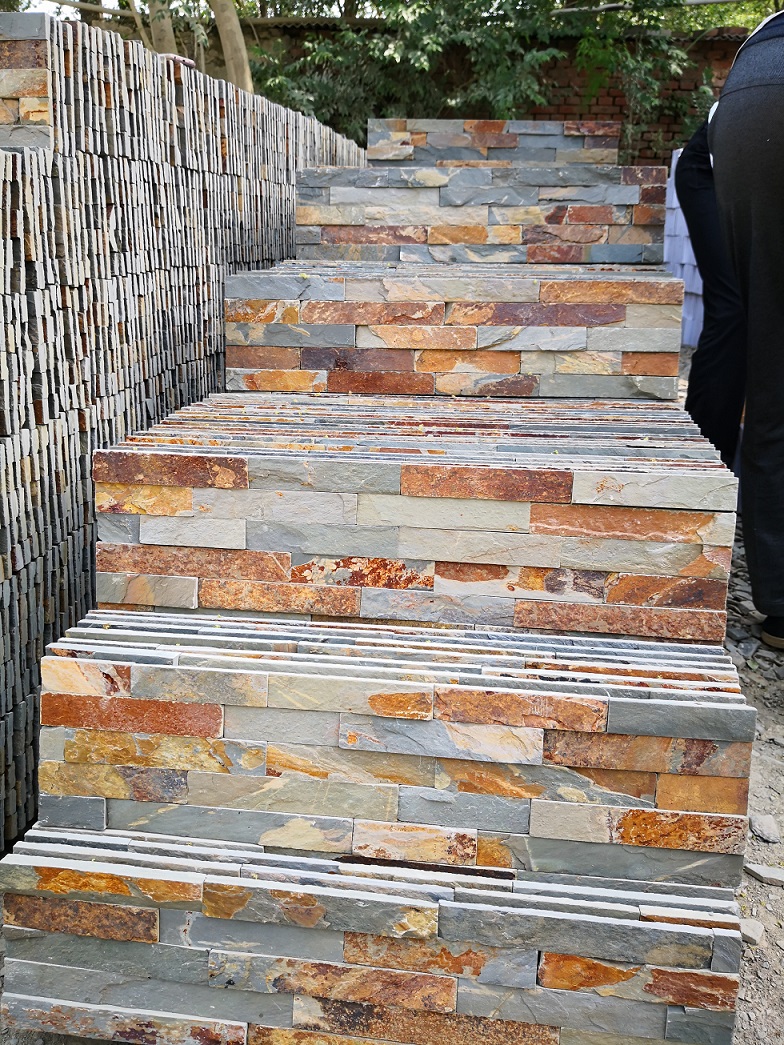
Top Source Stone panels weigh between 30-40kg/m² (8-12 lbs/sq.ft). This low mass keeps the installation below the threshold that triggers mandatory structural footings or brick ledges. By reducing the dead weight, these panels allow for vertical installation on standard substrates like cement board or cured concrete.
The engineering focus shifts from heavy foundations to high-performance bonding. We use CNC diamond-blade edges to ensure precision fits between Z-shape and S-shape panels, which eliminates visible gaps and creates a tighter lock. Key technical factors include:
- Adhesive Strength: Polymer-modified thinsets or high-strength epoxies provide the necessary shear bond strength for vertical surfaces.
- Substrate Compatibility: These systems install on wood or steel framing without reinforced steel foundations because the thin veneer reduces the load by up to 75% compared to full stone.
- Precision Edges: Mechanical interlocking camouflages the installation substrate and reduces the reliance on heavy mortar beds for stability.
Premium Factory-Direct Stacked Stone Ledger Panels
Adhesion Science: Bonding Heavy Stone to Vertical Substrates
Vertical stone adhesion relies on high shear bond strength. We use polymer-modified systems and high-strength epoxy to manage 8-13 lbs/sqft loads, ensuring permanent stability across all substrates.
Shear Strength and Surface Contact Mechanics
Gravity exerts constant downward pressure on vertical wall facades, making shear bond strength the primary defense against stone slippage. Most cladding failures occur when the adhesive cannot withstand the vertical load or fails to penetrate the irregular textures of the stone back.
Surface roughness dynamics dictate how the bonding agent performs. Adhesives must bridge the gap between the substrate and the stone, especially when surface irregularities exceed 100 μm. We apply anisotropic adhesion principles to ensure the bond is strongest when loaded in the vertical shear direction common to architectural walls.
- Shear Resistance: Essential for managing the 8-13 lbs/sqft weight of natural thin veneer.
- Gap Bridging: Polymer-modified thinsets accommodate surface roughness variability.
- Directional Loading: Systems are optimized for vertical tension rather than horizontal pull.
High-Strength Epoxy Resin and Permanent Internal Bonding
We anchor individual stone pieces to the panel substrate using high-strength epoxy resin specifically formulated for natural stone. This chemical bond creates a rigid internal structure that prevents individual stones from vibrating loose or delaminating over time.
Precision manufacturing significantly improves bond reliability. Our CNC diamond-blade edges create a tight, interlocking fit that minimizes the required adhesive thickness while maximizing the surface contact area. This high-density bond survives extreme environmental shifts without failing.
- Freeze-Thaw Resistance: Adhesives remain stable through thousands of thermal cycles to prevent stone fatigue.
- CNC Precision: Diamond-cut edges ensure a “male-female” connection that reduces stress on the epoxy.
- Chemical Integrity: The epoxy resin resists salinity and high humidity, crucial for coastal or tropical B2B projects.
This engineering approach ensures that the finished panel functions as a single structural unit. By controlling the chemistry of the bond and the precision of the cut, we eliminate the variables that typically lead to vertical stone failure.

Impact Resistance: Which Stone Withstands Accidental Damage?
Quartzite remains the top choice for high-traffic areas; its dense mineral structure and compressive strength exceeding 40,000 PSI allow it to absorb energy without fracturing under accidental force.
Distinguishing Surface Hardness from Structural Toughness
Hardness and toughness are different physical properties. Hardness measures scratch resistance on the Mohs scale, but toughness determines how much energy the stone absorbs before it actually cracks. In high-traffic environments, a hard stone that lacks toughness can still shatter upon heavy impact.
Granite offers a crystalline structure that provides high impact resistance under normal residential and commercial usage. Its internal grain structure tightness influences how the material reacts to sudden point-load impacts from heavy objects. We prioritize stones with dense mineral compositions to ensure the wall doesn’t fail when subjected to accidental strikes.
- Mohs Hardness: Granite typically sits at 6–7, offering high scratch resistance alongside its structural toughness.
- Energy Absorption: Toughness allows the stone to deform slightly at a microscopic level rather than snapping.
- Microfracture Control: Higher density stones contain fewer internal voids, reducing the risk of a “domino effect” during a localized hit.
Quartzite Density and the Structural Integrity of Rough Series Panels
Pierre de source supérieure quartzite models reach compressive strengths of 276 MPa (40,000 PSI). This makes them naturally resistant to crushing forces that would cause slate or limestone to fail. The mineral density of quartzite provides a level of structural integrity that is difficult to match with manufactured alternatives.
Thickness is a primary factor in impact durability. While standard veneers are 1cm to 2.5cm, our RoughStacked Series provides panels up to 3.5cm thick. This additional mass offers significantly more impact absorption. We also implement same-batch quarry consistency to ensure uniform mineral density across the entire wall, which eliminates the weak points often found in mixed-batch shipments.
- Compressive Strength: 40,000 PSI (276 MPa) for quartzite models.
- Panel Thickness: Up to 3.5cm in the Rough Series for maximum kinetic energy dissipation.
- Batch Uniformity: Sourcing from the same quarry vein ensures consistent mineral strength throughout the project.
- Material Type: 100% natural quartzite and granite outperform softer sedimentary stones in high-velocity impact scenarios.

Seismic Performance of Natural Stone Cladding Systems
Modern seismic engineering utilizes 3D anchoring to decouple panels from structural frames, preventing detachment during lateral shifts while maintaining architectural integrity through precision-cut interlocking designs.
Anchor Systems and Movement Accommodation
Seismic reliability in Revêtement de pierre depends on the system’s ability to move independently of the building’s primary skeleton. When ground acceleration occurs, rigid attachments often fail, causing stone panels to crack or eject. Engineers solve this by using mechanical systems that prioritize flexibility and energy absorption.
- Three-Dimensional Anchors: These systems accommodate building tolerances and lateral shifts by allowing movement across three axes.
- Horizontal Expansion Joints: Integrated into mullion connections, these joints absorb seismic energy and prevent panels from colliding during swaying.
- Independent Vertical Mullions: Separating mullions from stone joints ensures that racking forces from the structure do not transfer to the veneer.
- Individual Panel Support: Supporting each stone piece individually allows for independent movement while keeping the unit securely fixed to the substrate.
Structural Integrity of CNC-Machined Interlocking Panels
Manufacturing precision directly impacts how a cladding system survives high-frequency vibrations. Pierre de source supérieure utilizes CNC diamond-blade technology to ensure every interlocking joint functions as a structural safeguard rather than a point of failure.
- Precision Interlocking: CNC-cut Z-shape and S-shape models create tight male-female connections that minimize panel shifting during tremors.
- Epoxy Resin Bonding: High-strength resins prevent individual stone strips from delaminating when subjected to vibration stress.
- Modular Weight Distribution: Top Source Stone panels distribute weight evenly across the wall surface, reducing the risk of localized attachment failure.
- ASTM-Standard Durability: Rigorous testing ensures the stone maintains its structural properties even after repeated seismic cycles.
By combining these mechanical anchor requirements with precise factory fabrication, natural stone systems provide a high safety margin for commercial projects in active seismic zones.
Foire aux questions
Can I install natural stacked stone directly onto drywall?
No. Drywall lacks the structural integrity to support the concentrated weight of stone veneer, which typically ranges from 8 to 13 lbs per square foot. Installing directly onto gypsum panels often leads to the stone pulling away or the substrate bowing. For a secure bond, you must install a cement backer board or a metal lath with a scratch coat over the studs.
Does natural stacked stone require a brick ledge or structural footing?
Most thin natural stone veneers do not require a brick ledge because they weigh less than 15 lbs per square foot. This allows the wall substrate to support the load rather than the foundation. But full-depth masonry or stone thicker than 2 inches generally requires a footing or ledge to carry the vertical load safely.
How much does a standard Top Source Stone panel weigh?
Our standard 6 x 24 inch panels weigh approximately 30-40kg per square meter, which is roughly 8-12 lbs per square foot. Our rough-textured premium models are heavier, averaging about 55kg per square meter. These weights meet North American building codes for adhered veneer without requiring foundation modifications.
Is manufactured stone significantly lighter than natural stone veneer?
Manufactured stone is often 50% to 75% lighter than traditional full-bed natural stone. When comparing manufactured stone to natural thin veneer, the gap is smaller. Manufactured stone averages 6-10 lbs per square foot, while natural thin veneer averages 8-15 lbs. The slight weight increase in natural stone provides superior UV stability and prevents the fading often seen in concrete-based products.
Can I install stone veneer on the second story of a home?
Yes, stone veneer is safe for two-story applications if the wall framing can support the dead load. Installation requires a weather-resistive barrier, properly fastened lath, and a mortar scratch coat. For large upper-story spans, builders often use lintels or grade beams to manage the weight distribution effectively.
What is the weight limit for interior accent walls?
Standard 2×4 or 2×6 interior wall studs spaced 16 inches apart can typically support thin stone veneer weighing up to 15 lbs per square foot. If your stone choice exceeds 40 lbs per square foot, building codes require an anchored masonry system with metal ties. Top Source Stone products stay within the lighter range, making them suitable for most residential interior projects.
