
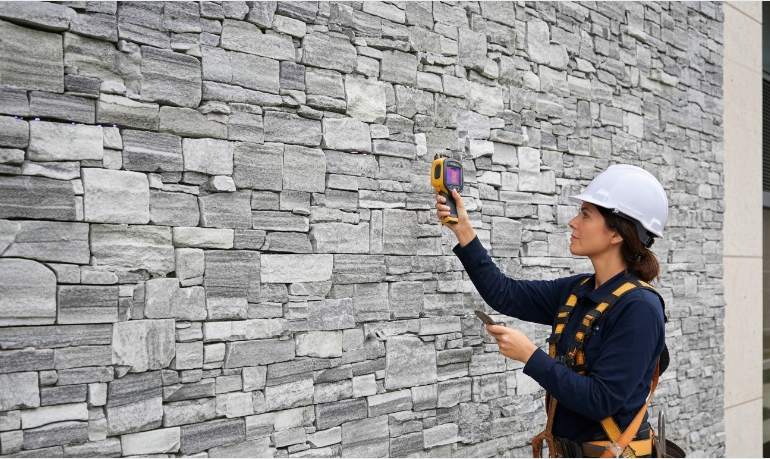
Multi-Story Safety for stone cladding serves as the primary safeguard against facade failure and the escalating liability risks in high-rise development. Selecting materials that fail to account for negative wind pressure or lateral force distribution often results in catastrophic delamination, leading to massive structural remediation costs and professional negligence claims.
We evaluate how 68kg/sq.m to 80kg/sq.m cement-backed stone panels solve these height-to-weight conflicts. Utilizing CNC-diamond precision edging and thermal resistance rated from -30°C to +50°C ensures engineers meet strict 2026 IBC building codes while passing FISP safety inspection cycles.
Weight vs. Height: Calculating Structural Load for High-Rise Facades
Engineers calculate structural load by totaling dead loads and lateral forces. Using Top Source Stone’s 68-80 kg/sq.m panels enables predictable weight management for 2026 high-rise safety.
Analyzing Dead Loads and Lateral Force Distribution
Structural stability in high-rise design depends on accurately aggregating permanent weights. Engineers categorize these as dead loads, which include floor slabs, roofs, and the specific 150 kg/m² weight typically assigned to wall components. Calculating these figures accurately ensures the building frame can support the facade over its entire lifespan.
- Dead Load Components: Aggregate the permanent weight of floors, roofs, and 150 kg/m² wall components.
- Cantilever Method: Apply this analysis for buildings between 25 and 35 stories to assess axial forces in interior columns.
- Environmental Forces: Account for wind suction and seismic loads based on regional 2026 building safety coefficients and total facade surface area.
Weight Management with Cement Backed Stone Panels
Pietra sorgente superiore engineers its stone panel systems to solve the weight-to-height conflict. By utilizing cement-backed substrates, we provide a predictable material weight that simplifies structural load calculations. This allows architects to specify natural stone for skyscraper exteriors without the prohibitive weight of full-bed masonry.
- 68kg/sq.m Panels: Select panels with 2-3.5cm thickness to minimize the vertical burden on high-rise support frames.
- 80kg/sq.m Panels: Deploy 3-4cm thick panels for ground-level features where higher impact resistance is needed.
- CNC-Diamond Precision: Precision edging ensures tight modular fitting, which prevents uneven weight distribution across the installation substrate.
- Interlocking Engineering: The Z-shape design ensures individual panels disappear into a continuous face, maintaining structural alignment without visible joints.

When is Mechanical Anchoring Required vs. Chemical Bonding?
Use mechanical anchors for immediate loading in uncracked concrete. Switch to chemical bonding for seismic zones, high-load facades, or installations near substrate edges to prevent concrete fracturing.
Load Thresholds and Substrate Integrity for Anchor Selection
Choosing the right fastening system depends on the substrate condition and how quickly the structure needs to bear weight. Mechanical anchors rely on physical tension, while chemical systems create a structural bond with the host material.
- Mechanical Expansion: Best for solid, uncracked concrete where contractors require immediate load application without curing wait times.
- Chemical Load Capacity: Supports heavy-duty applications up to 800 kg by distributing stress along the entire depth of the hole.
- Environmental Resistance: Chemical resin provides a moisture seal, protecting the connection in corrosive marine or high-humidity settings.
- Seismic Performance: Resin systems offer superior vibration resistance, maintaining bond integrity during tectonic shifts or heavy machinery operation.
Edge distance is a deciding factor for engineers. Mechanical anchors exert internal expansion stress that can crack concrete near corners or narrow pillars. Chemical bonding eliminates this outward pressure, allowing for secure installations much closer to the edge of a substrate.
Securing High-Density Cement-Backed Stone Panels
For commercial projects using Top Source Stone cement-backed Z-panels, the anchoring strategy must account for the substantial weight of natural stone and the height of the facade.
- System Weight: Standard panels weigh approximately 68 kg/sq.m (2-3.5cm thickness) or up to 80 kg/sq.m (3-4cm thickness).
- Vertical Bonding: High-strength epoxy adhesives provide the permanent chemical bond necessary for heavy vertical stacks.
- Height Safety: Installations exceeding 3 meters typically require mechanical clips to complement chemical bonding, managing the increased structural load on multi-story facades.
- Thermal Range: Anchoring systems must withstand fluctuations from -30°C to +50°C without compromising the bond between the stone and the backup structure.
CNC-diamond precision edging on these interlocking panels ensures a tight modular fit. This precision allows for hidden mechanical fasteners within the joints, maintaining a seamless aesthetic while meeting the safety requirements of high-density rivestimento in pietra.
Premium Natural Stacked Stone for Architectural Projects

Wind Suction and Lift: Ensuring Panels Stay Secure at Height
Wind suction creates a vacuum on facades. We counter this lift using high-density cement-backed panels and specialized epoxy adhesives to maintain permanent bonds under extreme negative pressure.
Mechanics of Negative Wind Pressure on Elevated Walls
Wind forces on high-rise structures are often misunderstood. Most assume wind only pushes against a wall, but the Bernoulli effect creates a more dangerous force: suction. As air accelerates around building corners or over the roof, pressure drops across the stone surface, effectively trying to pull the cladding away from the substrate.
Engineering for high-rise stability requires identifying corner vortex zones. These specific areas on multi-story facades experience the highest suction loads. We manage air gaps behind the stone to prevent pressure differentials that could otherwise compromise the panel attachment over time.
- Pressure Calculation: Engineering standards for 2026 mandate peak wind gust calculations for any installation exceeding 20 meters in height.
- Bernoulli Management: High-velocity air creates a pressure drop that we counter through specific panel density and mechanical anchoring.
- Vortex Mitigation: Heavily reinforced attachment points are required at the outer edges of building facades where suction is most intense.
High-Strength Epoxy Bonding and Cement-Backed Reinforcement
At Top Source Stone, we address wind lift through a composite manufacturing process. Our cement-backed stone panels provide a rigid, non-deformable base. This structural advantage ensures the panel does not flex or warp when subjected to the negative pressure found at high altitudes.
The bond integrity relies on high-strength epoxy resin adhesives. We formulate these specifically for Pietra naturale and cement-backed substrates to ensure the adhesive remains elastic enough to handle building movement but strong enough to resist hundreds of kilograms of pull force.
- Thermal Resistance: All bonding agents are tested for extreme temperature fluctuations ranging from -30°C to +50°C to prevent delamination in diverse climates.
- Mechanical Interlocking: Our Z-shape and S-shape panels utilize a precision-engineered connection system. This distributes wind loads across the entire wall surface instead of stressing individual units.
- Substrate Compatibility: The cement backing allows for superior chemical adhesion compared to mesh-backed alternatives, making it the standard for elevated B2B commercial projects.
For tall wall applications, using a reinforced backing is not just an upgrade; it is a safety requirement. The weight of our cement stone panels (up to 80 kg/sq.m for 3-4cm thickness) works in tandem with the epoxy bond to provide the mass and stability needed to withstand hurricane-force wind speeds and seismic vibrations.

Compliance with International Building Codes (IBC) for Stone
IBC compliance requires 7,500 psi granite compression, a 3/16-inch drainage plane, and non-corrosive anchoring every 2.5 square feet to ensure structural safety in multi-story environments.
| Performance Metric | Granite (ASTM C503) | Limestone (ASTM C568) |
|---|---|---|
| Min. Compressive Strength | 7,500 psi | 4,000 psi |
| Max. Water Absorption | 1.0% | 3.0% |
| Min. Density | 160 lbs/cu.ft | 140 lbs/cu.ft |
| Flexural Strength | 1,200 psi (Ref) | 1,000 psi |
Material Performance and Durability Testing
Standard building codes treat natural stone as a structural component, not just a decorative finish. To meet 2026 IBC mandates, every batch must undergo rigorous laboratory verification to prevent catastrophic delamination or crushing under load. This is especially critical for multi-family and commercial tenders where liability is high.
- Compression strength: Standards require a minimum of 7,500 psi for granite and 4,000 psi for limestone per ASTM C568/C503 protocols.
- Absorption limits: Granite must stay under 1% absorption, while limestone is capped at 3% to mitigate internal hydrostatic pressure.
- Weather resistance: All exterior stone must survive 100-cycle freeze-thaw testing to confirm long-term stability in shifting climate zones.
- Flexural strength: Structural applications demand a minimum of 1,000 psi to handle mechanical stress and building movement.
Choosing stone that barely meets these specs is a risk for high-rise facades. Top Source Stone utilizes batch-specific selection from consistent quarry veins to ensure the density and strength remain uniform across the entire project, avoiding the “patchy” structural integrity often found in mixed-source wholesale lots.
Precision Engineering for Structural Veneer Requirements
Modern building codes for 2026 place heavy emphasis on moisture management and anchoring precision. The gap between the stone and the substrate is now a regulated safety feature. Poorly cut panels lead to moisture traps, which eventually rot the backing and compromise the ties.
- Drainage plane integration: Codes mandate a minimum 3/16-inch depth between the water-resistive barrier and stone panels in Moist (A) and Marine (C) regions.
- Anchoring frequency: One non-corrosive metal tie is required for every 2 to 2.5 square feet of stone surface area.
- Density standards: We maintain material density above 160 lbs/cu.ft by sourcing strictly from specific quarry layers to ensure structural uniformity.
- CNC-Diamond Precision Edging: This ensures the tight modular fit necessary for meeting wind suction and lift requirements at significant heights.
For B2B distributors and contractors, these specs are non-negotiable. Using precision-cut Z-shape or S-shape panels from Top Source Stone simplifies the process of meeting these codes. The interlocking design eliminates visible joints and works with standard mechanical anchors to distribute load evenly across the building frame, protecting both the structure and your professional reputation.

Routine Safety Inspections for Multi-Unit Stone Exteriors
FISP inspections identify structural risks. Using thermal-resistant stone panels ensures compliance, reduces repair cycles, and prevents safety hazards in multi-unit building facades.
Regulatory Framework for Facade Inspection Safety
Building authorities mandate strict evaluation cycles to protect the public from falling masonry. In high-density urban areas, these regulations target buildings exceeding six stories, requiring owners to verify the structural integrity of every street-facing wall.
- Inspection Cycle: Qualified Exterior Wall Inspectors (QEWIs) must conduct hands-on evaluations every five years.
- Primary Indicators: Assessments focus on identifying physical damage such as bulges, loose stones, and deteriorating mortar joints.
- Condition Classifications: Findings fall into three categories: Safe, Safe with a Repair and Maintenance Program (SWARMP), or Unsafe.
- Enforcement Timelines: Unsafe findings trigger an immediate 90-day remediation window and require the installation of sidewalk sheds to prevent pedestrian injury.
Thermal Expansion Resistance and Long-Term Stability
Material selection directly impacts the outcome of safety inspections. Choosing stone panels engineered for environmental stress reduces the likelihood of cracks or delamination that lead to “Unsafe” classifications and costly remediation penalties.
- Thermal Range: Top Source Stone panels withstand extreme fluctuations from -30°C to +50°C without structural cracking.
- Material Density: Variants like Blue Diamond Quartzite provide high load-bearing strength, minimizing the risk of panel separation over time.
- Batch Uniformity: We use batch-specific selection from the same quarry vein to guarantee 95% hue and density uniformity, ensuring the facade weathers evenly.
- Mechanical Protection: Our interlocking Z-shape design conceals the substrate, shielding secondary anchors from water infiltration and oxidative rust.
Domande frequenti
Can natural stone panels be safely installed on high-rise buildings?
High-rise applications are safe but require professional engineering and specialized anchoring. Industry guidelines generally set a 30-foot height threshold for standard veneers. Projects exceeding two stories must utilize metal gravity anchors and lateral supports to manage wind loads and structural deflection. We recommend a cladding designer evaluate these variables for any building beyond residential heights.
How do contractors anchor stone veneer on tall exterior walls?
Tall installations rely on horizontal joint reinforcement and embedded wall anchors, such as eye and pintle systems, to transfer the stone’s weight to the building frame. The system rests on a structural ledge or footing. To maintain long-term integrity, we incorporate 1.5-inch airspaces and through-wall flashing at multiple elevations. This setup manages moisture and prevents air pressure buildup behind the stone panels.
What is the maximum weight allowed for exterior stone cladding?
International building codes limit thin stone veneer to 15 pounds per square foot. Our standard 2-3.5cm panels weigh approximately 13.9 pounds per square foot (68kg/m²), keeping them within code for easy support. This is significantly lighter than full-bed Pietra naturale, which can exceed 40 pounds and often requires expensive structural footings or specialized brick ledges.
Do stone panels provide resistance against hurricanes and impact?
Natural stone panels excel in high-velocity hurricane zones because their mass resists impact from wind-blown debris better than vinyl or fiber-cement. When installed with dual-layer water-resistant barriers and breathable drainage systems, the panels allow airflow to dry the substrate quickly. This prevents structural decay and mold following heavy rain events common in tropical or coastal climates.
Is a building permit necessary for installing exterior stone?
In most jurisdictions, rivestimento in pietra counts as a structural alteration and requires a building permit. Local codes often dictate specific material percentages, such as requiring 65% masonry coverage for walls facing public streets. Guidelines also get stricter for installations over 10 feet in height. You should verify specific requirements with your local code enforcement office before starting 2026 projects.
