
Designing a stacked stone fireplace involves much more than just picking a pretty stone. Project success depends on meeting strict safety standards, selecting the right materials for thermal performance, and understanding substrate preparation. This requires technical expertise and careful planning.
This guide explores key design and installation considerations for stacked stone fireplaces, from integrating them into modern architectural spaces to managing thermal properties of materials like slate and quartzite. We cover customization options, minimum order quantities of around 100 m² for factory-direct orders, and the importance of adhering to safety codes like NFPA 211, which mandates a 36-inch clearance to combustibles for room heaters.
The Role of Stacked Stone Fireplace in Modern Architecture
In modern architecture, stacked stone fireplaces are key focal points, often extending full height to the ceiling. They integrate linear fireboxes and media elements, combining aesthetics with utility while adhering to precise material and installation standards.
Design Integration and Aesthetic Impact
Stacked stone fireplaces frequently run full height to the ceiling, acting as vertical focal elements in open-plan and double-height spaces.
They are paired with linear gas fireboxes and integrated television recesses, creating multi-functional media and architectural features.
Manufacturers emphasize dry-stacked ledgestone, honed travertine, and linear quartzite panels for modern, minimal profiles.
Material Specifications and Functional Applications
Typical fireplace openings range from 36–48 inches wide by 21–48 inches tall.
Stone veneer panel thickness for interior fireplaces is commonly 20–40 mm (approximately 3/4–1 1/2 inches).
Cladding is designed for installation over existing substrates such as unpainted brick, with interlocking corner units ensuring structural continuity.
Thermal Properties of Natural Slate and Quartzite
Natural slate offers superior insulation for fireplaces due to its low thermal conductivity and anisotropic structure, minimizing heat transfer. Quartzite, while durable, generally has higher thermal conductivity, dispersing heat faster. This impacts material choice for heat management and safety.
Slate’s Insulating Characteristics
Natural slate has low thermal conductivity, ranging from 1.43 to 3.15 W/(m·K), which is lower than many common natural rocks like granite or marble.
Its anisotropic property means heat transfer is significantly lower perpendicular to the slaty cleavage, making its shingle surface an efficient barrier against heat.
High thermal inertia allows slate to act as a temperature buffer, maintaining cooler exterior surfaces even when exposed to high heat from a fireplace.
Quartzite’s Thermal Conductivity and Durability
Quartzite generally exhibits higher thermal conductivity, with values around 2.00 W/(m·K), suggesting faster heat dispersion compared to slate.
While direct thermal data for quartzite is less detailed in research, its properties align with sandstone proxies, which are known for quicker heat transfer.
Despite faster heat dispersion, quartzite’s inherent durability makes it suitable for fireplace applications, although thicker slabs might be necessary to manage heat gradients effectively.
Factory-Direct Customization for Fireplace Feature Walls
Factory-direct customization for fireplace feature walls involves specifying modular ledger panels, custom shapes like corners or Z-shapes, and coordinating certifications and logistics directly with manufacturers. This approach allows for aesthetic and functional tailoring at the batch level, optimizing for both design and performance requirements.
Customization Options and Minimum Order Quantities
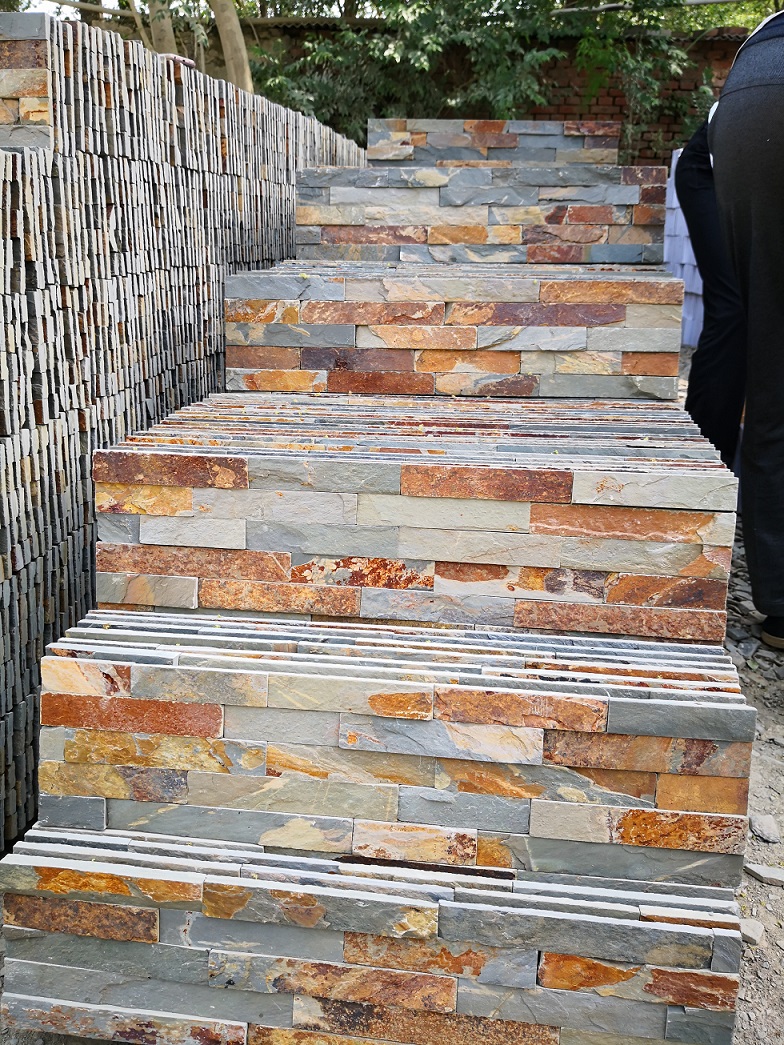
Modular ledger panels are available in sizes such as 6 in × 24 in (600 × 150 mm) and 21.75 in × 6 in (550 × 150 mm).
Options include customized shapes like corners, rectangles, S-shapes, and Z-shapes for seamless feature walls.
Factory-direct minimum order quantities (MOQs) are around 100 m².
Supply capacity is approximately 10 containers/month, with lead times of 18–25 days from order confirmation.
Performance Standards and Logistics for Feature Walls
Products meet or exceed ASTM standards, such as ASTM C1670 for adhered manufactured stone masonry veneer units, and may include IAPMO product certification.
Manufacturers advise maintaining at least a 6 in (152 mm) non‑combustible border between the firebox opening and stone panels.
Stone veneer thickness is commonly 1–2.5 in, reducing dead load on framed feature walls.
Packaging involves strong cartons plus plywood/wooden crates with reinforced straps, foam, or inner cartons to minimize breakage during multi-pallet shipments.
Elevate Projects with Premium Stacked Stone.
Substrate Preparation: Installing Stone Over Drywall vs. Brick
Preparing substrates for stacked stone installation differs significantly between drywall and brick. Drywall needs a metal lath, weather-resistive barrier, and specific mortar application to manage deflection. Brick, being more rigid, often allows direct adhesion provided it’s plumb and structurally sound, focusing on bond strength and proper mortar beds.
| Substrate | Key Requirement | Details |
|---|---|---|
| Drywall | Deflection Control & Mechanical Attachment | L/720 deflection limit, weather-resistive barrier, metal lath (26 gauge, self-furred, ASTM C1063), mortar encapsulation. |
| Brick | Direct Adhesion & Bond Strength | Plumb, true, and structurally sound. Minimum 50 psi mortar bond strength. Max 1/8 inch variation in 10 feet for flatness. Thinner mortar beds (3/32 inch) possible. |
Drywall Substrate: Requirements and Preparation
Deflection limits for natural stone over frame construction like drywall are L/720.
A weather-resistive barrier (WRB) with a minimum 3.5-inch vertical flange is essential.
Metal lath (self-furred, minimum 0.0179 inches / 26 gauge) per ASTM C1063 is required for mechanical keying.
Mortar encapsulation is necessary to manage deflection and prevent cracking.
Brick Substrate: Direct Adhesion and Bond Standards
Brick and masonry substrates often allow direct adhesion if plumb, true, and structurally sound.
Mortar bond strength must be a minimum of 50 psi for adhered stone veneer.
Substrate flatness requires a maximum variation of 1/8 inch in 10 feet.
Thinner mortar beds (as thin as 3/32 inch after tamping) are possible due to brick’s inherent rigidity and higher direct tensile bonds (>175 psi concrete equivalent).
Safety Standards: Heat Resistance and Non-Combustibility
Ensuring fireplace safety involves adhering to established building codes and standards like NFPA 211 and IRC Chapter 10. These guidelines mandate specific clearances from combustible materials, non-combustible hearth protection, and fire-resistance ratings for wall assemblies, preventing heat transfer and ignition risks.
| Standard/Requirement | Description | Key Metric/Compliance |
|---|---|---|
| NFPA 211 / IRC Chapter 10 | Governs design, installation, and clearances for fireplaces and solid-fuel appliances. | Mandatory clearances, material specifications. |
| Clearance to Combustibles (Room Heaters) | Distance between room heater/masonry heater exterior and combustible surfaces. | 36 inches (914 mm) minimum. |
| Clearance to Combustibles (Connector Pipe) | Distance between solid-fuel connector pipes and combustibles. | 18 inches (single-wall); 1-2 inches (listed double-wall/Class A). |
| Non-Combustible Hearth Protection | Required floor protection to prevent ember or thermal damage. | Type 1 (ember) or Type 2 (thermal) with specified insulation value. |
| Wall/Floor Assembly Fire Resistance | Testing for fire barriers to limit heat transfer. | ASTM E119 or ANSI/UL 263; unexposed side temp rise ≤ 250 °F (≈121 °C). |
| Interior Finish/Wall Cladding Fire Growth | Testing to assess flame spread and contribution to room fire growth. | NFPA 286 or UL 1715 room-corner tests (pass/fail). |
Clearance Requirements and Code Compliance
NFPA 211 and IRC Chapter 10 govern fireplace and solid-fuel appliance design, installation, and clearances. A 36-inch (914 mm) clearance is required between room-heater stoves or masonry heater exteriors and combustible surfaces. Single-wall solid-fuel connector pipes need an 18-inch clearance to combustibles; listed double-wall/Class A chimney components can be as close as 1-2 inches.
Material Performance and Testing Standards
Non-combustible hearth protection (Type 1 for ember, Type 2 for thermal protection) is essential. Wall/floor assemblies for fire barriers are tested to ASTM E119 or ANSI/UL 263, limiting temperature rise on the unexposed side to 250 °F (≈121 °C) above ambient. Interior finishes and wall claddings are qualified via NFPA 286 or UL 1715 room-corner tests to assess flame spread and contribution to room fire growth.
Selecting Trends: From White Quartzite to Rustic Slate
Current trends in stacked stone fireplace veneers emphasize both modern aesthetics, often with white quartzite panels for clean lines, and rustic charm, using individual slate units for natural textures. Material selection balances visual appeal with performance metrics like compressive strength, water absorption, and adherence to installation standards.
Modern Aesthetics: White Quartzite Panels
White quartzite offers a Mohs hardness of around 7, making it highly scratch-resistant for light finishes. Typical compressive strength for quartzite building stone is over 100–150 MPa, indicating superior durability. Water absorption is commonly less than 0.5–1.0%, contributing to low porosity and resistance to freeze-thaw cycles. Modular 6 x 24 inch panel systems, like those from Norstone, enable dry-stack, contemporary looks without visible grout.
Rustic Charm: Natural Slate Units
Rustic slate features a natural cleft texture and color banding, enhancing lodge/cabin aesthetics. Compressive strength ranges from 70–200 MPa, providing robust performance for veneer applications. Water absorption is usually 0.4–0.6% for quality slate, supporting resistance to thermal cycling. Individual slate stones, typically 1–3 inches in height and 6–16 inches in length, create irregular joints and deeper shadows.
Long-term Maintenance: Managing Soot and Dust
Regular maintenance, including weekly dusting, monthly pH-neutral cleaning, and annual deep cleaning, prevents soot and dust buildup. Applying breathable penetrating sealers every 12-24 months protects porous stones, ensuring long-term durability and appearance.
Preventative Measures and Routine Cleaning Protocols
Perform weekly dusting using a soft cloth or non-abrasive vacuum to stop soot and dust buildup.
Execute monthly cleaning with pH-neutral stone cleaner and a microfiber cloth for light soot.
Use a soft-bristled brush for textured or split-face stone during monthly cleaning to address crevices.
Schedule deep cleaning 1-2 times per year, which can include a thorough clean or professional chimney sweep based on local regulations.
Advanced Cleaning, Sealing, and Chimney Care
Apply a baking soda paste for 5-10 minutes on tough soot stains, then gently scrub with a soft-bristle brush.
Seal porous stones like limestone and sandstone with a breathable penetrating sealer every 12-24 months to block soot and moisture penetration.
For limestone, apply sealer annually due to its higher porosity.
Conduct chimney sweeping and soot cleaning 1-2 times per year using flexible Nylon or Perlon brushes (avoid metal brushes).
Vacuum lateral smoke channels during chimney cleaning to ensure complete removal of soot and debris.
Final Thoughts
Designing and installing a stacked stone fireplace for B2B projects needs a careful blend of aesthetics, material science, and adherence to safety standards. From choosing slate for its insulating properties or quartzite for durability, to understanding customization options and substrate preparation, each decision impacts the final product. The integration of modern linear fireboxes and media elements also shapes design.
Project success depends on selecting materials that meet both visual goals and technical requirements. Following safety codes, ensuring proper clearances, and regular maintenance protocols protect the investment and provide lasting performance. For professionals in architecture and construction, a deep understanding of these elements helps create high-quality, long-lasting stacked stone fireplace features.
Domande frequenti
Is stacked stone fireplace safe for gas and wood?
Stacked stone veneer fireplaces are safe for gas and wood use. They need proper installation as a non-combustible facing outside the firebox. They offer heat resistance up to 120°C/248°F and fire ratings like EU class Cfl-s1 or B1. Installation requires Type S mortar and a non-combustible substrate, following ASTM C1780 and IRC/IBC codes.
Can I install stone over a brick fireplace?
Yes, you can install stone veneer over a brick fireplace. Use metal lath, scratch coat, and mortar adhesion. The brick surface should be rough, porous, and unpainted. If the surface is smooth or painted, add metal lath and a 1/2-inch scratch coat. The minimum bond strength required is 50 psi.
How do you clean soot off natural stone?
First, dry-clean loose soot with a vacuum and chemical sponge. Next, wet-clean using a poultice or specialty stone cleaner designed for soot/carbon on natural stone. Avoid generic acids or household cleaners not approved for stone. Laser cleaning, an industrial method, removes soot by ablating the thin black layer at temperatures above 100°C, while keeping the stone below damage thresholds. The stone must withstand ≥100°C surface temperatures during this process.
Do I need a mantel for a stone fireplace?
A mantel is not mandatory for a stone fireplace; it is an optional design choice. Any combustible mantel or trim must meet specific clearance rules. Keep it at least 6 inches (150 mm) away from the fireplace opening. If it projects more than 1½ inches (38 mm) from the face, add 1 inch of vertical clearance for every extra inch of projection. Many installers aim for about 12 inches minimum above the firebox opening for a combustible mantel shelf.
Does natural stone veneer get hot to the touch?
Natural stone veneer will warm up and can feel hot to the touch in front of a fireplace or in direct sun. The stone itself is non-combustible. Typical veneers only add a few degrees of surface temperature above the surrounding air. This is due to their relatively low R-value (thermal resistance) of about R-0.3 to R-0.6 per inch of thickness. The veneer will get noticeably warm/hot where exposed to radiant heat. It is not a fire risk and is routinely used around fireplaces.
What is the best adhesive for fireplace stone?
For a stacked-stone fireplace surround, a polymer-modified thinset mortar or veneer mortar is best. It should meet ANSI A118.4 or A118.15 (and often A118.11). This type of mortar is specifically for adhered stone veneer and high-temperature fireplace use. For traditional adhered thin stone veneer, use Type S or Type N mortar conforming to ASTM C270 or CAN/CSA‑A179. Alternatively, use a veneer/thinset mortar tested to ANSI A118.4 / A118.15. Avoid generic construction glue unless the manufacturer explicitly lists fireplace surrounds and temperature ratings for that product.
