

Designing modern Interior Accent Walls requires more than visual selection; it requires managing the structural risk of material weight and the financial cost of batch inconsistency. Sourcing low-grade ledger panels often leads to substrate delamination and patchy finishes, creating a significant liability for designers and long-term warranty costs for homeowners.
We eliminate these failures by sourcing 100 percent natural stone from single quarry veins to maintain 95 percent hue uniformity. This analysis benchmarks how CNC diamond-blade precision and standardized 8-12 lbs/sq.ft panels enable seamless, structurally sound installations that secure project margins and architectural integrity.
Texture as Design: Why is Stacked Stone the Ultimate Accent Material?
Natural stacked stone provides tactile depth and UV stability that flat finishes cannot replicate, ensuring centuries of durability for high-end interior and exterior architecture.
Organic Dimension and the Visual Appeal of Split-Face Finishes
Designers increasingly prioritize tactile surfaces over flat, printed patterns. Natural stone panels offer a three-dimensional relief that changes character depending on the light source. This physical depth creates a focal point that feels permanent and structural rather than decorative.
- Dynamic Shadows: Natural split-face textures create shadow lines that shift as ambient or accent lighting moves throughout the day.
- Authentic Mineralogy: Genuine quartzite and slate offer unique mineral patterns, preventing the repetitive, “stamped” look common in concrete-based faux stone。
- Rough Series Relief: High-relief surfaces provide a rugged aesthetic specifically designed for grand entryways and large-scale fireplace surrounds.
- Mineral Composition: 100% natural stone ensures the material ages gracefully without the surface delamination seen in synthetic alternatives.
Aesthetic Uniformity Through Same-Batch Quarry Sourcing
The biggest risk in large-scale commercial stone projects is color “patchiness.” We solve this by controlling the supply chain from the mountain to the crate. By sourcing raw material from the same quarry vein for each batch, we maintain a level of visual consistency that middleman wholesalers cannot match.
- 95% Hue Uniformity: Sourcing from the same vein ensures minimal color shift across thousands of square feet.
- CNC Precision: Diamond-blade edges allow for interlocking Z-shape panels that use a male-female connection to hide vertical joints.
- Environmental Resilience: Natural composition provides inherent freeze-thaw resistance and high salinity tolerance for coastal installations。
- Modular Standards: Standardized 6×24 inch panels and matching pre-fabricated L-corners reduce on-site labor costs while ensuring a professional architectural wrap.
This combination of precision engineering and raw mineral beauty allows architects to specify stacked stone for high-traffic environments where both durability and luxury aesthetics are non-negotiable.

Lighting Your Stone Wall: Using Sconces to Enhance Dimensional Relief.
Sconces use grazing light to define surface textures. Placing them at eye level casts shadows across natural split-face stone, highlighting relief while providing functional ambient light.
Maximizing Texture Through Grazing and Dual-Directional Lighting
Standard overhead lighting often flattens the appearance of natural stone. To pull the character out of the material, we focus on the angle of incidence. Grazing light techniques involve placing the source extremely close to the wall surface so the light skims the face of the stone.
- Cylinder Sconces: These fixtures project light both upward and downward, covering the entire vertical span of the wall from a single mounting point.
- Eye-Level Positioning: Mounting fixtures at eye level ensures the stone’s most detailed textures receive illumination where they are most visible to occupants.
- Surface Definition: Grazing light creates intentional shadows that define surface irregularities, making the organic relief of the panel stand out.
Illuminating the Dramatic Shadows of Natural Split-Face Panels
The engineering behind the panel affects how it reacts to light. Our Rough Series features deep, natural clefts specifically designed to work with directional light to create high-contrast shadows. This adds a rugged, architectural aesthetic to commercial and residential interiors.
- Invisible Joint Technology: We use CNC diamond-blade precision on our interlocking Z-shape joints. This ensures that even under the scrutiny of close-range grazing light, the vertical seams remain hidden.
- Shadow Control: Designers vary the distance between the sconce and the stone surface to manipulate shadow depth. Increasing the distance softens the relief, while moving it closer sharpens the contrast.
- Material Integrity: Using 100% natural stone ensures that the textures revealed by the light are authentic minerals, not the repetitive patterns found in molded faux alternatives.
Premium Stacked Stone Panels for Commercial Success
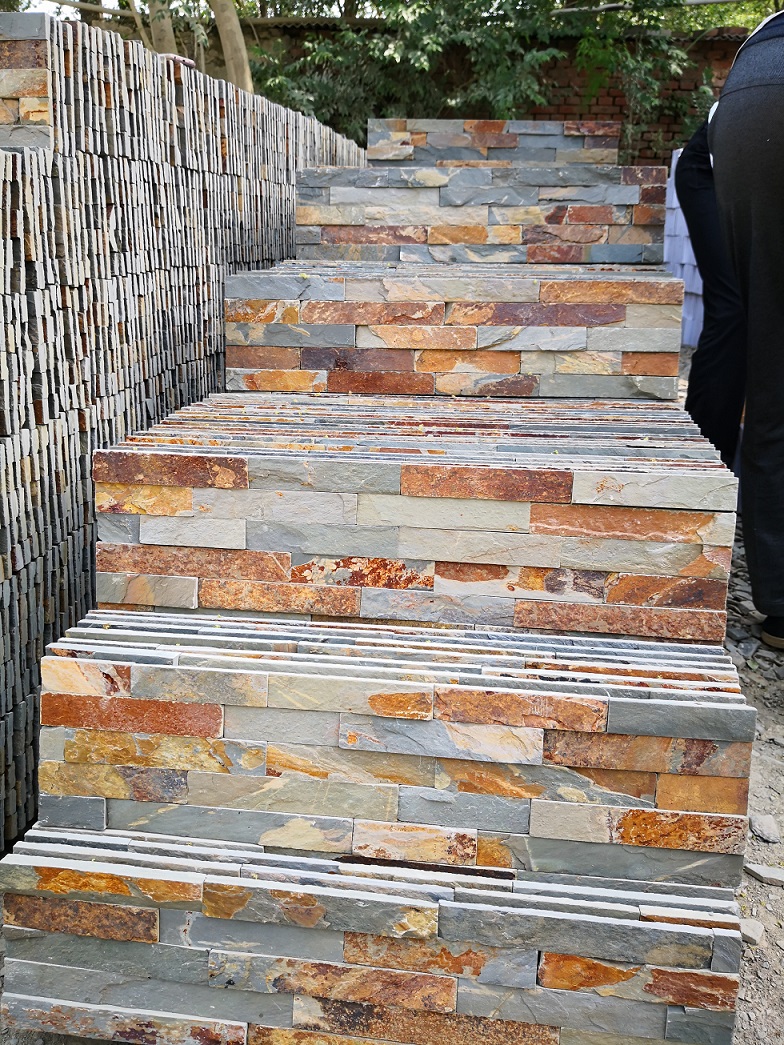
Color Coordination: How to Match Stone with Modern Interior Paint Palettes?
Balance undertones and temperature by pairing cool stones with minimalist whites and warm textures with earthy palettes, using low-contrast finishes to maintain a sophisticated, organic interior flow.
Balancing Temperature and Visual Contrast
Natural stone defines the atmosphere of a room through its inherent temperature. Choosing between cool and warm hues dictates whether a space feels like a clinical modern gallery or a rustic Mediterranean retreat. Successful designers focus on the specific undertones of the stone to ensure the paint colors do not clash or feel muddy.
- Cool-Toned Pairings: Match slate or quartzite varieties, such as Sierra Blue, with calming palettes including cobalt blue, muted grays, or crisp whites to foster relaxation in residential interiors。
- Warm-Toned Pairings: Use sandy and earthy hues, like Golden Honey, to complement terracotta or warm beige paint, a combination driving 2026 Southwestern architectural styles.
- Contrast Management: Select stone with natural dappling to provide organic variation. Low-to-medium contrast prevents the wall from becoming an aggressive focal point that overwhelms the room.
- Lighting Integration: Test stone samples against high-CRI LED fixtures. Proper lighting prevents darker stones from absorbing too much light and making the space feel confined.
Maintaining Palette Integrity via Same-Batch Sourcing
Architectural color coordination fails if the material lacks consistency. In large-scale installations, even a slight shift in quarry layers can result in a “patchy” appearance that disrupts the paint scheme. Professional sourcing ensures that the base colors of the stone remain predictable across the entire surface area.
- Strategic Inventory: Utilize Top Source Stone’s “Big 10 Inventory” to select reliable base colors like Glacier White or Carbon Black that align with minimalist design requirements.
- Hue Uniformity: We maintain 95% hue uniformity by sourcing material exclusively from the same quarry vein per order, preventing the visual fragmentation common in mixed-source products.
- CNC Precision: Use diamond-blade cutting to create tight, seamless transitions. This level of craftsmanship ensures that the focus remains on the color match rather than visible joint gaps.
- Visual Verification: We provide pre-shipment photos and videos of the finished batch. This allows B2B buyers to verify that the stone matches the specified interior paint swatches before the product leaves the factory.
Achieving a professional result depends on the synergy between the stone’s mineral profile and the surrounding wall colors. By controlling the quarry source and understanding temperature principles, designers create environments where the stone feels like a permanent, integrated part of the architecture.

Is Stacked Stone Too Heavy for Installation on Standard Interior Drywall?
Standard drywall fails under natural stone’s 8-15 lbs/sq.ft. weight. Installers must secure 1/2-inch cement backer board to framing studs to prevent structural collapse or stone separation.
| Panel Type | Weight (lbs/sq.ft) | Metric Weight | Substrate Requirement |
|---|---|---|---|
| Standard Natural Panel | 8 – 12 lbs | 30 – 40 kg/m² | 1/2″ Cement Backer Board |
| Rough / Premium Stacked | Up to 15 lbs | 55 kg/m² | Reinforced Cement Board |
Structural Risks and Weight Loads of Natural Stone Panels
Standard gypsum drywall relies on a paper facing to provide structural integrity. When you apply heavy masonry, the shear force exceeds the limits of the gypsum core. Natural stone panels from Top Source Stone typically range from 30-40kg/m² (8-12 lbs/sq.ft) for standard thickness, while our rough-cut premium models reach 55kg/m². This mass creates a constant downward pull that drywall cannot sustain long-term.
Environmental conditions inside a building often accelerate failure. High humidity levels weaken the bond between the drywall paper and its core. Over time, this causes the stone and the paper facing to delaminate, leading to sagging, visible wall separation, or a complete collapse of the accent feature.
- Standard Load: 8-12 lbs/sq.ft for slate or quartzite panels.
- High-Density Load: 55kg/m² for rough-cut stone up to 3.5cm thick.
- Failure Point: Paper facing delamination and gypsum core fractures.
Engineered Substrate Requirements for Safe Installation
Safe installation requires a rigid surface that handles moisture and weight without flexing. A 1/2-inch thick cement backer board serves as the ideal base for high-strength thin-set mortars or epoxies. Unlike drywall, cement board provides a mechanical bond that won’t degrade under the weight of 100% natural stone minerals.
The substrate must transfer the load directly to the building’s framing. Installers should fasten backer boards with 2-inch minimum screws spaced at 24-inch centers into the wall studs. トップソースストーン panels utilize a precision-engineered profile (8-13 lbs/sq.ft) that generally avoids the need for heavy concrete footings, provided the wall substrate and framing meet these technical standards.
- Approved Substrates: Cement backer board, concrete block, or brick.
- Fastener Specs: 2-inch corrosion-resistant screws into wood or metal studs.
- Mortar Standards: ANSI A118.15 polymer-modified thin-set for maximum adhesion.
- Precision Fit: Our Z-Shape interlocking panels camouflage the substrate by eliminating vertical “stepped” gaps.

Clean Lines: Integrating Floating Shelving and Home Tech into Stone Walls.
Combine heavy-duty masonry anchors with CNC-precision stone cutting to secure floating shelves and hide tech wiring directly within the textured accent wall.
Mounting Brackets and Anchoring Techniques for Irregular Stone Surfaces
Standard drywall hardware fails under the 8-12 lbs/sq.ft weight of natural ledgestone. For a secure installation, we require anchors that create a mechanical bond with the structural substrate behind the stone veneer。
- Anchor Selection: Use specialized masonry anchors or concrete screws that thread directly into the cement board or masonry substrate.
- Drill Placement: Align drill holes with mortar joints to minimize the risk of cracking individual stones and to simplify the drilling process.
- Leveling Shims: Apply thin wood or plastic shims behind shelving brackets to compensate for the 1cm to 3.5cm natural cleft variance of split-face stone。
- Notching: Notch the stone panels at mounting points using a wet saw to create a flat contact surface for brackets, ensuring the shelf sits flush.
Utilizing CNC Precision and Interlocking Panels for Hidden Wiring
Modern media walls require clean cable management. Our Z-shape and S-shape interlocking panels utilize specific manufacturing tolerances to facilitate tech integration without visible conduits.
- CNC Cut-outs: Use CNC diamond-blade precision edges to create tight, professional cut-outs for electrical outlets and smart home control panels.
- Cable Routing: Path low-voltage wiring through the natural voids created by the male-female interlocking system to avoid cutting into the wall frame.
- Recessed Components: Leverage the 2.5cm to 3.5cm thickness of premium panels to recess slim tech components directly into the stone layer.
- L-Corner Finishing: Install matching pre-fabricated L-corners to wrap stone around media centers, maintaining texture consistency at every 90-degree transition.
よくある質問
Is stacked stone out of style for 2026 interior design?
2026 design trends favor seamless surfaces and oversized slabs, but natural stacked stone remains a primary choice for organic texture. Architects still specify natural stone panels for accent walls to provide depth and character that flat surfaces cannot replicate. While minimalist styles use large-format pieces for flow, the tactile nature of split-face stone continues to hold value in high-end residential and commercial lobbies.
Can I install natural stacked stone directly on interior drywall?
No, you must not install stone panels directly on drywall because of weight and moisture concerns. Natural stone panels weigh between 8 and 12 lbs per square foot, which exceeds the load capacity of standard drywall. Secure a 1/2-inch cement backer board to the wall studs first to create a stable, moisture-resistant substrate for the mortar and ensure the structural integrity of the installation.
How do I ensure a seamless look between stone panels?
Use Z-shape or S-shape interlocking panels rather than straight-edge rectangles. Our interlocking series utilizes a male-female connection system that camouflages vertical joints. Combined with CNC diamond-blade precision edges, these panels fit tightly together to eliminate visible gaps and create a continuous architectural finish that hides the underlying substrate.
Which stone colors complement modern gray wall palettes?
Warm neutrals like light oak, cream limestone, or honey-stained quartzite balance cool gray undertones. For cool grays with blue tints, stones with tan or gold highlights, such as Golden Honey or Arctic Golden, provide contrast to keep the space from feeling sterile. For warm grays (greige), choose stones with beige or white minerals to maintain a harmonious color scheme.
How do you mount a flat-screen TV to a stacked stone wall?
The most secure method involves mounting the bracket directly to the wall studs or cement board substrate before you install the stone. If the stone is already in place, drill through the material using a masonry bit and use heavy-duty anchors or lag bolts that reach the studs. Use shims behind the bracket to compensate for the irregular stone texture and ensure a level mounting surface.
Does natural stone require sealing for interior applications?
We recommend applying a penetrating stone sealer after the mortar cures for 24 to 48 hours. This protects the natural slate or quartzite from household stains and dust buildup while enhancing the stone’s inherent colors. Sealing is especially helpful in high-traffic areas or near kitchens where grease may contact the surface, and it ensures the material maintains its aesthetic for decades.
