
Removing stone projects often spiral into costly structural repairs when mortar bonds prove stronger than the underlying gypsum. For crews and dealers, failing to assess the 40kg/m² vertical load risk results in destroyed substrates and multi-day project delays that erode profit margins.
We provide a technical breakdown of demolition versus refacing using interlocking seamless technology. By leveraging CNC diamond-blade precision and same-batch quarry consistency, you can transition from high-labor teardowns to high-margin installs that meet 95% hue uniformity standards。
When to Remove vs. When to Reface Your Interior Stone?
Base your decision on substrate stability. Full removal is mandatory for moisture damage, while refacing with natural stone panels offers a high-margin, low-labor upgrade for stable walls.
| Decision Factor | Full Removal (Demolition) | Refacing (Stone Overlay) |
|---|---|---|
| Substrate Health | Compromised, moldy, or crumbling | Structurally sound and flat |
| Labor Intensity | High (4+ days for average projects) | Low (Direct application) |
| Waste Management | Heavy debris and disposal fees | Minimal dust and waste |
| Wall Preparation | Often requires full drywall replacement | Light scuffing or cement board |
Criteria for Structural Stone Demolition
Demolition becomes necessary when the underlying structure can no longer support the weight of natural stone. We see many projects where moisture intrusion behind old stone has rotted the wall studs or created mold colonies. In these cases, covering the problem only accelerates structural failure. If the mortar is crumbling or the backing material is pulling away from the framing, you must clear the surface back to the studs.
Removing natural stone or heavy veneer is a violent process. Mortar bonds are often stronger than the drywall paper, meaning the removal will likely destroy the wall surface. For inventory managers and contractors, plan for full drywall replacement if you choose demolition. This path requires a specific toolkit to handle the weight and dust safely.
- Demolition Tools: Pneumatic jackhammers for heavy masonry and diamond-blade saws for precision corner cuts。
- Safety Protocol: Industrial respirators and steel-toed boots are non-negotiable due to silica dust and heavy debris.
- Corner Transitions: Demolition allows you to reset the wall geometry, ensuring 90-degree L-Corners fit perfectly in high-traffic areas.
- Substrate Assessment: Check for loose mortar or crumbling backing before deciding to overlay; if it moves, it must go.
Refacing with Interlocking Seamless Technology
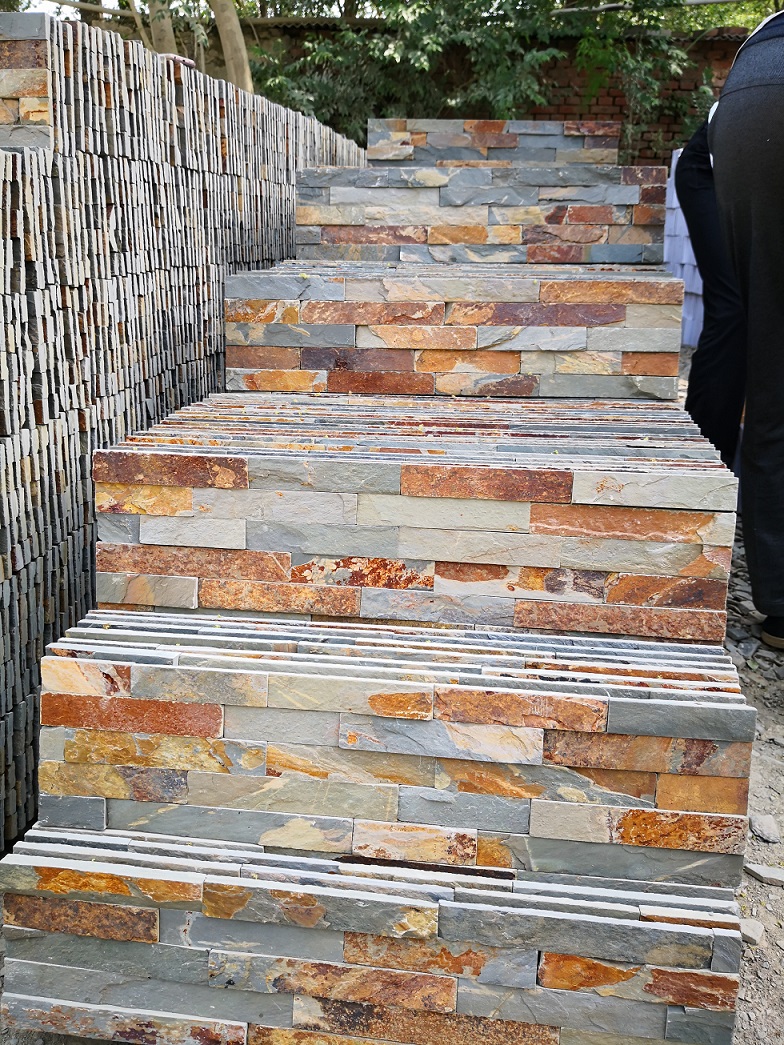
Refacing is the most profitable route for B2B dealers and installers when the wall is stable. Top Source Stone engineers natural stacked stone panels specifically for this application. By using panels with a thickness of 1cm to 2.5cm, you apply real slate or quartzite directly over existing concrete or cement board without adding excessive depth that interferes with door casings or electrical outlets.
We use CNC diamond-blade edges to create a precision Z-shape interlocking system. This male-female connection hides the vertical joints that usually plague cheap, straight-edged panels. Because we source from the same quarry vein for each batch, we maintain a 95% hue uniformity, preventing the “patchwork” look that ruins large-scale interior walls。
- Panel Specs: Standard 6″ ×24″ panels weighing 30-40kg/m² allow for installation without secondary structural footings.
- Joint Camouflage: Z-shape designs eliminate visible “stepped” gaps between modular pieces.
- Material Integrity: 100% natural minerals (Quartzite, Slate) provide UV stability that outperforms faux “stone” products.
- Labor Savings: Overlaying a stable surface cuts project timelines by 60% compared to full structural teardowns.
For professional results at wall transitions, we provide matching L-shaped corners for every model in our “Big 10” inventory. This ensures the texture and color remain synchronized as the stone wraps around pillars or fireplace hearths, maintaining the architectural look of a traditional full-bed stone build.

Tools Required for Safe Interior Stone Demolition
Modern interior stone removal combines high-impact electric jackhammers with CNC diamond-blade saws for precision, while hydraulic crushers and respirators ensure a vibration-controlled, silica-safe demolition environment.
High-Impact Breaking and Mechanical Tools
Dismantling natural stone panels requires equipment that balances raw power with the structural constraints of an indoor environment. Selecting the wrong tool risks unnecessary vibration that can travel through the framing and damage adjacent rooms.
- Electric Jackhammers: Use these to break through thick natural stone and stubborn mortar beds efficiently without the exhaust issues of gas-powered units.
- Hydraulic Concrete Crushers: Employ these to reduce noise and vibration in sensitive interior environments where structural integrity must be preserved.
- Pneumatic Saws: Utilize these for deep plunge cuts and precise corner work where spatial limitations prevent the use of larger machinery.
- Compact Hydraulic Hammers: Select these for small-scale residential projects to maintain maximum control in tight corners or narrow hallways.

Precision Diamond Blade Saws and Safety Gear
Clean extraction is the difference between a simple renovation and an expensive structural repair. Precision tools isolate the stone from the substrate, while specialized safety gear protects the crew from the specific hazards of masonry dust.
- CNC-Grade Diamond Blades: Equip demolition saws with high-precision diamond blades to ensure clean separation between the stone and the wall substrate, minimizing collateral damage.
- Air Respirator Masks: Wear NIOSH-rated respirators to prevent the inhalation of fine silica dust generated during the cutting of natural stone。
- Personal Protective Equipment (PPE): Implement heavy-duty eye goggles, steel-toed boots, and impact-resistant gloves to mitigate risks from flying stone shards and heavy debris.
- Surface Protection: Use 5-ply reinforced protection or heavy-duty tarps to shield surrounding flooring and furniture from mechanical impact and falling stone.
Premium Natural Stone for Architectural Excellence
Protecting Your Floors and Furniture During Stone Removal
Seal the area with 6-mil plastic and install Masonite or plywood barriers. Physical shielding prevents heavy stone debris from cracking substrates or spreading micro-dust.
Dust Containment and Multi-Surface Shielding Strategies
Demolition creates micro-dust that easily bypasses basic drop cloths. You must establish a pressurized seal to keep particulates from entering your HVAC system or settling into delicate upholstery in adjacent rooms.
- Seal Openings: Block all doorways and HVAC vents with heavy-duty 6-mil plastic sheeting to keep stone particles contained within the work zone.
- Furniture Shields: Cover stationary furniture with industrial-grade drop cloths or plastic wrap to protect fabric and wood finishes from fine grit.
- Edge Security: Use blue painter’s tape or professional floor tape to secure plastic barriers. This ensures the seal holds while preventing adhesive residue on finished surfaces.
Impact Barriers for Heavy Natural Stone Debris
Natural stone panels are significantly heavier than ceramic tile, typically weighing between 30-40kg/m² (8-12 lbs/sq.ft). Falling fragments can act like hammers on your subfloor, requiring rigid shielding to absorb the force.
- Floor Reinforcement: Install 1/4-inch plywood or thick Masonite boards over finished flooring. These layers provide the structural thickness needed to withstand the impact of falling natural stone。
- Dedicated Debris Paths: Set up reinforced runners from the demolition site to the exit. This allows for the safe movement of heavy waste bins without scratching adjacent floor sections.
- Cabinet and Corner Guards: Apply the same 5-ply reinforced protection logic used in export-grade stone cartons to wrap vulnerable corners and built-in cabinetry near the demolition site.

Repairing Drywall Damage After the Stone is Gone
Scraping adhesive reveals if you need spackle for minor gouges or full drywall replacement to support heavy 30-40kg/m² stone panels in future renovations.
Patching Gouges and Structural Holes
Removing stone veneer usually tears the drywall paper because the mortar bond is stronger than the gypsum surface. You cannot simply paint over these wounds. You must follow a systematic restoration process to return the wall to its original structural integrity.
- Debris Removal: Clear old mortar and adhesive using a stiff scraper to reveal the actual extent of the damage.
- Surface Filling: Fill shallow pits and torn paper areas with lightweight spackle or quick-set joint compound.
- Section Replacement: Cut out severely damaged sections with a utility knife to create clean, square edges for a new patch.
- Structural Anchoring: Secure replacement drywall pieces to wall studs or wooden backing to ensure stability.
- Reinforcement: Apply fiberglass mesh tape over seams to prevent future cracking at the joints.
Substrate Preparation for Natural Stone Weights
Repairing the wall is only half the battle if you plan to re-install natural stone。 トップソースストーン products, such as our Alaska Gray or Carbon Black series, require a surface that handles significant vertical loads without delamination or sagging.
- Load Capacity: Verify the repaired wall can support the 30-40kg/m² weight required for 100% natural stacked stone panels.
- Substrate Choice: Transition to cement board if you plan to install heavy ledgestone to avoid future drywall tearing.
- Surface Leveling: Maintain a flat surface profile to accommodate Z-Shape interlocking panels and their CNC diamond-blade precision edges.
- Curing Time: Allow final coats of joint compound to dry for 24 hours before sanding to avoid substrate shifts.
- Environmental Rating: Ensure the repaired area meets high salinity and humidity resistance standards for 2026 project longevity.
Cost Comparison: DIY Removal vs. Professional Demo
DIY removal costs $200–$500 in tools but risks heavy substrate damage. Professional demolition averages $10–$25 per square foot, ensuring wall preservation and efficient debris disposal.
Labor and Equipment Expenses for Interior Stone Demolition
Direct expenses for a self-managed project focus on specialized hardware and waste management. While the upfront cost for a DIY approach seems lower, the manual labor requirement often extends the project timeline by three to four times compared to mechanical demolition by a crew.
- Primary Demolition Tools: Rotary hammers, flat-head masonry chisels, and heavy-duty pry bars.
- Waste Management: 10-yard dumpster rentals or local landfill tipping fees for heavy natural stone。
- Safety Gear (PPE): N95 respirators, impact-resistant goggles, and puncture-proof gloves to handle sharp stone shards.
- Time Investment: 24–40 hours of manual labor for a standard 100-square-foot feature wall。
Impact of High-Strength Resin Bonding on Replacement Costs
Manufacturing techniques dictate how easily a panel separates from the wall。 トップソースストーン uses high-strength epoxy resin bonding to create a permanent attachment between the stone and the backing. This bond strength often exceeds the tensile strength of drywall paper, leading to significant substrate tearing during aggressive DIY prying.
- Panel Weight: Standard natural quartzite and slate panels weigh between 30-40kg/m² (8-12 lbs/sq.ft), complicating vertical removal.
- Interlocking Precision: Professional removal of Z-shape and S-shape interlocking panels preserves the underlying cement board by cutting through seams rather than prying from the center.
- Substrate Repair: DIY removal frequently necessitates full drywall replacement, adding $1.50–$3.00 per square foot in material and finishing costs。
- Structural Risk: Excessive force on heavy stone panels can loosen wall studs or damage internal electrical conduits if not handled with precision.
よくある質問
How difficult is it to remove interior stacked stone?
Removal difficulty boils down to the bonding agent used during installation. Most natural stone panels utilize mortar, creating a stubborn bond that requires chipping away each stone individually. This labor-intensive process typically demands three workers about four days to handle demolition and debris cleanup for a standard residential project.
Will removing the stone damage the underlying drywall?
You should expect significant drywall damage. Mortar bonds are almost always stronger than the paper facing of the wallboard, so the stone will pull the surface apart during extraction. We suggest cutting out the compromised drywall sections and replacing them with new panels to ensure a smooth, structurally sound finish for your 2026 renovation.
What is the average cost for professional stone fireplace removal?
Budget between $1,500 and $4,000 for standard stone fireplace removal. If the project involves structural repairs to load-bearing walls or full chimney demolition, costs can increase to $10,000. Current 2026 labor rates typically range from $25 to $50 per vertical linear foot for professional masonry demolition.
Which tools are essential for a safe demolition process?
Start with a hammer, cold chisel, and a 2.5-foot pry bar for manual extraction. For stubborn mortar, an angle grinder with a diamond blade helps smooth the substrate. Always use a spray bottle to suppress dust, along with high-quality respiratory protection and safety goggles to prevent injury from stone fragments.
Can I reuse the natural stone panels for a different project?
You can repurpose intact stones if you avoid aggressive tools like roto-hammers during removal. These salvaged pieces are excellent for 2026 outdoor projects such as garden pathways or fire pit surrounds. Ensure you scrub all dust and old mortar from the stone surfaces before re-applying landscape adhesive.
Are Top Source Stone products safe for high-heat areas like fireplaces?
Every model in our Big 10 Inventory, including Glacier White and Carbon Black, consists of 100% natural quartzite or slate. These materials are non-combustible and UV stable, making them a safe choice for fireplace surrounds. We provide matching L-corners to ensure a professional finish that withstands natural thermal expansion.
