

Prioritizing Stone Durability & Impact prevents the inevitable failure of manufactured veneers in high-traffic zones. When faux panels chip, they reveal a grey cement substrate, forcing expensive replacements that destroy project ROI.
We evaluate 100% natural quartzite and slate using ASTM freeze-thaw standards to ensure 25-year structural integrity. Sourcing materials under HS codes 6803.00.90 or 6802.93.11 guarantees through-body color and 95% hue uniformity for a maintenance-free architectural finish.
Mohs Hardness: Comparing Mineral Strength to Concrete
Natural stones like quartzite and slate reach up to level 7 on the Mohs scale, significantly outperforming standard concrete which typically plateaus between level 3 and 5.
The Mohs Scale and Scratch Resistance in Masonry
The Mohs scale ranks minerals from 1 to 10 based on their ability to scratch other materials. For B2B buyers and architects, this qualitative rank dictates how a facade survives physical contact from maintenance tools or environmental debris. While diamond sits at 10, the construction industry focuses on the mid-range where most masonry materials reside.
Concrete hardness varies based on the compressive strength and the specific minerals used in the aggregate mix. Soft concrete ranks poorly, while high-performance mixtures attempt to reach the mid-tier of the scale. The following benchmarks represent typical concrete performance:
- Soft Concrete: Mohs 2–3 (comparable to gypsum or calcite)
- Medium Concrete: Mohs 3–5
- Hard Concrete: Mohs 5–7 (requires specialized cutting tools)
Aggregate selection directly dictates the longevity of the surface. Harder aggregates increase the cutting time and shorten the life of diamond-blade tools, but they provide the essential friction resistance needed for high-traffic environments.
Natural Quartzite and Slate vs. Concrete-Based Faux Stone
We specialize in 100% natural stone, specifically Quartzite and Slate, which provide a density that manufactured concrete products cannot replicate. Faux stone panels utilize a concrete core pigmented with iron oxide; once the surface chips, the non-aesthetic gray substrate becomes visible, ruining the architectural intent.
Natural minerals offer structural and aesthetic advantages that protect project margins over time. These materials maintain their integrity in conditions where pigmented composites fail:
- UV Stability: Natural minerals do not fade under direct sun exposure, unlike the dyes used in manufactured stone。
- Salinity Resistance: Our stone withstands high-salt environments, making it suitable for coastal or high-humidity regions.
- Freeze-Thaw Resilience: Geologically stable stone prevents the micro-fissures that cause concrete-based products to crack during winter cycles.
- Surface Integrity: High mineral hardness resists scuffing from landscape tools and heavy foot traffic.
By sourcing from a direct quarry factory, we ensure that every panel in a batch maintains consistent mineral density. Real stone provides the durability required for exterior facades, ensuring that the 2026 architectural standards for longevity and wear resistance are met without the frequent replacement costs associated with faux alternatives.

Hail and Storm Resistance: Protecting Your Home’s Facade
Natural stone provides a high-density barrier against Class 4 hail and high-velocity winds, outperforming faux alternatives through extreme freeze-thaw cycles.
Impact Performance Against Hail and Wind-Blown Debris
Standard building materials often fail when high-velocity debris or large-scale hail strikes the building envelope. Natural 積み重ねられた石 utilizes the inherent density of minerals like quartzite and slate to absorb energy that would typically shatter vinyl or crack thin faux veneers. This physical mass acts as a shield, ensuring the underlying structure remains dry and intact even after the most violent storm fronts pass.
- Hail Rating: Stone facades withstand impacts equivalent to Class 4 ratings, resisting two-inch ice ball strikes without fracturing.
- Debris Resistance: Dense mineral structures resist 40mm diameter hailstones and wind-blown debris during hurricane-force events.
- Wind Load: Heavyweight panels reaching up to 55kg/m² provide the necessary mass to resist wind speeds exceeding 120 mph.
- Structural Defense: Reinforced stone layers prevent breach of the building envelope, protecting interior assets from water damage.
ASTM Freeze-Thaw Resistance and Material Integrity
Top Source Stone manufactures panels that specifically address the “thermal shock” common in Northern climates. While manufactured stone uses porous concrete that traps water—leading to expansion and “popping” during freezes—our 100% natural minerals remain stable. This geological resilience ensures that your inventory maintains its structural bond and aesthetic finish for decades, not just a few seasons.
- Climate Durability: ASTM-standard freeze-thaw testing confirms the stone will not crack or delaminate in extreme cold.
- Moisture Control: Natural quartzite and slate maintain near-zero water infiltration, preventing internal expansion damage.
- Adhesive Strength: High-strength epoxy resin creates a permanent chemical bond between the stone and the panel substrate.
- UV Stability: Inherent mineral pigments prevent the fading and surface degradation that occurs in pigmented concrete imitations.
We focus on sourcing from the same quarry vein to ensure that every panel in a batch shares the same mineral density. This consistency is vital for large-scale commercial projects where uniform performance across thousands of square meters is a non-negotiable requirement for insurance and safety compliance.
Premium Factory-Direct Stacked Stone Ledger Panels
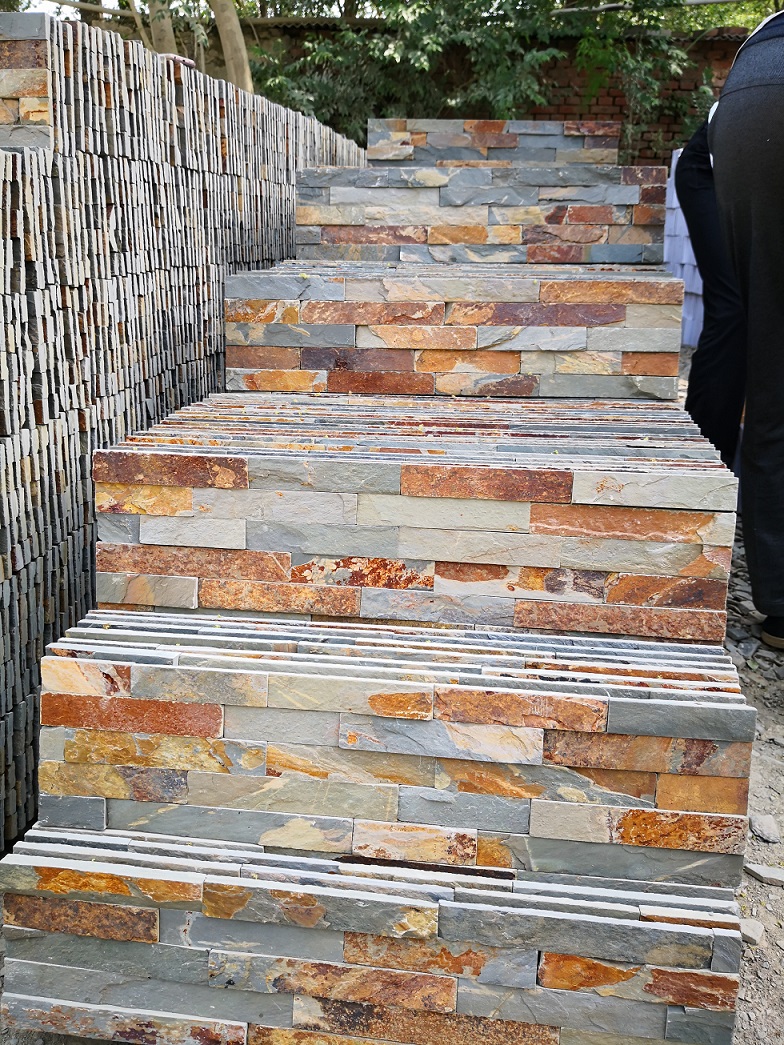
Yard Tool Damage: Can a Weed Whacker Break Your Stone?
Weed whackers cause superficial scuffing but cannot break natural stone. 100% natural quartzite and slate resist deep chipping far better than concrete-based faux alternatives.
String Trimmer Velocity and Surface Wear
Gas-powered trimmers spinning at 8,000+ RPM generate significant centrifugal force. When nylon strings strike a surface at these speeds, they act as high-speed abrasives. While this force is enough to scuff mineral surfaces, the string itself lacks the mass to cause structural failure or deep cracks in a dense wall system.
The damage from mechanical trimmers is almost entirely cosmetic. Repeated contact over several years can wear down sharp natural cleft edges, but the stone remains structurally sound. The impact remains on the surface level, unlike the heavy metal blades of lawn mowers which pose a much higher risk of knocking out large chips.
- Trimmer Speed: 8,000+ RPM average operating velocity.
- Impact Type: High-velocity abrasion and superficial scuffing.
- Material Response: Gradual wear on edges rather than immediate breakage.
Durability of Natural Quartzite and Slate
Top Source Stone provides 100% natural minerals that outperform imitation products in high-maintenance zones. Faux stone is typically a pigmented concrete cast. When a string trimmer hits these imitations, it often peels away the outer color layer to reveal a dull gray concrete core. Natural stone is consistent through its entire thickness, making minor scuffs nearly invisible.
We use CNC diamond-blade precision to cut our interlocking Z-shape panels. This engineering ensures the edges fit tightly together, leaving very few exposed “lips” or gaps for a trimmer string to snag. This tight fit protects the installation from mechanical wear and prevents the delamination commonly seen in lower-quality composite materials.
- Natural Slate: HS Code 6803.00.90 with high geological density.
- Natural Quartzite: HS Code 6802.93.11 with superior scratch resistance.
- Manufacturing: CNC diamond-blade cutting for tight, snag-free interlocks.
- Visual Integrity: Through-body color prevents visible failure if the surface is scuffed.

Cracking and Spalling: Why Faux Stone Fails in High-Traffic Areas
Faux stone reveals an ugly cement core when chipped. Natural stone provides through-body color and density, lasting 25+ years even in high-salinity coastal regions or harsh freeze-thaw cycles.
| Feature | トップソースストーン (Natural) | Manufactured Stone (Faux) |
|---|---|---|
| Composition | 100% Quartzite, Slate, or Granite | Pigmented Concrete/Aggregate |
| Mohs Hardness | 6.0 – 7.0 (Quartzite/Granite) | 3.0 – 5.0 (Medium Concrete) |
| Visible Failure | 25+ Years (Minimal wear) | 12 – 15 Years (Surface chipping) |
| Color Integrity | Through-body (UV Stable) | Surface-only (Fades in 8-10 years) |
Impact Damage and the Concrete Core Vulnerability
Faux stone relies on a thin, pigmented surface layer applied over a standard concrete substrate. This design works for high-interior walls with zero contact, but it fails in commercial high-traffic zones. Any mechanical stress—whether from heavy foot traffic, luggage carts, or yard maintenance tools—easily chips this brittle outer shell.
Once the surface breaks, it exposes the dull, gray cement interior. This creates a permanent eyesore that owners cannot “buff out” or repair easily because the color exists only on the skin. Commercial field assessments show that manufactured panels typically reach a point of aesthetic failure within 12 to 15 years of exposure.
We solve this by using 100% natural minerals. If a piece of our natural stacked stone takes a hit, the color underneath is identical to the surface. The material remains visually consistent for decades, even under mechanical stress that would ruin a concrete imitation.
ASTM Freeze-Thaw Resistance and Mineral Density
Technical durability in extreme climates depends on mineral density. Man-made concrete composites are porous by nature. In regions with frequent temperature swings, water penetrates the micro-fissures in the concrete. When that water freezes and expands, it causes spalling—the surface literally begins to flake off in layers.
Top Source Stone utilizes high-density Quartzite and Slate that meet 2026 ASTM standards for freeze-thaw durability. These natural stones possess geological structures that prevent water absorption. This density provides several key advantages for B2B distributors and project managers:
- 25-Year Integrity: Maintains structural density in high-salinity coastal regions where salt spray destroys concrete.
- 95% Hue Uniformity: Sourced from the same quarry vein to ensure large-scale projects don’t look patchy.
- UV Stability: Natural minerals do not use iron oxide pigments, so they won’t fade after 10 years of sun exposure.
- ASTM Compliance: Tested to withstand the expansion and contraction cycles of Northern US and Canadian climates.
For high-prestige commercial applications, the risk of cosmetic failure makes manufactured stone a liability. Real stone is the only way to guarantee a facade that looks as good in year 20 as it did on the day of installation.

Repairability: Fixing a Chip in Real Stone vs. Patching Faux
Real stone allows for nearly invisible repairs due to through-body mineral consistency, whereas chipped faux stone exposes a contrasting concrete core that is impossible to hide.
Through-Body Integrity: Restoring the Surface of Natural Minerals
Natural stone panels maintain their color and texture throughout the entire material. If a heavy impact occurs, the exposed interior looks identical to the surface, which simplifies the restoration process for commercial property managers.
- Mineral-Matched Fills: Masons mix crushed stone dust with high-strength epoxy to fill deep gouges, effectively recreating the original mineral patterns.
- Core Contrast: Synthetic faux stone uses a cement-cast core. When the surface layer breaks, it reveals an unnatural gray or white substrate.
- On-Site Reshaping: Installers use diamond-blade trimming to reshape real stone edges on-site to hide damage, a technique that fails on pre-cast faux molds.
Quarry-Direct Consistency: Using Same-Batch Materials for Seamless Replacement
Long-term facade maintenance requires a stable supply chain. When a panel needs replacement years after the initial installation, the success of the repair depends entirely on the geological source and UV stability of the material.
- 95% Hue Uniformity: Top Source Stone utilizes Same-Batch Quarry Consistency to ensure replacement panels match existing 2026 installations by sourcing from the same mineral vein.
- UV Stability: Natural Slate and Quartzite do not fade. This prevents the “patchwork” look where new synthetic panels stand out against an old, sun-bleached wall.
- Modular L-Corners: Pre-fabricated 90-degree corners provide a direct solution for repairing high-traffic corner transitions without complex on-site mitering.
- Direct Access: Sourcing directly from the quarry provides contractors the exact mineral type needed for large-scale commercial restoration.
よくある質問
Natural stacked stone provides superior durability and UV stability compared to manufactured alternatives, maintaining structural integrity and color consistency across decades of environmental exposure.
Does natural stacked stone crack easily in 2026 climate conditions?
Natural stone resists cracking due to its high density and mineral composition. Cracking usually occurs from improper installation or moisture trapping behind the panel. We use freeze-thaw resistant materials that meet ASTM durability standards, ensuring the stone handles temperature swings without structural failure.
Is natural stone veneer more durable than manufactured faux stone?
Natural stone provides superior longevity and structural strength. Faux stone uses cement and pigments that fade under UV exposure, while natural stone maintains its color and integrity for decades. Natural stone also offers higher impact resistance and better performance in high-moisture environments.
Can I repair a chipped natural stone panel without replacing it?
Yes. Small chips are repaired using stone-specific epoxy mixed with stone dust for color matching. Because natural stone is consistent in color throughout the material, repairs are much less visible than on faux stone, which reveals a grey cement core when damaged.
How does stone siding perform against hail and storm impacts?
Natural stone is one of the most hail-resistant siding materials available. While extreme storms with hailstones larger than two inches may cause minor surface chipping, real stone does not dent or shatter like vinyl or thin composite veneers. Its mass and hardness provide a significant protective barrier for the building envelope.
Which stone types are best for high-traffic commercial facades?
Granite and Quartzite are the most durable options for commercial areas. These stones offer high Mohs hardness ratings, making them resistant to scratches, salt air, and heavy foot traffic. We recommend our Quartzite series for commercial projects requiring both aesthetic depth and industrial-grade resilience.
Does manufactured stone eventually crumble or lose its color?
Manufactured stone typically shows signs of degradation within 20 to 50 years as the cement bond weakens and pigments fade. Natural stone does not crumble or lose its hue because its color is a permanent geological trait. Sourcing from our same-batch quarry veins ensures the stone remains visually consistent over the life of the property.
Final Thoughts
Choosing manufactured imitations might lower initial bidding costs, but it creates long-term liability when the pigmented surface inevitably chips to reveal a dull gray concrete core. Our 100% natural quartzite and slate provide a Mohs hardness of up to 7.0 and through-body color, ensuring your facades withstand mechanical impact and UV exposure for over 25 years. Sourcing directly from our quarry veins protects your project margins by eliminating the frequent replacement costs associated with brittle faux alternatives.
Verify the mineral density and CNC precision of our “Big 10” inventory by requesting a sample kit today. We support your territory growth with a 300-square-meter trial order that includes private labeling and high-definition visual verification before you pay the balance. Contact our team to receive the 2026 technical catalog and a container-load quote tailored to your port requirements.
