

Kitchen Backsplash sourcing often exposes developers to high labor costs and long-term grout maintenance liabilities. While cheap ceramic options appear cost-effective, their 15% waste factor and slow installation speeds frequently lead to budget overruns and delayed project handovers.
This analysis evaluates how 100% natural stacked stone panels leverage CNC diamond-blade precision and Z-Shape interlocking technology to reduce labor hours by 60%. We benchmark material durability using the 7-8 Mohs scale to ensure your specifications meet the technical demands of high-heat cooking zones.
Why Choose a Stacked Stone Backsplash Over Traditional Tile?
Stacked stone panels cut labor time by 60% and eliminate grout maintenance, offering a 50-year lifespan with superior scratch resistance compared to ceramic alternatives.
Wholesalers and developers are increasingly moving away from individual ceramic units in favor of natural stone ledgestone. The shift is driven by a need for faster project turnaround and a finished product that withstands higher physical stress than standard porcelain.
Installation Efficiency and Structural Resilience
Using modular panels instead of loose tiles changes the economic profile of a kitchen install. The panelized format at Top Source Stone minimizes layout errors and simplifies the logistics of large-scale wall coverage.
- Labor Costs: Installation expenses drop to $4.50–$7.00 per square foot, compared to $7.00–$12.00 for traditional tile.
- Material Durability: Natural stone reaches 7–8 on the Mohs scale, outperforming ceramic (4–7 Mohs) in scratch and impact resistance.
- Operational Lifespan: Stone provides a 50-year service life, nearly doubling the 20–40 year average of manufactured tile。
- Efficiency: Waste factors stay between 5–8%, whereas traditional tile projects often lose 10–15% to breakage and complex cuts.
CNC Precision and Seamless Interlocking Technology
Engineering advancements allow natural stone to mimic the clean lines of modern architecture. We use precision machinery to ensure every panel integrates into a unified surface without visible junctions.
- Interlocking Design: Z-Shape and S-Shape panels utilize a male-female connection to hide vertical joints and eliminate the need for grout.
- CNC Diamond-Blade Precision: Machine-cut edges ensure a tight modular fit, removing the “stepped” gaps common in lower-grade hand-cut stone。
- Hue Uniformity: Sourcing from the same quarry vein per order allows us to maintain 95% color consistency across entire kitchen walls.
- Matching L-Corners: Pre-fabricated 90-degree corners eliminate the need for complex miter cuts and ensure texture continuity at wall transitions.
These technical specifications provide a repeatable, professional result for high-volume B2B projects. By choosing a direct quarry source, dealers secure material that balances architectural aesthetics with extreme durability.

Is Natural Stone Practical for High-Heat Cooking Zones?
Natural stone panels withstand 1,200°F, making them a non-combustible, fire-safe solution for backsplashes behind gas ranges and high-heat commercial cooktops.
Thermal Stability and Heat Tolerance of Natural Minerals
Natural minerals like quartzite and granite serve as the gold standard for heat-intensive kitchen environments. These stones formed under extreme geological pressure and temperature, giving them a physical threshold far beyond the output of standard cooking appliances.
Quartzite and granite handle temperatures between 1,000°F and 1,200°F without structural damage or surface degradation. This thermal stability ensures that direct contact with hot pots or exposure to the intense BTU output of gas burners will not cause the material to crack or lose its finish.
- 花崗岩 & Soapstone: Withstands up to 1,200°F; handles thermal shock from hot cookware without cracking.
- Quartzite: Retains integrity at temperatures approaching 1,000°F; superior scratch resistance (7 Mohs).
- Thermal Dissipation: Natural stone surfaces spread heat efficiently across the panel, preventing localized hot spots.
Stone backsplashes also resist the daily wear caused by steam and humidity. Unlike ceramic glazes that might craze or faux stones that can melt, natural minerals remain chemically inert when exposed to moisture and heat transitions.

Non-Combustible Integrity of 100% Natural Stone Panels
Top Source Stone manufactures panels using 100% natural stone, creating a permanent non-combustible barrier. This material composition is critical for safety codes in residential and commercial kitchens, as it does not catch fire or release toxic fumes when exposed to open flames.
We use high-strength epoxy resins engineered to stay stable in high-traffic cooking zones. This bond ensures the individual stones in our interlocking panels remain secure despite the constant expansion and contraction cycles typical of stove-side installations.
- Fire Safety: 100% natural minerals qualify as non-flammable materials.
- UV & Color Stability: Inherent mineral stability prevents yellowing or fading from heat exposure.
- Structural Bond: CNC diamond-blade edges and industrial-grade epoxy maintain a seamless fit behind ranges.
Choosing natural stone over synthetic veneers eliminates the risk of melting or warping. The stone provides a professional, architectural finish that meets rigorous durability standards for the most demanding cooking zones.
Premium Natural Stone for Architectural Excellence
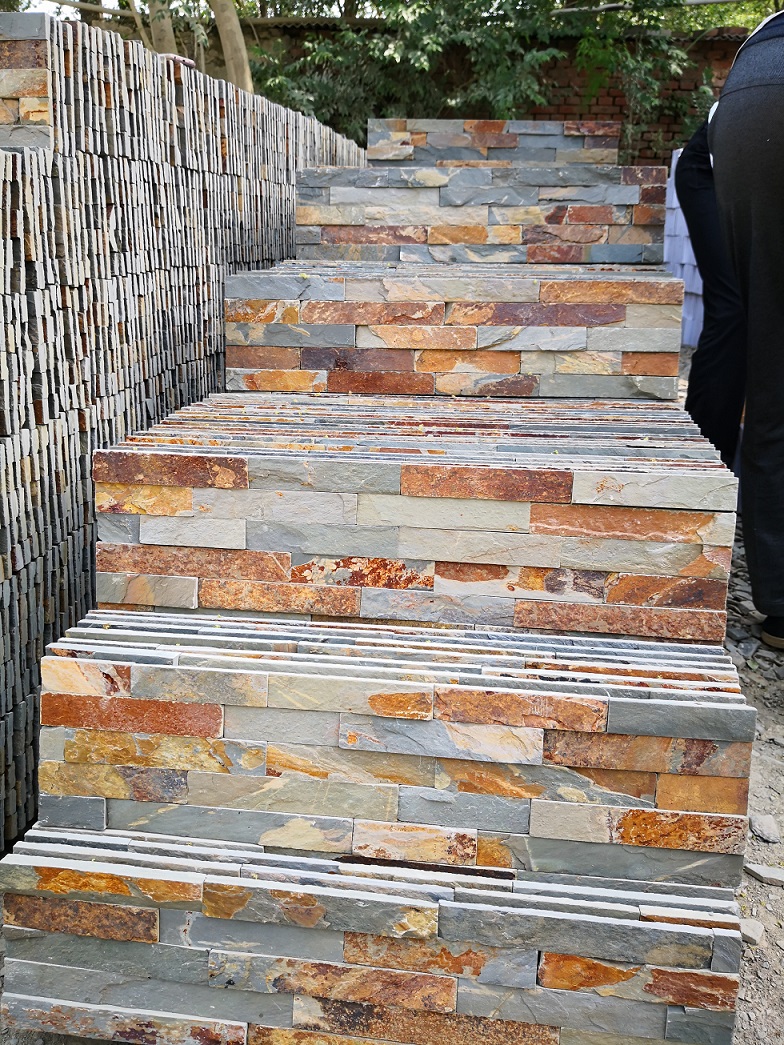
Selecting the Right Stone Texture: Honed vs. Split-Face
Maintenance vs. depth: Honed stone offers a smooth, easy-to-clean matte surface for modern designs, while split-face provides 3D character for traditional focal points.
| Feature | Honed (Flat Series) | Split-Face (Rough Series) |
|---|---|---|
| テクスチャ | Smooth, matte, and uniform | Rugged, high-relief 3D peaks |
| Maintenance | Simple wipe-down cleaning | Requires brush for deep crevices |
| Design Style | Minimalist, Contemporary | Rustic, Traditional, Dry-stack |
| 厚さ | 0.75” to 1.25” | Up to 1.75” |
Comparing Visual Impact and Practical Maintenance
Honed finishes undergo grinding and sanding to produce a flat surface. This process eliminates reflections, creating a matte look that minimizes the visibility of fingerprints and water spots. It serves as a soft, refined backdrop that doesn’t compete with other kitchen elements.
Split-face textures involve naturally splitting the stone along its cleavage layers. This creates high-dimensional peaks and valleys that cast dramatic shadows under cabinet lighting. While visually striking, these crevices can trap grease and cooking debris if installed directly behind a high-heat cooktop.
Current design directions for 2026 favor honed surfaces for minimalist kitchens. This choice achieves clean lines and an understated, high-end atmosphere that aligns with the shift toward warmer, calmer neutral tones.
Specifying the Flat vs. Rough Series for Project Requirements
Technical requirements often dictate the texture choice, especially regarding electrical integration and wall depth。 トップソースストーン classifies these textures into two distinct production standards to meet specific architectural needs.
- The Flat Series: Features a gauged thickness of 0.75” to 1.25”. This consistency makes it the preferred choice for seamless installation behind electrical outlets and light switches.
- The Rough Series: Provides a deep texture with panels reaching up to 1.75” thick (3.5cm). This creates a rugged character that mimics traditional masonry but requires deeper cabinet offsets.
- Precision Edges: Both series utilize CNC diamond-blade edges to ensure a tight, male-female interlock, regardless of the face texture.
- Application Suitability: Honed finishes offer 7–8 Mohs hardness, outperforming ceramic tile in high-traffic zones while providing a smoother touch.
Wholesalers should note that honed finishes typically involve more labor due to the extra grinding and sanding steps. However, the Flat Series provides easier onsite handling and faster installation for contractors working with complex kitchen layouts.

How to Seal Stone to Prevent Oil and Grease Stains?
Apply a high-quality penetrating sealer to saturate microscopic pores. This prevents grease absorption while maintaining the stone’s natural finish and UV stability in heavy-use kitchens.
Applying Penetrating Sealers for Deep Porosity Protection
Natural stone requires a physical barrier to withstand the rigors of a commercial or residential kitchen. Penetrating sealers work by filling the internal voids of materials like slate, quartzite, and marble without altering the natural cleft finish. This method ensures the stone remains breathable while blocking the liquid paths that lead to deep-set staining.
- Porosity Management: Sealers fill microscopic gaps to stop oils from wicking into the stone’s core.
- Anti-Etch Coatings: These provide a resilient shield against acidic substances and heavy cooking oils used in high-heat zones.
- Surface Preparation: Cleaning the stone with a pH-neutral solution before sealing ensures the product absorbs uniformly across the panel.
Preserving UV Stability and Resistance Through Maintenance
Top Source Stone panels utilize 100% natural minerals that feature inherent UV stability and high salinity resistance. These properties only remain effective if the protective sealer layer remains intact. Regular maintenance prevents the grease buildup that can eventually degrade the stone’s surface and lead to permanent discoloration.
- Resealing Schedules: High-traffic areas exposed to steam and heat typically require resealing every few years to maintain the barrier.
- Color Protection: Using professional-grade sealers prevents the natural color shifts often caused by deep grease penetration into the stone vein.
- Environmental Resilience: Maintaining the sealer ensures the stone continues to resist humidity and salt, especially in coastal or outdoor kitchen projects.
Installation Secrets: Managing Outlets and Under-Cabinet Lighting
Integrate electrical components by using box extenders to bridge 1cm-3.5cm stone depth and CNC-cut Z-shape panels to hide wiring seams for a flush, professional finish.
Adjusting Electrical Boxes for Split-Face Stone
Natural stacked stone panels vary between 1cm and 3.5cm in thickness. This depth means standard electrical boxes sit too deep behind the stone face, creating a gap that standard outlet screws cannot reach. Contractors must address these surface irregularities to meet 2026 safety and aesthetic standards。
- Box Extenders: Install electrical box extenders to bridge the gap between the substrate and the natural stone face, ensuring the outlet sits flush.
- Surface Leveling: Grind down high points on split-face panels directly behind outlet covers so the plate sits level without wobbling.
- Low-Voltage Routing: Route wiring for under-cabinet lighting through the mortar layer before setting the panels to keep all cables hidden.

CNC Diamond-Blade Precision for Clean Cutouts
The quality of the finishing around switches and light tracks depends heavily on manufacturing tolerances. Standard hand-cut stones often leave jagged edges that require excessive caulking. Using precision-engineered panels allows for tighter margins and a cleaner architectural look.
- CNC Diamond-Blade Edges: These ensure straight, clean cuts that minimize visible gaps around electrical plates and lighting tracks.
- Z-Shape Interlocking: Our interlocking panels utilize a male-female connection system that camouflages horizontal seams and prevents wiring from showing through joints.
- Matching L-Corners: Pre-fabricated 90-degree corners provide a seamless transition where under-cabinet lighting meets exposed wall ends or cabinet returns.
よくある質問
Are stacked stone backsplashes difficult to clean?
Stacked stone requires more attention than flat ceramic tile because the uneven surface traps dust and grease. Use a stiff-bristled brush with a pH-neutral stone cleaner to reach into crevices. Applying a high-quality sealer annually prevents grease and food debris from penetrating the natural pores of the slate or quartzite.
Can I safely install natural stone behind a gas stove?
Natural stone panels are inherently heat-resistant and non-flammable. They withstand the temperatures produced by gas ranges without warping. To minimize smoke residue and discoloration, we recommend maintaining at least 12 inches of clearance between the burner and the stone surface.
Do stone backsplashes require grouting?
Grouting is necessary to prevent moisture, food particles, and oil from entering the gaps and damaging the wall behind the installation. You can choose a traditional grout application to keep the stone texture defined or an over-grout technique for a smoother, rustic cottage aesthetic.
How do I protect the stone from cooking grease?
The most effective protection is applying a professional-grade sealer once a year to create an oil-repellent barrier. Use a splatter screen during heavy frying and wipe away spills immediately with a damp cloth. Avoid using vinegar or citrus-based cleaners, as acidic substances can etch the stone and degrade the sealer.
What are the leading color trends for backsplashes in 2026?
For 2026, kitchen design moves away from stark white toward deep forest greens, warm neutrals like greige and mushroom, and moody tones like midnight slate. These colors provide a sophisticated contrast to natural wood cabinetry and reflect the growing preference for organic, textured surfaces.
Final Thoughts
Relying on generic stone units risks labor overruns and inconsistent color batches that ruin large-scale kitchen installs. We use CNC diamond-blade edges and same-vein sourcing to ensure a 95% hue match across every order. This precision safeguards your project margins and prevents the costly call-backs common with lower-grade hand-cut materials.
Start with a trial order of 300 square meters to test our interlocking fitment and thermal stability on-site. We offer private labeling and reinforced export packaging to streamline your inventory management. Reach out to our team to request a catalog of our Big 10 inventory and high-definition pre-shipment verification photos.
