
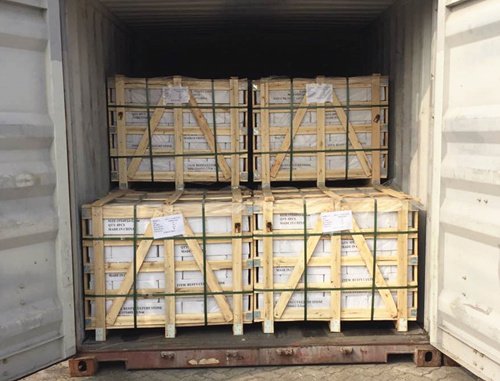
Reliable Stacked Stone Export Packaging & Safety protocols represent the narrow margin between a successful project delivery and thousands of dollars in lost inventory due to transit damage. Shipping heavy, brittle materials across oceans exposes every crate to immense kinetic forces that can crush stone panels if the load shifts by even a few millimeters. When packaging fails, the buyer faces more than just broken materials; they deal with insurance disputes, construction downtime, and the logistical stress of sourcing replacements mid-project.
This guide details our technical standards for securing export-grade stone shipments. We explain the structural engineering of our reinforced crates, the geometric tension required for 6×24 panels, and the container-loading strategies we use to mitigate motion during sea swells. Use this as a standard operating procedure for understanding how we maintain material integrity from the factory floor to the job site。
The Physics of Motion: Why loose gaps, not lack of padding, cause stone breakage.
Structural failure in natural stone shipments stems from kinetic energy accumulation within internal void spaces; eliminating these gaps through geometric rigidity is more effective than traditional soft cushioning.
Inertia and the Mechanics of Internal Collision
Kinetic energy builds rapidly when a 13-pound stone panel slides even a fraction of an inch during transit. When loose space exists within a crate, individual stones act as hammers against their neighbors, generating force that quickly exceeds the material’s natural fracture point.
- We identify that static loads become dynamic threats the moment a panel gains independent momentum.
- Internal collisions cause the majority of fractures seen in high-density slate and quartzite shipments.
- Our 2026 logistics data shows that most breakage occurs from internal shifting rather than external impact on the wooden crate.
The Failure of Compressible Padding under Heavy Loads
Soft buffers often collapse under the high-density weight of natural stone, creating the very gaps they intended to fill. Traditional foam and bubble wrap fail to support the 8-13 lbs/sqft pressure exerted by 積み重ねられた石 panels, leading to “dead space” during long-haul sea voyages.
- Padding compression allows the entire stack to destabilize under the G-forces of maritime transport.
- We prioritize rigid structural alignment over soft cushioning to protect the precision-cut Z-shape interlocking edges.
- Rigid containment prevents the “bottoming out” effect where foam loses all protective capability under weight.
Creating a Unified Mass through Geometric Tension
Eliminating gaps transforms a collection of fragile panels into a single, vibration-resistant block. Precision stacking ensures that every stone surface makes direct contact, utilizing friction to prevent lateral movement during container handling.
- We apply vertical pressure during the crating process to lock the 6×24 panels into a fixed geometric arrangement.
- A zero-gap environment distributes shock across the entire surface area of the crate.
- Tight-packing prevents stress concentration on vulnerable stone corners and interlocking “fingers.
Resonating Frequency and Micro-Vibration Control
Constant engine vibrations and sea swells in 2026 shipping lanes require tight-pack solutions to prevent edge-chafing. When panels are loose, they vibrate at different frequencies, leading to “scuffing” and micro-fractures along the natural cleft edges.
- Tight-pack loading ensures the stone stack moves in unison with the vessel, negating abrasive harmonic vibration.
- Strategic crate sizing minimizes the need for unreliable void fillers.
- Securing the load as a unified mass maintains the stone’s surface aesthetics from quarry to job site。
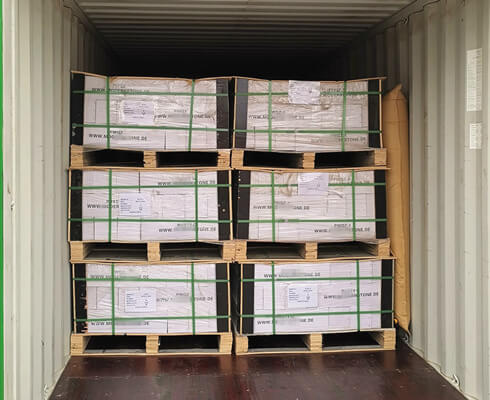
Crate Architecture: Building reinforced wooden crates with ISPM-15 compliant heat-treated wood.
Structural integrity in stone logistics relies on a hybrid of kiln-dried timber and moisture-wicking barriers to prevent both physical collapse and chemical degradation during multi-week sea transit.
International shipping in 2026 mandates strict adherence to ISPM-15 protocols to mitigate the transboundary spread of timber-borne pests. For B2B importers, this means every wooden component—including pallets, dunnage, and bracing—must undergo a certified heat treatment process. We ensure the core temperature of our solid wood materials reaches a minimum of 56°C (133°F) for at least 30 continuous minutes. This kiln-drying process serves as a non-chemical alternative to methyl bromide fumigation, preserving the structural bond of our natural stone panels without introducing corrosive residues into the container environment.
Global Compliance: ISPM-15 Heat Treatment Standards
Compliance facilitates entry into over 80 countries, including the primary markets of the USA, Canada, and Australia. By utilizing heat-treated timber rather than untreated raw wood, we eliminate the risk of customs rejections and costly port delays. This standard applies specifically to solid wood; however, we also offer plywood crate options which are technically exempt from ISPM-15 requirements as they are manufactured products. This flexibility allows us to tailor the packaging to the specific regulatory and weight requirements of the destination port.
Structural Reinforcement for Heavy Stone Payloads
Natural stone panels weigh between 8–13 lbs per square foot, which places immense stress on the crate floor and corner posts. We engineer our 110cm x 110cm crates with reinforced timber frames to prevent sagging or “bottoming out” during vertical stacking. High-strength fasteners secure the lumber into a rigid skeleton, capable of supporting a gross weight of 900kg to 1000kg per unit. This structural rigidity is essential for maintaining the 95% hue uniformity of a single batch, as it prevents the vibration-induced friction that causes surface scratching.
| Crate Specification | Solid Wood (HT) | Fumigation-Free Plywood |
|---|---|---|
| Regulatory Status | ISPM-15 Compliant | Exempt / Manufactured |
| Load Capacity | Up to 1200kg | 900kg – 1000kg |
| Best Use Case | Heavy Rough-Cut Stone | Standard 6×24 Panels |
Official Certification Stamping and Traceability
Every finished crate receives a permanent, legible ISPM-15 “wheat stamp” from an accredited producer before loading. This mark includes the country of origin, the facility code, and the treatment type (HT for Heat Treatment). Our logistics teams maintain detailed audit trails for all timber used in 2026 shipments, providing B2B clients with the documentation needed for seamless customs clearance. We eliminate the risk of container rejections by performing secondary inspections on all stamps prior to the container being sealed at the Xingang port.
Integrated Moisture and Humidity Protection
Ocean transit exposes natural stone to high salinity and fluctuating humidity levels. Beyond structural strength, our crate architecture incorporates protective barriers to defend the stone’s epoxy resin adhesives.
- Desiccant Integration: We place industrial-grade moisture absorbers within the crates to prevent condensation buildup during temperature shifts.
- 5-Ply Reinforced Liners: We use moisture-wicking liners between the stone panels and the wooden frame to prevent “sweating” and salt efflorescence.
- Polythene Shielding: A double-layered polythene wrap covers the entire pallet, protecting the slate and quartzite surfaces from environmental degradation and seawater spray.
Premium Natural Stacked Stone Factory Direct

The “Tight-Pack” Method: Securing 6×24 panels through precision stacking and geometric tension.
Eliminating internal voids through interlocking geometry and calibrated mechanical tension is the only engineering solution that prevents stone-on-stone impact fractures during transoceanic transit.
Vertical Alignment and Columnar Strength for Z-Shape Panels
Precision stacking leverages the interlocking Z-shape of our 6×24 panels to create a self-supporting vertical column within the crate. By aligning panels vertically on their edges, we ensure that the weight of the entire stack transfers through the densest part of the stone rather than the fragile center points. This orientation utilizes the natural compressive strength of the slate and quartzite, protecting the 0.75” to 1.75” thickness variations from pressure-induced snapping.
- Aligning panels vertically transfers weight directly through stone edges to the crate base.
- Geometric locking minimizes the internal voids that typically allow panels to shift during 2026 transoceanic shipping.
- Precision stacking maintains the integrity of the varied thickness found in our Rough and Flat series.
Mechanical Tension and Industrial-Grade Banding Systems
Applying calibrated mechanical tension transforms individual stone units into a single rigid block capable of withstanding heavy sea swells. We use industrial-grade banding systems to apply consistent PSI to the stack, which eliminates micro-movements between the natural stone surfaces. This tension works in tandem with the high-strength epoxy resins used during our manufacturing process, ensuring that individual stone strips do not vibrate loose under the rhythmic swaying of a cargo vessel.
| Packaging Parameter | Loose/Traditional Stacking | TSS Tight-Pack System |
|---|---|---|
| Internal Movement | High (leads to friction/chipping) | Zero (geometric tension) |
| Vibration Resistance | Low; individual pieces rattle | High; block acts as single unit |
| Structural Banding | Manual/Lightweight straps | Industrial PSI Calibrated Banding |
- Industrial-grade tension banding applies consistent PSI to eliminate stone-on-stone friction.
- Heavy-duty straps secure panels against the reinforced base to prevent vertical bouncing.
- The system prevents epoxy-bonded strips from vibrating loose during 20-25 day shipping durations.
Protective Barrier Integration and Surface Friction Management
High-density foam and shrink-wrap layers act as a friction buffer between the textured faces of the stacked panels. We place thin foam sheets between the natural stone faces to prevent the abrasive textures of the Rough Series from scratching neighboring panels. This is followed by heat-sealed shrink wrapping, which provides a secondary layer of tension and creates a moisture-resistant cocoon for the 8-13 lbs/sqft payload.
- Thin foam sheets prevent abrasive stone textures from scratching neighboring panels。
- Heat-sealed shrink wrapping provides a secondary layer of structural tension.
- Friction management keeps the delicate linear edges of the Pencil Series free of chips.
Optimized Weight Distribution for Interlocking 6×24 Units
Strategically balancing the pallet payload prevents the crate from becoming top-heavy or leaning during forklift maneuvers at the destination. We distribute the 10-13 lbs/sqft weight of the Marble and Slate series evenly across the pallet footprint to ensure stability. This coordinated stacking geometry ensures that the pressure from upper layers does not exceed the structural limits of the bottom panels, keeping the 17.5-ton USA port standard containers balanced and safe.
- Stacking patterns distribute the heavy stone weight evenly across the 110cm x 110cm pallet footprint.
- Coordinated geometry prevents pressure from upper layers from crushing bottom panels。
- Even weight distribution facilitates faster, safer unloading for wholesalers and project site logistics。
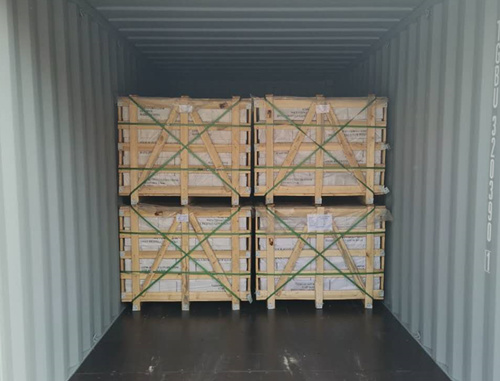
Container Payload Optimization: How interlocking pallets prevent shifting during heavy sea swells.
Maritime logistics for natural stone require a shift from vertical compression strength to lateral stability, utilizing interlocking geometry to counteract the dynamic multi-axis forces of ocean transit.
Strategic Interlocking for Lateral Stability
Traditional column stacking fails under the rhythmic pitch and roll of a container ship. We implement brick-style interlocking arrangements, where each 90-degree rotated layer acts as a physical brace for the one below it. While this configuration can reduce vertical compressive strength, it provides the essential structural integrity needed to withstand heavy sea swells in 2026 shipping lanes. This method ensures individual boxes remain locked within the pallet footprint rather than sliding outward under horizontal G-forces.
| Stability Metric | Traditional Column Stacking | TSS Interlocking Pattern |
|---|---|---|
| Lateral Displacement Risk | High (Individual box sliding) | Minimal (Geometric binding) |
| Swell Resistance | Unstable (Column toppling) | High (Unified mass movement) |
| Load Distribution | Localized pressure points | Even surface weight spread |
Mechanical Restraint Systems and Base Anchoring
Structural stacking only works if the load remains married to the pallet. Our logistics team secures the dense stone panels so the wooden crate and the stone move as a single, unified mass. This prevents internal friction which often leads to hairline fractures before the container even reaches the destination port.
- We apply heavy-duty stretch wrapping that extends at least 3 inches onto the plywood pallet deck to anchor the load securely.
- Industrial-grade strapping is used for all stone crates exceeding 150 lbs to provide mechanical tension.
- Precision wrapping techniques maintain the center of gravity and prevent the load from leaning during forklift or crane handling.
Eliminating Void Spaces for Minimal Inertial Shift
Loose space inside a container is the primary catalyst for breakage. When a pallet has room to move, it gains momentum during vessel pitch and roll, resulting in high-impact collisions against container walls or neighboring pallets. We optimize the container floor plan to remove these gaps, turning the entire payload into a self-supporting block.
- Strategic loading patterns minimize internal void spaces, ensuring flush alignment between plywood crates.
- Removing pallet overhang prevents edge damage and crushing when pallets press against each other during movement.
- Strict adherence to weight limits, such as the 17.5-ton USA port standard, prevents overload stress on the bottom-most stone layers.
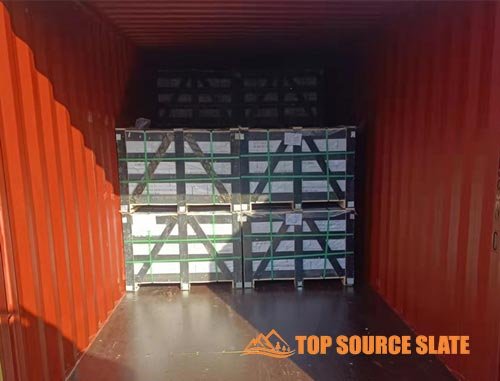
Quality Transparency: Photo-documentation and the logistics claims protocol.
Digital proof eliminates the “he-said-she-said” dynamic in international stone logistics, transforming shipping from a high-risk variable into a verifiable audit trail.
Three-Stage Internal Quality Inspections
トップソースストーン implements a rigid verification process at every production milestone to eliminate defects before any material enters a crate. Our quality teams perform manual checks immediately following the initial stone cutting, again after panel assembly, and a final time before the 6×24 units go into their reinforced cartons. This layered approach ensures that structural weaknesses or aesthetic outliers never reach the packing stage.
- Inspectors verify interlocking precision and epoxy bond strength to guarantee every panel meets modular architectural standards.
- Final stage verification confirms hue uniformity, maintaining a 95% color consistency within specific batches for the 2026 project season.
- Manual sorting by quarry vein prevents the “patchy” appearance often found in lower-tier supply chains。
Comprehensive Photo-Documentation for Export Loading
Visual evidence serves as the primary defense for distributors against transit-related damage. Our logistics staff captures high-resolution imagery of the interior of every wooden crate to confirm the “Tight-Pack” configuration. By documenting the lack of internal gaps and the presence of reinforced corner protectors, we provide empirical proof that the cargo was secured to professional standards at the point of origin.
- We record the container loading process, specifically showing the placement of industrial air bags and tension straps used to mitigate sea swell movement.
- Distributors receive these records as part of the Pre-Shipment Visual Verification protocol before the balance payment.
- Photos include the container seal number and the final payload layout to assist with destination customs clearance.
Standardized Logistics Claims and Dispute Protocols
Clear documentation simplifies the resolution process for shipping damages and establishes absolute accountability. Our standardized protocol requires importers to photograph the container seal and the condition of pallets immediately upon arrival. This baseline data, when compared against our pre-shipment inspection reports, allows insurers and carriers to pinpoint exactly where structural shifting or mishandling occurred.
- Pre-shipment benchmarks act as the legal standard for assessing liability during international transit.
- Standardized reporting forms help contractors file claims quickly with the necessary visual evidence for rapid payout.
- We strictly protect dealer margins by providing the data required to hold logistics providers accountable for rough handling.
Reinforced Export Packaging and Compliance Standards
Every shipment utilizes heavy-duty materials designed for the physical stress of global transit while adhering to strict biosecurity regulations. We use ISPM-15 compliant, heat-treated wooden crates (heated to 56°C for 30 minutes) to prevent customs delays or rejection at North American and European ports. These crates provide the external rigidity necessary to shield the 5-ply reinforced export-grade cartons from crushing forces.
- Strategic pallet loading maximizes 20GP container volume while protecting the bottom-most crates from vertical pressure.
- Internal corrugated dividers increase stacking strength, outperforming foam alternatives which often bottom out under the weight of natural stone。
- We manage weight limits strictly, observing the 17.5-ton USA port standard to ensure smooth inland transport post-discharge.
結論
Eliminating internal movement through the tight-pack method and reinforced crate architecture prevents the physical stress that typically causes stone breakage during sea transit. These logistics protocols ensure that every 6×24 panel maintains its structural integrity from our quarry source to your warehouse. High-quality packaging standards minimize shipping claims and keep your inventory ready for immediate distribution.
You can browse our Big 10 inventory to see ready-to-ship options or contact our logistics team for a detailed breakdown of our container loading specifications.
よくある質問
How do you pack 6×24 panels?
Our 6×24 ledger panels are packed using a high-density vertical alignment strategy. Panels are first placed into reinforced, double-walled corrugated boxes—typically six panels per box—positioned face-to-face and back-to-back to protect the natural stone texture. These boxes are then vacuum-packed into heavy-duty export crates to ensure zero internal movement.
Is your wood ISPM-15 certified?
Yes. All wooden packaging materials, including crates, pallets, and dunnage, undergo mandatory heat treatment (HT) and carry the official ISPM-15 IPPC stamp. This ensures full compliance with international phytosanitary standards, preventing the spread of pests and facilitating seamless customs clearance during global transit.
Why don’t you use foam dividers?
Foam dividers are counterproductive in stone logistics because they are compressible. Compression creates “micro-gaps” that allow stone panels to shift under G-force during transport. This movement generates kinetic energy that leads to impact fractures. Instead, we utilize a “tight-fit” rigid packing method that eliminates internal voids, ensuring the crate acts as a single, solid structural unit to prevent breakage.
How many panels per standard crate?
A standard export crate contains 30 boxes, with 6 panels per box, totaling 180 panels. This configuration provides approximately 180 square feet of coverage and is optimized for the weight-bearing capacities of standard maritime containers and logistical handling equipment.
What is your breakage guarantee?
We provide an industry-leading breakage guarantee that limits allowable transit damage to 3%. If more than 3% of the panels arrive fractured, we will issue a full credit or ship replacement materials for the damaged portion, provided the damage is documented on the Bill of Lading and supported by photographic evidence within 48 hours of delivery.
