
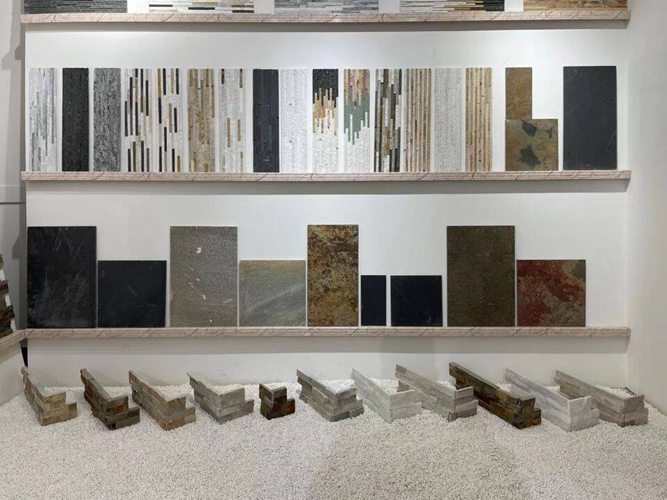
Stone Edge Finishing remains the most visible point of failure in high-end cladding projects. Cutting faux stone alternatives exposes unsightly industrial foam cores, requiring manual staining and additional labor hours that quickly erode contractor margins.
We solve this through 100% natural mineral panels featuring through-body color and CNC diamond-blade precision. By sourcing from the same quarry vein, トップソースストーン guarantees 95% hue consistency and provides matching L-corners for seamless architectural wraps around every corner and window jamb.
Solid Core vs. Painted Surface: The Importance of Edge Finishing
Natural stone maintains color consistency through the entire material, ensuring that any cut edges or corners look professional, while faux stone reveals an industrial core when modified.
| Feature | Natural Stacked Stone (Top Source Stone) | Painted Faux Stone Alternatives |
|---|---|---|
| Core Composition | 100% Solid Natural Mineral (Quartzite, Slate, etc.) | Concrete or Polyurethane Foam Base |
| Edge Appearance | Uniform color and texture after cutting | Exposed grey concrete or unpainted foam core |
| UV & Salinity Stability | Inherent resistance; no surface fading | Pigments may crack, yellow, or peel over time |
Material Integrity and Through-Body Color Consistency
Natural stone panels feature “through-body” color. Because the material consists of 100% minerals like Slate or Quartzite, the hue you see on the face exists throughout the entire thickness. When installers cut our Carbon Black or Alaska Gray panels, the exposed edge matches the surface perfectly. This eliminates the need for touch-up paint or specialized stains to hide the cut.
Faux stone products rely on a thin surface coating for their appearance. Cutting these panels reveals the underlying substrate—usually an unsightly industrial grey concrete or a yellow-tinted foam. This requires extra labor to sand, paint, or seal the edges. Over time, these surface coatings are also vulnerable to UV exposure and salinity, which often causes the artificial pigment to flake off, exposing the raw core.
- 100% Natural Minerals: Maintains a uniform hue across all exposed surfaces, even after heavy site cutting.
- UV Resistance: Natural stone remains color-stable in extreme sunlight, unlike painted pigments that fade or crack.
- Salinity Performance: Natural Quartzite and Slate resist salt-air corrosion, making them suitable for coastal projects.
CNC Diamond-Blade Precision for Seamless Panel Joins
We employ CNC diamond-blade technology to manufacture our panels. This equipment produces precision-cut edges that ensure consistent lines and eliminate visible gaps between modular pieces. For our interlocking Z-shape and S-shape series, these precision-milled edges create a “male-female” connection system. This design camouflages vertical joints and makes the finished wall appear as a single, continuous masonry surface.
Standard 90-degree transitions are managed through our matching L-corners. These pre-fabricated units ensure that the natural texture and solid core color wrap around corners without exposing a raw, unpolished substrate. This reduces the need for complex on-site mitering, which is often difficult with natural materials and nearly impossible to execute cleanly with faux stone.
- CNC Diamond-Blade Edges: Guarantees tight tolerances and clean architectural lines.
- Interlocking Connection: Specifically designed Z and S shapes hide the installation substrate。
- Matching L-Corners: Pre-fabricated pieces provide a seamless 90-degree wrap-around finish.

Mitering Corners: How Natural Stone Creates Seamless Joins
Mitering uses 45-degree cuts to create 90-degree transitions. Professional installations prioritize quirk miters and CNC precision to maximize edge durability and eliminate visible substrate across wall corners.
The Mechanics of 45-Degree Quirk Miter Joints
Professional stone masonry relies on precise 45-degree cuts to form a continuous wrap around corners. This technique hides the thickness of the stone and the installation substrate, making the wall appear as a solid, monolithic block rather than a series of thin panels.
- Angle Integration: We cut two stone pieces at complementary 45-degree angles to create a professional 90-degree wrap that maintains the natural flow of the material。
- Quirk Miter Finishes: Installers add a slight radius or chamfer to the edge rather than leaving it razor-sharp. This small adjustment prevents the brittle edges of natural stone from chipping during and after installation.
- Structural Safety: Rounded mitered joints improve safety in high-traffic commercial environments like hospitals or shopping malls, where sharp corners often cause injury or sustain damage from equipment impact.
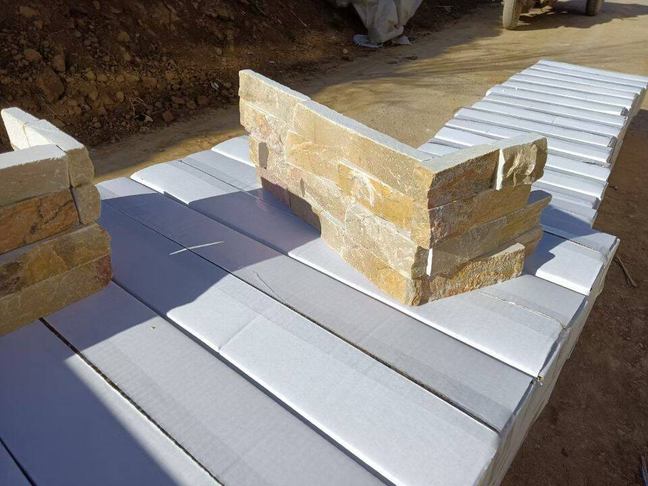
Pre-Fabricated L-Corners and CNC Cutting Precision
While on-site mitering is common, factory-made solutions offer higher consistency for large-scale B2B projects. Utilizing pre-fabricated corners ensures the texture and color remain synchronized across every wall transition without relying on the variable skill levels of field labor.
- Texture Synchronization: We use factory-made L-shaped corners sourced from the same quarry vein as the flat panels, maintaining 95% hue uniformity and consistent surface texture.
- CNC Diamond-Blade Precision: Computer-controlled cutting ensures tight, modular fits. These precise edges eliminate visible vertical gaps, providing a clean architectural finish that hand-grinding cannot achieve.
- Labor Cost Reduction: Pre-mitered corner units remove the need for complex on-site cutting. This reduces tool wear and labor hours, speeding up the project timeline for wholesalers and contractors.
Fast Installation, High-Value Natural Stone
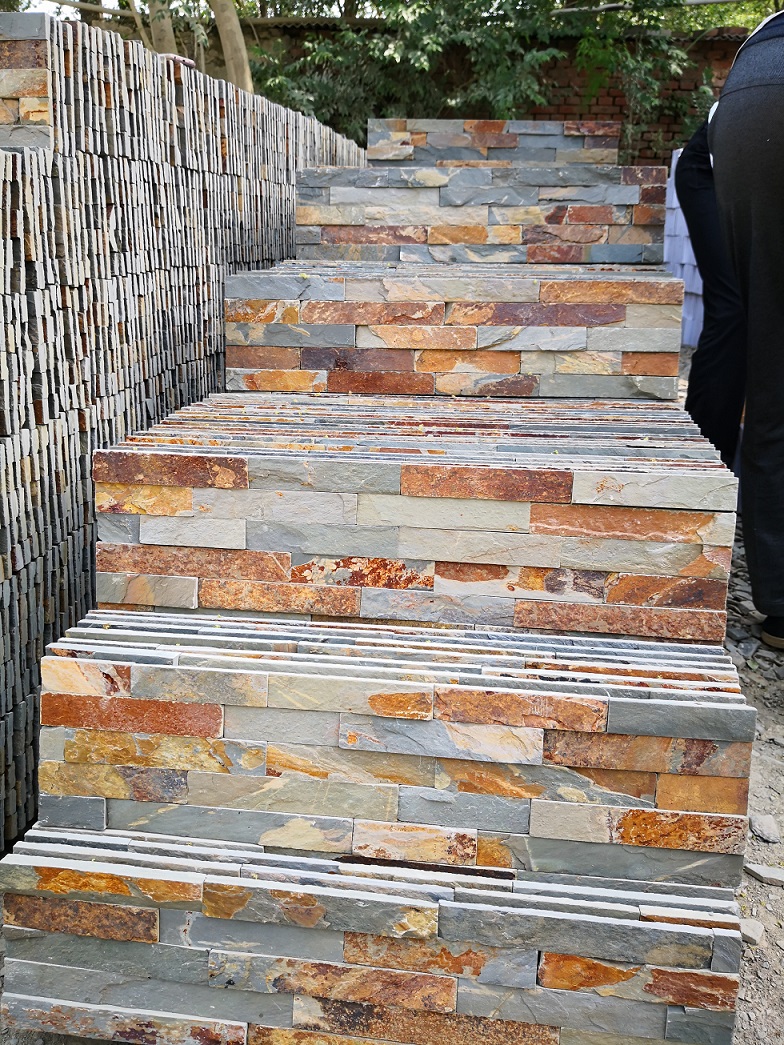
Exposed Edges: What Happens When You Cut Faux Stone?
Cutting faux stone exposes a polyurethane core that requires paint touch-ups. Natural stone panels maintain solid-core color and texture, ensuring professional edges without manual finishing or structural degradation.
The Aesthetic and Structural Risks of Exposed Foam
Faux stone panels rely on a high-density polyurethane core covered by a thin painted surface. When a contractor makes a cut to fit a window or corner, they immediately encounter a raw, off-white foam interior that breaks the illusion of real masonry. This creates a significant bottleneck during installation, as every cut becomes a site for manual repair rather than a finished edge.
- Core Material: High-density polyurethane foam with a white or beige interior。
- Labor Requirements: Installers must sand and apply color-matched paint kits to simulate stone。
- Vulnerabilities: Unprotected foam edges absorb moisture and sustain impact damage more easily than the factory-finished face.
- Layout Constraints: Design planning must hide cut edges behind specialized trim to avoid an unfinished look.
Ensuring Through-Body Color with 100% Natural Stone
Top Source Stone eliminates these finishing hurdles by providing 100% natural Slate, Quartzite, and Marble. Because the material is identical from the face to the core, a cut edge reveals authentic stone texture rather than a chemical foam. This “through-body” consistency allows for clean, architectural transitions without the need for touch-up kits or artificial sealants.
- Mineral Composition: 100% Slate, Quartzite, and Marble sourced from the same quarry vein.
- CNC Precision: Diamond-blade edges ensure tight fits and professional lines for windows and corners.
- Environmental Stability: Solid stone panels remain UV stable and freeze-thaw resistant after cutting。
- ASTM Standards: Natural stone maintains structural integrity under 2026 climate standards, whereas exposed foam can yellow and degrade.
Detailing Around Windows and Doors: Professional Tips
Proper window detailing requires integrated flashing and 3/16-inch expansion gaps. Using pre-fabricated L-corners ensures moisture protection and a seamless architectural finish for high-end projects.
Moisture Protection and Expansion Gap Standards
Moisture management around openings dictates the longevity of the entire facade. Water intrusion at window headers or sills often stems from poor flashing integration rather than the stone itself. We require these specific technical standards to protect the substrate and maintain structural integrity over the long term.
- Through-Wall Flashing: Install flashing that extends 8 inches up the wall and 1 inch over sloped ledgers to redirect moisture away from the building envelope.
- Expansion Gaps: Maintain a 3/16-inch gap between cut stone edges and window profiles to allow for natural thermal expansion and contraction without cracking.
- End Dams: Turn sill flashing up into the wall to create a dam, ensuring water moves toward the exterior wall face and never reaches the interior substrate.
- Edge Treatment: Apply color-matched caulk to all cut edges to prevent raw material exposure and ensure UV stability in harsh climates.
Seamless Jamb Transitions Using Matching L-Corners
Field-cutting corners on-site often results in jagged seams that compromise the project’s visual quality. Professional B2B installations rely on engineered components to ensure texture and color synchronization at 90-degree transitions around doors and window jambs. This approach reduces on-site labor while delivering a high-end finish.
- Pre-fabricated L-Corners: Use Top Source Stone matching L-corners to synchronize texture and color across every architectural opening.
- CNC Precision: Our CNC diamond-blade edges provide a consistent fit, enabling a tight “male-female” interlock that camouflages vertical joints around door frames.
- Offset Patterning: Begin the stone course at the corners to establish the necessary offset pattern that hides vertical seams across the rest of the wall face.
- Support Trim: Incorporate reverse J-channels for window sills to prevent stone sagging and maintain perfect level alignment throughout the installation.

Custom Profiles: Bullnosing and Polishing Natural Stone
Edge profiling turns raw stone into finished architectural components. We use CNC diamond-blade shaping and manual polishing to ensure texture matching and 95% batch hue consistency.
Standard Edge Geometries for Architectural Finishing
Standard edge treatments transform raw slabs into functional architectural elements like window sills, wall caps, and stair treads. These profiles eliminate sharp factory edges, improving safety and aesthetics in high-traffic commercial environments. We focus on specific geometries that accommodate different design requirements, from traditional soft curves to sharp, modern lines.
- Full and Half-Bullnose: These rounded profiles create a smooth transition on wall caps and sills. Half-bullnose keeps the bottom edge flat while rounding the top for a cleaner profile.
- Beveled and Chamfered: A 45-degree angled cut creates a linear, contemporary look. This geometry highlights the stone’s thickness without the weight of a rounded profile.
- Flat Polish and Mitered: We use mitered edges for seamless 90-degree transitions in countertop and wall cladding applications, hiding the joint line effectively.
- Convex and Flat: These specific geometries allow architects to tailor the stone’s edge to match existing site conditions or specific project load requirements.
CNC Diamond-Blade Precision and Source Consistency
Precise manufacturing is the only way to ensure batch consistency across large-scale B2B orders. We utilize a dual-stage workflow where CNC diamond-blade systems handle the heavy shaping to maintain tolerances, followed by manual polishing to match the natural face texture of the stone panels. This process eliminates the “patchy” look often seen in lower-grade fabrications.
- 95% Hue Uniformity: We source stone from the same quarry vein per batch to minimize natural color shifts between panels and their finished edges.
- Dual-Stage Processing: Automated CNC profiling ensures dimensional accuracy while manual hand-finishing matches the specific split-face or natural cleft texture.
- Synchronized L-Corners: Pre-fabricated 90-degree corners provide a professional wrap-around finish, ensuring the color and texture match the flat panels perfectly.
- High-Speed Fabrication: Belt-driven systems with diamond shaping motors allow us to maintain high output levels for wholesalers without sacrificing edge quality.
Proprietary CNC cutting ensures that interlocking Z-Shape or S-Shape models fit tightly, camouflaging vertical joints and the installation substrate. This precision is critical for maintaining structural integrity and a professional architectural finish on-site.
よくある質問
What are the best methods for finishing the edges of natural stacked stone?
Installers typically use matching profile strips for a clean finish or hand-chip the stone edges with a hammer and chisel to maintain a rustic, natural appearance. For a professional result that hides vertical seams, we recommend our interlocking Z-shape panels. These use a male-female connection system to create a seamless architectural look without visible joints.
Can I miter stone corners at the job site?
You can miter stone by cutting it at 45-degree angles using a wet saw equipped with a diamond blade. While this works, using pre-fabricated L-corners is more efficient for large-scale projects. Our matching L-corners ensure color synchronization across the wall transition and significantly reduce the labor hours required for on-site fabrication.
How do I hide the cut ends of stone panels at the end of a wall?
Always position the factory-finished edge toward the outside of the wall and place the cut side toward the adjacent stone. If you must expose a cut edge, use color-matched paint or caulk to touch it up. This prevents the internal core color from standing out and protects the material from yellowing over time.
Is bullnosing an option for natural stone ledgestone?
Bullnosing is a rounded edge treatment generally reserved for stone steps, pool coping, and wall caps. Since ledgestone features a split-face, textured surface, it is not typically bullnosed. To finish a project with rounded edges, use matching solid stone accessories available in full or half-bullnose profiles.
What is the proper way to install stone around window and door trim?
You must install through-wall flashing and a weather-resistant barrier before the stone. Leave a 3/16-inch gap between the stone edge and the window or door trim. Seal this transition with color-matched caulk to provide moisture protection and allow the stone to expand naturally without putting pressure on the trim.
Why do interlocking panels provide a better edge finish than rectangular panels?
Our Z-shape and S-shape panels use a CNC diamond-blade male-female interlocking system. This precision engineering camouflages the installation substrate and prevents the “stepped” gaps common with traditional straight-edge panels. This results in a continuous stone surface that looks like it was hand-laid by a master mason.
Final Thoughts
Faux stone presents a significant liability for dealers when installers encounter exposed foam cores that require manual paint repairs and constant maintenance. Top Source Stone delivers 100% through-body color and CNC-precision edges, reducing on-site labor and eliminating the risk of UV-fading claims. Stocking quarry-direct natural stone ensures your clients receive consistent architectural results that painted alternatives cannot replicate.
Request our current catalog to explore “The Big 10” inventory of North American best-sellers, all ready for immediate 10-15 day dispatch. We recommend starting with a 300-square-meter trial order to verify our interlocking fitment and finish quality firsthand. Contact our sales team today to discuss private labeling and territory-protected pricing for your distribution business.
