

Exterior corner systems sourcing represents the primary defense against structural delamination and moisture intrusion at a facade’s most vulnerable transition points. Relying on field-mitered joints creates a significant technical liability, as thermal expansion and wind channeling often trigger adhesive failure, leading to expensive site repairs and eroded project margins.
We resolve these vulnerabilities with CNC-diamond precision L-corners engineered specifically for our interlocking Z-panel system. By utilizing batch-specific sourcing to ensure 95% hue uniformity, these pre-fabricated units eliminate manual cutting bottlenecks and reduce on-site labor by 30% while maintaining a monolithic architectural finish.
Why Outside Corners are the Most Vulnerable Part of a Facade?
Outside corners concentrate structural stress from perpendicular planes, wind channeling, and thermal expansion, causing standard mitered joints to crack or delaminate without reinforced, factory-cut transition units.
Structural Movement and Environmental Stress Concentration
Building corners act as the meeting point for two independent wall planes. When environmental changes trigger masonry movement, these forces converge at the 90-degree turn. This creates a focal point for lateral pressure that often exceeds the bond strength of traditional mortar joints.
- Lateral Pressure: Movement of masonry on both sides of a turn creates high-intensity stress at the junction point.
- Wind Channeling: Urban geometry amplifies air pressure at building corners, specifically during extreme weather events.
- Thermal Cycles: Constant expansion and contraction exert perpendicular forces that propagate cracks through the facade envelope.
- Internal Corrosion: Corner steel columns with two exterior faces are prone to rusting, which generates outward pressure against the stone veneer.
Reinforcing Transitions with CNC-Diamond Precision L-Corners
Field-mitered corners rely on thin adhesive bonds and manual cutting, which creates a long-term liability. Factory-engineered corner units solve this by providing a solid, monolithic structure that handles architectural loads and prevents water penetration at the most critical points of the building.
- L-Corner Engineering: Top Source Stone pre-fabricated 90-degree units eliminate the weak vertical joints common in on-site miter cuts.
- CNC Precision: Diamond-blade edging ensures a tight modular fit, effectively sealing the substrate from moisture intrusion.
- Batch-Specific Selection: Sourcing from the same quarry vein per order guarantees 95% hue uniformity at visual transition points.
- Interlocking Z-Shape: Precision engineering allows the corner unit to integrate into the main wall face, creating a continuous, gap-free architectural skin.
Using these specialized units reduces on-site labor while ensuring the facade withstands the thermal expansion and wind pressures common in high-performance building standards.

L-Shaped Corner Units vs. Mitered Cuts: A Durability Study
L-shaped units use single-piece stone construction to eliminate joint separation and moisture leaks common in mitered edges, providing superior structural longevity at wall transitions.
| Feature | Field-Mitered Cuts | L-Shaped Corner Units |
|---|---|---|
| Structural Build | Two 45° pieces bonded on-site | Single solid stone unit |
| Thermal Resistance | High risk of adhesive failure | Expansion-resistant solid face |
| Moisture Defense | Prone to vertical gap intrusion | Seamless water deflection |
| Installation Speed | Labor-intensive on-site cutting | Up to 50% faster installation |
Structural Integrity of Pre-fabricated L-Corners vs. Field Miter Cuts
Field-mitered joints create a significant mechanical weakness at the most exposed point of the building. These joints require installers to back-cut stone at 45-degree angles, which leaves thin, brittle edges that often chip during the settling process. Because these corners rely entirely on topical adhesives to hold two separate pieces together, they cannot withstand the long-term stress of exterior environments.
Outside corners face the highest concentration of environmental pressure. L-shaped units solve this by distributing structural stress across a continuous stone face. This solid construction prevents the vertical cracking and separation seen in field-assembled joints.
- Thermal Cycling: Mitered adhesives often fail during freeze-thaw cycles, creating visible vertical gaps and pathways for water penetration.
- Impact Resistance: Solid L-corners provide a thicker profile at the corner, protecting the facade from mechanical damage in high-traffic commercial areas.
- Moisture Control: Pre-fabricated corners eliminate the joint line, ensuring water sheds away from the substrate instead of seeping into the cavity.
CNC-Diamond Precision Edging for Seamless Interlocking Transitions
Top Source Stone utilizes CNC-diamond precision edging to manufacture corner units that integrate perfectly with our Z-panel system. While field-cut miter joints often result in a “stepped” or jagged appearance due to manual cutting errors, our factory-engineered specs ensure every corner aligns with the interlocking male-female connection system.
This precision manufacturing extends to the visual finish. We use a batch-specific selection process, sourcing stone from the same quarry vein per order. This protocol ensures the corner transitions look natural and unified rather than like an afterthought.
- Color Matching: Batch-specific sourcing guarantees 95% hue uniformity across both flat panels and matching L-corners.
- Substrate Concealment: The interlocking Z-shape design hides the installation substrate, maintaining a professional dry-stack aesthetic.
- Standard Specs: Every L-corner is built to match our 20*55cm or 15.2*61cm panel heights, eliminating the need for height adjustments on-site.
Premium Natural Stacked Stone for Professionals
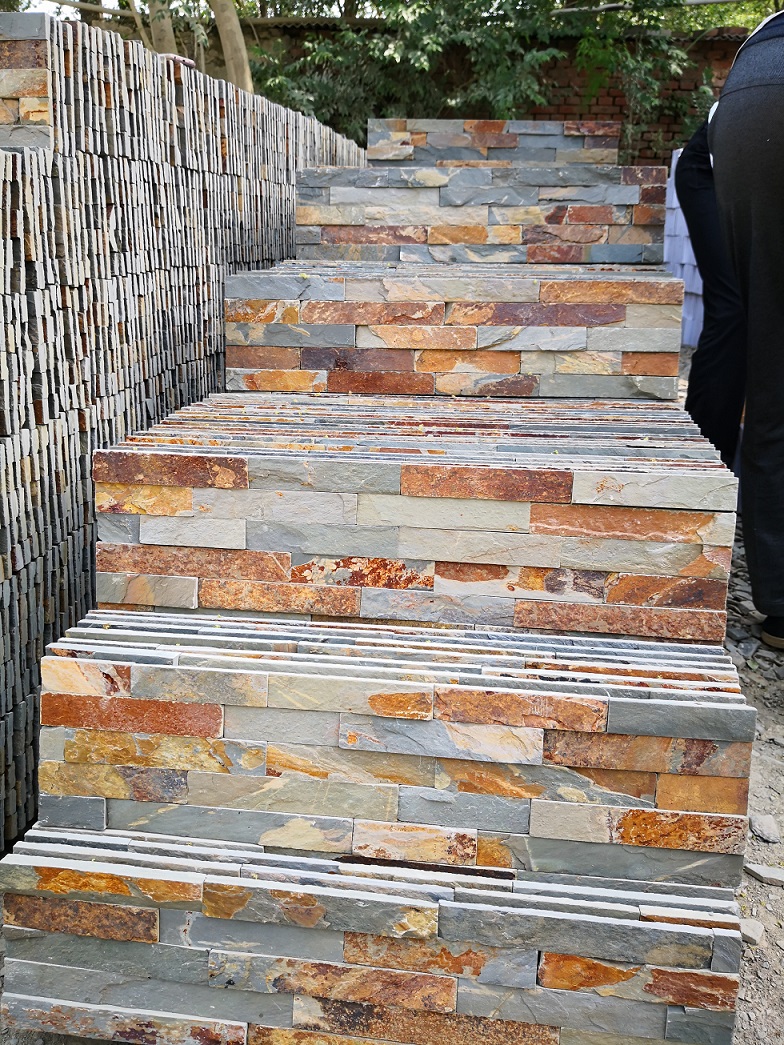
How Corners Create the Illusion of Solid Stone Construction?
Pre-fabricated L-shaped units hide wall substrates and eliminate vertical seams. By alternating long and short legs, these components replicate the depth and weight of structural masonry.
Alternating Leg Lengths for Masonry Realism
Traditional full-bed stone construction relies on stones that wrap around corners to provide structural stability. This creates a staggered bond pattern where the stones lock together. To replicate this look with thin panels, installers use specialized corner units that mimic the dimensions of full stones.
- Staggered Bond Pattern: Alternating the long and short legs of L-corners on outside edges prevents a continuous vertical seam, which would immediately signal a modular veneer.
- Inside Corner Nesting: Tucking flat panels into interior corners stops vertical gaps from revealing the installation substrate or wall framing.
- Mortar Bed Depth: Full mortar coverage behind these units eliminates hollow spots, ensuring the corner feels as dense and permanent as structural stone.
Matching L-Corners with CNC-Diamond Precision Edging
Visual continuity breaks the moment a corner piece looks different from the main wall. Achieving a high-end finish requires manufacturing precision that field-cutting simply cannot provide. Top Source Stone utilizes specific factory protocols to ensure these transitions remain invisible to the eye.
- CNC-Diamond Precision: Diamond-blade edges create clean, tight lines that allow L-corners to meet flat panels with zero visible gaps.
- Batch-Specific Sourcing: Extracting stone from the same quarry vein per order ensures 95% hue uniformity across 90-degree wall turns.
- Natural Split-Face Finish: Pre-fabricated units maintain the raw stone texture on the outer edges, avoiding the flat, exposed “core” common with site-made mitered cuts.
Using these factory-matched components removes the guesswork from the job site. Builders save on labor because they don’t have to manually miter every corner, while the final result remains indistinguishable from traditional masonry.
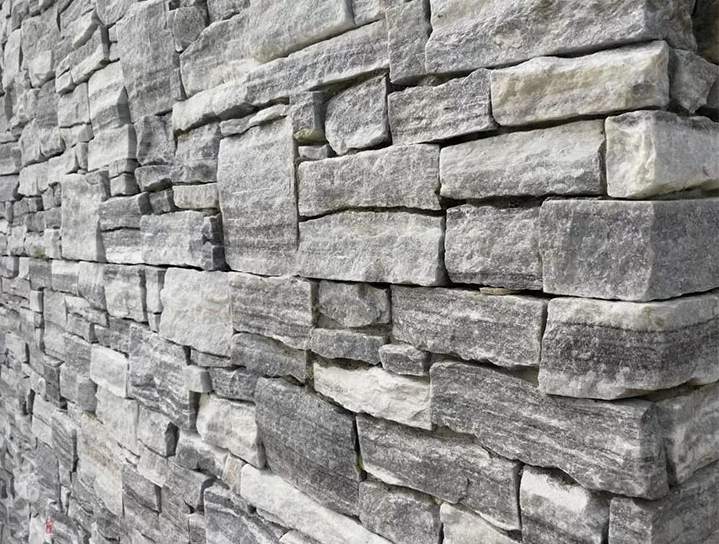
Sealing the Join: Preventing Water Intrusion at 90-Degree Turns
Stop water intrusion by combining shingle-style weather barrier overlaps with factory-matched L-corner units. This creates a continuous drainage plane that eliminates moisture traps at vulnerable 90-degree junctions.
Drainage Plane Continuity and Shingle-Fashion Overlapping
Exterior corners face the highest structural and environmental stress on any facade. Wind channeling and thermal expansion concentrate at these points, often causing mitered joints to separate over time. Without a robust moisture management strategy, these tiny gaps become entry points for water that eventually rots the substrate or causes efflorescence in the stone.
- WRB Extension: Wrap Weather Resistive Barriers (WRB) at least 12 inches past every corner transition and secure all seams with high-performance acrylic-backed tape.
- Shingle-Fashion Pattern: Layer all drainage components so the higher piece always overlaps the lower one, forcing gravity-fed water to move downward and away from the building.
- Inside Corner Contact: Maintain tight contact between the barrier and the sheathing at inside corners. Air gaps in these recessed areas often lead to hidden condensation and mold growth.
- Rain Screen Integration: Use a dedicated rain screen system behind the stone veneer to provide a clear path for moisture to exit the wall assembly if it bypasses the primary stone face.
Cement-Backed L-Corner Units and High-Strength Epoxy Sealing
Field-mitered corners are a major liability for wholesalers and installers because they rely entirely on the precision of on-site cuts. Top Source Stone eliminates this variable by providing pre-fabricated L-Corner units. These units use a solid, continuous stone face that removes the vertical miter line—the most common failure point in exterior cladding.
- Monolithic Face: Deploy pre-fabricated L-Corner units to provide a solid stone face at 90-degree turns, shielding the internal corner substrate from direct wind-driven rain.
- Epoxy Bond Integrity: We use high-strength epoxy resin adhesives that resist delamination even in high-salinity coastal environments and high-humidity tropical climates.
- CNC Precision Edging: Our CNC-diamond blade edges ensure a tight modular fit. This precision minimizes the volume of sealant required at the joints, reducing maintenance for the building owner.
- UV Stability: Natural stone materials like slate and quartzite offer inherent UV stability. This ensures that the corner junctions do not degrade or discolor under intense sun exposure by 2026 standards.
By moving the corner assembly from the job site to the factory, dealers can offer their clients a product that installs faster and performs better. These L-shaped units create the illusion of full-bed masonry while maintaining the lightweight benefits of a cement-backed panel system.
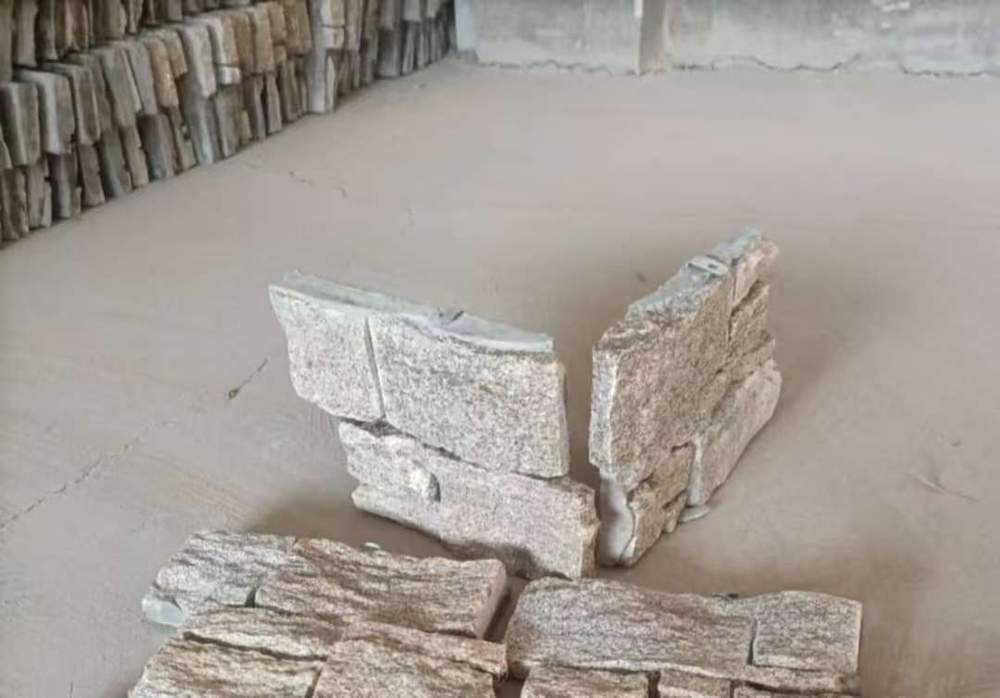
Installation Speed: How Factory Corners Save 30% Site Labor
Factory-assembled corners eliminate manual cutting and measuring, reducing site labor by 30% while ensuring structural integrity and precise 90-degree transitions.
Professional builders now use factory-assembled corners to kill the three biggest time-wasters on a job site: measuring angles, manual stone cutting, and fixing quality errors. These pre-engineered units install roughly 40% faster than field-built mitered corners. This efficiency allows masonry teams to finish projects earlier while providing better weather protection at the facade’s most vulnerable points.
Eliminating On-Site Measuring and Manual Miter Cuts
Field-built corners demand perfect 45-degree cuts to maintain a natural grain flow. This process creates a massive precision bottleneck. If a stone chips during a manual miter cut, the installer wastes the entire piece and the time spent cutting it. Factory corners move this high-risk work from the scaffolding to a controlled production line.
- Tool Reduction: Crews no longer need high-precision wet saws on scaffolding, reducing setup and cleanup time.
- Waste Mitigation: Pre-fabricated units eliminate the “trial and error” cuts that lead to high stone breakage rates.
- Labor Focus: Teams spend their hours setting stone rather than measuring and adjusting individual mitered joints.
Seamless Integration with CNC-Diamond Cut L-Corner Units
Top Source Stone L-Corners utilize CNC-diamond precision edging to ensure a modular fit with our straight Z-Panels. These units provide immediate texture and color synchronization. This prevents the “patchy” appearance often seen when installers try to match field-cut transitions manually.
The standardized dimensions allow installers to maintain a consistent rhythm. Instead of pausing for individual stone adjustments, the crew moves upward in a continuous flow. This system effectively hides the installation substrate and creates the look of full-bed masonry with significantly less effort.
- Standard Sizes: 15.2*61cm or 20*55cm matching units.
- Precision Edging: CNC diamond-cut for tight, gap-free joints.
- Visual Continuity: Pre-matched texture prevents color breaks at structural transitions.
- Engineering: Integrated 90-degree structural integrity for outside corners.
Veelgestelde vragen
How do you install outside corners for stone siding correctly?
Always install corner pieces first, working from the bottom up to establish a structural lead. Wrap the corners with a weather-resistant barrier using a 16-inch overlap and secure metal lath with a 4-inch overlap. We recommend the back-buttering technique: apply a half-inch layer of mortar to the back of each stone to create a strong suction bond before you fill any joints with a grout bag.
Are prefabricated stone corner units worth the higher material cost?
Yes. Prefabricated L-corners slash installation labor by up to 50% because they eliminate manual miter cuts. Since professional labor drives the bulk of project expenses, these units usually lower the total installed cost. Current market data shows stone veneer projects provide over 150% return on investment, so choosing factory corners is a logical move for long-term property value.
Can these stone panels wrap structural pillars or columns?
You can wrap columns by prepping the substrate with a moisture barrier and metal lath, then applying a cement scratch coat. For interlocking systems, apply high-strength adhesive in a zigzag pattern and secure the panels with exterior-grade screws. Seal the assembly with a matching column cap and textured caulk to ensure a water-tight, architectural finish.
Is miter cutting a reliable alternative to factory corner units?
Miter cutting works for custom angles using a tile wet saw with a diamond blade, but it requires perfect dry-fitting to avoid visible gaps. Most contractors stick to factory-made L-corners for exterior facades. They provide better water resistance and a more authentic solid-stone look without the high labor bottleneck of manual cutting.
How do you finish exposed edges if a corner piece is not used?
You can create a rustic chipped edge with a hammer and chisel to simulate a natural break, or use “live edges” that stay in their quarry-cut state. If you have to trim panels, hide the cut edges above eye level or mask them with color-matched mortar to keep the texture consistent across the wall surface.
How does Top Source Stone ensure color consistency at corner transitions?
We use a batch-specific selection protocol, sourcing all material from the same quarry vein for every order. This process guarantees 95% hue uniformity between the flat Z-panels and the matching L-corners. This prevents the patchy or mismatched appearance often found when using mixed-batch natural stone from retail suppliers.
