

Mastering Corner Details is the primary defense against the “zipper effect” that ruins high-end stone facades. Relying on manual on-site miter cuts creates a structural liability, increasing material waste by 20% and inflating project labor costs through precision-heavy rework.
Standardizing with 6″x12″+6″x12″ L-shaped corner units eliminates these site inefficiencies. Our units utilize marine-grade epoxy bonding and machine-sawn gauged backing to cut installation time by 50% while ensuring structural integrity across large-scale commercial builds.
The “Zipper Effect”: Why Amateur Corners Ruin Walls
L-shaped units wrap naturstein faces around 90-degree angles, eliminating visible “zipper” seams while reducing material waste by 20% and site labor costs by 50%.
| Performance Metric | Manual Site-Cutting | L-Shaped Corner Units |
|---|---|---|
| Visual Aesthetic | Visible vertical “Zipper” seam | Seamless wrap-around flow |
| Material Waste | High (approx. 20% loss) | Near zero (Pre-fabricated) |
| Installation Labor | Precision-intensive; high cost | Rapid assembly; 50% savings |
| Joint Integrity | Susceptible to chipping | Marine-grade epoxy bonding |
Visual Disruption and Manual Miter Limitations
Manual 45-degree miter cuts frequently result in jagged, chipped edges on natural slate and quartzite. These vertical seams highlight the panelized nature of the installation rather than mimicking solid stone blocks. When installers butt flat panels together, the mechanical line breaks the organic flow expected in high-end masonry.
Site-cutting also exposes the stone’s inner core. This often reveals color inconsistencies and raw textures that clash with the weathered natural face. In high-traffic commercial zones, these thin, mitered edges lack structural support and suffer rapid impact damage from carts and heavy foot traffic.
- Edge Failure: Manual mitering creates brittle points prone to spalling.
- Visual Seams: Aligned vertical joints create an unnatural “zipper” look.
- Core Exposure: Cutting reveals unweathered stone colors not seen on the face.
L-Shaped Corner Units and Material Efficiency
Top Source Stone manufactures pre-fabricated 6″x12″+6″x12″ L-shaped units that provide a continuous stone face. These units wrap around 90-degree angles to maintain the illusion of full-bed depth masonry. By using factory-controlled corners, wholesalers and contractors eliminate the 20% material waste typically lost to site-cutting errors and breakage.
We use marine-grade epoxy resin to bond these units, ensuring they withstand thermal expansion in extreme 2026 climate conditions. This factory bonding provides zero stone detachment, a critical requirement for heavy-load transit and long-term exterior durability.
- Format: 6″x12″+6″x12″ L-shaped wrap-around geometry.
- Bonding: Marine-grade epoxy resin for extreme climate resilience.
- Labor ROI: 50% reduction in on-site corner installation time.
- Standards: Sawn backing ensures 100% mortar contact for bond strength.

Anatomy of a Pre-Fabricated L-Corner Panel
Pre-fabricated L-corners eliminate on-site miter cutting, reducing material waste by 20% and labor costs by 50% while ensuring structural stability through marine-grade epoxy bonding.
Geometric Design and Dimension Standards
The layout of a corner unit determines how well a pillar or wall end maintains the appearance of traditional masonry. These units utilize a one-piece construction with interlocking returns to ensure vertical seams disappear into the natural rock strata, preventing the “zipper effect” common in lower-quality installations.
- Standard Dimensions: Dual 6″x12″ returns forming a fixed, factory-set 90-degree angle.
- Vertical Calibration: A uniform 6-inch height ensures vertical alignment across long wall spans without cumulative error.
- Bond Pattern Integration: Staggered joint designs allow the units to integrate with standard 6″x24″ flat ledger panels.
- Edge Profile: Finger-jointed or interlocking edges mask vertical seams and simulate hand-stacked stone.
Marine-Grade Epoxy Bonding and Gauged Backing
Structural integrity relies on the quality of the adhesive and the precision of the mounting surface. While average panels use standard resins that degrade under thermal expansion, we use industrial-grade bonding agents to survive extreme climates and high-vibration logistics.
- High-Strength Adhesive: Marine-grade epoxy resin prevents stone detachment during 26.5-ton heavy-load transit and severe thermal shifts.
- Gauged Backing: Machine-sawn back with a +/- 2mm tolerance ensures 100% mortar contact and eliminates air pockets.
- Material Density: Crystalline stone sourced from deep-strata quarry layers provides near-zero water absorption and freeze-thaw resilience.
- On-Site Efficiency: Direct-bond assembly removes the need for manual 45-degree miter cutting, directly lowering project overhead.
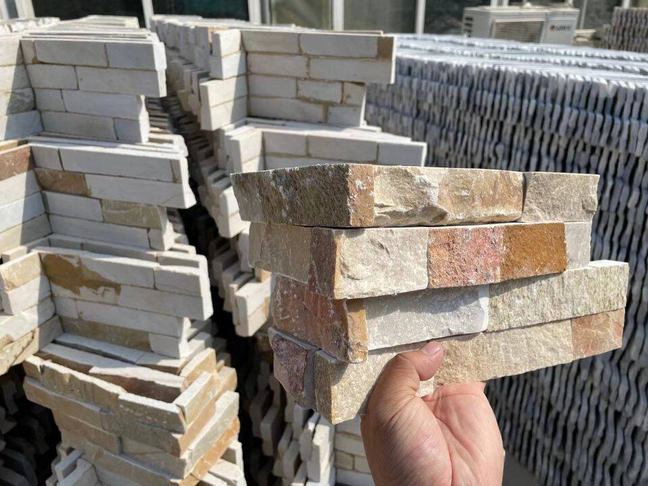
Labor Cost Comparison: Man-Hours Saved
Prefabricated L-corners reduce on-site installation time by 50% and eliminate 20% material waste by removing manual miter cutting.
| Efficiency Factor | Manual Miter Cutting | Prefabricated L-Corners |
|---|---|---|
| Installation Speed | Slow (Manual Alignment) | High (50% Faster) |
| Material Waste | ~20% (Breakage/Errors) | Near Zero |
| Labor Skill Level | High (Expert Mason) | Standard (General Crew) |
| Joint Precision | Variable (Site Conditions) | Factory Consistent |
Measuring Unit Labor Cost in Traditional Masonry
Labor consumes 16% to 30% of the total budget in traditional stone projects. On-site miter cutting is the primary bottleneck. Every 45-degree cut performed manually increases the likelihood of rework, which typically raises effective man-hours by 20% due to alignment errors or stone shattering.
Commercial projects often stall because of slow setup times and the constant need for quality inspections on custom-cut corners. Traditional masonry relies on highly skilled labor for these details, creating a scarcity issue that drives up the hourly rate per square foot.
The Impact of L-Corner Efficiency on Project ROI
Toppkildestein prefabricated L-corners bypass these site inefficiencies. By providing a one-piece factory-finished corner, we eliminate the 20% material loss associated with manual miter failures. This system allows a standard installation crew to match the quality of an expert mason at twice the speed.
- Corner Dimensions: 6″x12″ + 6″x12″ one-piece units
- Gauged Backing: +/- 2mm machine-sawn tolerance for 100% mortar contact
- Adhesive Type: Marine-grade epoxy bond to prevent stone detachment
- Installation Logic: Z-shape modular interlock to mask vertical seams
The machine-sawn backing ensures installers do not waste time with leveling adjustments. This precision guarantees maximum bond strength and eliminates air pockets that lead to future stone delamination. For high-volume wholesalers, this translates to faster project turnover and significantly lower site-related liabilities.
Secure Wholesale Pricing on Premium Ledger Panels
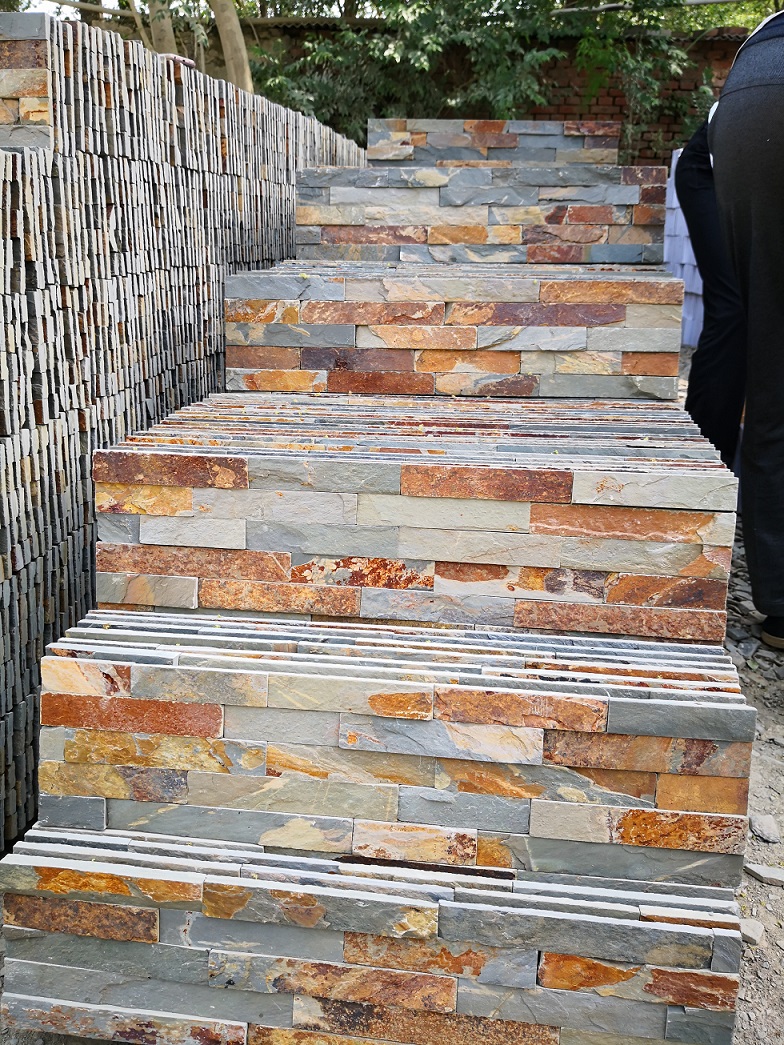
How to Miter Corners On-Site (If You Must)
Field mitering requires precision 45-degree cuts and marine-grade adhesives. While manual fabrication works, it typically increases material waste by 20% compared to prefabricated L-shaped units.
Precision Cutting and Tooling for Manual Stone Joints
Contractors often encounter site-specific layouts where standard prefabricated corners do not align with existing architectural features. When manual mitering becomes necessary, achieving a factory-grade finish depends entirely on thermal management and blade selection. Imprecise cuts lead to the “zipper effect,” where visible vertical seams ruin the naturstein estetikk.
- Blade Specification: Use a professional-grade wet saw equipped with a continuous-rim diamond blade to prevent edge fracturing.
- Back-Bevel Technique: Apply a slight back-bevel to the 45-degree cut, allowing the front faces to meet tightly without substrate interference.
- Grain Alignment: Hand-align stone fragments before the final cut to maintain a continuous natural grain across the 90-degree transition.
- Cutting Method: Strictly avoid dry cutting to eliminate the risk of thermal distortion and ensure proper adhesive bonding.
Securing Field Miters with Gauged Backing and Marine-Grade Epoxy
The structural integrity of an on-site corner joint relies on the contact surface area and the chemical resistance of the adhesive. Naturstein is subject to heavy thermal expansion, meaning standard thin-set often fails at the mitered seam during freeze-thaw cycles. Using the machine-sawn backing of the panels provides the necessary flat surface for high-strength bonding.
- Alignment Baseline: Utilize the +/- 2mm gauged backing of Top Source Stone panels for consistent saw fence alignment.
- Adhesive Standard: Bond mitered edges with Marine-Grade Epoxy Resin to prevent stone detachment in extreme climates.
- Joint Protection: Apply a pH-neutral sealer to freshly cut edges to block moisture absorption at the seam.
- Inventory Calculation: Factor in a 20% material waste increase when choosing on-site mitering over L-shaped corner units.
While on-site mitering provides flexibility for odd-angled walls, B2B wholesalers should advise clients that prefabricated L-corners save approximately 50% on-site labor. Manual mitering remains a specialized fallback for custom dimensions rather than a primary installation strategy.
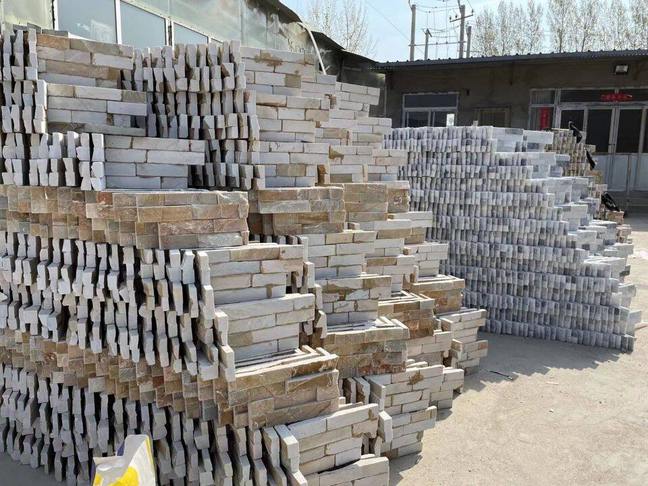
Staggering Joint Patterns for a Natural Look
Staggering joints by one-third or one-half eliminates the “zipper effect,” replicating hand-laid stone by breaking the modular grid and forcing a horizontal, natural visual flow.
Breaking the Grid with Horizontal Offsets
Natural rock strata never forms a perfect vertical grid. When you install ledger panels in a straight stack, you create a “zipper effect”—highly visible vertical seams that scream “pre-fabricated.” Offsetting these joints is the standard for high-end architectural realism. This technique forces the eye to follow the horizontal lines of the stone, masking the modular nature of the panels.
For commercial projects, this visual trick turns a rapid installation into a bespoke masonry feature. We recommend the following layout logic to maintain consistency across large wall sections:
- 1/3 Offset Pattern: Shifting each course by one-third of a panel length mimics a traditional “Running Bond” often found in historic quarry work.
- Perimeter Adjustment: Start every second or third course with a cut piece to shift the starting point of the vertical seams.
- Seam Disruption: Ensure no vertical joints align across at least three consecutive rows to fully break the grid pattern.
Leveraging Rectangle Planks for Versatile Patterning
While Z-shape panels offer speed, our 6″x24″ Rectangle format provides the “Modern Linear Aesthetic” that architects currently demand for minimalist designs. These clean-edged planks allow for precise staggering that interlocking systems can’t match. They eliminate the “busy” look of wavy seams, favoring sharp, contemporary lines that elongate a space.
Beyond aesthetics, our rectangle panels are engineered for structural reliability in staggered layouts. The technical specs ensure that even with significant offsets, the bond remains permanent:
- Gauged Backing: Machine-sawn backs with a +/- 2mm tolerance ensure 100% mortar contact, preventing air pockets behind offset joints.
- Marine-Grade Epoxy Bond: High-strength resin holds the individual stones together, resisting the stress of thermal expansion in exterior applications.
- L-Corner Integration: Use our pre-fabricated 6″x12″ corners at wall ends to conceal cut edges, saving 50% on-site labor and 20% in material waste.
- Universal Format: The 6″x24″ rectangle serves as a multi-use SKU for both interior backsplashes and exterior facades.
By focusing on the Rectangle format, retailers can stock a single, versatile profile that supports multiple patterns like Stacked Bond, Herringbone, or the classic Running Bond. This flexibility simplifies inventory while meeting the specific stylistic needs of high-budget commercial and residential projects.
Corner Prep for High-Impact Retail Zones
Prefabricated L-corners and marine-grade epoxy resins eliminate miter failures, meeting UL 970 standards while cutting on-site labor costs by 50% in high-traffic retail environments.
Structural Integrity and Impact Resistance in Commercial Paths
Retail environments punish wall corners. Shopping carts, heavy pedestrian flow, and industrial floor scrubbers create constant physical stress and moisture exposure that destroy standard stone installations. We focus on structural stability to prevent the buckling and stone detachment common in low-tier masonry.
- Compliance: Adherence to UL 970 standards for retail fixture and wall stability under dynamic dynamic loads.
- Impact Defense: Reinforced corner geometry prevents stone detachment caused by repeated shopping cart collisions.
- Moisture Barrier: Specialized sealing at the installation base resists damage from frequent commercial floor mopping and chemical cleaners.
- Retail Footprints: Dimensional specs follow retailer-specific footprints to avoid overhang, minimizing snagging and breakage in tight aisles.
L-Shaped Efficiency and Marine-Grade Epoxy Bonding
Manual on-site miter cutting is a liability for B2B projects. These 45-degree joints often fail under thermal expansion or physical vibration. Moving to a factory-controlled L-Corner system removes the guesswork and protects the contractor’s margin by eliminating the most common point of failure.
- Corner Format: Pre-fabricated L-shaped units (6″x12″ + 6″x12″) eliminate 20% material waste compared to manual miter cuts.
- Adhesion: Marine-Grade Epoxy Resin bonding ensures zero stone detachment during 26.5-ton heavy-load transit or extreme thermal shifts.
- Gauged Backing: Machine-sawn back (+/- 2mm) ensures 100% mortar contact, removing air pockets where impact energy causes stone cracking.
- Density Standards: Natural stone sourced from deep-strata quarry layers provides near-zero water absorption for salt-air or high-humidity retail climates.

Managing External vs. Internal 90-Degree Angles
Verify corner integrity using the 3-4-5 method. Use pre-fabricated L-corners to cut on-site labor by 50% and eliminate the 20% waste associated with manual miter cuts.
Structural integrity depends on precise geometry. If walls aren’t square, steinpaneler won’t seat correctly, creating visible gaps or uneven load distribution. External corners act as the focal point of a project, while internal corners must manage the transition of stone strata without creating a weak vertical seam.
Verifying Perpendicular Alignment with the 3-4-5 Method
Before applying mortar, verify that wall intersections are exactly 90 degrees. Even minor deviations cause stress concentrations that lead to stone detachment or cracking in high-traffic zones. Internal corners specifically require a staggered overlapping technique—alternating which side of the corner “leads”—to maintain a natural look and structural lock.
- Measurement: Mark 3 units on one wall and 4 units on the intersecting wall.
- The Hypotenuse: The diagonal distance between these marks must measure exactly 5 units to confirm a right angle.
- Correction: Identify and fix framing deviations where the hypotenuse fails the benchmark to prevent uneven load distribution.
- Internal Overlap: Stagger the joints at internal intersections to mimic natural rock strata and avoid the “zipper effect.”
L-Corner Efficiency for External Profiles
Traditional 45-degree miter cuts on-site are a liability for B2B wholesalers. They are labor-intensive, prone to misalignment, and often result in material failure. Using Top Source Stone pre-fabricated one-piece units removes the technical risks associated with manual fabrication while ensuring batch color consistency across large-scale commercial facades.
- Specifications: 6″x12″ + 6″x12″ pre-fabricated one-piece corner units.
- Bonding: Marine-Grade Epoxy Resin handles thermal expansion and ensures zero stone detachment during 26.5-ton heavy-load transit.
- Labor ROI: Reduces on-site installation time by 50% by eliminating manual cutting and fixturing.
- Waste Management: Removes the 20% material waste typical of field-mitered corners.
- Climate Resistance: High-density mineral selection ensures near-zero water absorption, making corners resistant to spalling in freeze-thaw cycles.
For professional retailers and wholesalers, stocking L-corners alongside Z-shape or Rectangle panels is a profit protection strategy. It ensures the end-user achieves a clean, sharp aesthetic without the high rework costs associated with on-site errors.
Final Thoughts
Manual mitering drains project margins through 20% material waste and specialized labor overhead. Our L-corner system protects your ROI by replacing site-cut errors with factory-calibrated precision and marine-grade epoxy durability. Choosing engineered corner units ensures your crews deliver a consistent, high-end aesthetic that withstands extreme climate shifts without stone detachment.
Stop absorbing the cost of site breakage and manual rework. We recommend requesting a sample kit to verify our gauged backing and bond strength firsthand. Contact our wholesale team today to review our “Big 10” best-sellers and discuss how our 26.5-ton loading strategy minimizes your landed cost per square meter.
ofte stilte spørsmål
How do you finish the edges of stacked stone panels without visible seams?
Install factory-fabricated L-shaped corner units (6″x12″+6″x12″) instead of miter cutting on-site. These pre-manufactured pieces interlock to eliminate vertical seams and the “zipper effect.” This method saves 50% on labor and removes the 20% material waste caused by manual cutting. For exterior stability, wrap the metal lath 16 inches around the corner per ASTM C 1063 to prevent moisture infiltration.
What is the best way to hide cut ends at corner transitions?
Set pre-manufactured corner pieces first and work inward toward the flat wall sections. Alternating the long and short returns of the L-corners hides the cut ends completely. Avoid using any stone pieces shorter than 6 inches at the end of a run to maintain the structural bond and ensure the pattern looks natural across the facade.
Is it necessary to seal natural stacked stone for exterior projects?
Apply a pH-neutral penetrating sealer after installation. While we source stone from deep-strata quarry layers for near-zero water absorption, a sealer prevents staining from mineral deposits or organic growth. This is critical for projects in coastal environments where salt air can accelerate surface wear over time.
Can stacked stone panels be installed directly over interior drywall?
Drywall lacks the structural integrity to support the 8–13 lbs per square foot weight of natural stone panels. You must install a cement backer board or a metal lath and scratch coat system over the studs first. Our machine-sawn gauged backing (+/- 2mm) ensures 100% mortar contact, allowing the polymer-modified thin-set to create a permanent bond without air pockets.
How do the panels stay intact during shipping and extreme weather?
We bond individual stones to the panel backing using marine-grade epoxy resin. This high-strength adhesive prevents stone detachment during 26.5-ton heavy-load transit and resists failure during severe thermal expansion. Sourcing from high-density mineral layers also ensures the stone remains resilient through repeated freeze-thaw cycles without spalling.
