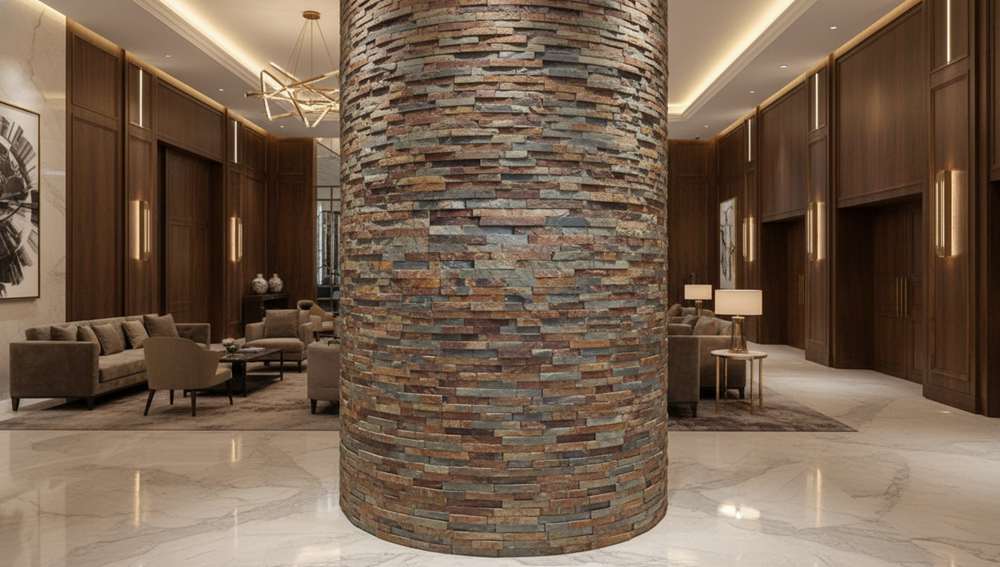
Engineering Curved Walls with natural stone requires managing the tangent point conflict to prevent expensive structural gapping. Standard rigid panels create a stepped effect on radius substrates, often causing a 20% spike in material waste and excessive billable labor hours for landscape architects.
Top Source Stone solves this through CNC diamond-blade precision and Z-shape interlocking technology. Utilizing modular 6-inch by 24-inch panels with 95% hue uniformity ensures architectural continuity and total surface contact on complex exterior curves without the risk of delamination.
The Structural Challenge of Rigid Panels on Curved Substrates
Rigid steinpaneler resist bending, causing tangent point gaps. Managing these requires precision-cut interlocking edges and specific panel sizes to maintain visual continuity on curved surfaces.
Mechanical Incompatibility and the Tangent Point Conflict
Natural stone panels provide high load-bearing capacity, but their inherent rigidity creates a mechanical conflict on curved walls. Because flat materials cannot naturally conform to a radius, the installation often suffers from the “tangent point” effect. This occurs where the flat backing of the panel fails to meet the curved substrate, forcing the edges to lift away and creating prominent vertical gaps.
- Out-of-Plane Resistance: Rigid panels resist bending forces, which introduces structural stress when installers attempt to force them into curved configurations.
- Magnified Imperfections: Even minor variations in the wall substrate magnify building imperfections across the curve, complicating alignment precision.
- Negative Detail Management: Inconsistent spacing becomes visible at intersections where horizontal curves meet vertical alignments, requiring skilled intervention to maintain a clean look.
CNC Diamond-Blade Precision in Interlocking Systems
Top Source Stone addresses these engineering gaps through manufacturing tolerances that facilitate smoother “faceted” transitions. By using specialized cutting technology and modular dimensions, we reduce the visual flaws typically associated with rigid materials on radius substrates.
- CNC Diamond-Blade Edges: This precision ensures a 95% hue uniformity and a tight fit, which minimizes visible joints on wide-radius curves.
- Z-Shape Interlocking: The “male-female” connection system camouflages the installation substrate that would otherwise show through the gaps created by the curve.
- Faceted Geometry: Standard 150x600mm (6″ x 24″) panels provide more frequent break points than large slabs, allowing for a more natural-looking arc.
- Seamless Technology: Our interlocking series eliminates “stepped” vertical gaps by providing modular pieces that nest tightly together, maintaining architectural continuity.

Kerf-Cutting Methods: How to Induce Controlled Bending?
Kerf-cutting uses parallel incisions to relieve material stress, allowing rigid stone or wood to conform to architectural curves without compromising structural integrity.
| Technical Parameter | Requirement | Structural Purpose |
|---|---|---|
| Kerf Depth | 75% of total thickness | Relieves compressive and tensile resistance. |
| Spacing Frequency | Variable by radius | Closer cuts facilitate tighter bend radii. |
| Tooling Type | CNC Diamond-Blade | Ensures uniform width to prevent fractures. |
Structural Mechanics of Kerf Spacing and Depth
Rigid materials naturally resist bending because their internal fibers cannot compress or stretch enough to accommodate a radius. Kerf-cutting bypasses this mechanical limit by physically removing material from the “inside” of the bend, creating space for the substrate to fold inward.
- Stress Relief: Material resistance decreases as parallel saw cuts relieve compressive and tensile stresses.
- Depth Ratio: Kerf depth should reach at least three-quarters of the panel thickness to ensure sufficient flexibility.
- Bend Radius: Spacing frequency determines the arc; closer cuts support tighter curves, while wider spacing supports gentle arcs.
- Stage-Bending: Shaping the material to twice the required radius before final clamping prevents surface splitting.
Precision CNC Cutting for High-Density Stone Panels
Applying kerf-cutting to naturstein requires high-precision machinery. Manual cuts often result in uneven depths that create weak points, leading to panel failure during installation. At Toppkildestein, we use factory-calibrated equipment to ensure every incision is mathematically aligned with the stone’s mineral density.
- Uniformity: CNC diamond-blade precision ensures uniform kerf width across 6″ x 24″ natural stone panels.
- Material Integrity: Factory-controlled incisions maintain the structural stability of 100% natural Quartzite and Slate during the bending process.
- Seamless Interlock: Standardized cuts prevent the “stepped” appearance common with manual methods on curved substrates.
- Labor Efficiency: Pre-engineered kerf patterns on our products reduce on-site labor and minimize material waste for radius wall installations.
Premium Stacked Stone for Architectural Excellence
When to Switch from Full Panels to Segmented Stone Strips?
Switch to segmented strips when wall radii tighten beyond rigid 24-inch limits. This eliminates structural gapping, prevents “stepping” visual defects, and cuts material waste by 20% on organic curves.
Radius Thresholds and Material Waste Management
Architects hit a practical wall when trying to force standard 6×24 rigid panels onto curved substrates. Once the radius tightens, a flat 24-inch panel cannot physically follow the arc. This creates a “stepping” effect where the panel edges protrude, breaking the architectural flow and compromising the structural contact with the substrate.
- Curvature Complexity: Standard panels fail to maintain 100% surface contact on tight radii, leading to instability and moisture traps behind the stone.
- Labor Efficiency: Segmented strips eliminate the heavy on-site cutting required to “kerf” or trim full panels, significantly reducing billable hours.
- Waste Reduction: Modular strips reduce material loss by approximately 20% compared to the breakage and off-cuts generated when modifying rigid 24-inch units.
- Structural Stability: Utilizing segmented materials allows the wall to benefit from lateral earth pressure distribution without the stress points caused by rigid panel mechanical incompatibility.
The Pencil Series Solution for Tight Architectural Curves
For 2026 projects requiring fluid motion on feature walls or pillars, modular systems provide the necessary flexibility. We developed the Pencil Series specifically to solve the gapping issues inherent in large-format ledgestone. By reducing the horizontal footprint of each stone element, the material flows around the arc naturally.
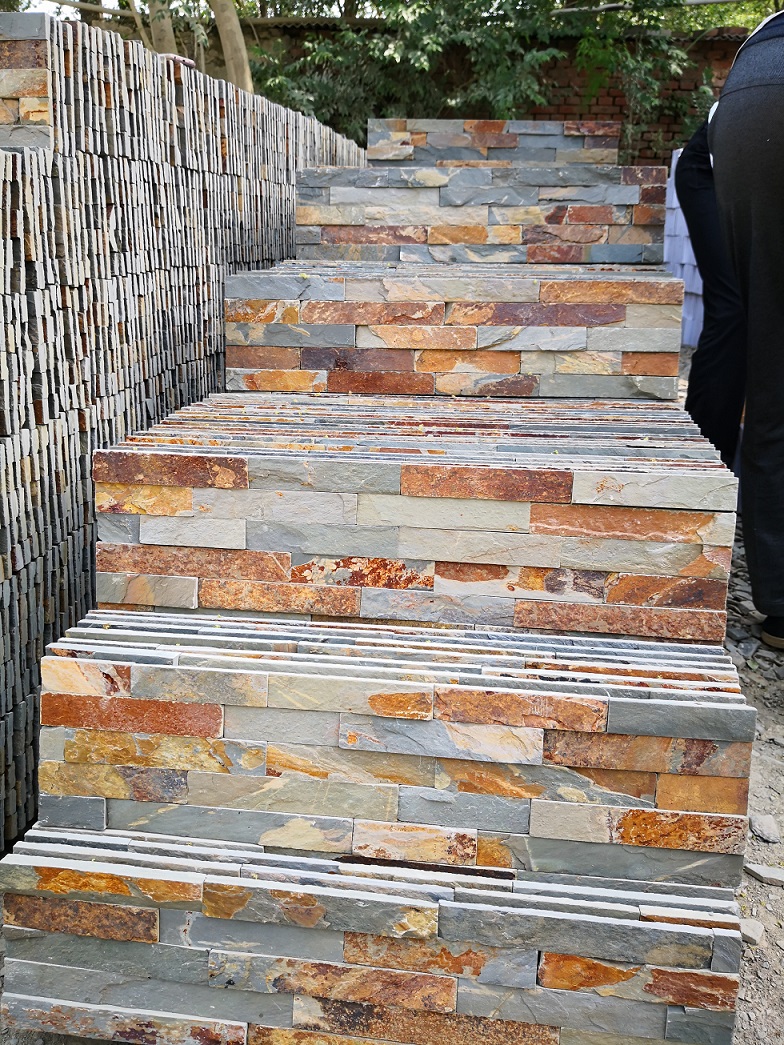
- Row Configuration: The Pencil Series features 10 to 12 rows of thin, linear stone strips that create a seamless flow on high-impact curved surfaces.
- Same-Batch Uniformity: We source 100% natural slate or quartzite from the same quarry vein per order to ensure 95% hue uniformity across the entire curved surface.
- Interlocking Technology: Matching L-Corners and CNC-cut Z-Shape panels camouflage vertical joints, transitioning smoothly from straight runs to curved sections.
- Environmental Resistance: Disse natural stone materials provide inherent UV stability and freeze-thaw resistance, preventing delamination on exposed exterior curves in Northern climates.
Anchor Requirements and Structural Integrity for Radius Walls
Radius walls require 1/2-inch bolts with 7-inch embedment to resist lateral forces. Lightweight Top Source Stone panels minimize structural footprint, while CNC-cut interlocking ensures seamless transitions on curves.
Mechanical Fastening for Lateral and Shear Force Resistance
Substrate stability is the baseline for any curved masonry project. Curved geometry intensifies out-of-plane forces, particularly in seismic zones where in-plane and perpendicular loads fluctuate. You cannot rely on adhesive alone for structural radius projects; the substrate must handle the tension and shear loads before the stone is applied.
- Anchor Diameter: Install 1/2-inch minimum diameter bolts for residential concrete substrates.
- Embedment Depth: Sink anchors at least 7 inches into the concrete to maintain structural grip.
- Spacing Standards: Space fasteners no more than 6 feet apart.
- Edge Placement: Secure anchors within 12 inches of plate ends to prevent edge lifting.
Weight Distribution and High-Strength Resin Bonding Standards
Managing the weight-to-bond ratio is critical on tight curves. Top Source Stone panels weigh between 30-40kg/m² (8-12 lbs/sq.ft), which significantly reduces structural strain compared to full-bed stone. This lower mass allows for tighter radiuses without the need for additional footings or heavy-duty reinforcement typically required for heavier materials.
- Adhesive Selection: Use high-strength epoxy resin formulated specifically for 100% naturstein to prevent delamination on curved surfaces.
- Corner Alignment: Utilize matching pre-fabricated L-corners for 90-degree transitions to ensure color and texture synchronization.
- Precision Cutting: Select CNC diamond-blade precision panels (Z-shape or S-shape) to maintain a tight interlock that conceals the substrate.
- Material Integrity: 100% natural slate or quartzite ensures UV stability and freeze-thaw resistance, preventing cracks during thermal expansion on the curve.

How to Calculate Material Overlap and Waste on Tight Curves?
Calculate using true slope length rather than 2D area. Expect a 10% waste factor for tight radii to account for grain alignment and precision cutting.
Calculating True Surface Area and Geometric Waste Factors
Standard 2D measurements often result in a 23% material shortage on curved projects because they ignore the geometry of the arc. We calculate quantities based on the true slope length to ensure full coverage and prevent mid-project delays.
- Trigonometric Calculations: Use the actual surface distance of the arc rather than linear horizontal dimensions to avoid a 23% discrepancy in material volume.
- Geometric Waste Factor: Apply a 10% waste buffer for tight curves to handle edge trenching and the natural fragility of slate or quartzite during radial trimming.
- Convex Overlap: Plan for 3-5% additional material when using linear panels on convex surfaces to ensure the substrate remains fully concealed at the joints.
Optimizing Yield with CNC-Precision Interlocking Panels
Material yield depends heavily on how the stone is engineered. Top Source Stone utilizes CNC diamond-blade technology to create precision edges that maintain tight connections even when the installation angle deviates from a straight line.
- Interlocking Systems: Use Z-shape or S-shape panels to leverage male-female connections that camouflage vertical joints on curved substrates.
- Matching L-Corners: Incorporate pre-fabricated L-corners into the estimate to eliminate on-site mitering, which is the primary cause of material breakage and installer error.
- Format Flexibility: Select 6″ x 24″ panels for gradual curves and switch to shorter 6″ x 22″ formats for tighter radii to minimize the “stepped” gap effect and reduce total trimming volume.
ofte stilte spørsmål
Can natural stacked stone panels actually bend to fit curved surfaces?
Naturstein remains rigid and does not physically bend. Installers achieve curves by rotating panels progressively along the radius. Top Source Stone interlocking Z-shape and S-shape panels utilize precision CNC diamond-blade edges to follow these contours while camouflaging vertical joints to maintain a seamless architectural finish.
What is the best mortar for installing stone on radius walls?
Type N masonry cement is the standard choice because it provides the flexibility needed to accommodate dimensional irregularities on curved surfaces. For vertical applications requiring higher adhesion, use a tile mortar mixed with latex. This combination offers better stickiness and moisture resistance than standard masonry mixes.
How do you cut stone panels for round pillars or fireplaces?
The most effective method involves using a wet saw with a diamond blade for straight precision cuts and an angle grinder for specialized shaping. When installing on fireplaces, maintain at least a 6-inch non-flammable border between the firebox and the panels to meet safety standards.
How can I minimize visible gaps on a curved column installation?
We recommend using matching L-shaped corners and Z-shape panels to hide vertical seams effectively. If small gaps appear due to tight radii, installers often use color-matched stone dust mixed with mortar or specialized stone fillers to seal the joints and maintain a cohesive look.
Does a curved stone wall require extra structural support?
Standard 6×24 panels from Top Source Stone weigh between 30-40kg/m² (8-12 lbs/sq.ft). This weight typically does not require a structural footing or brick ledge. However, the substrate must be sound concrete, brick, or cement board to support the load on a radius without shifting over time.
Final Thoughts
Forcing unengineered stone onto architectural curves leads to visible “stepping” gaps and expensive on-site rework. Our CNC diamond-blade precision and interlocking systems eliminate these structural risks by ensuring a tight, seamless fit on every radius. Investing in quarry-direct consistency protects your project margins from the 23% material discrepancies common with poorly calculated inventory.
Secure your next radius project by verifying our material tolerances firsthand. We recommend requesting a sample kit or starting a 300-square-meter trial order to test our Pencil Series or Z-Shape interlocking fitment. Contact our technical team today to receive a project-specific quote and high-definition pre-shipment verification photos.
