
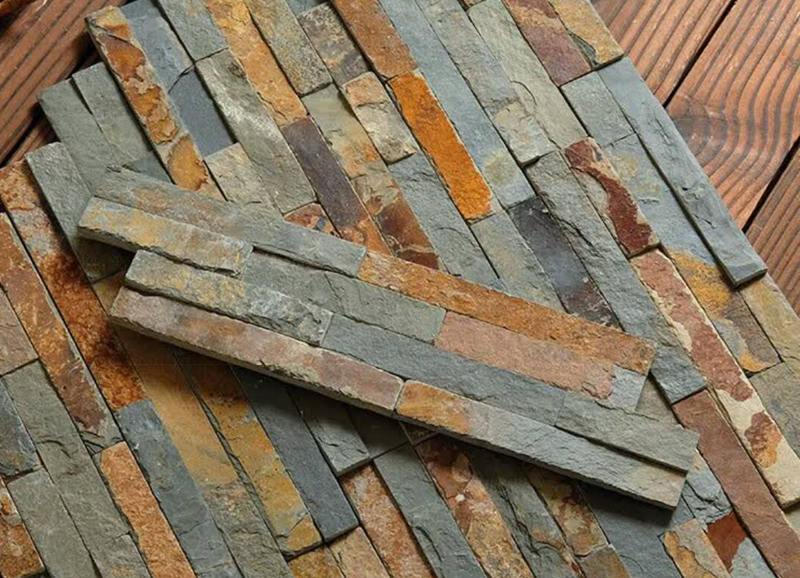
Retailers sourcing a Stacked Stone Backsplash must bridge the gap between architectural demand for texture and the technical risks of grease retention and weight failure. Selecting inferior materials leads to permanent staining and substrate delamination, destroying dealer reputation and project profitability.
This analysis benchmarks materials against ASTM C97 absorption and ASTM C170 compressive strength standards. We focus on 8–12 lbs/sqft slim profiles and 17.5-ton port-optimized logistics to help wholesalers secure batch-consistent inventory for the 2026 luxury kitchen market.
Why Stacked Stone is Trending in High-End Kitchen Design
High-end design favors naturstein for architectural depth and tactile contrast, using interlocking Z-shape panels to boost property value through authentic, quarry-sourced materials.
Architectural Dimension and Organic Contrast
Luxury kitchen design in 2026 balances cold, high-gloss surfaces like quartz or polished granite with raw, organic textures. Natural stone panels provide a sophisticated visual hierarchy, introducing shadows and depth that flat porcelain tiles lack. This shift toward biophilic design prioritizes authentic materials that offer unique character in every installation.
- Core Materials: Slate, Quartzite, Sandstone, Granite, and Marble.
- Best-Selling Aesthetics: Alaska Gray, Glacier White, and Carbon Black Slate.
- Visual Variation: High-level sorting ensures natural cleft and color variation without the “patchy” look of lower-grade lots.
Seamless Z-Shape Panel Integration for Clean Lines
Visual continuity defines high-end culinary spaces. Standard modular panels often leave visible vertical grout lines that disrupt the stone’s flow. Toppkildestein utilizes a Z-shape interlocking system that creates a continuous stone face, mimicking a site-built masonry wall while maintaining the efficiency of a modular system.
- Standard Dimensions: 6″ x 24″ panels (fits standard 18″ backsplash heights with zero cutting waste).
- Engineering Tolerances: Adheres to ASTM C170 for compressive strength and ASTM C97 for low water absorption.
- Installation Weight: 8–12 lbs/sqft (requires cement backer board rather than standard drywall).
- B2B Advantage: Direct quarry sourcing allows for batch color consistency across large-scale multi-unit developments.
Wholesalers and developers choose these systems because they offer the “dry-stack” aesthetic without the labor costs of traditional masonry. By removing the need for grout, the installation timeline drops significantly, protecting dealer margins while delivering a premium architectural finish.
Material Suitability: Slate vs. Marble for Wet Areas
Slate provides superior density and natural traction for wet zones, whereas marble requires intensive sealing and specific textures to mitigate slip and etching risks.
Mineral Stability and Texture in Moisture-Prone Zones
Dense slate varieties minimize water absorption and provide natural traction through riven textures. This physical profile makes them a reliable choice for high-moisture zones like bathrooms and pool surrounds. Problems often arise when suppliers sell low-grade mudstones as slate; these materials risk spalling and delamination in continuously wet environments.
Marble contains calcium carbonate, which reacts with acidic cleaners and stains easily. It requires high-quality penetrating sealers to remain durable. To manage safety, architects specify honed or sandblasted marble finishes in wet areas to improve the dynamic coefficient of friction compared to polished surfaces.
Stone Density Standards for ASTM C97 Compliance
Material performance in humid environments depends on stone density. We select Grade A materials to meet high-density requirements equivalent to ASTM C97 for absorption and ASTM C170 for compressive strength. Direct quarry sourcing ensures batch color consistency and eliminates the high-porosity stones that typically lead to installation failure.
- Weight Load: 8–12 lbs/sqft (30–40kg/m2) for standard 6″x24″ panels.
- Adhesion Integrity: High-strength glue systems maintain panel bonds during humidity fluctuations.
- Technical Compliance: Materials meet ASTM C97 (Absorption) and ASTM C170 (Compressive Strength) standards.
- Standard Dimensions: 6″ x 24″ modular panels designed for grout-free interlocking.
Regular application of penetrating sealers protects the 100% natural stone surface from grease and water ingress. For B2B wholesalers, we offer pre-shipment visual verification—including photos and videos—to confirm material density and texture before the balance payment, protecting your project margins from sub-standard sorting.
Grease Resistance: Why Sealing is Critical for Kitchen Use
Naturstein porosity allows cooking oils to cause permanent staining. Professional-grade sealers create an essential barrier against aerosolized grease and microbial growth in high-use kitchens.
Soil Retention and Surface Contamination in Textured Stone
Aerosolized lipids and animal fats settle into the micro-crevices inherent in split-face and pencil series stone profiles. Unsealed naturstein acts as a sponge, pulling these organic oils deep into the substrate and causing irreversible darkening that standard cleaning cannot fix.
Textured geometries increase the total surface area available for soil retention. This makes unsealed installations difficult to sanitize without using aggressive chemicals that can eventually degrade the stone. If you fail to control permeability, you risk microbial growth within the cavities behind cooktops where steam and grease accumulate.
- Primary Contaminants: Aerosolized lipids, animal fats, steam-borne particulates, and organic oils.
- Surface Risks: Irreversible darkening, microbial growth, and chemical etching from improper cleaning.
- Geometry Impact: Increased surface area in split-face profiles accelerates grease entrapment compared to honed surfaces.
ASTM C97 Compliance and the Role of Penetrating Sealers
Top Source Stone selects raw materials to meet high-density requirements equivalent to ASTM C97 for absorption and ASTM C170 for compressive strength. While our Quartzite and Slate are naturally dense, professional sealing protocols are required to transform them into grease-resistant surfaces suitable for commercial and residential kitchen backsplashes.
Applying a penetrating sealer maintains the natural aesthetic of models like Alaska Gray or Carbon Black Slate while preventing bond failure caused by moisture ingress. We recommend using epoxy grout alongside sealed panels to create a fully impermeable joint network that resists kitchen contaminants.
- Density Standards: Compliance with ASTM C97 (Absorption) and ASTM C170 (Compressive Strength).
- Material Suitability: High-grade Quartzite, Slate, and Granite sourced directly from Hebei quarries.
- Installation Grout: Epoxy grout is preferred for creating impermeable, grease-resistant joints.
- Maintenance Protocol: Periodic resealing is necessary to ensure the stone meets modern hygiene requirements for 2026 kitchen standards.
Wholesalers should note that Grade A stone consistency from a direct quarry source minimizes the “patchy” appearance often seen in lower-grade imports when sealers are applied. Providing pre-shipment visual verification ensures the batch color consistency remains intact after the sealing process.
Scale Your Business with Premium Ledger Panels
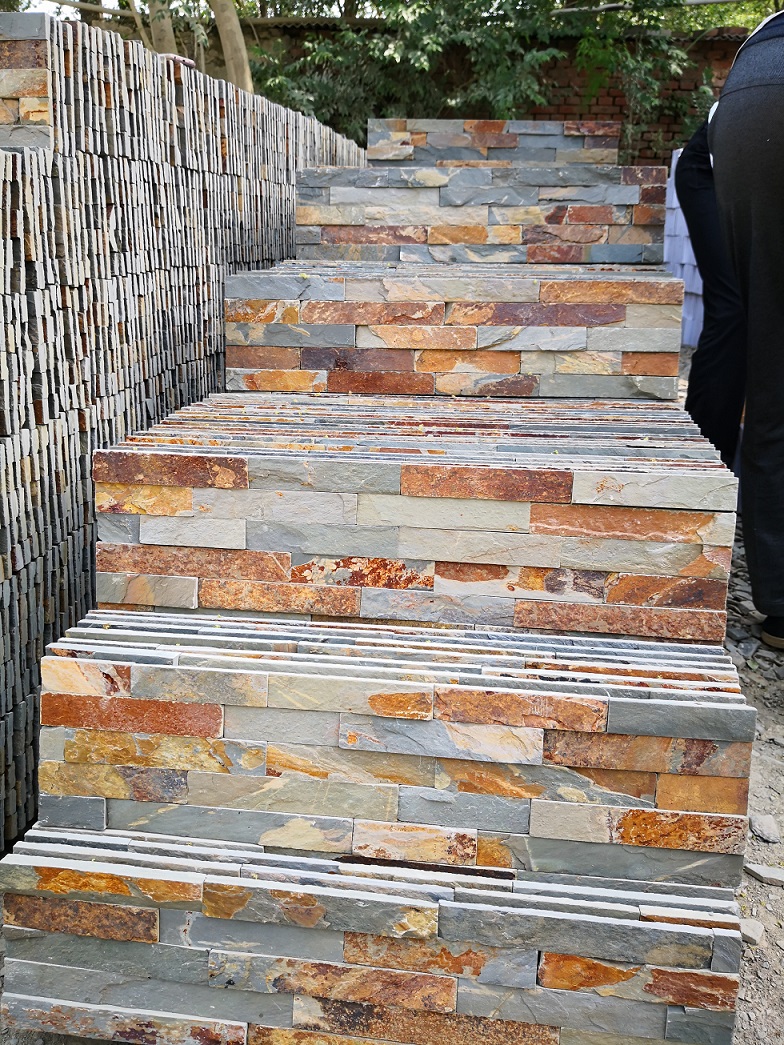
Slim Profile Panels: Reducing Depth Without Sacrificing Texture
Slim steinpaneler solve the protrusion and weight issues common in traditional ledgestone by calibrating depth to 0.3–0.75 inches while maintaining authentic slate and quartzite textures.
| Trekk | Standard Ledger paneler | Top Source Slim Series |
|---|---|---|
| Average Thickness | 0.75″ – 1.75″ | 0.3″ – 0.75″ |
| Dead Load Weight | 12 – 15 lbs/sqft | 8 – 10 lbs/sqft |
| Substrate Required | Metal Lath / Masonry | 1/2″ Cement Board |
| Outlet Compatibility | Requires Box Extenders | Standard Trim Fit |
Space Optimization and Weight Management in Backsplash Design
Thick ledger panels create technical headaches in modern kitchens. When stone exceeds 1 inch in depth, it often interferes with electrical outlet placement and crowds the limited clearance between countertops and upper cabinetry. Wholesalers now prioritize slim profiles to simplify the contractor’s installation process.
Reducing panel thickness to under 0.75 inches lowers the structural load to approximately 8 lbs per square foot. This weight reduction prevents substrate failure on standard interior walls, provided the installer uses a proper cementitious backer board. By staying under the 10 lb threshold, these panels avoid the need for heavy-duty structural reinforcement or specialized masonry anchors.
- Standard Load: 8–10 lbs/sqft for slim quartzite and slate.
- Dimensions: 6″ x 24″ modular panels calibrated for 18″ backsplash heights.
- Compliance: High-density stone meeting ASTM C170 for compressive strength.
Technical Specs of the Flat Series Stone Panels
Maintaining structural integrity in a 0.3-inch stone strip requires industrial-grade bonding. We use high-strength epoxy resins to secure naturstein strips, ensuring they withstand the vibrations of shipping and onsite cutting without delaminating. This engineering allows for a “Pencil” or “Flat” aesthetic that looks modern but feels rugged.
The Z-shape interlocking system eliminates visible vertical seams. For B2B buyers, this translates to faster project turnaround and fewer aesthetic complaints from end-users. Unlike standard split-face stone, these calibrated series maintain a tighter tolerance for contemporary feature walls.
- Core Materials: Alaska Gray (Quartzite), Midnight Slate, and Glacier White.
- Backing System: High-strength glued mesh or epoxy-bonded strips.
- Wholesale Packaging: 7–8 pieces per carton, optimized for 17.5-ton US road weight limits.
- Finish Profile: Natural cleft texture with a calibrated 0.75″ maximum protrusion.
Direct quarry sourcing ensures these thin-cut panels maintain batch color consistency. Because we control the extraction in Hebei, we sort the raw material to prevent the patchy, inconsistent walls often seen with middleman-sourced stone. This transparency protects dealer margins and simplifies the pre-shipment visual verification process.
Color Matching: Coordinating with Quartz & Granite Countertops
Pairing organic stone with smooth surfaces requires deliberate tonal contrast and factory-level batch sorting to ensure vertical backsplashes complement horizontal slabs without unexpected color shifts.
Achieving aesthetic harmony between heavily textured stacked stone and smooth engineered quartz or natural granite involves managing light and material variation. Subtle undertone mismatches often ruin high-end kitchen projects when horizontal slabs and vertical walls compete for dominance.
Navigating Tonal Contrast and Vertical Orientation
High-contrast pairings remain the most reliable strategy for B2B buyers looking to minimize installation risks. Choosing Carbon Black Slate to sit against white quartz bypasses the struggle of matching near-identical whites, which often clash under different light temperatures.
Light reflects differently on a vertical backsplash than it does on a horizontal countertop. A gray quartzite slab might appear warmer when laid flat, while the vertical ledger panels look cooler. Neutral models provide a sophisticated transition for patterned granite:
- Alaska Gray: A quartzite option that bridges the gap between white cabinets and gray-veined granite.
- Glacier White: Ideal for tone-on-tone designs where texture provides the primary distinction.
- California Gold: A slate choice that anchors earth-toned granite through natural rust and gold accents.
Batch Color Consistency and Visual Verification
Naturstein variation can turn a large-scale project into an expensive mess if the material arrives in disjointed color lots. We solve this by implementing Batch Color Consistency sorting at our Hebei factory. This protocol ensures that every panel in a 20GP container maintains a uniform tonal range before it reaches your warehouse.
Direct quarry sourcing gives us control over Grade A blocks, which is vital for high-demand models. Wholesalers should demand transparency before the balance payment is made to protect their margins and reputation.
- Direct Quarry Control: Ensures consistent mineralogy for models like Golden White and Sierra Blue.
- Pre-Shipment Visual Verification: We provide high-definition photos and videos of the actual batch to confirm it matches the project slabs.
- Technical Durability: All panels meet high-density requirements equivalent to ASTM C170 for compressive strength and ASTM C97 for low absorption.
Relying on texture dominance rather than exact chromatic precision allows the naturstein to stand as a focal point. This approach accommodates the inherent heterogeneity of slate and quartzite while maintaining the architectural intent of the kitchen design.
Ease of Maintenance: Cleaning Real Stone vs. Faux Products
Naturstein requires pH-neutral chemistry and periodic sealing to meet ASTM C97 standards, while faux products tolerate mild detergents but share the same geometric grease-trapping challenges.
| Maintenance Factor | Natural Stone (Slate/Quartzite) | Manufactured/Faux Stone |
|---|---|---|
| Chemical Sensitivity | High (Reacts to acids/vinegar) | Moderate (Resists mild soaps) |
| Porosity/Sealing | Required (ASTM C97 Compliance) | Optional but recommended for joints |
| Cleaning Tools | Soft brush + pH-neutral cleaner | Soft brush + mild detergent |
| Standard HS Codes | 6803.00.90 (Slate) / 6802.93.11 (Quartzite) | 6810.19.00 (Cementitious) |
Material Porosity and Chemical Sensitivity in Kitchen Zones
Naturlig stone surfaces like Alaska Gray Quartzite or Midnight Slate are inherently porous. Without professional-grade sealing, cooking oils and animal fats penetrate the mineral structure, causing permanent darkening. Wholesalers must educate clients that acidic substances—including vinegar, lemon juice, or standard glass cleaners—chemically etch the surface of natural stone, leading to irreversible dulling of the finish.
Manufactured stone uses cementitious or polymer-modified matrices that offer higher resistance to common household detergents. While the material is less chemically sensitive, both real and faux products share a jagged geometric profile. These deep crevices trap aerosolized grease and dust, which eventually hardens if not agitated manually. Cleaning these surfaces requires more labor than smooth tile, regardless of the material’s chemical makeup.
Maintenance Protocols for High-Density Natural Stone Panels
Protecting the longevity of a B2B stone installation starts with the right chemistry. We select our natural stone to meet high-density requirements equivalent to ASTM C170 for compressive strength, but surface care remains the primary variable for appearance retention. Dealers should advise installers to use penetrating sealers immediately after the mortar cures to block moisture ingress.
- Cleaner Selection: Use only pH-neutral stone cleaners to preserve the color of Quartzite models like Glacier White or Golden Honey.
- Debris Removal: Employ soft-bristled brushes to reach into the Z-shape interlocking joints where grease splatter accumulates.
- Sealing Schedule: Reapply penetrating sealers every 12 to 24 months based on kitchen volume to maintain ASTM C97 absorption standards.
- Prohibited Tools: Avoid high-pressure washing or abrasive scouring pads that degrade the hand-split texture of slate and quartzite.
For high-relief textures like our “Rough” finish (55kg/m2), consistency in cleaning is more effective than aggressive chemicals. Regular wipe-downs with a soft, damp cloth prevent grease from bonding to the stone. This proactive maintenance ensures the natural variation of the stone remains a focal point rather than a trap for kitchen contaminants.
Small Batch Customization for Boutique Design Firms
Top Source Stone provides 300 m2 MOQs for custom sizes and private labeling, allowing boutique firms to secure exclusive stone patterns without the financial burden of massive inventory.
Tailored Production for Diverse Architectural Formats
Standard 6″x24″ panels often fall short for high-end boutique projects that demand unique spatial geometry. We use precision infrared cutting to produce custom panel dimensions that move beyond commodity sizes, ensuring the stone fits the specific architectural site requirements perfectly.
Designers can select specialized masonry layouts, including Z-shape and S-shape interlocking options. These formats eliminate the visible vertical seams that often ruin the aesthetic of natural stone feature walls. During the 2026 production runs, our factory team performs manual color-matched sorting. This process ensures tonal consistency across the entire batch, preventing the patchy appearance typically found in lower-grade quarry outputs.
MOQ 300 m2 for Private Label and Custom Box Solutions
Inventory overhead and warehouse costs usually prevent smaller firms from developing their own branded lines. We solve this by lowering the entry barrier for OEM services, making direct quarry sourcing accessible for mid-sized architectural projects.
- Low MOQ: 300 m2 minimum order quantity for trial orders and full private label services.
- Branded Packaging: Customized 5-ply export cartons featuring firm-specific logos and project-specific labeling.
- Visual Verification: We provide high-definition photo and video documentation of all custom production batches before you pay the balance.
- Logistical Efficiency: 17.5-ton container loading optimized for North American road weight limits to maximize shipping value.
This flexibility allows firms to maintain project exclusivity with models like Alaska Gray or Midnight Slate while keeping their cash flow lean. By removing middleman markups and offering direct factory control, we protect the margins of boutique design partners.
Sourcing Decisions and Project Integrity
Low-grade stone imports often lead to patchy color lots and high absorption rates that ruin high-end kitchen installations. Sourcing ASTM-compliant quartzite and slate directly from the quarry ensures your inventory withstands grease and moisture while maintaining strict batch consistency. High-quality thin-veneer panels protect your retail margins by minimizing installation failures and homeowner complaints.
Verify our calibration and finish firsthand by requesting a sample kit of our best-selling Alaska Gray or Carbon Black Slate models. We offer 300 m² MOQs and private labeling to help you secure exclusive territory designs without excessive inventory risk. Contact our team to review our US-port weight-optimized shipping schedules and receive pre-shipment visual verification for your next order.
ofte stilte spørsmål
Why do some installations fail when using stacked stone for backsplashes?
Failures typically occur because the substrate cannot support the weight of natural stone. Our ledger panels weigh between 8 and 12 lbs/sqft, which exceeds the load-bearing capacity of standard drywall. To prevent delamination, installers must use 1/2-inch cement board and polymer-modified thinset. Moisture infiltration in cooking zones can also erode the backing of lower-grade stone, so we recommend ANSI A118.10 waterproof membranes for high-convection areas.
Is a textured stone backsplash difficult to clean in a high-grease kitchen?
Natural split-face textures have crevices that trap aerosolized grease. We resolve this by applying high-quality penetrating sealers immediately after installation to close the stone’s pores. Maintenance involves pH-neutral stone cleaners and soft brushes to lift debris from the relief. For B2B clients, we emphasize that regular sealing prevents oil from darkening the stone, preserving the original color consistency of the lot.
Does stacked stone require grouting between the panels?
Standard 6″ x 24″ ledger panels do not require grout. We engineer our stone with a seamless Z-shape interlocking system that creates a tight, grout-free dry-stack appearance. Installers apply polymer-modified mortar to both the wall and the back of the stone to ensure a permanent bond. This design eliminates visible joints and reduces labor costs for large-scale B2B projects.
Can I install stacked stone panels directly behind a range or stove?
Yes, natural stone is inherently heat-resistant and non-combustible. It performs well as a stove backing when installed over a non-combustible substrate like cement board. You must use high-performance mortars, such as ANSI A118.15, to handle the thermal expansion and steam exposure typical in active cooking zones. This ensures the panels remain secure despite frequent temperature fluctuations.
What are the best stone colors for contemporary white kitchens?
Wholesale buyers frequently request Glacier White and Alaska Gray Quartzite for a tone-on-tone aesthetic in modern kitchens. These models provide a clean, crystalline look that complements white cabinetry. If the design requires more warmth, Golden Honey Quartzite offers natural contrast and depth without overwhelming the light, airy feel of contemporary interior architecture.
Is it possible to install stone veneer over existing ceramic tile?
Installation over tile is possible only if the original surface is structurally sound and thoroughly deglossed. You must mechanically abrade the glossy glaze to allow the mortar to bond. Because our panels weigh 8–12 lbs/sqft, the existing tile must have a high-strength bond to the substrate to prevent shear failure. We recommend polymer-modified thinset (ANSI A118.4) to manage the dead load of the new steinfiner.
