
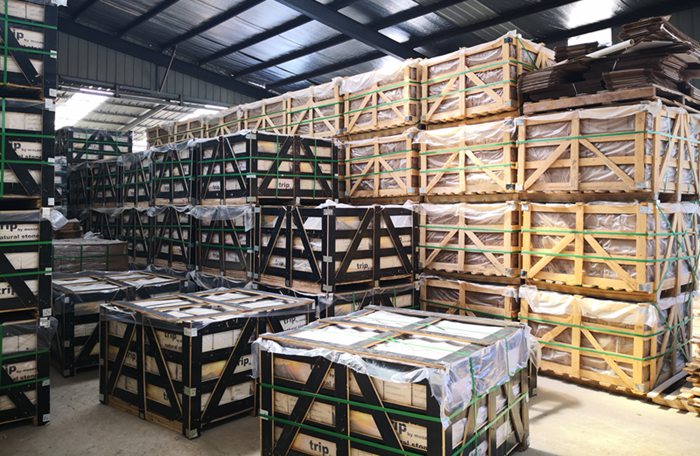
Poorly managed stacked stone logistics frequently spikes breakage rates from a 5% baseline to 25%, forcing wholesalers to absorb heavy profit losses and 15% material overage claims. While substandard packaging looks attractive on a quote, shattered panels at the port destroy the landed cost for both novice importers and veteran distributors.
We mitigate these risks through 17.5-ton US port weight optimization and ASTM C1670-compliant bonding systems. This analysis benchmarks 5-ply export cartons and steel-reinforced crating against industry standards to ensure your shipments remain road-compliant and job-site ready.
The Hidden Cost of Breakage: Why Cheap Packaging is Expensive
Substandard packaging spikes breakage from 5% to 25%, forcing contractors to buy 15% more material. High-strength crating and industrial adhesives protect these B2B margins.
Financial Impact of Transit Damage and Site Waste
Cheap packaging is a margin killer for wholesalers. While a low quote might look attractive on a spreadsheet, the “savings” disappear when the stone arrives shattered. Logistics data shows that inadequate protection pushes breakage rates well past the 5% industry baseline.
- Breakage Rates: Substandard packaging results in 15% to 25% failure rates during LTL transit.
- Material Overage: High waste requires contractors to purchase 10-15% more material as a buffer, inflating procurement costs.
- Labor Drain: Installers lose billable hours sorting through debris and trimming chipped pieces for concealed areas.
- Vulnerable Points: Thin corners and large flat-faced panels chip easily when not secured by reinforced spacers.
3-5 Ply Export Cartons and High-Strength Adhesive Systems
We mitigate these risks at the source. Top Source Stone uses a direct quarry control model to ensure every pallet meets export-grade durability. We focus on structural integrity and chemical bond strength to survive international shipping and rough handling at the job site.
- Carton Specs: We use 3-5 ply export cartons to provide the rigidity needed for heavy-weight loading.
- Adhesive Strength: Our high-strength glued systems meet ASTM C1670 standards (>50 psi bond), preventing panels from delaminating during wet-saw cutting.
- Visual Verification: We provide pre-shipment photos and videos of pallet stability before the final balance payment.
- Weight Optimization: We target 17.5-ton loads for US ports to maximize container value while strictly meeting road weight regulations.
This approach shifts the focus from low-cost materials to high-yield delivery. By maintaining stone-to-backing bond strength and using plywood crates that require no fumigation, we remove regulatory and physical friction from the supply chain.
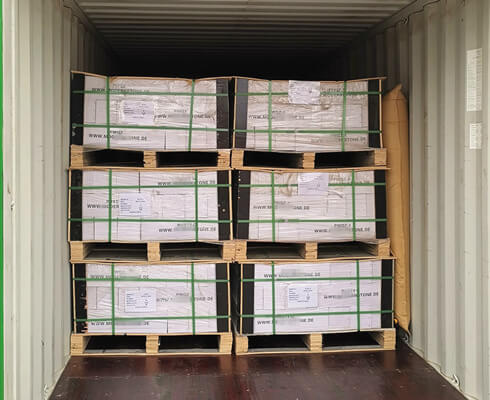
Triple-Layer Packaging: Crate Reinforcement and Shock Absorption
We use a 3-layer protection system of 5-ply cartons, foam-lined interiors, and steel-reinforced crates to keep breakage under 5% while meeting 17.5-ton North American road weight limits.
| Packaging Metric | Standard Market Practice | Toppkildestein Standard |
|---|---|---|
| Outer Protection | Non-fumigated or loose bundles | ISPM 15 Fumigated Wooden Crates |
| Reinforcement | Plastic poly-strapping only | Deformed steel bars & steel banding |
| Breakage Rates | 15% – 25% per shipment | Under 5% (Verified) |
| US Road Weight | 24+ Tons (Risk of fines) | 17.5 Tons (Optimized Compliance) |
Structural Reinforcement via Steel-Banded Wooden Crates
The exterior shell provides the primary defense against the mechanical stresses of sea transit and heavy-duty crane handling. For high-density natural slate and quartzite, we utilize crates that meet ASTM standards for structural integrity. These crates undergo mandatory ISPM 15 fumigation to ensure seamless customs clearance in the US, Australia, and Europe.
- External Stabilization: Horizontal joint reinforcement prevents load shifting within 20ft containers during rough sea conditions.
- Steel Integrity: Deformed steel bars reinforce crates where unit length exceeds 15 times the minimum thickness, preventing structural collapse.
- Logistics Optimization: We size crates to fit 20 pallets per container while maintaining a 17.5-ton total load, meeting North American over-the-road weight regulations.
- Banding Specs: Heavy-duty steel banding secures the crate lid and walls, ensuring the stone remains compressed and immobile.
Internal Shock Absorption with 5-Ply Export Cartons
Individual 6×24 inch panels require localized protection to prevent corner chipping and tensile failure. While many factories use thin 3-ply boxes, we use 5-ply heavy-duty corrugated export cartons. This adds a critical buffer against the micro-vibrations that typically cause breakage in ledger panel shipments.
- Packing Configuration: We pack 7–8 pieces per carton for standard panels and 5 pieces for rough textures to distribute weight evenly.
- Vibration Dampening: Internal foam lining and spacers prevent face-to-face rubbing and absorb impact energy during forklift operations.
- Moisture Control: Polythene linings protect the stone from staining and environmental moisture during the 30–45 day sea transit period.
- Visual Verification: We provide high-resolution photos and videos of the packaging and container loading process before the 70% balance payment.
This multi-stage approach directly protects your profit margins by reducing the need for the industry-standard 10-15% overage. By keeping actual breakage under 5%, distributors can commit to tighter inventory schedules without the risk of project delays or material shortages.

20ft Container Loading Strategy: Balancing Weight and Volume
Wholesalers balance stone density against regional weight limits. We optimize US shipments at 17.5 tons for road compliance, while global heavy routes handle 24-26.5 tons.
| Loading Parameter | US Port Optimized | Global Standard/Heavy |
|---|---|---|
| Max Payload Weight | ~17.5 Tons | 24 – 26.5 Tons |
| Coverage Volume | 756 – 864 m² | 756 – 864 m² |
| Pallet Configuration | 20 Reinforced Pallets | 20 Reinforced Pallets |
| Regulatory Focus | North American Road Limits | Heavy-Weight Carrier Approval |
Logistics Standards for Weight Distribution and Axle Compliance
Shipping natural stone requires strict adherence to physical stability rules. Misaligned loads lead to container tilt during sea transit, which often results in crushed packaging or refused entry at the port. We follow ISO 668 dimensions to maintain a safe payload capacity within the standard 33m³ volume.
Proper weight distribution protects your bottom line. Cargo that shifts during transit triggers SOLAS VGM non-compliance fees and secondary handling surcharges. Our logistics team implements specific loading protocols to ensure container integrity:
- Weight Bias: We maintain a 60% forward weight bias to ensure axle compliance and prevent tipping.
- VGM Verification: Every shipment undergoes Method 1 or 2 weighing to meet 2026 carrier standards.
- Structural Packing: Heavy stone pallets are distributed evenly to prevent structural failure of the container floor.
- Payload Limit: We target a maximum payload of approximately 28,180kg for heavy-route global shipments.
US Port Weight Optimization and Global Tonnage Limits
For North American wholesalers, road weight regulations are the primary constraint. Overloading a container beyond 17.5 tons frequently results in expensive drayage fines and the need for specialized “heavy-haul” permits. We solve this by calibrating the product density against pallet counts before the container leaves our factory.
Material density varies significantly across our inventory. Flat or pencil-style panels weigh between 8–12 lbs/sqft, while rough-textured ledgestone reaches 55kg/m². We adjust the loading plan based on these technical specs to maximize your square footage without exceeding regional legal limits.
- Slate (HS 6803.00.90): Higher density materials require fewer pieces per carton to stay within weight thresholds.
- Quartzite (HS 6802.93.11): We typically load 756–864 m² across 20 reinforced pallets for high-volume orders.
- Packaging Density: Standard loads include 7–8 pieces per carton for flat styles, reduced to 5 pieces for rough textures.
- Cost Control: Limiting North American shipments to 17.5 tons minimizes inland freight costs and avoids port congestion penalties.
Premium Factory-Direct Stacked Stone Panels
Fumigation and Customs Documentation: Navigating Port Entry
Entry requires correct HS codes—6803.00.90 for slate or 6802.93.11 for quartzite—and ISPM 15 wood compliance. Keep US loads under 17.5 tons to avoid road weight penalties.
Essential Documentation for International Stone Clearance
Customs brokers focus on classification accuracy to determine duty rates. Mislabeling natural stone leads to immediate audits and potential overpayments. For US-bound wholesalers, shipments valued over $2,500 require a formal entry and the submission of the CBP importer identity form under 19 CFR 24.5. Ensuring your paperwork matches perfectly prevents port holds that trigger demurrage fees after the standard five-day window.
- Slate HS Code: 6803.00.90 (Covers worked natural slate panels)
- Quartzite HS Code: 6802.93.11 (Specific to quartzite ledger stone variants)
- CBP Identity Form: 19 CFR 24.5 (Mandatory for formal US entries)
- Verification: Document set must include a matching commercial invoice, packing list, and bill of lading.
- Trade Compliance: Include a Certificate of Origin to satisfy regional import license requirements.
ISPM 15 Compliance and Export Packaging Standards
The stone itself is inert and does not require fumigation, but solid wood packaging is a different story. Every pallet and crate must bear the IPPC stamp certifying ISPM 15 heat treatment or methyl bromide fumigation. Using non-compliant wood often results in the port rejecting the entire container. We utilize 3-5 ply premium export cartons and reinforced crates to protect individual panels from the mechanical stress of port inspections.
- Fumigation Standard: ISPM 15 (Required for all solid wood pallets entering the US, EU, and Australia)
- Inner Packaging: 3-5 ply premium export cartons with protective spacers to prevent face-to-face rubbing.
- US Port Optimization: 17.5 tons per 20GP container to align with strict road weight limits.
- Transparency: Pre-Shipment Visual Verification (Photos and Videos) provided before final payment.
- Weight Capacity: Standard loads reach 24-26.5 tons, but regional road laws usually dictate the final loading strategy.

Tracking Your Shipment: Managing Lead Times from Hebei to Port
Total supply chain lead times from Hebei average 60-81 days, covering production, inland trucking to Tianjin, and roughly 14-35 days for sea freight transit.
Inland Transport and Northern China Port Dynamics
Moving stablet stein from Hebei production sites to northern hubs like Tianjin or Qinhuangdao requires 5 to 10 days of inland trucking. Northern Chinese ports face seasonal congestion, particularly during 2026 peak windows, which can add up to 14 days to standard processing. Selecting FCL (Full Container Load) over LCL (Less than Container Load) removes the 3-to-7-day delay typically spent in consolidation warehouses.
- Trucking Time: 5–10 days from factory to port.
- Peak Season Buffer: 5–14 additional days for port congestion.
- Customs Approval: 2–4 days for natural stone documentation.
- FCL Advantage: Saves 3–7 days by avoiding cargo consolidation bottlenecks.
Pre-Shipment Verification and Container Weight Optimization
We use Pre-Shipment Visual Verification to protect your cash flow. We provide photos and videos of the order before you pay the 70% balance. This ensures the batch matches your specifications before it leaves the direct quarry source. Lead times depend on inventory status: in-stock items ship within 10 to 15 days, while custom manufacturing runs require 20 to 25 days.
- US-Port Weight Limit: 17.5 Tons per 20GP container (Targeted for North American road weight regulations).
- Standard/Heavy Load: 24–26.5 Tons (Requires specific heavy-weight approval).
- Load Capacity: 756–864 m2 per 20ft container across 20 pallets.
- Production Lead Time: 10–15 days (Stock); 20–25 days (Production runs).
- HS Codes: Slate (6803.00.90) and Quartzite (6802.93.11).

LTL (Less Than Truckload) Challenges for Local Distributors
Multi-stop LTL transit causes 47% damage rates. Distributors mitigate risk using 17.5-ton port weight optimization and reinforced factory packaging to avoid heavy OTIF penalties.
LTL shipping is a high-risk variable for stone wholesalers. Multi-stop routes expose heavy pallets to excessive vibrations and frequent forklift handling, which explains why nearly half of these shipments face damage or rejection. For commercial cladding projects, these delays ripple through the schedule, triggering significant fines from contractors and big-box retailers who demand high on-time-in-full (OTIF) performance.
Transit Variability and the Financial Impact of OTIF Penalties
Logistical failures in the LTL sector directly erode dealer margins. In 2026, regional carriers continue to struggle with driver shortages and urban navigation hurdles, making last-mile delivery for heavy stone pallets increasingly unpredictable. We track these failure points to ensure our packaging exceeds the standard durability required for consolidated hauls.
- Late Arrival Rate: One in six LTL shipments fails to meet scheduled deadlines.
- Damage Frequency: Rejection rates reach 47% due to frequent handling and trailer vibrations.
- Financial Risk: Annual OTIF penalties for enterprise shippers can exceed $6.1 million.
- Urban Logistics: Driver shortages and local traffic disruptions account for 16.7% of transit delays.
Optimizing Regional Freight with 17.5-Ton US Port Loading
We solve regional logistics bottlenecks at the source. Our 17.5-ton loading strategy targets North American road weight limits precisely, allowing distributors to move containers directly from the port without costly transloading or overweight fines. This optimization balances container value with the physical safety of the stone panels.
- Weight Optimization: 17.5-ton loads ensure compliance with strict US road weight regulations.
- Pallet Density: 48–60 cartons per pallet ensure even weight distribution for safer LTL transfers.
- Reinforced Protection: 3–5 ply export cartons protect 6-inch by 24-inch panels during multiple loading cycles.
- Inventory Integrity: Factory-level batch color sorting eliminates the need for distributors to open and mix pallets locally.
- Volume Capacity: Each 20GP container accommodates 756–864 m2 across 20 specialized pallets.
By controlling the packaging specifications and loading weight at our Hebei factory, we protect your cash flow and reduce the 10-15% overage typically required to buffer transit breakage. This proactive approach ensures that Grade A Slate (HS 6803.00.90) and Quartzite (HS 6802.93.11) arrive job-site ready.

Handling Insurance and Damage Claims: The Manufacturer’s Role
We eliminate logistics disputes by enforcing ASTM C1670 standards and providing Pre-Shipment Visual Verification, ensuring batch quality before you release the final 70% balance payment.
Defining Liability in Transit and Installation
Disputes in stone logistics usually arise from a lack of clear boundaries between manufacturing defects and onsite handling errors. We mitigate this by establishing technical benchmarks that separate material integrity from external stressors during the transit and installation phases.
- Material Standards: Strict adherence to ASTM C1670 for compressive strength and dimensional tolerances.
- Bonding Strength: Use of high-strength marine-grade epoxy (not PVA) to ensure panels withstand mechanical stress and wet-saw cutting.
- Adhesive Protocol: Liability for bond failure shifts to the installer if they fail to use ANSI 118.4/118.11 compliant polymer-modified thinset.
- Vertical Limits: Cladding applications exceeding 15 feet require specific engineering assessments to manage the 8–12 lbs/sqft weight load.
By documenting the condition of marine-grade bonds before they leave the factory, we provide distributors with evidence that the material is structurally sound for both transport and mechanical cutting. This prevents installation failures from being mischaracterized as factory defects.
Risk Mitigation via Pre-Shipment Visual Verification
Standard logistics often leave wholesalers in the dark until the container arrives at the warehouse. Our protocol removes this uncertainty by providing visual proof of quality and specialized packing configurations designed for the rigors of 2026 global shipping routes.
- Verification: High-resolution batch photos and videos of the actual order provided before the 70% balance payment.
- Three-Stage QC: Inspections occur post-cutting, post-assembly, and immediately prior to final crate sealing.
- Weight Optimization: Containers targeting US ports are limited to 17.5 tons to prevent road-weight fines and internal shifting during inland trucking.
- Export Packaging: Use of 3-5 ply export cartons and reinforced, fumigated plywood crates that comply with ISPM 15 standards.
Our specialized loading strategy balances weight and volume to prevent cargo tilt, which is the primary cause of crushed edges in stablet stein. By keeping breakage under the 5% threshold, we protect your margins and eliminate the need for the excessive 15-25% overage typically required for poorly packed shipments.
Final Thoughts
Cheap shipping quotes often mask the devastating cost of 25% breakage and unexpected heavy-haul fines at the port. Our 17.5-ton optimized loading strategy and reinforced 5-ply cartons stabilize your landed cost by keeping transit damage below the 5% industry threshold. Direct quarry control protects your wholesale margins from the hidden waste and administrative friction typical of middleman sourcing.
Stop absorbing the financial impact of transit damage and start scaling with a supply chain engineered for durability. Request our technical catalog or a sample kit to verify the bond strength and finish of our Alaska Gray or Midnight Slate collections firsthand. Contact our logistics team today to plan a 300m² trial order and secure factory-direct pricing for your next project.
ofte stilte spørsmål
What is the standard packaging configuration for a 20ft container?
We pack 6″x24″ panels in reinforced 3-ply to 5-ply export cartons, which are then stacked on plywood pallets. For North American logistics, we optimize loads to 17.5 tons to stay within regional road weight limits. Other markets typically utilize 24 to 26.5-ton capacities depending on port equipment.
How many square meters of stacked stone fit in one shipment?
A standard 20ft container accommodates between 756 and 864 square meters (approximately 8,100 to 9,300 square feet). This volume varies based on material density—slate is generally lighter than quartzite—and whether you choose flat pencil styles or rough-cut panels.
Are your stone crates compliant with US and EU import regulations?
Yes. All solid wood packaging meets ISPM 15 standards, including heat treatment and the mandatory IPPC stamp. To speed up customs entry, we frequently utilize plywood crates which are exempt from fumigation requirements while offering the same structural integrity as solid wood.
How does Top Source Stone minimize breakage during sea transit?
We use a high-strength glue system and a seamless Z-shape interlocking design to prevent individual stones from shifting. Before you pay the balance, we provide photos and videos of the secured crates. We also recommend a 10% overage to cover any minor chips or cutting waste during installation.
Which HS codes are used for natural stone panel imports?
Natural slate panels are classified under HS code 6803.00.90. Quartzite and other stone variants fall under 6802.93.11. Using these specific codes ensures accurate duty calculation and prevents customs holds at the port of entry.
SEO
Title: Zero Breakage: Shipping & Packaging Logistics for Stone Importers
Description: Stacked Stone Logistics: 17.5-ton US port optimization, ASTM C1670 bonds, and 5-ply cartons. Direct Hebei quarry wholesale factory.
URL: stacked-stone-logistics
Keywords: stacked stone logistics
