

Installing stone over drywall involves navigating the structural limits of vertical shear stress and paper-to-gypsum bond strength. For contractors, exceeding the 15-pound-per-stud weight threshold results in catastrophic substrate delamination, leading to expensive insurance claims and total project failure.
This analysis benchmarks the 8 to 12 lbs per square foot dead load of Top Source Stone slate and quartzite panels against residential framing standards. We define the technical requirements for substrate reinforcement and adhesive performance to ensure every vertical installation remains secure and visually seamless.
Is Standard Drywall Strong Enough to Support Natural Stacked Stone?
Standard 1/2-inch drywall cannot support the 8–15 lbs per square foot required for natural stone. Installers must use cement backer board to prevent substrate delamination and structural failure.
Structural Limitations and Shear Strength of Gypsum
Drywall engineers design the material to handle point loads, like hanging a mirror from a stud. It is not engineered for the continuous vertical shear stress created by a full wall of stone. Naturstein creates a constant downward pull across the entire surface that standard gypsum cores cannot resist.
The primary failure point is the paper facing. This layer provides the board’s tension, but it easily delaminates when subjected to weights exceeding 15 lbs per stud. When natural stone panels apply a continuous load, the bond between the paper and the gypsum core shears, leading to the entire stone facade pulling away from the wall framing.
Substrate Reinforcement for 8-13 lbs per Square Foot Loads
Toppkildestein flat panels typically weigh between 8 and 12 lbs/sq.ft (30-40kg/m²), while our Rough series can reach 55kg/m². These specifications exceed the safe operating limits of residential drywall. A rigid substrate is mandatory to prevent the minor flexing that causes high-density quartzite and slate panels to crack at the joints.
- Substrate: Use 1/2-inch cement backer board as a direct replacement for drywall.
- Fastener Intervals: Secure the board to studs at 12-to-16-inch intervals using 2-inch minimum screws.
- Weight Capacity: Concrete block or brick provides the most stable backing for heavy-weight “Rough” series applications.
- Adhesive Standard: Apply polymer-modified thin-set (ANSI A118.4) to ensure a high-strength bond that handles the stone’s density.
If removing existing drywall is not feasible, installers can screw cement backer board directly over the drywall. This approach requires longer fasteners to penetrate the cement board, the drywall, and at least 1 inch into the wood or metal studs to ensure the structural load transfers to the building frame.

Calculating the Weight Load: Comparing Stone Panels to Stud Capacity.
Multiply surface area by thickness and density to determine dead load. Standard panels weigh 8-12 lbs/sq.ft, typically aligning with 16-inch on-center structural stud capacities.
| Product Type | Thickness Range | Stone Density (lbs/ft³) | Avg. Weight (lbs/sq.ft) |
|---|---|---|---|
| Standard Stablet stein | 1.0cm – 2.5cm | 165 (Slate/Quartzite) | 8 – 12 lbs |
| Rough/Premium Series | Up to 3.5cm | 165 – 175 (Granite) | Approx. 11.3 – 14 lbs |
The Mathematical Formula for Stone Dead Loads
Calculating the gravitational force on a vertical surface requires precise material data. Engineers use the primary calculation: Square Feet × Thickness (converted to feet) × Stone Density = Total Weight in Pounds. This formula identifies the exact pressure applied to the wall’s structural skeleton before the first panel is set.
Density benchmarks vary by mineral composition. Natural Slate and Quartzite average 165 lbs per cubic foot, while Granite reaches 175 lbs per cubic foot. When running these numbers for 2026 commercial installations, the “dead load” variable must include the weight of the stone, the mortar scratch coat, and any structural adhesives. A standard mortar coat often adds an additional 2 to 4 lbs per square foot to the total assembly.
Load distribution depends on the framing configuration. We analyze per-stud load by looking at the standard 16-inch on-center (OC) spacing. Since most natural stone panels remain under 15 lbs per square foot, the vertical force distributes safely across the studs, provided the installer uses an appropriate substrate like cement backer board rather than drywall.
Weight Parameters for Standard and Rough Stacked Stone Panels
Top Source Stone supplies two distinct weight classes for B2B inventory planning. The standard 6″ x 24″ panels weigh approximately 30-40kg/m² (8-12 lbs/sq.ft). These specs work efficiently for interior accent walls and standard exterior facades without requiring reinforced heavy-duty framing.
- Standard Panel Weight: 8-12 lbs/sq.ft; ideal for 1/2″ cement board applications.
- Rough Series Weight: Reaches 55kg/m² (approx. 11.3 lbs/sq.ft) due to high-texture projections.
- Thickness Influence: Standard models (1cm–2.5cm) differ significantly from Rough/Premium models (up to 3.5cm), which increase the load per square foot by nearly 40%.
- Crate Logstics: Full plywood crates average a gross weight of 900kg – 1000kg.
Commercial planning requires structural alignment for vertical surfaces. Large-scale projects involving the Rough Series require stringent verification of vertical load capacity because the extra depth increases the leverage on fasteners. We recommend ensuring the wall system handles the 1000kg average gross weight of our standard crates during the initial staging phase to prevent floor-load failure in high-rise applications.
Premium Factory-Direct Stacked Stone Ledger Panels
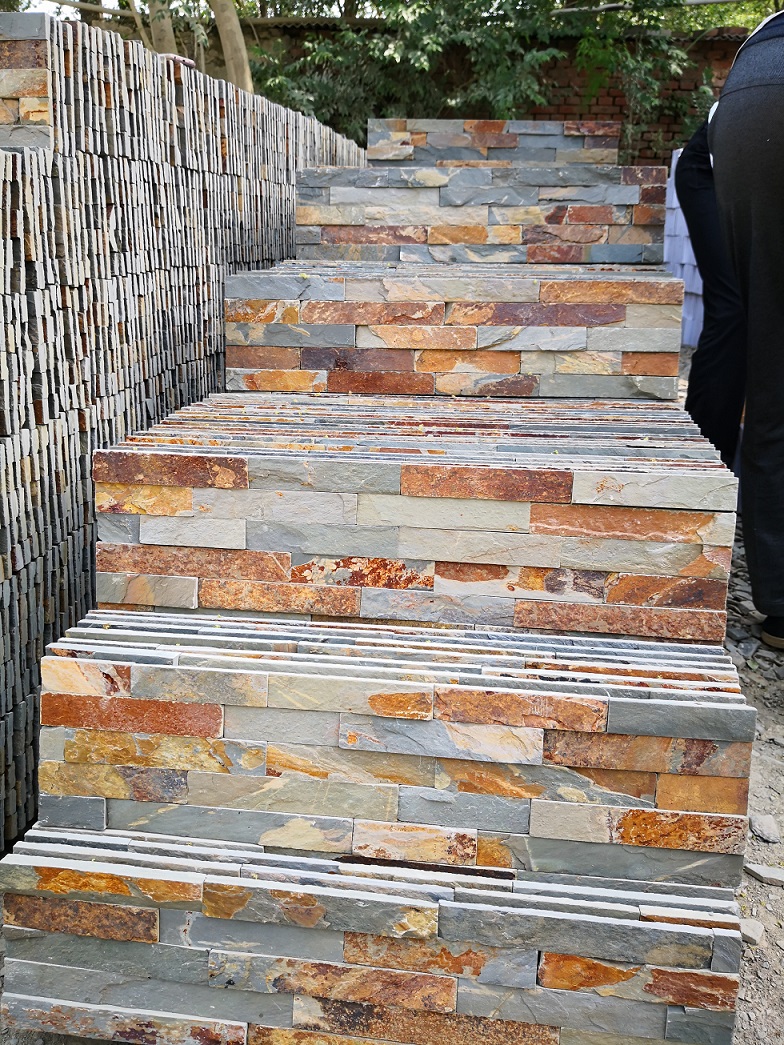
Why You Should Always Use a Polymer-Modified Thin-set on Drywall.
Polymer-modified thin-set provides the 50-75 psi bond strength and moisture control necessary to secure 8-12 lbs/sq.ft steinpaneler to porous drywall without sagging or delamination.
Adhesion Performance and Moisture Resistance on Gypsum
Polymer and latex additives transform standard mortar into a high-performance adhesive by increasing shock resistance. These additives create a sticky, reliable bond between the naturstein and the paper-faced surface of the drywall substrate.
Drywall is naturally porous and often absorbs water from the mortar mix too quickly, which starves the cement of the hydration it needs to cure. Modified thin-set effectively limits this absorption rate. This chemical management ensures the bond reaches a strength of 50-75 psi, which remains the industry benchmark for interior vertical stone applications in 2026.
Supporting the 8-12 lbs/sq.ft Weight of Stacked Stone
Standard 6″ x 24″ flat panels from Top Source Stone weigh between 30-40kg/m² (8-12 lbs/sq.ft). Supporting this dead load on a vertical surface requires an adhesive with high-grab properties to prevent panels from slipping or sagging during the installation process.
- Structural Integrity: Modified thin-set provides the necessary grip for heavy-duty inventory models like Carbon Black and Golden Honey.
- Panel Specs: Ideal for 1cm to 2.5cm thick natural stone panels used in residential wall frames.
- Movement Tolerance: The polymer content allows the installation to absorb micro-movements as building frames settle, preventing visible cracks in the stone face.
By choosing a modified formulation, installers protect the project against the structural failure often seen when using rigid, unmodified mortars on flexible gypsum-based walls.
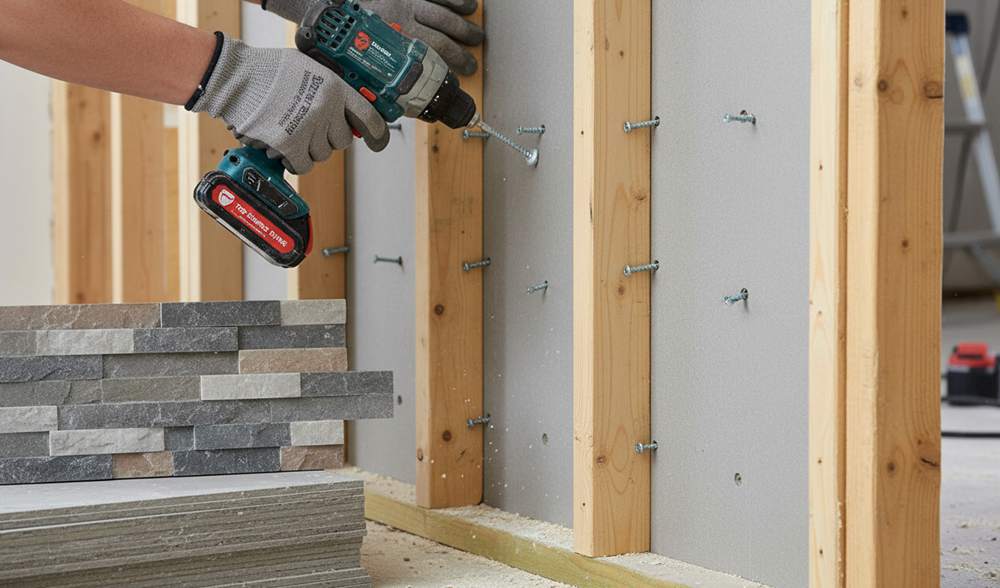
When is it Time to Switch from Drywall to Cement Backer Board?
Switch to cement backer board for high-moisture zones or any installation exceeding 10 pounds per square foot to prevent substrate failure and mold growth.
Identifying High-Moisture Zones and Adhesion Risks
Standard drywall fails in bathrooms, shower surrounds, and laundry areas because gypsum cores degrade when exposed to humidity. Moisture-saturated paper backing becomes a breeding ground for mold, compromising the entire wall structure behind the stone veneer.
Adhesion failure is a primary concern for B2B distributors. When heavy steinpaneler are glued to drywall, the weight often pulls the paper facing right off the gypsum core. Inorganic cementitious materials provide a direct bond to the substrate core, eliminating this “paper-peel” risk.
- Environment: Mandatory for all zones with direct water contact or humidity levels consistently above 70%.
- Material Composition: Inorganic cement cores vs. organic paper-faced gypsum.
- Bonding Strength: Compatible with polymer-modified thin-sets meeting ANSI A118.4 standards.
Structural Support for Heavy Natural Stacked Stone Panels
Naturstein isn’t a lightweight finish. While standard panels range from 30-40kg/m², premium architectural series require significantly more support. A rigid, non-flexing surface is the only way to maintain the integrity of a professional installation.
For Toppkildestein products, substrate rigidity is a technical requirement. Our CNC diamond-blade edges and interlocking Z-Shape systems rely on a perfectly flat foundation. Any wall flex will cause the “male-female” connections to shift, creating visible gaps and ruining the seamless finish.
- Rough Series Weight: Reaches 55kg/m², exceeding the safe distributed load capacity of standard drywall.
- Precision Alignment: Rigid backing prevents movement that causes “stepping” in Z-Shape or S-Shape interlocking joints.
- Corner Stability: Provides the necessary anchor for matching L-Corners to ensure 90-degree transitions stay locked.
- Freeze-Thaw Durability: Essential for exterior projects in northern climates to prevent delamination during thermal expansion.

Waterproofing Protocols for Installing Stone in Bathroom Wet Areas.
Replace drywall with cement board and ANSI membranes. Use polymer-modified thin-set for 95% coverage and breathable penetrating sealers to prevent structural moisture failure in high-humidity zones.
Substrate Preparation and ANSI-Standard Membranes
Standard drywall lacks the structural capacity to support natural stacked stone, which typically weighs between 8 and 12 lbs per square foot. In wet areas, moisture compromises the gypsum core, leading to catastrophic bond failure. Professionals must replace all moisture-sensitive surfaces with inorganic cement backer boards or specialized foam substrates to ensure a stable, mold-resistant foundation.
- Substrate: Use minimum 1/2-inch cement board or foam backer board securely fastened to wall framing.
- Primary Barrier: Apply ANSI A118.10 certified liquid-applied or sheet membranes across the entire wet zone.
- Reinforcement: Embed fabric mesh in the first coat of membrane at all wall-to-floor transitions and plumbing penetrations.
- Verification: Conduct a flood test for 24 hours to confirm the integrity of the waterproofing system before setting any stone.
Natural Stone Density and Humidity Resistance Specifications
Top Source Stone recommends 100% natural slate or quartzite for wet environments due to their inherent high salinity and humidity resistance. Because naturstein is porous, the installation technique must focus on preventing water from being trapped behind the panels, which can cause mineral leaching or mortar degradation over time.
- Mortar Technique: Apply polymer-modified thin-set using the back-buttering method to achieve 95% coverage, eliminating air pockets where water can collect.
- Sealing Protocol: Apply a breathable, penetrating sealer specifically designed for natural minerals; avoid film-forming sealers that trap moisture inside the stone.
- Panel Design: Utilize CNC-cut Z-shape or S-shape interlocking panels to create a tight, male-female connection that protects the substrate from direct spray.
- Curing: Allow the entire assembly to cure for at least 72 hours before regular exposure to moisture or steam.
Final Thoughts
Installing 100% natural stone directly on standard drywall invites structural failure and costly insurance claims. We provide the technical data and quarry-direct materials needed to eliminate “paper-peel” risks and ensure stability for loads up to 55kg/m². Your reputation as a dealer or contractor relies on using professional-grade substrates and CNC-cut precision stone that stays on the wall.
Secure your next project with inventory from our “Big 10” series, specifically engineered for high salinity and freeze-thaw durability. We recommend requesting a sample kit or discussing a 300-square-meter trial order to verify our “Same-Batch Quarry Consistency” firsthand. Contact our B2B team today to receive wholesale pricing and pre-shipment visual verification for your next container.
