
Acquiring professional tooling for Z-panels is the only way to prevent vertical drift and edge fracturing in heavy natural stone facades. Inadequate equipment fails to support 80kg/sq.m cement-backed stone panels, resulting in visible gaps and costly material waste that destroys project margins.
We evaluate job site essentials against the CNC-diamond precision edging standard required for a professional finish. This guide benchmarks high-torque wet saws and infrared leveling systems to help crews execute the interlocking modular blueprint with zero structural delamination.
The Contractor’s Kit: What You Need for Z-Panel Success
Professional Z-panel setup requires high-precision wet saws, infrared laser levels for alignment, and high-strength epoxy adhesives to support the 80kg/sq.m load of natural steinkledning.
| Tool Category | Required Equipment | Project Function |
|---|---|---|
| Alignment | Infrared Laser Levels | Maintaining horizontal baselines |
| Fabrication | Wet Saw (Diamond Blade) | Clean, dust-free masonry cuts |
| Bonding | Epoxy Resin / 1/4″ Trowel | Securing panels to cement substrate |
| Fastening | Stainless Steel Z-Clips | Mechanical stabilization for heavy loads |
Essential Layout and Fabrication Equipment
Accuracy in the first row dictates the success of the entire facade. Crews must establish a perfect horizontal baseline to ensure the interlocking male-female connections align without forcing the stone. Traditional bubble levels often fall short on large-scale commercial walls where cumulative errors lead to visible gaps.
- Infrared laser levels: These provide a continuous horizontal reference line across interlocking rows to prevent “stepping” in the stone pattern.
- Wet saws with diamond-tipped blades: Essential for clean cuts on dense slate or quartzite. These tools eliminate the silica dust hazards common with dry cutting.
- 5-inch angle grinders: Used for fine-tuning interior edges, cutting around electrical outlets, or making complex notches that a wet saw cannot reach.
- Heavy-duty chalk lines and squares: These help establish vertical centerlines and maintain 90-degree accuracy on large facades and pillars.
High-Strength Adhesives and CNC-Precision Hardware
The weight of natural stone panels, reaching up to 80kg/sq.m for 3-4cm thick models, requires a mechanical and chemical bond strategy. Standard thin-set mortars lack the grab needed for heavy cement-backed panels. We recommend high-strength epoxy resins designed specifically for bonding 100% natural stone to rigid substrates.
- High-strength epoxy resin: Formulated to manage the thermal expansion and heavy weight of interlocking modular systems without delamination.
- 1/4-inch notched trowels: Proper trowel selection ensures 100% mortar coverage, which is vital for panels weighing between 68kg and 80kg per square meter.
- Stainless steel Z-clips: Combined with 2.5-inch triple-coated decking screws, these provide the mechanical stabilization required for heights exceeding 10 feet.
- CNC-diamond precision edging: Our factory-milled edges ensure the modular pieces fit tightly, allowing the interlocking design to conceal the installation substrate completely.
Wet Saw vs. Angle Grinder: Which is Better for Precision Z-Cuts?
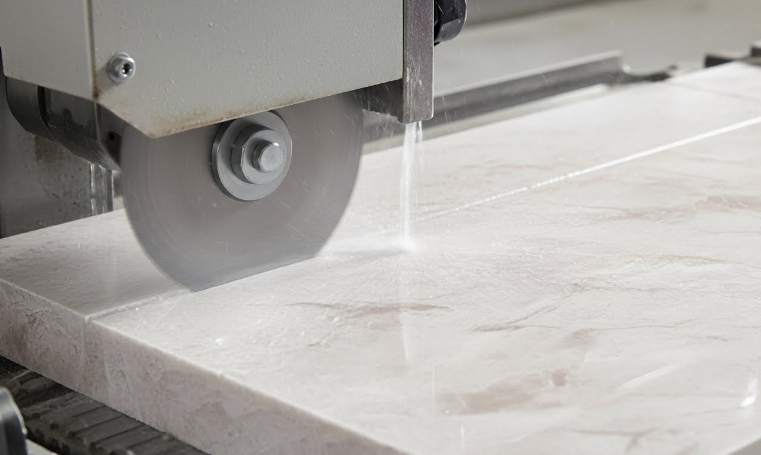
Wet saws provide high-precision straight cuts and silica dust suppression, while angle grinders handle complex L-cuts and site adjustments for seamless interlocking stone panel installations.
Choosing between a wet saw and an angle grinder depends on the specific phase of the installation. For primary sizing, the wet saw is the industry standard for maintaining the integrity of natural stone. Our interlocking Z-panel system relies on CNC-diamond precision edging to hide vertical joints, and the wrong tool can ruin that factory finish.
Straight-Cut Accuracy and Silica Dust Suppression
Wet-cutting technology is a requirement for high-end architectural projects heading into 2026. Beyond the cleaner finish, water-cooled systems protect the structural integrity of the stone during the fabrication process.
- Clean Edge Profile: Wet saws provide straight lines that prevent visible gaps in the stone face.
- Thermal Protection: Constant water-cooling reduces heat friction, which prevents stress cracks in dense materials like Quartzite or Slate.
- Dust Management: Integrated water systems suppress silica dust at the source, ensuring a safer and compliant workspace.
- Surface Integrity: Specialized precision blades minimize chipping on the natural cleft or split-face surfaces of the panel.
Protecting CNC-Diamond Precision on Interlocking Edges
The interlocking modular blueprint uses a male-female connection system to create a continuous stone surface. While a wet saw handles the bulk of the straight cuts, the angle grinder remains a necessary secondary tool for the fine details that a fixed saw cannot reach.
- Connection Integrity: Precise tool selection maintains the factory-cut interlocking system for a gap-free, professional finish.
- Architectural Notching: Handheld grinders allow for intricate cuts and notches required around electrical outlets and existing fixtures.
- Power Requirements: Heavy cement-backed panels with a 3-4cm thickness require high-torque motors to maintain a uniform cutting depth.
- Edge Preservation: Skilled tool use preserves the CNC-diamond precision edging during on-site modifications to ensure the pieces fit tightly.
Scale Your Business with Premium Stone Panels

Why an Infrared Laser Level is Mandatory for Interlocking Systems?
Z-panel systems require a perfectly level starting row to prevent vertical drift and gaps. Laser levels ensure factory-engineered tolerances are met across the entire installation.
Preventing Vertical Drift in Modular Stacking
Installing Z-shape interlocking panels starts with the base row. If the first layer is off by even a fraction of a millimeter, that error compounds as the wall height increases. In large-scale commercial facades, this “vertical drift” creates visible gaps or a “stepping” effect that ruins the natural stone aesthetic.
- Cumulative Accuracy: Prevents small leveling errors in the first row from multiplying into significant misalignments at the top of the wall.
- 360-Degree Reference: Projects a consistent horizontal line across large surfaces, allowing installers to maintain precision on wide exterior cladding projects.
- Tight Interlocking: Ensures the “male-female” connections of the Z-shape pieces sit flush, effectively concealing the installation substrate.
Matching Field Setup to CNC-Diamond Precision Edging
Top Source Stone manufactures these panels using CNC-Diamond precision edging. This factory-level engineering creates a modular fit designed for tight tolerances. To achieve the “Seamless Technology” promised by the Interlocking Modular Blueprint, the on-site environment must match the precision of the manufacturing facility.
- Tolerance Alignment: Laser levels allow the installer to match the exact factory-engineered edges of each panel for a professional finish.
- Joint Disappearance: Accurate leveling ensures that vertical joints vanish, creating a continuous natural stone face rather than a grid of individual panels.
- Substrate Camouflage: A perfectly level installation prevents light from leaking through gaps, ensuring the backer or cement wall remains invisible.
Trowel Selection: Ensuring 100% Mortar Coverage for Heavy Panels
Proper 100% adhesion requires 1/2-inch square-notched trowels, straight-line combing, and back-buttering to support Top Source Stone panels weighing up to 80kg per square meter.
Ridge Direction and Air Entrapment Prevention
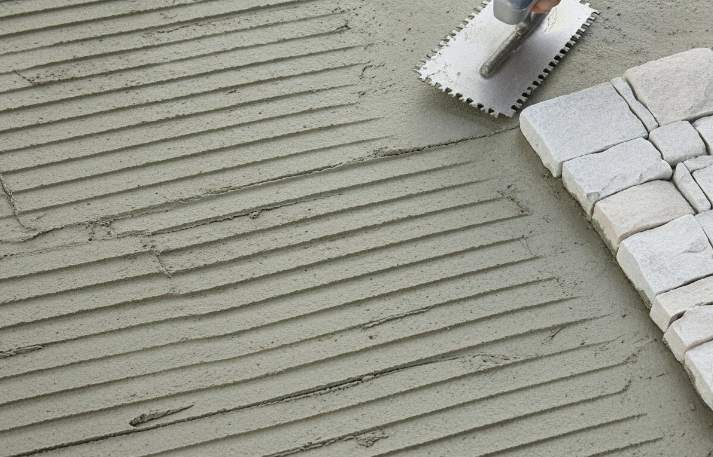
Mechanical bonding starts with “keying in” a thin layer of mortar using the flat side of the trowel. This forces the adhesive into the substrate’s pores. Once keyed, apply the mortar using the notched side to create uniform ridges. Avoid swirling the trowel; circular patterns trap air pockets that lead to panel failure under thermal expansion.
- Straight Line Combing: Keep all ridges parallel to allow air to escape as the panel is pressed home.
- Short Path Exit: Run ridges across the short direction of the panel to minimize the distance air travels to the nearest joint.
- Perpendicular Embedding: Press the Z-panel into the mortar and move it slightly perpendicular to the ridges to collapse the valleys and reach full coverage.
Trowel Specifications for 80kg per Square Meter Loads
Tool selection must align with the physical weight of the material. Toppkildestein panels with a 3-4cm thickness weigh approximately 80kg per square meter. Standard 1/4-inch notches are designed for light ceramic tiles and will fail to support these heavy-weight Z-clad systems.
- Primary Tool: 1/2″ x 1/2″ square-notched trowel is the minimum requirement for 3-4cm thick panels.
- Mandatory Back-Buttering: Apply a thin “skim coat” of mortar to the cement-backed base of every panel to fill irregularities in the natural cleft surface.
- Pull-Test Protocol: Remove one installed panel every few square meters to verify no trowel lines remain visible on the back of the stone.
- Mortar Thickness: Maintain a minimum 3/32″ (approx. 2.4mm) bed of mortar after the panel is fully embedded.
Achieving the 95% coverage standard is non-negotiable for exterior facades and large-scale commercial projects. Using the correct notch size ensures the mortar bed can absorb the structural load and resist moisture penetration in high-humidity or high-salinity environments.

Safety Gear: Protecting Against Silica Dust and Stone Shards
2026 safety requires P100/N100 respirators filtering 99.97% of silica. Combine high-impact eye protection with wet-cutting and CNC-precision panels to minimize airborne particles and ensure strict job site compliance.
Respiratory Standards and High-Impact Eye Protection
Installation crews wear P100 or N100 respirators to block fine crystalline silica particles. These filters provide an assigned protection factor (APF) of 10 or higher. Standard N95 masks fail current 2026 safety benchmarks for high-concentration stone dust and create significant liability for contractors.
- Filter Efficiency: P100 or N100 respirators capture 99.97% of hazardous dust.
- Eye Safety: High-impact goggles prevent injury from high-velocity stone shards and debris.
- Skin Protection: Full-body coveralls reduce skin contamination and dust transfer.
- Fit-Testing: Rigorous seal protocols ensure respiratory protection remains effective throughout the shift.
Wet-Cutting Methods and CNC-Diamond Precision Edging
Engineering controls reduce dust before it becomes airborne. Wet-cutting techniques use water-integrated saws to suppress silica at the source. When dry adjustments are necessary, crews use handheld grinders equipped with HEPA-filtered vacuum attachments to capture residual particles.
- Source Suppression: Water-integrated saws eliminate silica dust at the point of origin.
- HEPA Filtration: Vacuum attachments on all grinders capture dust during final on-site adjustments.
- Precision Engineering: Top Source Stone utilizes CNC-diamond precision edging to minimize the need for on-site trimming.
- System Maintenance: Regularly replace water and air filters to maintain maximum dust collection efficiency.
ofte stilte spørsmål
Which specific tools are required for installing the Top Source Stone panel system?
Professional installation requires a wet tile saw with a turbo diamond blade, a 1/4-inch notched trowel, a laser level, and high-strength masonry adhesive. We recommend using mechanical Z-clips alongside adhesive to provide the most secure support for heavy cement-backed steinpaneler.
What is the most effective way to cut Z-shape panels without chipping the edges?
Installers should use a wet saw equipped with a continuous rim diamond blade. Maintaining a constant water flow cools the stone and reduces friction, which prevents the natural edges from fracturing or splintering during the cutting process.
Are laser levels mandatory for setting interlocking stone panels?
Laser levels are not strictly mandatory, but they are highly recommended for commercial projects. A laser level allows for faster reference point establishment, ensuring the interlocking joints remain perfectly square across wide elevations or high-reaching walls.
When should a contractor use an angle grinder instead of a wet saw?
Contractors use angle grinders for intricate work, such as trimming stone to fit around electrical outlets, pipes, or complex corners. The wet saw remains the primary choice for long, straight cuts because it offers better dust control and cleaner, more consistent lines.
Does the interlocking stone panel system require grout between joints?
No. The Z-shape design and CNC-diamond precision edging create a seamless, dry-stack appearance. The panels fit together tightly to conceal the installation substrate, which eliminates the need for visible mortar or grout lines.
Final Thoughts
Generic stone systems and sub-standard tools risk vertical drift and structural failure under the heavy 80kg/sq.m load of natural stone. We manufacture every panel with CNC-diamond precision edging to ensure our interlocking modular blueprint fits perfectly without costly on-site modifications. This factory-level accuracy protects your profit margins by reducing labor hours and preventing expensive callback repairs.
Secure your local market reputation by starting with a 300-square-meter trial order to verify our batch-specific color uniformity firsthand. We provide HD visual verification of your finished crates before shipment to ensure the material meets your exact architectural standards. Contact our team today to request a technical catalog or discuss private label packaging for your distribution network.
