
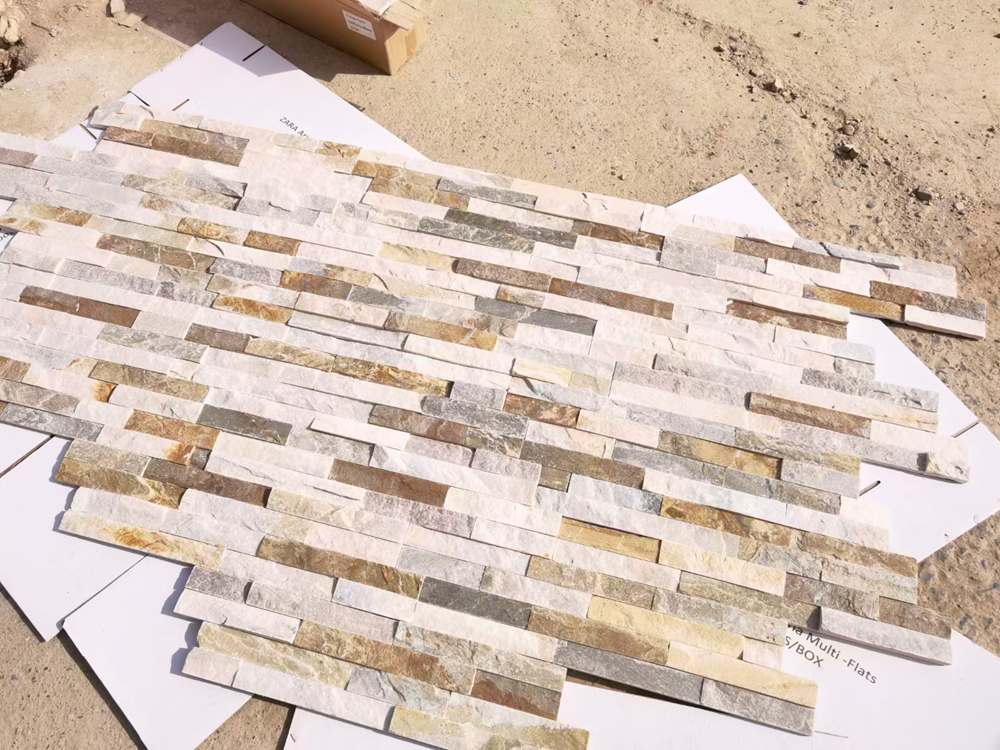
Builders and wholesalers often face high costs and complex structural requirements when using traditional heavy masonry. These materials impose a dead load of up to 40 lbs per square foot, which requires reinforced footings and expensive engineered supports. Selecting natural stacked stone veneer eliminates these burdens by reducing material weight to between 7.5 and 14 lbs per square foot, allowing for installation on standard 2×4 framing without structural modifications.
This article details how thin-sawn systems improve project efficiency through mechanical fastening and quarry-direct logistics. We examine the technical specs behind Z-shape interlocking panels and analyze transit data showing how a 24-ton truck carries up to 3,500 square feet of thin veneer, which lowers landing costs and simplifies inventory management for large-scale projects.
Evolution of Natural Stacked Stone Veneer in Siding
Stone veneer has transitioned from massive structural blocks to lightweight panels weighing under 2 lbs per sq. ft. By 2026, the industry emphasizes mortarless installation using finish nailers, achieving 10x faster application speeds while maintaining durability through ICC-ES fire and wind performance standards on diverse exterior substrates.
Transition from Structural Masonry to Lightweight Thin Systems
Builders previously relied on heavy, load-bearing stone blocks that required extensive structural support systems. Contemporary thin-sawn stone and polymer-based alternatives reduce material weight to less than 2 lbs per sq. ft., which removes the need for engineered tie-backs, steel lintels, or stone ledges. This weight reduction simplifies wall assembly design and allows for installation on projects that cannot support the mass of traditional masonry.
Modern veneer systems feature a thickness of less than 1 inch. This profile allows for application over standard exterior substrates, including guidelines typical for vinyl siding. By moving away from moisture-retentive mortar, these systems prevent structural decay and eliminate the chemical adhesion issues often found in older cement-aggregate manufactured stone. On-site cuttability ensures precise fitting around windows and corners without specialized masonry tools.
Mechanical Fastening Innovations and Building Code Compliance
Mechanical fastening represents a significant technical shift. Using 16-gauge finish nailers facilitates installation speeds roughly 10 times faster than traditional mortar-based methods. This approach eliminates the need for lath, grout, or specialized masonry labor, allowing siding crews to complete stone installations using existing tools. The nails recess into the material, creating a clean finish without visible fasteners.
Compliance with ICC-ES ESR-3970 and ESL-1247 ensures these materials meet high wind load and fire-rated safety requirements for 2026 building codes. The impermeable composition of modern polymer-based stone resists freeze-thaw cycles, UV exposure, and salt spray. This chemical stability prevents color loss and maintains structural integrity in harsh coastal or alpine environments, providing a durable alternative to traditional natural stone or heavy manufactured veneers.
Weight Analysis: Optimizing Logistics and Structural Load
Natural thin stone veneer typically weighs between 7.5 and 14 lbs per square foot, well below the 15 lbs limit set by ASTM C1670. This reduced mass allows for installation on standard 2×4 framing without structural footings and lowers shipping costs by approximately 75% compared to traditional full-depth stone.
| Material Type | Saturated Weight (sq ft) | Logistics Capacity (24T Truck) |
|---|---|---|
| Natural Thin Veneer | 7.5 – 14 lbs | 2,700 – 3,500 sq ft |
| Manufactured Veneer | < 15 lbs | Up to 3,200 sq ft |
| Full-Bed Stone | 25 – 40+ lbs | 600 – 840 sq ft |
Natural Thin Veneer vs. Full-Depth Load Requirements
Adhered natural stone panels maintain a saturated weight under 15 lbs per square foot. This specific weight profile ensures compliance with ICC AC51 safety standards for lightweight architectural cladding. Full-depth stone exerts 25-40+ lbs per square foot, which usually necessitates engineered footings and reinforced wall substrates to support the massive dead load. Using lightweight panels avoids these expensive structural modifications.
Standard thin panels vary in thickness from 0.75 to 2.5 inches. This range allows designers to balance aesthetic depth and texture with manageable structural loads. For projects in seismic zones, designers must account for IRC R301.2.2 provisions. These regulations require specific weight calculations for wall assemblies to ensure stability during high-risk events. Natural thin veneer provides a safer alternative in these environments by reducing the total mass of the wall assembly.
Engineering Standards and Transit Efficiency
ASTM C1670 testing confirms a minimum compressive strength of 2,100 psi for export-grade natural stone panels. This strength ensures the material survives the rigors of transit and long-term environmental exposure. Because these panels weigh significantly less than full-depth blocks, logistics become far more efficient. A single 24-ton truck carries between 2,700 and 3,500 square feet of thin veneer. In contrast, full stone yields only 25-35 square feet per ton, requiring multiple shipments for the same project coverage.
Wall surfaces must also meet strict deflection limits to prevent stone delamination or cracking. ICC AC51 mandates a deflection limit of 1/600 span for these substrates. Builders manage SKUs by thickness to ensure the combined weight of the stone and adhesive mortar remains within the 15 lbs per square foot limit. This strategic management prevents overages that could compromise the integrity of the wall or violate local building codes.
Sourcing Direct: How “Quarry-to-Container” Reduces Costs
Sourcing direct eliminates secondary handling and consolidation fees by moving material through a linear production chain. In 2026, this model uses precise 1-inch sawing tolerances and standardized 54 or 108 square foot pallets to ensure predictable landing costs and high-yield efficiency for international buyers.
| Production Metric | Specification Standard | Logistics Impact |
|---|---|---|
| Splitting Force | 600 Tons (Hydraulic) | Optimizes raw slab volume into usable cubes. |
| Sawing Tolerance | 1″ Thickness ± 1/4″ | Ensures predictable yield per quarried ton. |
| Pallet Configuration | 54 ft² / 108 ft² Modules | Maximizes container density and shipping efficiency. |
Integrated Production and the Quarry-to-Pallet Chain
Producers manage the entire linear flow from extraction to primary sorting to eliminate redundant handling fees. This vertical integration provides 2026 buyers with reliable yield data for every quarried ton through a controlled production flow. By bypassing secondary supply chain consolidators and third-party handlers, the direct logistics model significantly reduces price variance and ensures more stable landing costs for natural stone veneer.
Precise Specifications for Standardized Export Loading
The technical standard for veneer production begins with hydraulic guillotines applying 600 tons of force to prepare stone cubes for final 1-inch sawing. Strict ± 1/4 inch tolerances maintain consistency across large-scale orders. Standardized pallets use 9-square-foot layers to build 54-square-foot or 108-square-foot modules that optimize container space while protecting the integrity of the stone. Barcoded SKU labels track the collection, pattern, and order number to maintain precise inventory accuracy throughout the international supply chain.
Elevate Your Projects with Factory-Direct Stacked Stone Panels
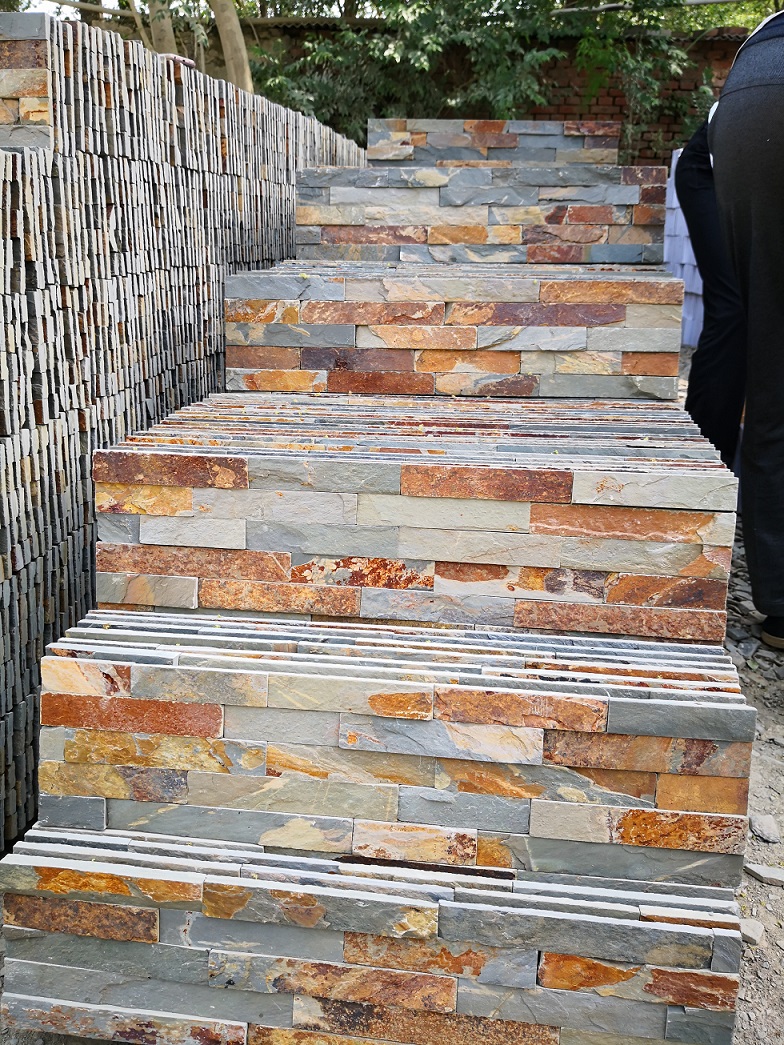
Quality Control: The Triple-QC Process for Export Grade
Export-grade quality depends on a three-tier inspection covering raw material grading, precision assembly with high-bond epoxy, and final structural audits. We test every batch against ASTM C1670 standards to ensure water absorption stays under 1.5% and compressive strength exceeds 30 MPa for global distribution.
Three-Stage Physical Inspection and Dimensional Accuracy
The production team inspects raw stone slabs immediately after infrared cutting to verify dimensional tolerances stay within a strict ±1–2 mm range. This precision prevents alignment issues during large-scale wall applications. A second check occurs after assembly to confirm the Z-shape interlocking edges create a seamless joint without visible gaps or height variations. This step ensures that once installed, the transition between panels remains undetectable to the eye.
We perform a final audit before loading into fumigated wooden crates to ensure stone pieces remain securely bonded to the mesh backing. This involves physical stress tests on the bond points to prevent detachment during transit or handling. Each batch also undergoes color grading at the quarry level. By sorting raw materials by tone, we prevent jarring transitions between panels in 2026 commercial installations and maintain a consistent aesthetic across thousands of square feet.
Engineering Specs and ASTM Performance Testing
Materials must meet ASTM C1670 specifications, which include a compressive strength of at least 30 MPa and linear shrinkage below 0.10%. These metrics guarantee the stone handles structural loads without cracking. We use specialized high-strength epoxy resin to ensure a permanent shear bond. This engineering choice prevents stone detachment even when the substrate experiences thermal stress from rapid temperature shifts.
Freeze-thaw testing per ASTM C666 validates that the stone maintains its integrity in extreme 2026 weather conditions. By keeping water absorption under 1.5%, the panels resist the internal pressure caused by ice expansion. The finished panels adhere to a maximum weight of 15 lbs per square foot. This weight limit satisfies IBC Section 1405.10.1 requirements for adhered veneer, allowing for safe installation on standard structural sheathing without the need for secondary mechanical supports.
Interlocking Z-Shape Design for Rapid Installation
Modular Z-shape panels eliminate visible seams by using stepped edges that overlap like puzzle pieces. This design reduces labor requirements for 2026 building projects, allowing installers to achieve a seamless dry-stack look using standard 6″ x24″ units without the need for on-site grouting.
Geometric Alignment and Joint Concealment
Stepped edge profiles overlap adjacent panels to hide vertical joints and maintain a continuous stone pattern across the entire surface. This puzzle-tab design forces panels into precise alignment, which reduces the technical skill level required to produce a flush finish. Since manufacturers bond the stone strips in the factory, installers no longer need to manage traditional mortar joints between individual pieces. High-strength epoxy resins ensure that these small stone components remain secure during transport and handling on 2026 construction sites.
Standardized Dimensions and Hardware Integration
Standard panels usually measure 6″ x24″ or 200 x 550 mm to provide predictable coverage and simplify inventory logistics. One-piece L-shaped corners, often sized at 200 x 200 x 40 mm, allow crews to wrap exterior edges without performing complex mitering in the field. The system specifications accommodate a weight of approximately 85 kg/m², making them compatible with load-rated cement boards or masonry substrates. Integrated metal Z-clips spaced at 300–400 mm intervals facilitate mechanical fastening, which accelerates the assembly of vertical wall sections.

Environmental Impact: Sustainable Quarrying in Yixian
Stone quarrying in Yixian generates approximately 3.13 kg of CO2 per ton, primarily through diesel and electricity use. Sustainable operations mitigate these effects by protecting local biodiversity, managing waste to allow animal movement, and restoring landscapes through reforestation. These practices ensure the long-term viability of natural stone veneer production for 2026 markets.
Habitat Preservation and Biodiversity Management
Regional research observations show that 63.3% of quarrying operations impact biodiversity and local forests. Waste accumulation and the creation of steep slopes block animal movement in 65% of surveyed areas, requiring active debris management to maintain migration paths. Restoration plans focus on reforestation and habitat enhancement to stabilize soil fertility and prevent land degradation. Quarry managers also implement blasting schedules and noise reduction protocols to minimize stress on local wildlife and surrounding communities.
Carbon Metrics and Air Quality Standards
Extraction processes release 3.13 kg of CO2 equivalent for every ton of limestone rock product produced. Electricity consumption drives 46.8% of fossil fuel CO2 emissions, which pushes the industry toward more efficient power grids and renewable energy sources. Modern machinery upgrades reduce nitrogen dioxide (NO2) and particulate matter levels during drilling and transport. Additionally, dust suppression systems and sediment monitoring protect local water quality and maintain air clarity for both workers and residents.
Custom OEM Branding for Major Building Retailers
Manufacturers provide full OEM and ODM services that allow building retailers to sell natural stone veneer under their own private brands. These services include custom-printed packaging, SKU-specific panel dimensions, and high-volume logistics that meet ANSI A118.4 standards for retail-ready distribution.
Private Labeling and White-Label Packaging Systems
Manufacturers offer full OEM and ODM services to help wholesalers create custom branding for natural stone ledger panels. Retailers choose specific colors and textures, including Ochre Blend quartzite or Portopo marble, to match 2026 inventory requirements. Packaging solutions provide custom-printed boxes featuring retailer logos, barcodes, and installation guides for 6” x 24” panels. This SKU management strategy allows vendors to market unique profiles like the Rockmount™ or Terrado® series under their own brand identity.
Supply Chain Logistics and Technical Standards for Retailers
Shipping configurations use 132 sq ft per skid for flats and 96 linear ft per skid for corners to lower costs for large-scale logistics. Products meet CMHA Certified MSV standards and Uniform Evaluation Services compliance to satisfy building codes required by major vendors. Standardized panel thickness stays between 1” and 2.5”, which ensures consistent stackability and manages structural loads in retail settings. Adhesion testing follows ANSI A118.4 and A118.11 standards so the stone panels bond reliably to cementitious surfaces.
Final Thoughts
The move toward lightweight stone systems changes how builders approach masonry. These materials stay under the 15 lbs per square foot threshold, which removes the requirement for specialized structural footers or heavy steel lintels. Siding crews can complete projects faster using standard tools while maintaining the authentic texture of real rock. This balance between reduced mass and durability makes thin veneer a practical choice for both residential and commercial exteriors.
Direct sourcing from quarries helps retailers manage inventory and control costs for large-scale orders. As 2026 building codes emphasize fire safety and moisture resistance, these tested materials provide a reliable way to meet strict performance standards. Selecting standardized panels with precise dimensions ensures that projects remain on schedule and within budget, even in demanding environments.
Często zadawane pytania
Is stacked stone veneer made of genuine rock?
Natural stone veneer consists of real sandstone, limestone, or granite sliced into thin sections. ASTM C1670 standards specify an average thickness of 2.625 inches (67 mm) or less. This measurement distinguishes natural stone from manufactured concrete alternatives.
How does thin stone veneer differ from full-bed stone?
Thin veneer weighs under 15 lbs per square foot and typically measures 0.5 to 1.25 inches thick. This profile allows for direct adhesion to walls. Full-bed stone ranges from 3 to 5 inches thick and weighs 35 to 45 lbs per square foot, necessitating a structural footing or ledge for support.
What packaging methods prevent stone breakage during export?
Suppliers use plywood crates lined with polythene to protect stone from moisture and impact. Standard 15x60cm panels ship in corrugated boxes containing 7 to 8 pieces. These boxes are stacked on 40×48 inch pallets, resulting in approximately 37.8 to 43.2 square meters per pallet.
Does this stone require a structural footing for installation?
Adhered thin stone veneer does not require a footing because the backing wall supports its weight. Full-depth stone requires a dedicated footing or masonry ledge at least 4.5 to 5 inches deep to accommodate the stone thickness and necessary air gaps.
Can these panels serve both interior and exterior applications?
Natural stone panels work for both indoor and outdoor projects on masonry or cementitious substrates. Exterior use requires a proper moisture-resistant barrier, flashing, and mortar specifically rated for freeze-thaw cycles.
What is the standard minimum order quantity for wholesale?
Wholesale orders generally require a minimum of one full pallet per SKU. This volume typically ranges from 150 to 300 square feet, depending on the stone profile and pallet configuration used for international logistics.
SEO
Title: Natural Stacked Stone Veneer: Sourcing Efficiency & Weight Specs
Description: Builders use natural stacked stone veneer to reduce structural loads and transit costs. This analysis covers technical specs and direct sourcing.
URL: natural-stacked-stone-veneer-logistics-efficiency
Keywords: natural stacked stone veneer
