
Sourcing stone veneers for large-scale projects requires more than just finding a low price; it demands a supply chain that balances technical precision with logistical reliability. As the global stone veneer market climbs toward a USD 2.8 billion valuation by 2032, B2B buyers face the challenge of navigating a landscape where China and India dominate exports but vary significantly in manufacturing infrastructure. Selecting the wrong partner can lead to inconsistent batches that fail to meet building codes or cause costly delays on the job site.
This guide examines the essential criteria for evaluating stacked stone manufacturers, comparing the 10–25% cost savings of quarry-direct sourcing against the flexibility of trading companies. We break down critical quality benchmarks, such as maintaining a dimensional tolerance of ±1–2 mm and water absorption rates below 0.5%, while providing a clear timeline for 20ft container production cycles. You will also find a deep dive into Incoterms 2020 and ethical sourcing standards to help secure your 2026 procurement contracts.
The Global Stacked Stone Manufacturing Landscape
China and India dominate the 2026 supply chain, collectively accounting for the majority of global stacked stone exports. While the total natural stone market is valued at approximately USD 44 billion, the specialized stone veneer and stacked panel niche is growing faster at 7.2%, driven by demand for modular, high-efficiency cladding solutions in North America and Asia-Pacific.
Primary Export Nodes and Regional Supply Capacity
China remains the leading global exporter of stacked stone, recording 199 major shipments centered primarily in the Fujian and Shandong provinces. These regions provide the high-volume manufacturing infrastructure necessary for large-scale commercial and residential projects. India follows as the second largest hub with 81 recorded shipments, drawing from extensive quartzite and slate reserves in Rajasthan and Karnataka to supply the international market.
In the premium segment, Brazil has emerged as a critical supplier of high-end quartzite. Extraction of Taj Mahal quartzite alone reaches 12,000 cubic meters per month, feeding the growing demand for luxury stone cladding. While South American and Asian hubs act as the primary origins, Singapore and other Southeast Asian locations serve as vital secondary logistics nodes, facilitating regional distribution across the Asia-Pacific corridor.
Market Valuations and 2026 Growth Projections
The global stone veneer market, which includes modular stacked panels, is on a trajectory to reach USD 2.8 billion by 2032. This growth outpaces the broader natural stone industry, as developers increasingly prioritize interlocking panel systems that reduce on-site labor costs. The Asia-Pacific region shows the most aggressive expansion with an 8.3% compound annual growth rate, supported by massive infrastructure investments in China and India.
Specific material segments also show significant financial scale; the granite-based stacked stone category is projected to reach USD 6.42 billion by 2033. High-value cladding systems are capturing a larger share of the overall market because they offer better installation efficiency compared to traditional loose stone masonry. This shift is particularly evident in North America and Europe, where rising labor costs drive the adoption of factory-assembled modular stone units.
Evaluating Quarry-Direct vs. Trading Company Suppliers
Quarry-direct suppliers offer 10–25% lower costs and superior color consistency through raw material control, making them ideal for high-volume commercial projects. Trading companies provide lower MOQs and mixed-material flexibility, serving smaller market-testing or residential niche orders.
| Feature | Quarry-Direct Manufacturer | Trading Company |
|---|---|---|
| Pricing Delta | 10–25% lower on bulk orders | Higher due to middleman margins |
| Order Flexibility | High MOQ (Full containers) | Low MOQ (Mixed SKU containers) |
| Kontrola jakości | Block-to-slab traceability | Inconsistent batch finishing |
| Customization | Non-standard sizes & bookmatching | Standard stock sizes only |
Operational Control and Cost Transparency
Eliminating middleman margins creates a price delta of 10–25% for bulk container orders. Direct access to raw stone blocks ensures year-round availability and stable pricing for multi-year 2026 contracts, protecting project budgets from market volatility. Transparent cost structures separate stone production from freight, providing clear logistics data that trading firms often hide within baked-in margins. Furthermore, in-house environmental and labor audits ensure compliance with documented sustainable extraction practices, fulfilling ESG requirements for corporate tenders.
Quality Consistency and Supply Chain Risk
Quarry owners select blocks at the face to maintain homogenous color and vein ranges across large batches, which is critical for maintaining visual uniformity in phased architectural projects. Full production traceability includes slab numbering, batch tracking, and live video inspections during the cutting process to verify quality before the material leaves the facility. Trading companies carry higher supply risks because they frequently switch sources at the last minute or rely on multiple factories with inconsistent surface finishing. Direct manufacturers support non-standard thicknesses and project-exclusive runs that trading firms cannot replicate with standard inventory.
Critical QC Benchmarks: From Thickness to Adhesion Strength
Top-tier quality control centers on precision and durability. Key benchmarks include a dimensional tolerance of ±1–2 mm, water absorption rates below 0.5%, and compressive strength exceeding 30 MPa. Adherence to ASTM C1670 and C629 standards ensures panels meet building codes and maintain structural integrity during long-term exterior use.
| Parameter | Benchmark Value | Testing Standard |
|---|---|---|
| Dimensional Tolerance | ±1–2 mm (L/W) | B2B Export QC |
| Compressive Strength | > 30 MPa | ASTM Dimension Stone |
| Water Absorption | ≤ 0.5% – 1.0% | ASTM C616 / C629 |
| Surface Flatness | < 1.5 mm deviation | Installation Readiness |
| Flexural Strength | 40–60 MPa | Engineered Stone Ref. |
Dimensional Precision and Surface Geometry Standards
Export-grade panels require a strict length and width tolerance of ±1–2 mm to prevent visible gaps in Z-shape interlocking systems. This precision ensures that large-scale commercial installations maintain a continuous aesthetic without mechanical interference between units.
Flatness deviation must remain under 1.5 mm across diagonals to avoid lippage and uneven surfaces after installation. We monitor squareness and diagonal accuracy within 1 mm per 1000 mm on both engineered and natural stone slabs to facilitate tight, professional joints.
Surface inspections verify the absence of visible glue lines and ensure all interlocking edges align for tight joints. Quality control teams classify and separate plates with excessive size deviation at the factory level, preventing mixed batches from reaching the project site.
Mechanical Performance and Material Certification
Compressive strength must exceed 30 MPa for building façades to withstand structural loads and environmental pressure. These metrics provide the necessary safety margins for high-rise cladding and high-traffic commercial exterior walls.
Water absorption targets of ≤ 0.5–1.0% are mandatory for exterior-grade stones to ensure freeze-thaw resistance in current climate conditions. Flexural strength benchmarks of 40–60 MPa serve as the primary indicator of resin quality and production integrity for engineered variants.
Compliance with ASTM C1670 for manufactured stone and ASTM C629 for slate validates fire safety and long-term weather resistance for commercial projects. These certifications demonstrate that the units meet building-code expectations for structural integrity and fire protection.
Adhesion systems require a scratch coat and polymer-modified mortar with sealant penetration depths of at least 5 mm. Proper installation follows adhered concrete masonry guidelines, utilizing corrosion-resistant metal lath to secure the veneer for the duration of the building’s lifecycle.
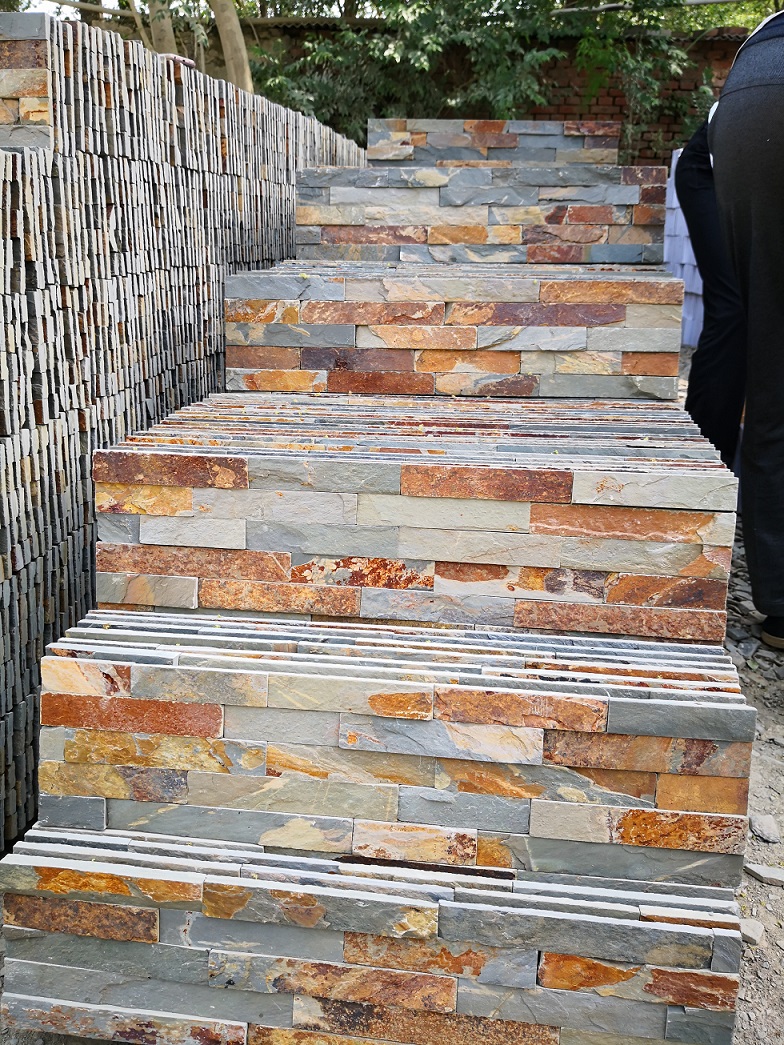
Premium Stacked Stone for Architectural Excellence
Lead Time Management: Standard Production Cycles for 20ft Containers
While a standard 20ft ISO container requires only 10–16 hours of physical assembly, the commercial lead time for 2026 planning typically spans 2–6 weeks. This includes 1–4 weeks for production scheduling and 1–3 weeks for inland transport and port handling before the unit is ready for ocean transit.
Technical Assembly and Factory Takt Time
Primary manufacturing involves 10–16 hours of direct labor. This cycle includes panel welding for two hours, frame assembly for three hours, and painting processes lasting four hours. These technical windows represent the physical movement of raw steel into a finished ISO 1CC dry cargo container.
High-volume plants utilize parallel workstations and continuous flow processing to achieve a takt time of 6–8 minutes per unit. This efficiency allows factories to output significant volumes daily once the line reaches full capacity. All units must adhere to ISO 668 and ISO 1161 standards to maintain structural integrity, particularly for heavy stacked stone loads that exert high pressure on the floor and corner castings.
The final stages of the technical cycle involve inspection and marking, which add approximately one hour to the total time per container. During this phase, quality control teams verify weld penetration and paint thickness to ensure the equipment meets CSC requirements for international transit.
Commercial Production Cycles and Logistics Buffers
The time between contract confirmation and production line entry requires a 1–4 week buffer. This period depends on factory capacity and seasonal demand fluctuations anticipated for 2026. Scheduling must account for existing order backlogs, even if the physical assembly takes less than a day.
Post-production logistics add 1–3 weeks to the timeline. This stage involves trucking the finished units from the factory to major Chinese ports and managing terminal handling. Since stone fabrication must sync with equipment availability, coordinating these inland movements is vital for maintaining a lean supply chain.
Customs clearance and domestic handling procedures typically consume another 1–2 weeks before the export leg begins. Importers should forecast a total order-to-ready-at-port window of 2–6 weeks. This duration allows enough time for stone suppliers to prepare materials while the container equipment moves from the assembly line to the port storage stack.
Understanding Incoterms and Global Logistics Safety
Incoterms 2020 governs the delivery, risk, and cost allocation for stacked stone imports. For containerized cargo, FCA is preferred over FOB to align with terminal hand-off points, while CIP ensures higher default insurance coverage (Institute Cargo Clauses A) for damage-sensitive natural stone.
Core Responsibilities and Risk Transfer in Incoterms 2020
The Incoterms 2020 standards apply to 11 distinct trade terms used in international and domestic sales. Each rule outlines 10 specific seller obligations, labeled A1 through A10, and 10 corresponding buyer obligations, labeled B1 through B10. These obligations define the division of tasks regarding delivery, carriage, and export or import clearance.
Risk transfer happens at precise geographic nodes. For FCA (Free Carrier), risk shifts when the seller loads the goods onto the buyer’s first carrier. In contrast, for maritime-only terms like FOB (Free on Board) and CIF (Cost, Insurance, and Freight), risk transfer occurs only when the goods are placed on board the vessel. Importers should use the specific notation formula: “[Rule] [Named place] Incoterms 2020” to ensure legal clarity in contracts.
The 2020 revision introduced DPU (Delivered at Place Unloaded) to replace the previous DAT (Delivered at Terminal) term. This change clarifies that the seller can unload goods at any agreed-upon location, such as a construction site or private warehouse, rather than being restricted to a transport terminal. The International Chamber of Commerce maintains these standards through at least 2026, with the next major update anticipated in 2030.
Logistics Safety Standards and Insurance for Stone Cargo
Security requirements are now integrated directly into the A4 and A7 obligations of each rule. This structure ensures that costs for mandatory security measures, such as ISPS-related terminal controls or cargo screening, are explicitly allocated under sections A9 and B9. This precision helps importers of heavy stacked stone avoid unexpected surcharges at the port of departure.
Insurance requirements also changed under the 2020 rules, particularly for CIP (Carriage and Insurance Paid To). While CIF maintains a lower “C” level of default insurance cover, CIP now requires the seller to provide “Institute Cargo Clauses A” coverage. This higher level of insurance is more suitable for natural stone, which faces risks of breakage and chipping during multimodal transport. Carriers and insurers suggest using FCA instead of FOB for containerized stone shipments to better reflect the actual point where the seller hands over control at an inland depot or container yard.
Modern rules also recognize changes in transport logistics by allowing buyers and sellers to use their own vehicles. Under FCA or D-terms like DAP and DDP, the parties no longer must hire a third-party carrier to fulfill the delivery requirements. This flexibility supports importers who manage their own trucking fleets for the final mile delivery of heavy palletized materials.
Customization (OEM/ODM): Private Labeling for Retail Chains
Retail chains can leverage ODM for rapid 1–4 week development cycles or OEM for full design control, supported by 72-hour 3D prototyping and precision tolerances of ±0.03mm to ensure brand consistency and durability.
Differentiating OEM and ODM Development Cycles
Retailers choosing between Original Design Manufacturing (ODM) and Original Equipment Manufacturing (OEM) must weigh speed against creative control. ODM cycles for stacked stone panels move quickly, often reaching completion within 1 to 4 weeks once the partner selects from existing designs and tooling. This path minimizes technical risk and accelerates time-to-market for seasonal inventory updates.
OEM projects offer a higher level of involvement, allowing for complete authority over material blends, exact dimensions, and specialized finishes. Because these projects require custom tooling and unique material sourcing, the timelines extend beyond the standard ODM window. Engineers initiate the process with 3D drawings and tolerance analysis, delivering technical blueprints within 72 to 96 hours. Following approval, physical sample proofing for feasibility takes roughly 7 to 15 days, ensuring the product meets all structural requirements before mass production begins.
Technical Compliance and Private Labeling Specifications
Precision in large-scale retail distribution relies on rigorous metrology and testing protocols. Production lines utilize 3D scanners with an accuracy of ±0.03mm, maintaining processing tolerances below 0.1mm to ensure every panel fits perfectly during installation. Durability is verified through EN 12472 standards for long-term wear resistance and ASTM F2923 for tensile strength, confirming that the panels can withstand structural stress without compromising integrity.
Regulatory compliance for 2026 mandates that all stone products satisfy ROHS and REACH heavy metal and lead-free requirements. To protect brand identity, private labeling services include custom-printed packaging, logo stamping on accessories, and the use of NDA-protected production lines. Quality control teams perform 100% full inspections using spectrophotometers for color consistency and hardness testers for material density, providing a documented trail of quality for retail procurement officers.
Ethical Sourcing and Social Responsibility Audits
Ethical sourcing in the stone industry centers on verifiable third-party audits such as ANSI/NSC 373 and Fair Stone. These frameworks ensure supply chain transparency, fair labor conditions, and environmental stewardship, providing importers with a measurable way to mitigate social risks and meet global sustainability benchmarks.
Global Compliance Frameworks: ANSI/NSC 373 and Fair Stone Standards
The ANSI/NSC 373 Natural Stone Sustainability Standard serves as a primary benchmark for assessing resource efficiency and environmental management. This certification tracks the ecological footprint of stone production by evaluating air and water pollution controls alongside supply chain transparency. Factories adhering to these protocols demonstrate a commitment to documented sustainability that goes beyond basic industrial requirements.
Fair Stone Certification provides the necessary third-party verification for labor conditions within the supply chain. This standard focuses on social responsibility by enforcing fair wages and maintaining a strict prohibition on child labor. When combined with ISO 14001 integration, manufacturers implement robust environmental management systems that specifically target water usage efficiency and waste reduction during the fabrication of stacked stone panels.
Regional compliance remains a critical factor for international trade. For the European market, adherence to the EU Construction Products Regulation (CPR) and the acquisition of CE marking are mandatory requirements. These certifications ensure that the stone products meet specific safety and performance criteria required for legal entry and distribution within the EEA, aligning with 2026 sustainability targets.
Operational Audits: Labor Safety and Environmental Impact Assessments
Operational audits evaluate the technical and social metrics of both factories and quarries. Social governance metrics involve rigorous verification of worker health and safety protocols. Auditors look for zero-tolerance policies regarding labor exploitation and ensure that safety equipment and training meet international occupational health standards. These inspections protect importers from reputational risks associated with unethical labor practices.
Ecological impact controls are measured through local environmental impact assessments. Certified facilities must operate mandatory dust control systems to protect air quality and implement water recycling loops to minimize groundwater depletion. These technical systems are essential for meeting the strict environmental codes enforced in major stone-producing regions. Furthermore, documented quarry rehabilitation plans are required to outline strategies for land restoration and replanting once extraction activities conclude.
Chain-of-custody documentation provides the final layer of transparency by tracing the material from its origin to the final delivery. This data is vital for North American importers seeking ASTM compliance and LEED material credits. By maintaining clear records of where and how the stone was extracted and processed, suppliers help developers achieve green building certifications and ensure long-term supply chain reliability.
Final Thoughts
Successful sourcing in the stacked stone market depends on balancing technical precision with supply chain transparency. By prioritizing direct factory relationships and verifying adherence to ASTM and ISO standards, buyers secure consistent quality and significant cost savings. The shift toward modular, factory-assembled panels reflects a broader industry move to reduce labor costs while maintaining the aesthetic value of natural stone.
As the 2026 manufacturing landscape evolves, ethical sourcing and logistics management remain central to mitigating risk. Companies that integrate sustainability audits like ANSI/NSC 373 into their procurement process protect their brand reputation and ensure long-term project viability. Clear communication regarding Incoterms and production timelines allows for a reliable flow of materials from the quarry to the final installation site.
Często zadawane pytania
How do I verify a stone factory’s quality from overseas?
Verify quality by requesting compliance with EN 13755 for water absorption and ASTM C97 for density. Professional manufacturers follow AQL 4% sampling per ISO 2859-1:2012 and provide CE marking for EU exports. You should also confirm Mohs hardness levels reach 7 or higher for quartz materials.
What are the typical lead times for stone production in 2026?
Standard production cycles for made-to-order stacked stone panels generally range from 4 to 6 weeks. Some factories maintain quick-ship programs that ready priority items for dispatch within 1 to 2 weeks.
How do manufacturers handle stone breakage claims?
Most export contracts establish an allowable breakage threshold of 2% to 3% of the total volume. Manufacturers compensate for damage exceeding this limit through credits or replacements in future shipments, provided you supply documented photo evidence and third-party inspection reports.
Can a factory customize stone panel sizes?
Factories offer sub-millimeter precision for custom dimensions, reaching up to 5 ft x 10 ft. Standard tolerances for length, width, and squareness are maintained at approximately ±1/16 inch (1.6 mm) to ensure seamless interlocking during installation.
What certifications should a stone manufacturer have?
Look for ISO 9001 quality management and ISO 14001 environmental standards. High-performance products should meet ASTM C39 for compressive strength (≥ 6,500 psi) and ASTM C642 for water absorption (≤ 6%). Sustainability-focused suppliers may also hold ANSI/NSC 373 certification.
Is it cheaper to buy direct from the factory?
Buying direct typically reduces costs by 15% to 25% compared to distributor pricing. By removing middleman markups, material costs for stacked stone flats can start as low as $4.79 per square foot.
