
Selecting the wrong bonding agent for natural stacked stone veneer creates significant liability and maintenance costs for commercial projects. These stone modules carry a saturated weight of 15 lbs per square foot, demanding an adhesive that supports sustained dead loads and resists environmental stress to prevent bond failure.
We compare the performance of Type N and Type S mortars, focusing on how Type S reaches the 1,800 to 3,000 PSI necessary for load-bearing applications. We also detail why modern standards favor polymer-modified mixes that achieve shear bond strengths up to 428 psi, far exceeding the 50 psi minimum required by ASTM C1670 for vertical adhesion.
Why Mortar Choice is Critical for Stacked Stone Longevity
By 2026, professional standards emphasize polymer-modified mortars to achieve shear bond strengths up to 428 psi, far exceeding the 50 psi minimum. These materials support the 15 lb/ft² saturated weight of stone while resisting freeze-thaw cycles and thermal expansion, preventing bond failure over a 50-year service life.
Structural Adhesion and Shear Bond Requirements
ASTM C1670 requires adhered masonry veneers to maintain a shear bond strength of at least 50 psi to prevent pieces from falling. While this serves as the minimum safety standard, many engineered stone veneer mortars reach 428 psi at 28 days. This high strength provides a massive safety margin for stone modules that carry a saturated weight of 15 lbs per square foot, ensuring the installation remains secure under sustained dead loads.
Non-sag formulas allow for precise dry-stack placement by holding stone pieces firmly against the wall during the 1.5 to 2.5-hour setting window. These specialized mortars prevent stones from slipping or shifting before the bond fully cures, which is vital for maintaining the intended aesthetic without the support of grout joints. Using the correct mix ensures that the vertical alignment stays perfect throughout the application process.
Environmental Resilience and Moisture Management
Mortar systems tested under ASTM C1690 show less than 1.5% weight loss after 50 freeze-thaw cycles when applied in 1/4 to 3/8 inch beds. This durability allows the facade to withstand the expansion and contraction caused by extreme temperature shifts. Polymer-modified mixes meeting ANSI A118.4 or A118.15 standards effectively manage thermal expansion stresses, protecting exterior stone walls from cracking or delaminating over time.
Full-mortared applications provide a reliable moisture barrier that supports a life expectancy of 20 to 50 years in wet climates. By creating a continuous bond coat without voids, the mortar prevents water from pooling behind the stones. This moisture management stops the formation of ice pockets and reduces the appearance of efflorescence, keeping the stone surface clean and structurally sound for decades.
Comparing Type S vs. Type N Mortar for Stone Cladding
Type N mortar offers 750 PSI and high flexibility for above-grade veneers, making it ideal for soft stone and minor wall movement. Type S provides 1,800 to 3,000 PSI, offering the structural rigidity needed for load-bearing walls, retaining structures, and below-grade installations.
| Property | Type N Mortar | Type S Mortar |
|---|---|---|
| Compressive Strength | 750 PSI | 1,800 – 3,000 PSI |
| Mix Ratio (C:L:S) | 1:1:6 | 2:1:9 (High Portland Cement) |
| Best Application | Above-grade veneers, soft stone | Load-bearing, below-grade, structural |
| Flexibility/Bond | High flexibility | High tensile strength |
Compressive Strength and Mix Ratios
Type N mortar utilizes a 1:1:6 mix of Portland cement, lime, and sand to reach 750 PSI. This ratio prioritizes workability and creates a softer bond that accommodates minor structural shifts. Type S mortar achieves 1,800 to 3,000 PSI because of higher Portland cement concentrations. This added strength provides the necessary support for heavy masonry and structural loads.
Type N provides superior bond flexibility which prevents cracks in soft stone during thermal shifts. The higher lime content allows the mortar to “breathe” and move with the building. Type S functions as a high-tensile binder for heavy exterior stone cladding and structural masonry. It creates a rigid connection that resists lateral forces and heavy vertical pressure.
Environmental Suitability and ASTM C270 Standards
Contractors select Type N for above-grade chimneys and interior accent walls where ease of tooling is a priority. It works well with manufactured stone and natural thin veneers. Type S serves projects involving high wind loads, moisture exposure, or freeze-thaw cycles. Its denser composition prevents water penetration in harsh climates.
Below-grade foundations and retaining walls require Type S to withstand soil pressure and lateral stress. Using a weaker mortar in these areas can lead to structural failure under the weight of wet earth. Adhering to ASTM C270 classifications ensures a joint lifespan of 20 to 30 years in standard construction environments. These standards guide the selection of the correct binder to match the specific demands of the site and the stone type.
Polymer-Modified Thinsets for Weight-Sensitive Walls
Polymer-modified thinsets provide the high shear bond strength and sag resistance needed to secure natural stone panels to vertical surfaces. By 2026 standards, these mortars must meet ANSI A118.4 to ensure long-term adhesion on substrates like plywood or gypsum without exceeding structural load limits.
| Mortar Product | Standards Met | Shear Bond Strength (28-Day) |
|---|---|---|
| VersaBond® Professional | ANSI A118.4, A118.11 | 450–550 psi (Glazed Wall Tile) |
| MAPEI Keraflex Plus | ANSI A118.4, A118.15 | 220–340 psi (Porcelain) |
| SPEC MIX XP500 | TMS 402/602, ASTM C482 | Exceeds High-Performance Thresholds |
Performance Standards for Vertical Adhesion
Polymer additives increase the mechanical bond between the stone backing and the substrate. This bond strength is essential for carrying vertical dead loads on interior and exterior walls. Sag-resistant formulations found in products like SPEC MIX XP500 and PROMA PRO FLEX SF allow installers to place heavy stone without vertical slip during the curing process. These mortars use specific sand gradations and chemical modifiers to support stone units weighing 8–13 lbs per square foot.
High-performance modified mortars frequently exceed ANSI A118.4 and ANSI A118.15 standards. These ratings ensure the adhesive maintains its integrity under environmental stress. In panelized stone manufacturing, companies often apply high-strength epoxy resins to secure the stone to mesh or concrete backings before field installation. This dual-layer approach provides a reliable system for vertical applications where weight management is a priority.
Shear Bond Strength and Substrate Requirements
Professional-grade thinsets like VersaBond achieve shear bond values between 450 and 550 psi on glazed tile and 300 to 400 psi on porcelain when tested under ANSI A118.4 protocols. These values offer a significant safety margin for natural stone veneers. Wood-framed wall assemblies require high stiffness to prevent stone cracking. Industry standards mandate a maximum deflection limit of L/720 for stone installations, which is twice as rigid as the standard L/360 limit used for ceramic tile.
Lightweight substrates, including gypsum or cement underlayments, must maintain a minimum compressive strength of 2,000 psi (13.8 MPa) to support polymer-modified bond coats. Proper application involves maintaining a minimum cured mortar thickness of 3/32 inch (2.4 mm). This layer effectively distributes stress across the wall surface. Typical coverage rates of 50–100 square feet per 50-lb bag help engineers calculate and manage the total dead load on weight-sensitive residential structures.
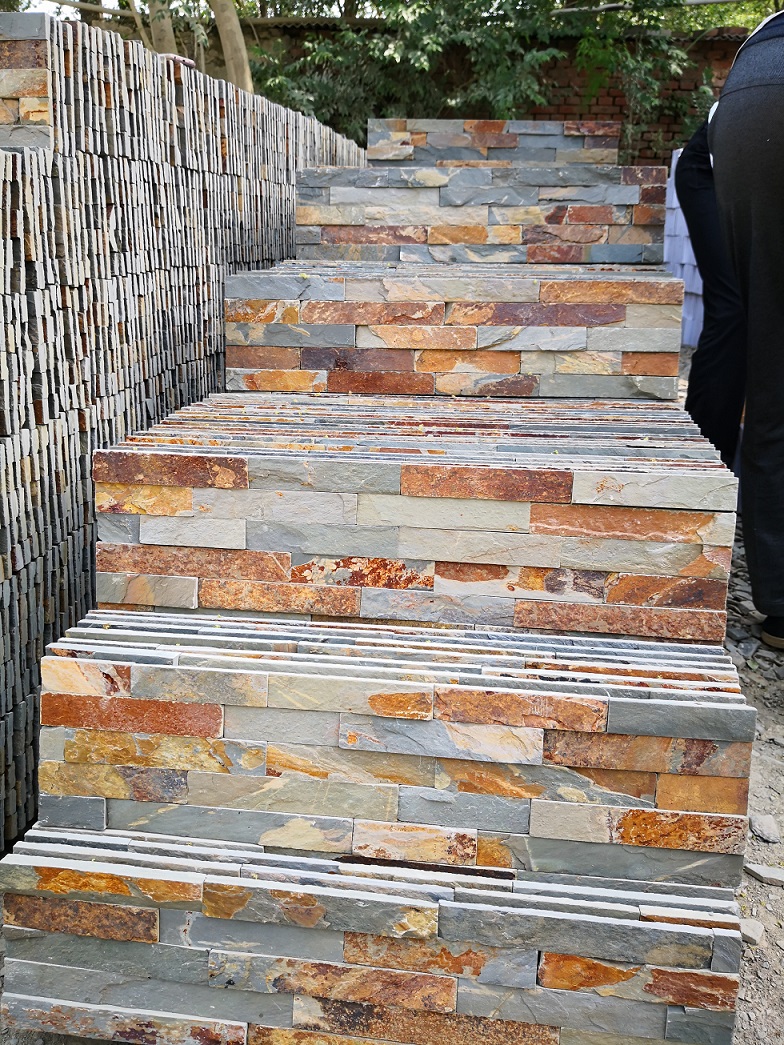
Elevate Your Projects with Premium Stacked Stone Ledger Panels
Substrate Prep: Metal Lath, Scratch Coats, and WRBs
In 2026, industry standards require a layered assembly starting with a continuous water-resistive barrier (WRB). Installers then attach self-furring metal lath per ASTM C1063 to provide a 1/4-inch gap for mortar keying. A 3/4-inch scratch coat completes the base, providing the mechanical grip and 100-200 psi bond strength necessary for heavy stacked stone.
Moisture Barrier Integration and Lath Attachment Standards
Installing a continuous water-resistive barrier (WRB) behind the lath serves as the primary defense against moisture. We integrate this barrier with weep screeds at the base of the wall to ensure any water that bypasses the stone veneer drains safely away from the structure. Using self-furring metal lath with 1/4-inch dimples provides the necessary standoff from the substrate, allowing mortar to flow behind the wire and create a complete mechanical key. We overlap lath sheets by 1 inch at all seams, ensuring metal-to-metal contact by keeping the WRB material behind the laps. Corrosion-resistant fasteners, spaced 6 inches on center, secure the lath into the framing members to meet ASTM C1063 structural requirements.
Scratch Coat Mix Requirements and Performance Data
The scratch coat must reach a thickness of 3/4 inch to establish a rigid foundation for stone adhesion. We maintain ambient temperatures between 45–85 °F for at least 48 hours during and after application to prevent flash drying or frost damage that could weaken the bond. The system utilizes expanded galvanized steel lath, typically weighing 2.5 lb/yd² or 3.4 lb/yd² as specified by ASTM C847 for heavy masonry loads. Before we apply the final stone layer, we verify that the scratch coat and substrate achieve a minimum tensile bond strength of 100-200 psi through ASTM C1583 testing. This data confirms the assembly can support the weight of stacked stone without delamination.
The Back-Buttering Technique for 100% Bond Coverage
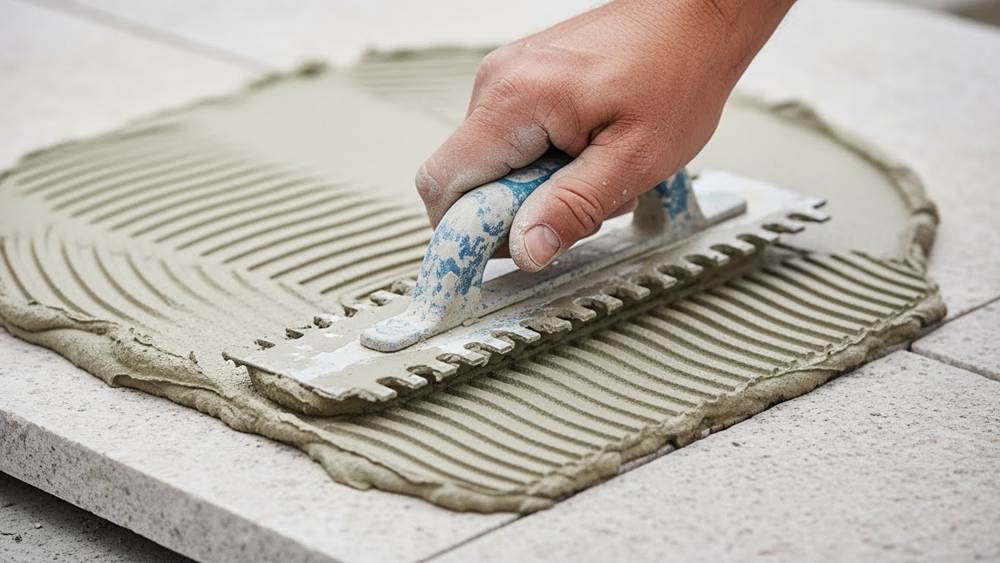
Installers achieve a full bond by applying a 1/2-inch layer of mortar to the entire back of the stone unit. This technique, combined with directional troweling on the substrate, ensures the 95% coverage required for natural stone and prevents voids that lead to cracking or moisture damage.
Application Process for Full Mortar Transfer
Applying a continuous 1/2-inch nominal coat of mortar across the entire back of each stone unit ensures a stable installation. This technique replaces the use of perimeter dabs, which often leave hollow centers and unsupported edges. Use the flat side of the trowel to force the mortar into the stone’s texture, filling any embossing or surface irregularities. This step creates a “burn coat” that maximizes the bond between the mortar and the stone. To maintain the material’s ability to transfer to the substrate, spread mortar on only 8 to 10 square feet of the wall at one time. This limit prevents the mortar from skinning over before the stone reaches the surface.
Bond Standards and Performance Specifications
Installations must maintain 95% mortar coverage for all natural stone to meet 2026 TCNA and ANSI A108.5 guidelines. This standard requires that no voids exceed 2 square inches and that all corners remain fully supported. For stone units larger than 1 square foot or longer than 24 inches, use ANSI A118.4 or A118.15 polymer-modified thinsets. These specialized mortars provide the necessary strength for larger dead loads. After placing the unit, wiggle the stone perpendicularly into the notched substrate to collapse mortar ridges. This action eliminates air pockets and creates a solid setting bed that resists moisture intrusion and structural failure.
Managing Thermal Expansion in Outdoor Stone Walls
Exterior stone walls require planned movement joints to absorb thermal stress. Standards like TCNA EJ171 recommend 3/8-inch joints every 8 feet, ensuring the system accommodates the 100-degree temperature swings common in 2026 climate designs without cracking or debonding.
Thermal Coefficients and Material Movement
Natural stone masonry typically exhibits a thermal expansion coefficient of 4 x 10⁻⁶ in/in/°F. When working with engineered stone products like quartz, designers must account for movement 4 to 7 times greater than natural masonry, with coefficients reaching 30–50 x 10⁻⁶ °C⁻¹. Stone units function as thermal mass with R-values between 0.58 and 0.62, transmitting temperature swings directly into the wall assembly rather than providing insulation. Moisture and freezing conditions increase the design expansion coefficient to 5 x 10⁻⁴ in/in under TMS 402 guidelines to ensure the system withstands combined environmental stressors over its service life.
Joint Spacing and Deflection Requirements
TCNA EJ171 requires 3/8-inch wide expansion joints at maximum 8-foot centers for exterior stone cladding to prevent bond failure. Installers must increase joint widths by 1/16 inch for every 150°F temperature variation that exceeds the standard 100°F baseline. For stone installed on metal studs, the Natural Stone Institute recommends a maximum out-of-plane wall deflection of L/720 to minimize the risk of cracking or debonding. Contractors often utilize two layers of 2-inch stone-wool strips within these joints to maintain thermal continuity while providing the compressibility needed for the wall to move freely.
Avoiding Common Adhesion Failures in Wet Climates
Reliable adhesion in wet climates depends on using polymer-modified mortars meeting ANSI A118.4 or A118.15 standards. Professionals prioritize 100% back-buttering to eliminate water-collecting voids and choose concave joints over dry-stacking to reduce moisture penetration and freeze-thaw expansion risks.
Mortar Chemistry and Environmental Thresholds for 2026 Standards
Successful stone bonding in moisture-heavy zones requires polymer-modified mortars that conform to ANSI A118.4 or ANSI A118.15. These materials provide the bond flexibility needed to survive repeated freeze-thaw cycles. While Type N mortars serve many standard roles, professionals favor Type S mortars meeting ASTM C270 guidelines for exterior applications because of their higher bond strength. Installation timing also impacts the integrity of the system; maintaining temperatures between 40°F (4.4°C) and 90°F (32°C) prevents brittle hydration or chalky bond lines. When using absorptive stones like limestone, installers pre-dampen the material to prevent the substrate from pulling water out of the mortar mix and weakening the chemical set.
Moisture Detailing and Mechanical Bond Execution
Physical application techniques prevent water-driven delamination by managing how moisture interacts with the stone veneer assembly. Following IBC §1404.10, contractors apply an adhesive bed between 3/8 inch and 1 1/4 inches for adhered masonry systems. Implementing 100% back-buttering coverage removes the internal pockets where water typically accumulates and expands during freezing cycles. To shed bulk water effectively, crews tool joints into concave shapes; dry-stack patterns invite moisture penetration and are generally avoided in harsh environments. For concrete surfaces such as tilt-up or cast-in-place walls, sandblasting or mechanical cleaning removes bond inhibitors to provide a suitable surface for the scratch coat.
Final Thoughts
Selecting a high-performance mortar ensures a stacked stone installation lasts for several decades. Projects rely on polymer-modified mixes and Type S mortars to manage the heavy dead loads of natural veneer. These materials provide the shear bond strength needed to withstand freeze-thaw cycles and vertical pressure without losing adhesion.
Long-term success also requires strict attention to substrate preparation and back-buttering techniques. Combining a solid scratch coat with 95% mortar coverage eliminates the air pockets where moisture typically collects. Sticking to these engineering standards keeps exterior walls structurally sound and prevents the costly repairs associated with bond failure and water intrusion.
Często zadawane pytania
What is the best mortar for stacked stone veneer in 2026?
Type S mortar or polymer-modified veneer stone mortar remains the industry standard. These mixes must meet ASTM C270 and ASTM C1714 requirements to ensure safety. Type S provides a minimum compressive strength of 1,800 psi at 28 days, which is necessary to support the weight of natural stone panels.
Can I use standard construction adhesive for stone installation?
No. Standard construction adhesive does not provide the structural bond required for heavy stone. You must use polymer-modified portland cement adhesive mortar that complies with ANSI A118.4. Ensure 100% coverage with a 1/2 inch (13 mm) mortar thickness on the back of each stone to prevent adhesion failure.
Is metal lath necessary for interior stone walls?
Metal lath is required when installing stone over wood studs, metal studs, or any painted masonry surface. Use 2.5 or 3.4 lbs./sq. yd. self-furring wire lath conforming to ASTM C847. You can install stone without lath only if the substrate is clean, unsealed concrete or concrete masonry units (CMU).
How much mortar should I order for a 100-square-foot area?
For typical dry-stack installations, use two 75-lb bags of Type S mortar to handle both the scratch coat and the bond coat. If your project requires grouted joints between the stones, add a third 75-lb bag to your materials list.
Why do stones sometimes pop off the wall after installation?
Stones typically detach due to moisture trapped behind the veneer or restricted thermal movement. Many failures occur when expansion joints are too narrow (often only 1/4 inch) or when the mortar bed depth is thinner than the 1 5/8-inch to 2-inch requirement for full-depth bonding.
Can I install stone panels directly over a painted exterior wall?
No. Paint serves as a bond breaker and will cause the stone to fall. You must either mechanically remove the paint to reach the bare masonry or install a layer of metal lath and a 1/2 inch (13 mm) mortar scratch coat to create a proper bonding surface.
