

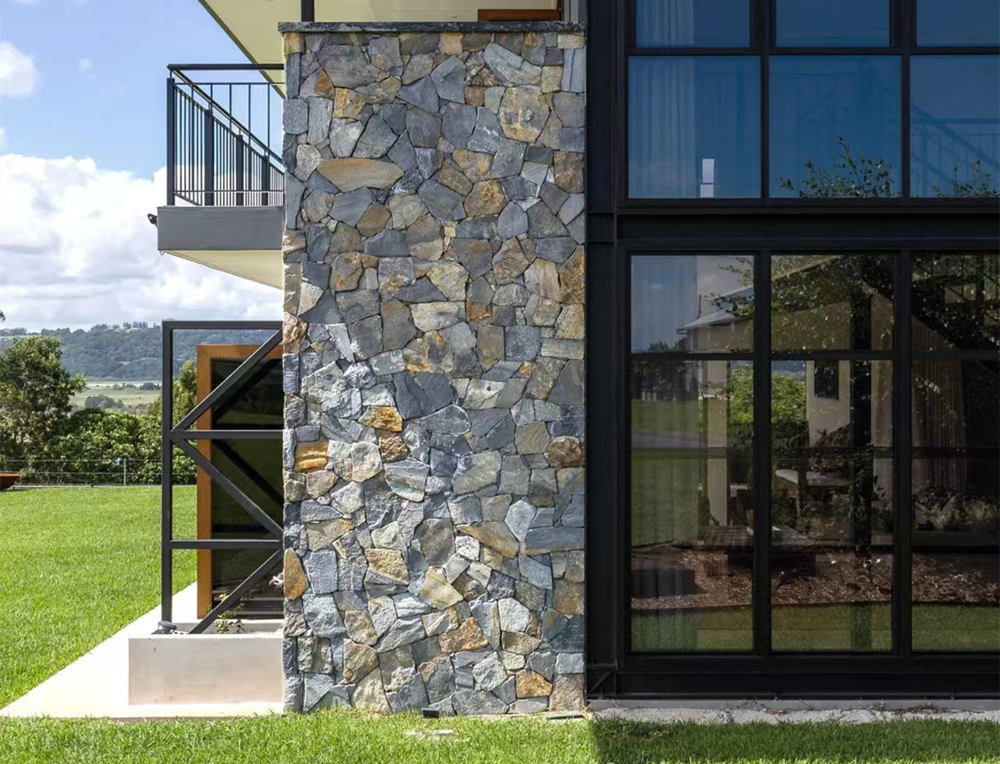
On-site miter cutting remains one of the most expensive hidden costs in masonry, with manual corner fabrication often adding $50 to $150 per linear foot over base material prices. For B2B buyers and contractors, these financial leaks grow larger when factoring in the 5% to 10% contingency fees required to cover stone breakage during delicate manual assembly. Transitioning to factory-prefabricated L-shaped stone corners eliminates these labor surcharges while providing the authentic look of full-bed masonry without the structural weight.
This guide analyzes the top global suppliers providing 90-degree corner units engineered for durability and visual depth. We examine the economic shift from $800 lump-sum masonry charges to modular 6” x 24” units, the technical precision of two-stage saw feed profiles that prevent transit fractures, and how specific return ratios create the illusion of massive eight-inch thick walls using lightweight veneer.
10 Top Global Thin Stone Veneer Suppliers Providing Prefabricated Corners
Quick Comparison: Top Picks
| Manufacturer / Brand | Location | Core Strength | Verdict |
|---|---|---|---|
| TopSource Stone | China (Global Shipping) | Natural Stone Ledger Panels & Prefab L-Shaped Corners | Best for factory-direct natural stone with precision interlocking systems and high profit margins. |
| J&N Stone, Inc. | Wakarusa, Indiana, USA | Natural Stone Veneer & Matching Corner Units | Top choice for North American residential and commercial masonry projects requiring regional stock. |
| MSI Surfaces (Rockmount) | Orange, California, USA | Split-Face Genuine Stone Interlocking Z-Panels & Corners | Top pick for North American buyers seeking seamless 90-degree corner returns with massive warehouse reserves. |
| Stonepanel (Cupa Group) | Spain / Europe Sourcing | Patented Monolithic Cement-Backed Natural Stone Corners | The absolute global benchmark for multi-story exterior wall corners with built-in safety anchors. |
| Stone Center USA | United States | Thin Stone Veneer & Matching Prefab Corners | High-quality U.S. distributor focused on cohesive exterior finishing accessories and quick dispatch. |
| ErthCoverings | Toronto, Canada | Precision-Cut Natural Interlocking Corner Veneers | Premier choice for high-end alpine residential projects requiring zero-water-absorption natural slates. |
| Tier Natural Stone | United Kingdom / Ireland | Modular Natural Stone Z-Panels & Calibrated L-Corners | Best for Western European commercial builds seeking completely hidden vertical joint layouts. |
| Eco Outdoor | Sydney, Australia | High-Relief Natural Stone Corner Units & Wall Strips | Top recommendation for Australian resort architecture requiring salt-resistant 90-degree corner returns. |
| RealStone Systems | Milan, Michigan, USA | Natural Stone Composite Panels & Mitered L-Kits | Excellent for professional designers seeking trending color palettes and optimized freight packaging metrics. |
| K2 Stone | Canada / North America | Natural Stone Veneer & Architectural Components | The go-to source for authentic, rugged natural stone and corner pieces throughout North America. |
TopSource Stone
TopSource Stone operates as a vertically integrated manufacturer, maintaining direct ownership of its quarries to ensure consistent material quality. By managing the supply chain from the raw stone extraction to the finished product, the company offers commercial contractors and distributors a level of pricing and quality control that is often lost through third-party sourcing. Their production facility utilizes advanced infrared precision cutting technology, which allows for the creation of interlocking ledger panels designed to fit together without visible grout lines, providing a high-end aesthetic for large-scale architectural projects.
The technical execution of their natural stone systems focuses on reducing onsite risks and labor costs for professional installers. Each panel is bonded with high-strength epoxy to prevent delamination, ensuring long-term durability in varied climates. Beyond standard production, they provide specialized OEM and ODM services, manufacturing L-shaped corners and custom dimensions to meet specific blueprints. This factory-direct model eliminates middleman markups while allowing for strict oversight of the calibration and adhesion standards required for global shipping and professional masonry applications.
At a Glance:
- 📍 Location: China (Global Shipping)
- 🏭 Core Strength: Natural Stone Ledger Panels, L-Shaped Stone Corners, Stacked Stone Veneer
- 🌍 Key Markets: Global B2B Wholesalers, Commercial Contractors, and Architectural Designers
Why We Picked Them:
| ✅ The Wins | ⚠️ Trade-offs |
|---|---|
|
|
J&N Stone, Inc.
J&N Stone, Inc. operates as a specialized manufacturer and supplier focusing on the North American building sector. By maintaining factory control over their thin stone veneer production, they ensure consistent quality standards that meet strict residential and commercial building codes. This centralized production model allows them to manage material durability and aesthetic accuracy, reducing the risks often associated with third-party sourcing in the masonry industry.
The company supports local execution through a network of distribution points across multiple states. This infrastructure helps project managers and contractors secure specialized masonry products and custom engravings without the lead times typical of international imports. Their focus on providing a complete solution—ranging from the base stone materials to decorative accents—streamlines the procurement process for large-scale landscaping and exterior cladding projects.
At a Glance:
- 📍 Location: Wakarusa, Indiana, USA
- 🏭 Core Strength: Stone veneer, landscaping products, pre-matched corner units
- 🌍 Key Markets: North American Residential and Commercial Masonry
Why We Picked Them:
| ✅ The Wins | ⚠️ Trade-offs |
|---|---|
|
|
MSI Surfaces (Rockmount)
MSI Surfaces commands an authoritative position across the North American building trade, managing large-scale import structures directly into regional hubs across the United States and Canada. They specialize in split-face modular stone panels configured in an exclusive interlocking Z-type format. By maintaining strict oversight over material grading, they provide a highly repeatable, consistent portfolio that eliminates erratic on-site depth variations.
Their signature Rockmount series includes factory-engineered 90-degree L-corners designed to match field panels seamlessly. These prefabricated corners disguise veneer thinness, creating the visual impression of full-bed masonry columns and window surrounds. By providing massive local stock reserves, MSI enables contractors to execute fast-track builds without waiting for custom overseas fabrication cycles.
At a Glance:
- 📍 Location: Orange, California, USA (Nationwide Depots)
- 🏭 Core Strength: Split-face interlocking Z-modules, natural stone ledger facings, pre-matched L-corner units
- 🌍 Key Markets: North American residential construction, volume commercial wall cladding projects
Why We Picked Them:
| ✅ The Wins | ⚠️ Trade-offs |
|---|---|
|
|
Stonepanel (Cupa Group)
Stonepanel, an engineering flagship developed by the multi-national Cupa Group, represents the technological benchmark for modern exterior stone cladding. This system mechanically integrates genuine quarried slate, quartz, or limestone slices into a reinforced concrete plate during factory production. Engineered specifically to comply with heavy wind suction metrics in Atlantic European climates, Stonepanel incorporates pre-cast structural steel anchor hooks for direct mechanical fastening.
By controlling structural dimensions at the industrial scale, they completely eliminate the manual layout variables common in traditional hand-laid masonry. Their pre-interlocking Z-shape geometry and matching prefabricated corner units mask panel junctions within standard stone course lines, achieving a flawless monolithic finish. Holding extensive European certifications (ETA), Stonepanel minimizes technical compliance risks for commercial developers working under strict building parameters.
At a Glance:
- 📍 Location: Spain (Sourcing globally with regional European logistics centers)
- 🏭 Core Strength: Patented concrete-backed Z-panels, monolithic corner blocks, certified commercial facade systems
- 🌍 Key Markets: European Union commercial projects, multi-story facades, public infrastructure sectors
Why We Picked Them:
| ✅ The Wins | ⚠️ Trade-offs |
|---|---|
|
|
Stone Center USA
Stone Center USA operates as a dedicated distributor within the United States, positioning itself as a reliable link between stone production and domestic architectural needs. By maintaining local execution and inventory, the company minimizes the long lead times often associated with international stone sourcing. They prioritize thin stone veneer systems, ensuring that masonry professionals and homeowners have access to materials that meet specific U.S. cladding standards and regional aesthetic preferences.
A significant part of their service involves risk reduction through the supply of matching prefabricated corner pieces. This focus on detail eliminates the common struggle of finishing edges or transitions, which often compromises the visual integrity of a stone facade. By controlling the selection of their natural stone products, they provide a consistent supply chain that supports large-scale exterior projects, allowing contractors to maintain a steady workflow without the unpredictability of direct-to-factory overseas shipping.
At a Glance:
- 📍 Location: United States
- 🏭 Core Strength: Stone veneer, natural stone products, matching 90-degree corner returns
- 🌍 Key Markets: U.S. Masonry and Exterior Cladding
Why We Picked Them:
| ✅ The Wins | ⚠️ Trade-offs |
|---|---|
|
|
ErthCoverings
ErthCoverings maintains an excellent reputation in the North American premium stone trade, supplying certified real quarry stones shaped into high-precision interlocking sheets. Their modular systems utilize fine-grained geologies selected for low water absorption properties, ensuring long-term durability in alpine resort settings. By executing strict calibration controls over piece dimensions, they provide panels that interlock cleanly without requiring extensive field modification.
Their pre-engineered L-corner units feature alternating return lengths that replicate traditional full-bed masonry bonding. This configuration conceals the thin veneer backing, providing a solid stone appearance around window surrounds and building columns. By supplying ready-to-set corner profiles, ErthCoverings helps contractors eliminate the high labor costs and stone fracturing associated with manual field mitering.
At a Glance:
- 📍 Location: Toronto, Ontario, Canada
- 🏭 Core Strength: Interlocking natural stone sheets, pre-matched L-shaped corner units, low-absorption selections
- 🌍 Key Markets: Alpine ski hospitality nodes, premium North American real estate voids
Why We Picked Them:
| ✅ The Wins | ⚠️ Trade-offs |
|---|---|
|
|
Tier Natural Stone
Tier Natural Stone serves the UK and European commercial sectors, specializing in a modular panelized system that integrates natural stone slips onto a reinforced concrete or cement base. Their manufacturing process utilizes a tongue-and-groove or stepped Z-shape design, allowing panels to interlock cleanly to speed up on-site installation and lower labor hours. This pre-assembled format ensures that the raw visual look of a dry-stone wall is preserved without the structural thickness of full-bed blocks.
To complete the system, Tier produces factory-matched corner components that wrap 90-degree turns without exposing cut edges or backer materials. These corner units maintain the same fiber-cement reinforced backing as the field panels, ensuring uniform thermal movement across the entire wall. This engineered approach eliminates vulnerable field joints, reducing the risk of water infiltration in cold climates.
At a Glance:
- 📍 Location: United Kingdom / Ireland
- 🏭 Core Strength: Pre-assembled natural stone Z-panels, modular corner units, fiber-cement backing plates
- 🌍 Key Markets: Western European commercial construction, multi-unit residential facades
Why We Picked Them:
| ✅ The Wins | ⚠️ Trade-offs |
|---|---|
|
|
Eco Outdoor
Eco Outdoor operates as a premier material design group in Australia, maintaining a strong presence across key metropolitan centers. They specialize in organic natural stone wall claddings, loose ledgestones, and modular wall systems. By emphasizing heavy surface relief and authentic split-face finishes, they provide architects with materials that deliver high visual impact for coastal estates and modern commercial facades.
Their product catalog includes factory-fabricated L-shaped corner units designed to match their flat walling lines. These corners use dense, low-porosity stones like granite and quartzite that stand up to harsh UV radiation and coastal salt spray. By supplying pre-built 90-degree corners, Eco Outdoor allows installation teams to achieve clean, heavy-masonry sightlines without requiring time-consuming site fabrication.
At a Glance:
- 📍 Location: Sydney, Australia
- 🏭 Core Strength: High-relief natural stone panels, L-shaped corner returns, salt-resistant materials
- 🌍 Key Markets: Australian luxury residential, boutique hospitality, resort landscapes
Why We Picked Them:
| ✅ The Wins | ⚠️ Trade-offs |
|---|---|
|
|
RealStone Systems
RealStone Systems supplies North American contractors with panelized natural stone cladding systems built for efficiency. Based in Michigan, the company controls the manufacturing process where real stone veneers are bonded to durable backing materials. Their product line focuses on ledger panels and matching corner accessories, providing a complete system for interior feature walls, fireplaces, and exterior facades.
The company’s L-shaped corner units are fabricated to interlock with their flat panels, reducing field measurement errors and cutting installation time. By offering corners with calibrated return lengths, RealStone Systems allows masons to establish clean vertical leads quickly. This pre-engineered approach minimizes material waste and ensures consistent joint spacing throughout the installation.
At a Glance:
- 📍 Location: Milan, Michigan, USA
- 🏭 Core Strength: Natural stone veneer panels, pre-matched corner units, composite backing systems
- 🌍 Key Markets: Residential interior renovations, commercial reception spaces across North America
Why We Picked Them:
| ✅ The Wins | ⚠️ Trade-offs |
|---|---|
|
|
K2 Stone
K2 Stone operates as a primary producer and distributor of natural stone products, maintaining deep vertical integration from the quarry to the final delivery. By managing their own extraction and processing facilities, they ensure strict factory control over the quality and consistency of every stone veneer piece. This localized execution allows builders and architects to source authentic materials while reducing the risks often associated with inconsistent third-party stone grading.
The company focuses on providing specialized solutions like matching corner components and architectural profiles that simplify the installation process for large-scale projects. Their distribution network spans across North America, ensuring that high-end residential and commercial builds have access to durable, natural materials. This streamlined supply chain minimizes lead times and provides a reliable anchor for construction schedules requiring precise architectural specifications.
At a Glance:
- 📍 Location: Canada / North America
- 🏭 Core Strength: Stone veneer, architectural stone, corner components
- 🌍 Key Markets: North American Building Stone Supply
Why We Picked Them:
| ✅ The Wins | ⚠️ Trade-offs |
|---|---|
|
|
The Cost of a Corner: How Traditional On-Site Miter Cutting Bleeds Contractor Budgets
Traditional on-site stone fabrication creates significant financial leaks through high labor surcharges, material wastage, and slow installation speeds. By contrast, factory-prefabricated L-shaped corner units eliminate complex field cutting, reduce budget contingencies for breakage, and standardize project timelines using engineered 90-degree components.
Hidden Labor Expenses in Manual Miter Fabrication
Manually cutting miter joints at the job site involves substantial financial overhead that often goes overlooked during initial estimating. Standard industry practices for non-standard corner angles typically trigger upcharges between $50 and $150 per corner. For complex compound or odd angles, masonry teams frequently bill at hourly rates ranging from $85 to $150 based on market benchmarks. Beyond direct labor, manual fabrication increases the risk of stone wastage and necessitates the use of specialized infrared machinery to achieve the precision required for accurate interlocking fits.
Pricing Complexity for Laminated and Vein-Matched Edges
Laminated or built-up mitered edges represent a premium tier of work, typically adding $50 to $150 per linear foot over the base material cost. When a project requires vein-matching—ensuring the natural patterns of the stone flow seamlessly around the corner—pricing multipliers of 1.5x to 2.0x are applied to reflect the intense layout and templating demands. Furthermore, premium natural stone installations now commonly include a 5% to 10% contingency fee specifically to cover the risk of stone breakage during the delicate manual assembly of mitered corners.
The Economic Advantage of Factory-Prefabricated Corners
Switching from on-site cuts to pre-matched L-shaped corner units offers a clear path to budget optimization. Utilizing these modular components eliminates the $300 to $800 lump sum charge often associated with waterfall-style corner masonry. These prefabricated solutions also leverage lightweight thin stone engineering (8-13 lbs/sqft), which removes the prerequisite for heavy on-site structural footings. By standardizing installations with 6” x 24” L-shaped units, contractors significantly reduce both the total project duration and the consumption of high-purity resin adhesives required for manual lamination.
Achieving Structural Illusions: Why L-Shaped Corner Units Make Thin Veneer Look Massive
L-shaped corner units utilize a 90-degree return geometry to wrap wall edges with a single piece of natural stone, effectively hiding the thin profile of the veneer. By replicating the interlocking bond patterns and shadow lines of traditional 8-12 inch masonry, these units create a convincing illusion of structural depth and mass while maintaining the weight and cost advantages of a thin-cladding system.
Continuous Stone Faces and Traditional Bond Patterns
L-shaped stone units wrap the corner with a single piece of material, a technique that hides the thin veneer profile and replicates the 8–12 inch depth typically associated with full-bed masonry. This geometry ensures that the transition between the front wall and the return face is seamless, as the stone appears to pass through the corner rather than meeting at a visible seam. By covering both faces with a continuous surface, the units address the specific points where clients and inspectors most frequently judge wall depth.
Alternating stone directions at the corner creates interlocking courses that mimic solid, load-bearing structural walls. These patterns are designed to follow traditional masonry logic, where one stone faces the front and the next in the sequence faces the side. This oscillation ensures that the coursing remains consistent with historical building methods, reinforcing the perception of a massive, monolithic block assembly rather than a modern applied finish.
Standard 90-degree geometry ensures that face textures and course heights remain uniform across both the front and return faces. Manufacturers typically calibrate these units to match the heights of adjacent flat veneer panels—often in 4, 6, or 8-inch increments. Such precision allows masonry crews to maintain tight-pack geometry and precise joint widths, which are essential for achieving an authentic architectural look on residential facades and commercial columns.
Visual Depth Through Edge Treatments and Shadow Lines
Eased or textured edges on the 3–6 inch return legs are specifically designed to catch light and cast shadows, which enhances the perceived thickness of the wall. In durable traditional stonework, the depth of the material is highlighted by how the edges interact with environmental lighting. Thin veneer L-corners emulate this effect by carrying a hand-dressed or chiseled texture around the arris, making the edge look like the side of a heavy, full-thickness block.
Specific projections and pitches on L-shaped capstones or water tables create deep profiles that shed water while adding significant architectural weight. When these components overhang the wall plane by an inch or two, they create a heavy shadow line that masks the underlying substrate. This visual thickening of the profile is a primary tool for masonry designers who want to present thin veneer as a protective, heavy-duty stone element on window surrounds and parapets.
Precision fabrication using dual-blade bridge saws eliminates the risk of micro-chipping, ensuring the inside corner reads as a monolithic block rather than a patched joint. Industrial cutting protocols involve calibrating vertical blades to descend slightly beyond the horizontal blade’s apex. This technique produces a crisp 90-degree intersection that prevents the “knife-edge” profile that often reveals a stone’s thinness, keeping the structural illusion intact even upon close inspection.
Installation Efficiency and Finished Aesthetic Quality
Single-unit L-corners remove the need for time-consuming on-site miter cutting, which prevents the visible vertical joints that often betray a veneer’s thinness. Manual mitering at the jobsite is prone to error and often results in gaps or “lippage” where the two stones meet. Pre-fabricated corners provide a factory-calibrated edge that is significantly stronger and more visually consistent than pieces joined with adhesive in the field.
Pre-sized heights allow masonry crews to maintain consistent joint widths across the entire installation. Because the corner units are engineered to mate cleanly with modular flat panels (such as 6×24 inch ledger strips), the installer can proceed without constant adjustments. This synchronization between the corner and field stone reduces non-productive labor and ensures that the finished wall maintains a professional, high-end aesthetic without the need for custom stone dressing.
Using L-shaped returns effectively converts linear feet of corner into billable face coverage, reducing material waste and on-site labor. For project estimators, calculating one linear foot of corner per vertical foot of wall height allows for precise material takeoffs. This system minimizes offcut waste—which can reach 20% on complex corner layouts—while providing the general contractor with the visual impact of a full-bed stone project within a veneer budget.
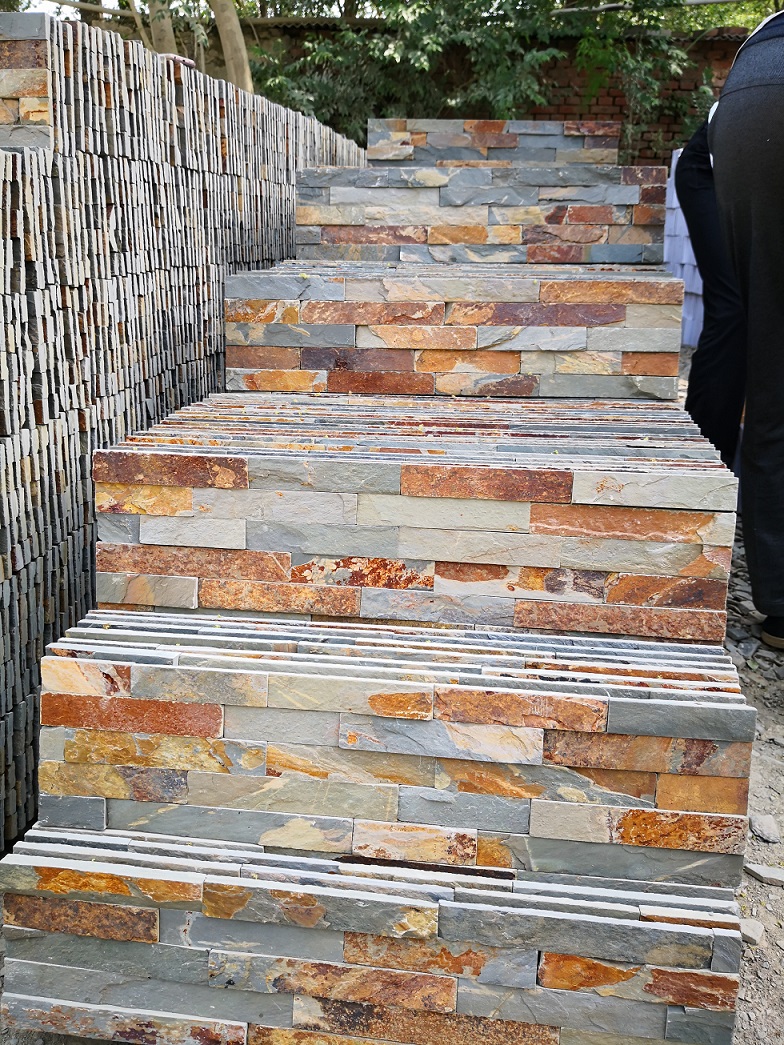
Elevate Your Projects with Premium Factory-Direct Stacked Stone
Tight-Pack Corner Geometry: Overcoming the Transit Breakage Trap of L-Shaped Stones
L-shaped stone corners are most vulnerable at the apex vertex, where undercutting during fabrication creates latent fracture planes. Using precision two-stage feed profiles—slowing to 600 mm/min at the intersection—and maintaining a vertical blade drop of 0.5–1.0 mm beyond the horizontal plane ensures full-thickness continuity. These industrial standards, combined with a 15–20% waste budget for geometric complexity, prevent the common transit breakage associated with thin-profile stone veneers.
Industrial Apex Integrity and Precision Cutting Standards
A primary cause of transit breakage is the concentration of stress at the corner vertex when the stone web is thinned by undercutting or misalignment. Thin stone veneer L-corners are engineered to wrap outside corners and hide the veneer thickness, but this geometry fails if the interior vertex becomes a “knife-edge” profile. To preserve the massive look and structural stability, the vertical blade must be calibrated to descend 0.5–1.0 mm beyond the horizontal apex plane. This micro-overlap ensures a precise intersection and maintains full-thickness continuity through the corner, effectively eliminating the fragile voids that serve as fracture initiation points during handling.
Two-Stage Feed Profiles for Reducing Micro-Fracture Density
Constant-velocity cutting across L-corners creates microscopic edge chipping that propagates into catastrophic cracks under the vibrations of shipping logistics. Automated production lines protect these vulnerable 90-degree joints by utilizing a two-stage feed profile. The conveyor slows to approximately 600 mm/min at both the entry and exit zones of the L-intersection, only accelerating to standard speeds once the blade reaches the supported core of the stone. This technical adjustment limits dynamic shock and reduces micro-fracture density at the corner geometry, resulting in a unit that survives pallet stacking, banding pressure, and forklift transport with edge chipping kept below a strict 1.5 mm tolerance.
Structural Survival through Substrate Levelness and Waste Budgeting
L-shaped geometry acts as a natural stress riser if the installation surface or shipping bed exceeds a 1/8 inch deviation over any 10-foot run. When stones bridge uneven substrates, they experience bending and torsion forces that concentrate at the tight-pack corner. Successful transit-oriented planning requires increasing the waste factor to 15–20% for L-shaped stones, compared to the 10% standard for straight runs, to account for these inherent risks. Precise layout calculations must also subtract the corner overlap (depth × depth) from total square footage to prevent aggressive slicing or oversizing that compromises the structural integrity of the final tight-pack units during the setting process.
Topsource Stone: Seamless 90-Degree Prefabricated Corner Stones Packed with Zero-Damage Engineering
Prefabricated L-shaped stone corners utilize factory-calibrated geometry—typically featuring 6–8 inch long returns and 3–4 inch short returns—to eliminate on-site miter cutting and create an authentic full-bed masonry appearance. These units are engineered with a 25–32 mm thickness and a two-stage industrial saw feed profile (600 mm/min at edges) to prevent transit fractures and ensure seamless alignment within ±2 mm tolerances.
| Engineering Feature | Technical Specification | Safety/Performance Benefit |
|---|---|---|
| Geometry Ratio | 8-10″ Long / 4-6″ Short Return | Hides veneer thinness at critical sightlines |
| Cutting Profile | Two-stage 600/2000 mm/min feed | Eliminates micro-edge chipping and fractures |
| Apex Alignment | 0.5–1.0 mm vertical blade over-cut | Ensures a clean 90° internal vertex |
| Batch Tolerance | ±2 mm thickness control | Prevents lippage with adjacent flat panels |
Factory-Calibrated L-Corner Geometry and Modular Coordination
Standardized dimensions for these corner units include long returns of 6–8 inches and short returns of 3–4 inches, specifically balanced to match the heights of flat series stones at 2, 4, or 6 inches. This geometry allows the units to wrap an external corner completely, mimicking the 8–12 inch visual depth found in traditional full-bed masonry despite the stone actually being a thin veneer. Because the faces wrap and bond around the corner as a single unit, they create the structural illusion of mass that clients and inspectors use to judge the quality of a facade.
Precision engineering maintains a veneer thickness between 25–32 mm, ensuring these heavy-looking units remain compatible with standard lightweight cladding systems. Modular coordination simplifies the calculation for procurement; a 1:1 ratio is generally applied where one linear foot of prefabricated corner units covers exactly one vertical foot of an external wall corner. This standardization reduces the need for complex field math and prevents the aggressive on-site slicing that often weakens the stone’s integrity.
Zero-Damage Engineering and Batch Thickness Control
The wall thickness of these L-shaped corners is maintained at a minimum of 1–1.25 inches to provide the necessary cross-sectional strength to survive global transit. Many manufacturers face the challenge of edge spalling or fracture when thinner units are subjected to the vibrations of sea freight or the banding pressure of palletized crates. By strictly adhering to these engineered thickness standards, the factory ensures that the stone remains robust throughout shipping and site handling, supporting a zero-damage logistics strategy.
Industrial cutting processes utilize a specialized two-stage feed profile to protect the most vulnerable sections of the stone. The bridge saw slows to 600 mm/min at the entry and exit points of the cut to minimize dynamic shock, while accelerating to 2000 mm/min in the supported core. Furthermore, maintaining a strict batch thickness tolerance of ±2 mm ensures that when corners meet flat panels, the transition is flush. This precise control eliminates lippage, improves mortar bedding uniformity, and allows for a professional finish even by teams without heavy masonry dressing experience.
Advanced Apex Indexing and Micro-Edge Chipping Control
Securing a clean 90-degree internal angle requires advanced infrared equipment and micro-overlap apex indexing. During fabrication, the vertical blade is calibrated to descend 0.5–1.0 mm beyond the horizontal plane. This minor over-cut ensures a clean severing of the stone fibers at the apex, preventing the formation of a fragile “web” or knife-edge profile that is prone to cracking. Such technical precision keeps visible edge chipping well below the 1.5 mm threshold, making the units suitable for demanding dry-stack facades.
To ensure the longevity of the prefabricated unit, a high-strength epoxy resin formulated specifically for natural stone is applied under controlled temperature and pressure conditions. This creates a permanent bond between the stone components that can withstand thermal expansion and contraction after installation. By integrating these advanced cutting and bonding protocols, the finished corner creates a monolithic appearance that preserves the architectural illusion of solid stone while delivering the practical benefits of a modern veneer system.
Frequently Asked Questions
Are L-shaped thin stone corners sold per piece or per linear meter (LM)?
L-shaped thin stone corners are almost always sold per piece (unit) or linear foot/meter. While linear meter calculations are used for project takeoffs to estimate total corner height, the product itself is manufactured as a discrete modular unit. Contractors should calculate the total vertical height of the corner and divide by the stone’s height to determine the required piece count.
How do specialized factories secure fragile 90-degree corner joints against rough sea shipping?
Engineered factories treat L-shaped corners as high-risk components. Each unit is wrapped in finish-safe kraft paper, then encased in 1/2-inch thick closed-cell foam profiles that cushion the leg and 90-degree arris. These are immobilized in timber export crates with internal blocking to prevent vertical load bearing on joints, ensuring they arrive without the breakage or chipping common in unengineered masonry packaging.
What are the exact dimensions—long return versus short return—of standard corner units?
Typical production dimensions follow a 2:1 ratio to mimic traditional full-bed masonry. Standard units usually feature a long return of 8–10 inches (200–250 mm) and a short return of 4–6 inches (100–150 mm). The thickness is calibrated between 0.75 and 1.25 inches to match flat veneer panels, ensuring a seamless 90-degree wrap without visible joints.
Do these prefabricated corners require additional structural footings or brick ledges?
No. Because these L-shaped units are part of a thin veneer system weighing only 8–13 pounds per square foot, they do not require the massive structural footings or brick ledges necessary for full-thickness stone. They can be installed on most stable surfaces, including cement board or masonry, using high-strength epoxy or thin-set mortar.
Final Thoughts
Choosing prefabricated L-shaped corners changes the math of stone masonry by shifting the complexity of fabrication from the job site to the factory floor. While manual cutting often leads to erratic labor costs and high material waste, these engineered units provide a predictable way to manage project budgets. By using precise industrial cutting and specific geometry, contractors can deliver the heavy, structural look of traditional masonry without the weight or the expensive on-site fabrication fees typically associated with mitered edges.
The transition to modular corner components also solves the technical challenges of transit breakage and installation alignment. With factory-calibrated thickness and specialized packaging, these stones survive long-distance shipping and arrive ready for immediate setting. This approach simplifies the installation process for masonry teams, ensuring that external corners remain the strongest visual feature of a building rather than a point of potential failure or a source of budget overruns.
