


French distributors and facade contractors often face costly site rejections when interlocking stone panels exceed a 2mm tolerance, leading to visible backing materials and broken alignment. These geometric failures, often dubbed the alignment nightmare, force installers to expand joints far beyond the 3mm to 10mm range required by architectural specifications. Success on high-end French job sites depends entirely on sourcing materials that meet strict NF DTU 55.2 standards to avoid cumulative measurement errors and structural instability across large elevations.
This guide details the top exporters providing Z-shape systems backed by CNC precision cutting and infrared calibration. We analyze how top-tier suppliers maintain dimensional variances within ±0.5 mm to ±1.0 mm, ensuring each unit integrates seamlessly without on-site grinding. You will also find a breakdown of the three-stage quality assurance protocols and substrate preparation rules necessary to achieve a co-planar finish for multi-container commercial projects in the French market.
10 Leading Natural Stone Panel Exporters Serving the French Market
Quick Comparison: Top Picks
| Manufacturer / Brand | Location | Core Strength | Verdict |
|---|---|---|---|
| Top Source Stone | China (Global Shipping) | Interlocking Stone Panels, Ledger Stone, Z-Systems | Best for B2B distributors seeking factory-direct pricing, zero-tolerance CNC cutting, and high-performance interlocking systems. |
| Stonepanel (Cupa Group) | Spain / Europe Logistics | Patented Interlocking Cement-Backed Natural Stone | The premier European benchmark for multi-story facades with built-in mechanical safety anchors. |
| Polycor | Quebec City, Canada | Granite, limestone, and marble panels | The top choice for industrial-scale North American stone supply in major architectural facades. |
| Cupa Stone France | Nantes, France | NF DTU 55.2 Certified Cladding & Natural Panels | Top local distribution choice for heritage restoration and rapid-delivery French projects. |
| Levantina | Alicante, Spain | Marble and engineered stone panels | Ideal for EU-based buyers needing consistent calibrated panels with fast regional logistics. |
| Antolini Luigi & C. S.p.A. | Custoza, Italy | Exotic stone slabs, Luxury panels | The premier selection for high-end luxury projects requiring unrivaled aesthetic and precision processing. |
| Granitop | Tallinn, Estonia | Finished granite panels, facade elements | Excellent for Western European installers requiring tight tolerances and efficient Baltic logistics. |
| Grupo Marcelino | Braga, Portugal | Granite panels, paving slabs | Specialized choice for civil works and exterior facades featuring unique flamed and brushed finishes. |
| Granitarnica | Central/Eastern Europe | Granite and basalt panels | Reliable source for mechanized finishing and competitive pricing within the European market. |
| RMC Group of Companies | Denizli, Turkey | Travertine and marble panels | Go-to expert for bulk containerized shipments of high-quality Turkish travertine and limestone. |
Top Source Stone
Top Source Stone operates as a specialized factory-direct manufacturer, focusing on the production of high-performance interlocking stone panels. By maintaining direct control over the manufacturing facility in China, they eliminate middleman markups and ensure rigorous quality oversight throughout the production cycle. Their product catalog centers on authentic natural stone solutions like ledger stone and marble panels, engineered to meet the structural and aesthetic demands of modern residential and commercial facades.
The company utilizes a proprietary high-strength epoxy bonding system combined with precision infrared cutting technology to produce panels that fit together seamlessly. This technical approach reduces the risk of installation errors and enhances the long-term durability of the stone cladding. For B2B distributors and contractors, they provide essential scale through full OEM/ODM capabilities and custom packaging, allowing partners to receive job-ready materials that arrive according to specific project requirements.
At a Glance:
- 📍 Location: China (Global Shipping Hub)
- 🏭 Core Strength: Interlocking Stone Panels, Ledger Stone, Flat Series, Rough Series, Marble Ledger Panels
- 🌍 Key Markets: France, European Union, North America, B2B Distributors & Contractors
Why We Picked Them:
| ✅ The Wins | ⚠️ Trade-offs |
|---|---|
|
|
Stonepanel (Cupa Group)
Stonepanel, an engineering flagship developed by the multi-national Cupa Group, represents the technological benchmark for modern exterior stone cladding. This system mechanically integrates genuine quarried slate, quartz, or limestone slices into a reinforced concrete plate during factory production. Engineered specifically to comply with heavy wind suction metrics in Atlantic European climates, Stonepanel incorporates pre-cast structural steel anchor hooks for direct mechanical fastening.
By controlling structural dimensions at the industrial scale, they completely eliminate the manual layout variables common in traditional hand-laid masonry. Their pre-interlocking Z-shape geometry masks panel junctions within standard stone course lines, achieving a flawless monolithic finish. Holding extensive European certifications (ETA), Stonepanel minimizes technical compliance risks for French developers working under strict building parameters.
At a Glance:
- 📍 Location: Spain (Sourcing globally with regional European logistics centers)
- 🏭 Core Strength: Patented concrete-backed Z-panels, embedded stainless steel anchors, certified commercial facade systems
- 🌍 Key Markets: European Union commercial projects, multi-story facades, public infrastructure sectors
Why We Picked Them:
| ✅ The Wins | ⚠️ Trade-offs |
|---|---|
|
|
Polycor
Polycor operates as a primary producer and fabricator of natural stone, maintaining direct control over its extensive network of quarries across North America. The company manages the entire production cycle from extraction to final fabrication, which allows for rigorous factory control and consistent material quality. By owning the source, they provide a reliable supply chain for granite, limestone, marble, and quartzite, specifically tailored to meet the technical demands of the European architectural market.
The company reduces project risk for international clients by offering industrial-scale production capacity for dimensional stone panels and landscaping materials. This centralized management ensures that even for massive urban developments or complex facade projects, the stone meets exact architectural specifications. Their logistical local execution simplifies the procurement process for developers in France and the European Union, bridging the gap between North American raw material resources and sophisticated European design requirements.
At a Glance:
- 📍 Location: Quebec City, Canada
- 🏭 Core Strength: Granite, limestone, marble and quartzite panels
- 🌍 Key Markets: North America, France, European Union
Why We Picked Them:
| ✅ The Wins | ⚠️ Trade-offs |
|---|---|
|
|
Cupa Stone France
Cupa Stone France serves as a cornerstone in the European natural stone sector, bridging the gap between raw quarry extraction and refined architectural application. By maintaining strict factory control over their supply chain, they provide a reliable source for high-quality stone cladding and specialized panels. Their operations in France emphasize local execution, ensuring that architects and developers receive materials that meet specific regional building codes and NF DTU 55.2 aesthetic standards.
The company effectively reduces project risk by managing a sophisticated distribution network that spans across France, Spain, and Portugal. Their catalog focuses on versatile stone solutions that facilitate both the preservation of historic heritage sites and the construction of contemporary structures. This dual focus allows them to support large-scale commercial developments while providing the precision required for delicate restoration work in the French market.
At a Glance:
- 📍 Location: Nantes, France
- 🏭 Core Strength: Natural Stone Cladding, Interlocking Stone Panels
- 🌍 Key Markets: France, Spain, Portugal
Why We Picked Them:
| ✅ The Wins | ⚠️ Trade-offs |
|---|---|
|
|
Levantina
Levantina stands as a central figure in the Spanish natural stone industry, maintaining direct control over a vast network of quarries and processing plants. This infrastructure allows the company to manage the entire supply chain, ensuring that the raw marble and limestone harvested meet specific architectural standards before they reaching the factory floor. By focusing on calibrated panels, the company provides a reliable solution for large-scale projects that require tight tolerances and uniform aesthetics, reducing the risks associated with material variations.
The company serves as a primary exporter to the French market, where they have built a reputation for logistical efficiency and deep stock availability. Their ability to supply consistent cladding materials makes them a preferred partner for international distributors who need to mitigate the unpredictability of natural stone sourcing. Through their factory-led execution, they provide high-volume production capabilities while maintaining the precise finish required for modern exterior and interior applications across Europe and the Middle East.
At a Glance:
- 📍 Location: Alicante, Spain
- 🏭 Core Strength: Marble, limestone, and engineered stone panels
- 🌍 Key Markets: Spain, France, Middle East, Latin America
Why We Picked Them:
| ✅ The Wins | ⚠️ Trade-offs |
|---|---|
|
|
Antolini Luigi & C. S.p.A.
Antolini Luigi & C. S.p.A. stands as a premier Italian authority in the natural stone industry, specifically catering to the demanding luxury architecture sector. Based in Custoza, the company manages extensive inventory across marble and quartzite categories, focusing on rare patterns that serve as focal points for high-end interiors. Their operation bridges the gap between raw quarrying and refined architectural finishing, providing a centralized point of factory control for international developers who cannot afford quality variations.
For projects in France and beyond, the brand emphasizes localized execution through precision-processed panels. They utilize advanced calibration technology to ensure every slab meets exact thickness requirements, which significantly reduces structural risks during installation on-site. By maintaining strict oversight throughout the cutting and polishing stages, they provide contractors with the predictable technical specifications needed for complex book-matching, effectively minimizing wastage and ensuring the visual continuity of large-scale stone surfaces.
At a Glance:
- 📍 Location: Custoza, Italy
- 🏭 Core Strength: Exotic stone slabs, Marble and Quartzite panels
- 🌍 Key Markets: Italy, France, Global Luxury Markets
Why We Picked Them:
| ✅ The Wins | ⚠️ Trade-offs |
|---|---|
|
|
Granitop
Granitop operates as a specialized Baltic-region fabricator that bridge the gap between heavy stone processing and the precision required by high-end interior installers. Based in Tallinn, the company runs industrial fabrication lines designed to output finished granite panels and facade elements with strict adherence to technical specifications. By maintaining direct factory control over the machining process, they reduce the risks typically associated with outsourced stone masonry, ensuring that every slab meets the high-tolerance requirements necessary for seamless installation in modern architectural projects.
The company streamlines its supply chain to serve the demanding markets of Scandinavia, France, and Germany. Their operational model prioritizes efficient Northern European logistics, which allows them to move heavy, fragile stone products across borders with minimal lead times and reduced handling risks. This local execution strategy provides Western European contractors with a reliable source for large-scale granite components that are ready for immediate site integration, eliminating the need for secondary on-site adjustments or localized finishing.
At a Glance:
- 📍 Location: Tallinn, Estonia
- 🏭 Core Strength: Finished granite panels, facade elements
- 🌍 Key Markets: Scandinavia, France, Germany
Why We Picked Them:
| ✅ The Wins | ⚠️ Trade-offs |
|---|---|
|
|
Grupo Marcelino
Grupo Marcelino operates as a dedicated stone specialist based in Braga, Portugal, with a sharp focus on granite production for large-scale civil works and structural building facades. They manage the technical demands of exterior systems by providing specific finishes, such as flamed and brushed panels, which meet the rigorous aesthetic and safety standards required for modern urban environments. By maintaining direct control over the manufacturing process in Portugal, they ensure that the stone maintains structural integrity while achieving the precise textures sought after for French streetscapes and high-end European construction projects.
The company mitigates project risks through local execution and a specialized supply chain that caters specifically to its main markets in Portugal, France, and Spain. Their expertise in paving slabs and granite panels allows for consistent quality across vast quantities of material, which is a critical factor for contractors managing public infrastructure or commercial exteriors. This narrow focus on granite varieties and specialized finishes enables them to offer enhanced factory control, ensuring that every shipment of flamed or brushed stone aligns with the architectural specifications and logistics requirements of intra-EU developments.
At a Glance:
- 📍 Location: Braga, Portugal
- 🏭 Core Strength: Granite panels, paving slabs
- 🌍 Key Markets: Portugal, France, Spain
Why We Picked Them:
| ✅ The Wins | ⚠️ Trade-offs |
|---|---|
|
|
Granitarnica
Granitarnica functions as a specialized gateway for granite and basalt processing within Central and Eastern Europe. They bridge the gap between raw stone extraction and high-end architectural needs by maintaining strict factory control over the finishing stages. Their operational model prioritizes mechanized production, which ensures that every stone panel meets the uniform standards required for large-scale facades and flooring projects. By focusing on industrial precision, they provide a reliable supply chain for developers who need volume without sacrificing the structural integrity or appearance of the material.
The company effectively reduces risk for Western European buyers, particularly those in France and Germany, by offering local execution within the European mainland. This proximity allows for better oversight of the manufacturing process and more predictable logistics compared to overseas sourcing. Their ability to deliver consistent basalt and granite products at competitive regional price points makes them a strategic partner for contractors managing commercial infrastructures. By leveraging automated finishing lines, they minimize the variations often found in manual stone masonry, resulting in a predictable and standardized product.
At a Glance:
- 📍 Location: Central/Eastern Europe
- 🏭 Core Strength: Granite and basalt panels, structural stone
- 🌍 Key Markets: Central Europe, France, Germany
Why We Picked Them:
| ✅ The Wins | ⚠️ Trade-offs |
|---|---|
|
|
RMC Group of Companies
RMC Group of Companies operates as a central figure in the Turkish stone industry, specifically managing high-volume exports from the mineral-rich region of Denizli. They focus on the logistical execution of moving heavy stone goods, providing an essential link between Turkish quarries and international wholesalers. By specializing in bulk containerized shipments, they ensure that large-scale orders of travertine and limestone reach global destinations with consistent factory control and systematic loading protocols.
The company maintains a strong foothold in the French market through dedicated supply contracts that prioritize calibrated tiles and facade units. Since these agreements target wholesalers with strict technical requirements, RMC Group emphasizes risk reduction by overseeing the calibration and finishing processes directly at the source. Their operational model supports stable supply chains for European buyers who require recurring shipments of standardized stone panels for large architectural projects and retail distribution.
At a Glance:
- 📍 Location: Denizli, Turkey
- 🏭 Core Strength: Travertine and marble panels, facade units
- 🌍 Key Markets: Turkey, France, Italy, Middle East
Why We Picked Them:
| ✅ The Wins | ⚠️ Trade-offs |
|---|---|
|
|
The Alignment Nightmare: How Uncalibrated Factory Cuts Cause Disastrous Gaps on French Sites
Uncalibrated stone panels that deviate from the required ±1–2 mm tolerance force installers to expand joint widths significantly, leading to visible backing materials and aesthetic rejection by French distributors. Precise geometric calibration and substrate preparation according to NF DTU 55.2 are essential to prevent cumulative measurement errors from creating structural and visual failures.
Tolerance Drift and the Failure of Tight-Joint Aesthetics
French architectural specifications for high-end facades typically require joint widths between 3mm and 10mm to maintain a premium appearance. When factory outputs fail to meet precision standards, the intended aesthetic is immediately compromised. Uncalibrated factory cuts that exceed the ±1–2 mm tolerance range force installers to open joints to 15mm or more to compensate for dimensional drift across the elevation.
This expansion creates significant technical and visual problems. Excessive gaps expose backing materials and create “zipper” lines that are highly visible from street level. Such deviations often lead to site rejections by French distributors, as the finished wall no longer conforms to the advertised architectural quality or the strict requirements of NF DTU 55.2 for thin stone cladding.
Cumulative Error and Substrate Misalignment
Variations in stone panel thickness prevent the maintenance of a uniform 9.5mm scratch coat, leading to surface lippage and rocking units during the setting phase. Proper substrate preparation requires a Type S mortar scratch coat to reach 70–80% compressive strength, but even a perfect base cannot correct for panels with bowed backs or inconsistent depths. When panel heights are inconsistent, masons cannot follow the critical “joint-breaking” rule, which results in concentrated loads and continuous vertical shadow bands.
Furthermore, uneven factory edges undermine the required 1-inch backward batter necessary for stable dry-stack walls. This geometric failure creates structurally questionable projections on French job sites, where panels may lean forward or create random steps. Precise CNC cutting and automated calibration are necessary to ensure that length, width, and squareness remain within tight bands, typically ±0.5 mm, allowing for predictable coursing lines and minimal on-site shimming.
CNC Precision Cutting: The Secret Behind Flawless Seamless Interlocking Walls in France
CNC precision cutting utilizes computer-controlled equipment to achieve dimensional tolerances as tight as ±1 mm, ensuring that interlocking stone panels meet strict NF DTU 55.2 standards for French building façades. This advanced fabrication eliminates manual variances, allowing Z-shape systems to fit seamlessly without visible grout lines or structural misalignments.
NF DTU 55.2 Compliance and Computer-Controlled Tolerances
The implementation of computer-controlled equipment ensures stone panels reach the tight tolerances and repeatable dimensions necessary for modern French building façades. By automating the sawing and edge profiling process, factories maintain length and height deviations within the ±1–2 mm range. This precision is vital for adherence to NF DTU 55.2 technical standards, which regulate attached thin stone wall coverings for both interior and exterior vertical surfaces. When panels exceed these limits, installers often face visible step-offs that compromise the architectural intent.
Manual cutting variances often lead to cumulative alignment problems during the installation of vertical building walls. Because NF DTU 55.2 excludes decorative masonry and focuses on structural cladding, the geometric integrity of each unit must be absolute. Automated calibration systems monitor spindle runout and axis tramming to prevent drift, ensuring that every container delivered to a French job site contains interchangeable components that support a uniform, flat surface across large elevations.
Infrared Calibration for Z-Shape Interlocking Systems
Advanced infrared cutting equipment facilitates precise dimensional stability for Z-shape panels, which are specifically designed to hide joints. This equipment verifies the geometric calibration of the interlocking edges, ensuring a fit that eliminates wide gaps or “zipper” lines. High-end architectural facades in France typically demand joint widths between 3 mm and 10 mm; infrared-guided CNC saws ensure the stone edges are square and consistent enough to maintain these narrow margins without site-side grinding or shimming.
Quality assurance involves a three-stage check following cutting, assembly, and prior to packaging. This process verifies that the stone-to-base adhesion remains permanent and that the interlocking teeth engage correctly. Precision finishing also manages the application of high-strength epoxy resin bonding, ensuring the panels withstand thermal movement and wind loads once fixed to the building envelope. This rigorous control protects distributors from the risk of receiving non-conforming batches that are impossible to install correctly.
Substrate Preparation and Load-Bearing Dynamics
Thin stone panels used in French construction typically weigh between 8-13 lbs/sqft, requiring a disciplined approach to substrate preparation. Installers must apply a Type S mortar scratch coat at a nominal thickness of 3/8 inch. Following NF DTU 26.1 guidelines, the render must be perfectly flat, as any waviness in the backing surface would magnify minor panel thickness errors into significant face misalignments known as lippage. This substrate control allows the precision-cut panels to sit in a single, continuous plane.
Standardized dimensions allow these systems to be installed on cement board, brick, or concrete without needing additional structural footings. Curing protocols are strict, requiring the scratch coat to reach 70-80% compressive strength—usually requiring a 72-hour wait—before panels are applied. This ensures that the bond between the precision-cut stone and the wall is secure. By strictly following these load-bearing rules and staggering vertical joints, contractors prevent continuous shadow bands and ensure the wall remains stable under environmental stress.
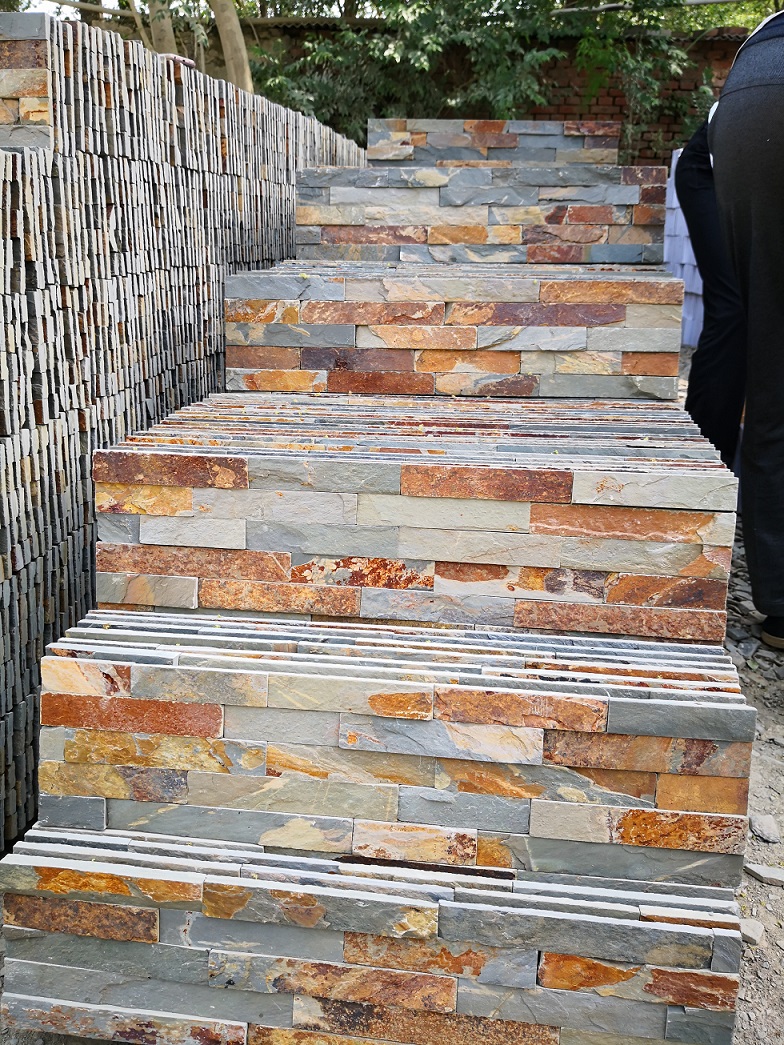
Elevate Your Architecture with Premium Natural Ledger Panels
French QA Logistics: Ensuring Consistent Thickness and Perfect Fit Across Multi-Container Orders
Multi-container logistics for French architectural projects require strict adherence to NF DTU 55.2 standards, ensuring that panel thickness variation remains within ±1.0 mm to prevent installation lippage. By combining CNC-calibrated fabrication with the 2m straightedge rule for substrate verification, suppliers ensure that interlocking stone panels maintain a co-planar finish and tight joint alignment across thousands of square meters.
NF DTU Compliance for Thin Stone Cladding Uniformity
Standardized French construction follows the NF DTU 55.2 protocol, which regulates the technical requirements for attached thin stone wall coverings. This standard defines the acceptable thickness ranges and material selection criteria necessary for vertical surfaces, particularly for large elevations where cumulative error can become a structural risk. In multi-container shipments, maintaining these tight tolerances is vital because variations in panel depth lead to “step-offs” that ruin the aesthetic continuity of the facade.
To prevent alignment issues, factory control establishes rigorous joint and flatness tolerances during the production phase. When stone panels drift beyond the specified ±1–2 mm edge length deviation, installers often struggle with “zipper” gaps or irregular shadow lines. Following NF DTU 26.1, quality checks also verify that mortar renders used as the substrate achieve a stable interlocking base, reaching 70–80% compressive strength before any stone is applied, ensuring the entire assembly remains structurally sound and visually level.
Multiphase Inspection and Substrate Planarity Standards
Quality assurance extends to the job site through the 2m straightedge rule (Règle de 2m). This French technical requirement demands continuous monitoring of wall planarity to ensure that steps between adjacent panels are nonexistent. If the substrate deviates more than 1/4 inch over 8 feet, the inherent geometry of interlocking panels makes site correction almost impossible. Advanced suppliers mitigate this by enforcing strict plumbness checks before the first crate is opened.
Technical fabrication employs a three-stage check system. First, CNC bridge saws use infrared cutting to maintain sub-millimeter precision on linear dimensions. Second, engineers test the bonding strength of assembled units to ensure durability under thermal expansion. Finally, pre-shipping container calibration involves inspecting each batch for color homogeneity and geometric squareness. This ensures that when the stone arrives, the specific interlocking grooves for ventilated rainscreens or adhered systems engage perfectly without on-site grinding.
Logistics safety is reinforced through engineered packaging. Using moisture-barrier systems and compression-resistant crate designs, suppliers protect the fragile edge profiles of the stone from maritime vibration. This detailed attention to packaging engineering preserves the “zero-tolerance” calibration achieved in the factory, delivering site-ready materials that allow French contractors to meet aggressive project timelines without construction claims or disputes.
Topsource Stone: Zero-Tolerance Geometrically Calibrated Interlocking Systems Shipped Globally
TopSource Stone utilizes advanced CNC bridge saws and infrared cutting technology to produce interlocking stone panels with dimensional tolerances of ±0.5 mm to ±1.0 mm. This geometric calibration ensures that every component acts as a precision-engineered unit, allowing French contractors to achieve tight 3–10 mm joints without on-site grinding or shimming.
Precision Machining and CNC Calibration Standards
TopSource Stone’s fabrication process replaces traditional decorative masonry approaches with industrial-scale precision. By utilizing advanced infrared cutting systems and CNC bridge saws, they achieve dimensional tolerances significantly tighter than the industry standard of ±2–3 mm. This workflow begins with the selection of homogenous quarry blocks and follows a strict calibration schedule where machines undergo daily edge checks and weekly laser alignment. Every panel is treated as a technical component, with edge profiling verified by laser measurement to ensure absolute consistency across large-scale elevations.
Traceable quality records document the accuracy of each production run, preventing out-of-tolerance units from entering the supply chain. This metrology-based approach ensures that when panels arrive at a French job site, they meet the rigorous requirements of NF DTU 55.2 for attached thin stone wall coverings. Such precision eliminates the common risks of lippage and irregular gaps, providing a flat, co-planar surface that meets architectural specifications for high-end commercial facades.
Mechanical Self-Alignment and Interlocking Geometry
The core of TopSource Stone’s system lies in the engineered Z-shape interlocking profiles and repeatable edge geometries. These features provide mechanical keying that facilitates automatic alignment during installation. The factory specifically engineers groove depths, widths, and rear reliefs to ensure reliable engagement with stainless steel hooks or rails, particularly for ventilated façade systems. Because the geometry is calibrated at the factory, the need for manual adjustment, shimming, or grinding is virtually removed, which reduces labor hours for French contractors and minimizes site dust and noise.
Properly machined interlocking joints also support structural integrity by ensuring even load distribution and staggered joint patterns. When panel heights and edge squareness are controlled to within a fraction of a millimeter, installers can maintain coursing rules without facing cumulative alignment errors. This technical predictability prevents the “zipper” gaps and shadow lines that often trigger aesthetic disputes on French projects, ensuring the final installation reflects the intended architectural design.
Metrology-Backed Quality Assurance and Global Logistics
The plant employs a three-stage inspection process to safeguard every shipment. Panels are measured after initial cutting, again following final assembly, and once more before packing. Utilizing go/no-go gauges and reference master panels, inspectors verify that each batch stays within the specified geometric limits. This process generates dimensional conformity sheets and batch-level inspection reports, allowing wholesalers to verify the quality of the shipment before the container arrives at French ports.
To maintain this precision during multi-modal transport, TopSource Stone uses compression-resistant crates and standardized stacking patterns. Specialized interleaves protect the machined edges and faces from vibration and impact, ensuring that the critical interlocking profiles remain intact. By engineering the packaging to withstand the rigors of global logistics, the factory guarantees that the calibrated geometry produced on the line is exactly what the installer receives, mitigating the risk of unusable stock and strengthening the warranty position for all stakeholders.
Frequently Asked Questions
What is the maximum thickness variation allowed for stone panel shipments to France?
For high-volume exports to the French market, the standard quality-focused maximum thickness variation is ±0.5 mm per panel. Factories uphold a hard upper limit of ±1.0 mm across an entire crate to ensure dimensional uniformity for cut-to-size cladding.
How does automated calibration protect French wholesalers from installation complaints?
Automated systems monitor CNC axes and spindle runout (targeting 0.001 in TIR or less) to maintain thickness and squareness within ±0.2–0.5 mm. By detecting dimensional drift at the factory, wholesalers prevent onsite issues like misaligned joints or visible steps, drastically reducing claims from construction clients.
What quality control steps do interlocking panels undergo prior to loading?
Panels undergo a multi-stage inspection process including a detailed professional review of workmanship, color matching against approved samples, and specific checks for edge integrity and structural stability. This ensures every crate meets the required European norms before beginning international transit.
Are these natural stone panels suitable for fireplace and exterior applications?
Yes, natural stone is inherently non-combustible and UV-resistant, making it ideal for fireplace surrounds and exterior facades. Unlike artificial alternatives, these panels do not fade and can withstand weathering, provided a moisture barrier and appropriate sealants are applied during installation.
How do factories ensure color consistency across large-scale commercial orders?
Consistency is managed by sourcing material from the same quarry batch and grading stones prior to production. This process allows for harmonious tonal transitions across hundreds of containers, ensuring a unified aesthetic for major development projects.
Final Thoughts
Achieving the seamless look demanded by French architectural standards requires moving beyond manual masonry toward industrial-grade precision. When stone panels maintain strict adherence to NF DTU 55.2 through CNC calibration, the risk of site rejection disappears. These technical standards ensure that interlocking units fit with enough accuracy to prevent visible gaps while managing the weight and load-bearing requirements of high-end facades. By prioritizing geometric consistency at the factory level, suppliers remove the burden of correction from the installer, protecting the project timeline and the aesthetic integrity of the building.
Investing in metrology-backed quality control and infrared cutting technology secures a predictable outcome for large-scale developments. These systems ensure that every batch, from the first container to the last, supports a co-planar finish and durable bond. The shift toward zero-tolerance fabrication will continue to define the benchmark for quality cladding. This focus on precision engineering reduces labor costs and ensures that natural stone remains a reliable, high-performance choice for both interior hearths and ambitious exterior envelopes.
