


Coastal environments subject structural cladding to aggressive salt spray and wind-driven rain that can quickly compromise architectural integrity. Selecting the wrong material leads to capillary action, pulling brine into porous stones like limestone or sandstone—which often have absorption rates as high as 3% to 15%—resulting in permanent staining, efflorescence, and internal salt crystallization that causes the stone to flake or spall.
Success in thin stone veneer sourcing for maritime projects depends on prioritizing high-density materials like granite and quartzite with ASTM C97 water absorption ratings below 0.4%. We evaluated the top 10 suppliers offering precision-sawn individual loose veneers based on their technical data sheets, Factory Acceptance Tests (FAT), and material traceability. This guide details how to verify Mill Test Certificates and implement vapor-permeable drainage systems to prevent metal anchor corrosion and ensure long-term facade durability in high-exposure zones.
10 Top-Tier Moisture-Resistant Thin Stone Veneer Suppliers
Quick Comparison: Top Picks
| Manufacturer / Brand | Location | Core Strength | Verdict |
|---|---|---|---|
| TopSource Stone | China (Global Shipping) | Low-Absorption Individual Thin Stone Veneers & Sawn Loose Cuts | Best for B2B wholesale and high-end commercial projects seeking factory-direct natural loose stone with <0.4% absorption. |
| Realstone Systems | Milan, Michigan, USA | Natural Quartzite & Granite Loose Veneers | Top choice for North American architects seeking tested low-porosity natural veneers and LEED compliance. |
| MSI Surfaces (Rockmount) | Orange, California, USA | Split-Face Natural Loose Stone & Calibrated Veneers | Best for North American buyers needing massive regional stock access and diverse natural mineral series. |
| ErthCoverings | Toronto, Canada | High-Density Natural Quartzite & Slate Loose Slices | The premier Canadian choice for coastal resort facades requiring verified low water absorption ratings. |
| Stonepanel (Cupa Group) | Spain / Global Offices | Calibrated Natural Stone Architectural Veneers | The global benchmark for multi-story maritime facades requiring structural anchoring against hurricane winds. |
| Norstone | Sydney, Australia / Global | Ultra-Dense Quartzite & Basalt Loose Veneer Profiles | Luxury brand offering tight joint calibration for high-salinity waterfront architecture. |
| Eco Outdoor | Sydney, Australia | High-Relief Loose Natural Stone Walling & Salt-Spray Resistance | Go-to Australian supplier for coastal estate walling designed to resist marine efflorescence. |
| Tier Natural Stone | United Kingdom / Ireland | Calibrated Loose Natural Stone Architectural Facings | Best for European commercial building envelopes needing zero-gap mechanical interlocks. |
| K2 Stone | Canada / USA | Quarry-Direct Thin Natural Stone Loose Veneers & L-Corners | Excellent choice for authentic North American quarried stone with proven freeze-thaw and salt defense. |
| Century Stone UK | United Kingdom | Calibrated Individual Natural Stone Slices | Reliable regional supplier for UK and Irish coastal developments needing low-porosity slate and granite. |
TopSource Stone
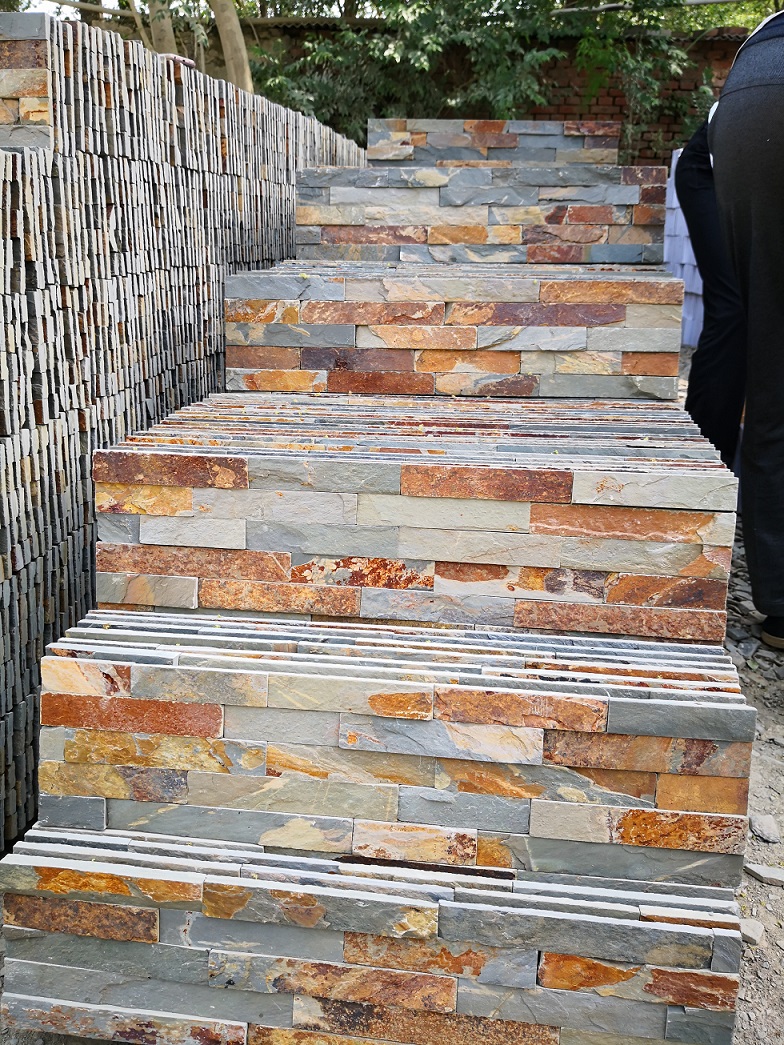
TopSource Stone operates as a direct manufacturer, providing a vertical supply chain that begins at the quarry and ends with a finished architectural product. By maintaining full factory control, they eliminate middleman markups while ensuring that every individual stone veneer piece meets strict ASTM C97 water absorption standards (<0.4%). Their catalog features a diverse range of high-density natural thin stone veneers, including flat, rough, pencil, and marble series, designed to serve wholesale distributors and large-scale commercial contractors who require performance consistency across high-volume orders.
The technical execution of their loose veneer line centers on precision back-sawing technology, creating ultra-flat contact planes that ensure complete adhesive coverage during wet-setting. To reduce the risks associated with coastal stone sourcing, the company implements a tri-stage quality control protocol that monitors the material from the raw block stage through to final packaging. This focus on precision—supported by advanced infrared cutting equipment—allows for seamless transitions on both interior feature walls and heavy-duty outdoor maritime applications, making them a reliable partner for B2B procurement.
At a Glance:
- 📍 Location: China (Global Shipping)
- 🏭 Core Strength: Natural Thin Stone Veneer (Flat, Rough, Pencil, and Marble Series), L-Shaped Corner Units, ASTM C97 Tested Low-Absorption Quartzite & Granite
- 🌍 Key Markets: Wholesale Distributors, B2B Contractors, and High-End Commercial Coastal Projects
Why We Picked Them:
| ✅ The Wins | ⚠️ Trade-offs |
|---|---|
|
|
Realstone Systems
Realstone Systems operates as a Michigan-based specialist focusing on high-end architectural natural stone. They maintain strict factory control over their production lines to ensure that natural quartzite and slate thin stone veneers meet the rigorous demands of commercial exterior specifications. This local execution strategy allows them to support architects and engineers who require precision-engineered materials for high-exposure building envelopes.
The technical core of their product range involves calibrated individual stone slices designed for high-bond thin-set mortar installation. These solutions reduce moisture risks by providing a stable, low-absorption surface that prevents salt efflorescence. By providing thorough laboratory testing logs for water absorption and flexural strength, Realstone Systems helps project teams satisfy strict building codes while ensuring long-term facade stability in coastal areas.
At a Glance:
- 📍 Location: Milan, Michigan, USA
- 🏭 Core Strength: Natural quartzite thin veneers, loose individual stone cuts, moisture-resistant cladding systems
- 🌍 Key Markets: Commercial real estate, luxury coastal residential, North American architectural specifications
Why We Picked Them:
| ✅ The Wins | ⚠️ Trade-offs |
|---|---|
|
|
MSI Surfaces (Rockmount)
MSI Surfaces manages a dominant distribution network across North America, sourcing dense natural slate, quartzite, and granite veneers for volume commercial and residential applications. By enforcing factory-level sorting standards, they supply individual stone pieces that keep thickness variations within narrow limits, preventing irregular shadow gaps where salt and water can accumulate.
Their Rockmount collection features 100% natural stone pieces cut specifically for thin veneer applications. These calibrated loose stones allow skilled masons to execute custom dry-stack or mortared finishes while ensuring the stone face stands up to atmospheric salt spray. With distribution centers across the US and Canada, MSI offers short fulfillment times for projects needing ready stock.
At a Glance:
- 📍 Location: Orange, California, USA (Nationwide Warehouses)
- 🏭 Core Strength: Natural split-face loose stone veneer, thin ledgestone cuts, low-porosity quartzite series
- 🌍 Key Markets: North American residential subdivisions, production housing, and commercial wall cladding
Why We Picked Them:
| ✅ The Wins | ⚠️ Trade-offs |
|---|---|
|
|
ErthCoverings
ErthCoverings focuses on providing high-performance natural stone veneers built to survive severe weathering cycles. Sourcing fine-grained quartzites and silty slates, they manufacture loose stone lines that resist moisture absorption. Their factory calibration ensures flat back cuts, minimizing unbonded gaps that allow salt-laden moisture to reach underlying backup walls.
The company helps architectural specifiers manage moisture risks by verifying raw stone density and water absorption values prior to production. Their lightweight thin veneer profiles allow for installation on high-performance building envelopes without creating excessive structural dead loads. This localized supply network supports responsive material fulfillment across North American projects.
At a Glance:
- 📍 Location: Toronto, Ontario, Canada
- 🏭 Core Strength: Loose natural stone veneer cuts, low-absorption quartzite, 3D ledgestone series
- 🌍 Key Markets: Canadian coastal estates, luxury alpine resorts, North American commercial projects
Why We Picked Them:
| ✅ The Wins | ⚠️ Trade-offs |
|---|---|
|
|
Stonepanel (Cupa Group)
Stonepanel, developed by Cupa Group, is an engineered system designed for demanding exterior facades. Each unit integrates natural slate, quartzite, or granite slices into a calibrated facing profile during factory assembly. This process creates a dense masonry component that provides superior flexural strength compared to soft sedimentation rocks, making it well-suited for high-wind coastal environments.
The system supports mechanical anchor integration for tall walls, ensuring each stone layer remains secured to structural concrete or metal subframes. Backed by European Technical Assessments (ETA), Stonepanel simplifies engineering reviews for commercial developments subject to wind suction and salt-spray weathering.
At a Glance:
- 📍 Location: Spain (Global Logistics Centers serving North America & Europe)
- 🏭 Core Strength: Calibrated natural stone veneer, mechanical anchor clips, commercial facade certification
- 🌍 Key Markets: High-rise commercial buildings, institutional developments, marine-exposure facade projects
Why We Picked Them:
| ✅ The Wins | ⚠️ Trade-offs |
|---|---|
|
|
Norstone
Norstone manufactures natural stone cladding products using dense igneous and metamorphic stones selected for low water absorption and high mechanical strength. Their manufacturing process enforces precise dimensional tolerances, producing individual veneer strips and calibrated components that fit together without open gaps. This precision helps prevent wind-driven rain and salt spray from bypassing the stone layer.
To maintain bond integrity in coastal environments, Norstone recommends high-strength polymer-modified mortars that remain flexible under thermal expansion. Their product lines are specified for high-end resort facades and coastal residential features where material density is critical to preventing salt-driven spalling and efflorescence.
At a Glance:
- 📍 Location: Sydney, Australia (Global Distribution in USA, UK, & Europe)
- 🏭 Core Strength: High-density quartzite and basalt veneers, precision-calibrated rock series, mitered corner systems
- 🌍 Key Markets: Waterfront resorts, luxury residential, commercial hospitality projects
Why We Picked Them:
| ✅ The Wins | ⚠️ Trade-offs |
|---|---|
|
|
Eco Outdoor
Eco Outdoor supplies natural stone walling products tailored to coastal and high-UV environments. Operating showrooms across Australia and international hubs, they specialize in deeply textured granite, sandstone, and quartzite loose veneers. Their stone selections are tested for salt-spray resistance, ensuring they retain structural integrity when exposed to marine atmospheres.
The company offers loose stone veneers that allow masons to execute traditional dry-stack or mortared layouts. By specifying dense stone types for coastal applications, Eco Outdoor helps contractors prevent efflorescence and surface flaking. Their technical team offers guidance on appropriate sealing and substrate preparation to ensure long-term performance along waterfronts.
At a Glance:
- 📍 Location: Sydney, Australia (Showrooms in USA & Australia)
- 🏭 Core Strength: Natural loose split-face walling, salt-resistant granite and quartzite ledges, pre-matched corner units
- 🌍 Key Markets: Coastal residential estates, luxury resort landscapes, architectural feature walls
Why We Picked Them:
| ✅ The Wins | ⚠️ Trade-offs |
|---|---|
|
|
Tier Natural Stone
Tier Natural Stone supplies natural stone cladding systems across the UK and European construction markets. Their product line includes individual thin veneer cuts and panelized options that speed up installation while providing uniform load distribution. The calibrated edges ensure tight fitting, creating a continuous stone appearance.
Tier subjects its stone products to freeze-thaw and water absorption testing to ensure compliance with European standards. Their low-porosity slate and quartzite veneers prevent moisture from collecting directly behind the stone face, offering commercial contractors a reliable method for installing natural stone cladding in wet maritime climates.
At a Glance:
- 📍 Location: United Kingdom / Ireland
- 🏭 Core Strength: Calibrated thin stone veneers, modular corner systems, natural slate & quartzite ledgers
- 🌍 Key Markets: European commercial developments, multi-family housing, public sector cladding
Why We Picked Them:
| ✅ The Wins | ⚠️ Trade-offs |
|---|---|
|
|
K2 Stone
K2 Stone extracts and processes natural stone from its own quarries in North America, maintaining vertical integration across production. They specialize in thin stone veneer cuts that preserve the structural density of full-bed masonry while reducing overall wall weight. Their materials include high-density granites and quartzites that perform well under high-moisture exposure.
The company manufactures matching 90-degree L-shaped corner units to complement their flat veneer lines. These prefabricated corners eliminate on-site miter cuts, creating a tight seal at building edges that prevents water infiltration. By managing quarrying and fabrication in-house, K2 Stone provides verifiable material data sheets and consistent quality control for coastal projects.
At a Glance:
- 📍 Location: Canada / USA (Quarries in Pacific Northwest)
- 🏭 Core Strength: Natural thin stone veneer, pre-fabricated corner units, low-water-absorption granite
- 🌍 Key Markets: Pacific Northwest, broader US & Canadian building stone supply
Why We Picked Them:
| ✅ The Wins | ⚠️ Trade-offs |
|---|---|
|
|
Century Stone UK
Century Stone UK supplies natural stone cladding systems across the UK and European construction sectors. Their catalog includes thin-cut natural stone veneers designed for installation on exterior facades. Sourcing from verified production plants, they ensure that each batch meets strict dimensional tolerances to prevent lippage and uneven joints.
The company evaluates stone performance against European freeze-thaw and water-absorption criteria, recommending low-porosity slate and quartzite options for high-humidity installations. Their thin stone series features flat-sawn backs that promote full adhesive coverage, reducing air pockets where moisture and salt can collect. This technical approach supports reliable facade performance for commercial and residential developments near coastal regions.
At a Glance:
- 📍 Location: United Kingdom
- 🏭 Core Strength: Calibrated thin stone veneer, natural slate and granite facing cuts, technical cladding supplies
- 🌍 Key Markets: UK and Irish residential housing developments, commercial facade renovations
Why We Picked Them:
| ✅ The Wins | ⚠️ Trade-offs |
|---|---|
|
|
The Coastal Vulnerability: How High Water Absorption Rates Ruin Structural Cladding Panels
High water absorption in coastal cladding triggers capillary action that pulls salt-laden moisture deep into stone pores, leading to permanent staining, efflorescence, and systemic structural decay through internal salt crystallization and metal anchor corrosion.
Capillary Action and Salt Transport in Porous Veneers
Oceanfront structures face aggressive moisture loads from salt spray and wind-driven rain that trigger repeated wetting and drying cycles. When cladding materials possess high porosity, capillary action pulls this moisture deep into the stone matrix. This process mobilizes soluble salts that, upon evaporation, leave behind permanent dark staining and white efflorescence crusts on the facade.
Beyond aesthetic issues, the physical transformation of these salts creates internal pressure. Salt crystallization within the pores generates cyclic stresses that lead to micro-cracking. Over time, these internal forces cause the stone’s structural integrity to degrade, resulting in scaling or surface delamination in harsh maritime environments.
Critical Absorption Thresholds for Marine-Grade Durability
Standard dense igneous stones like granite and quartzite typically exhibit water absorption rates below 0.5% by weight. This low rating provides high resistance to maritime moisture by preventing the deep penetration of brine. In contrast, porous stones such as limestone and sandstone can range from 3% to 15% absorption, making them highly vulnerable to saturation and subsequent failure in coastal zones.
For architectural projects, engineered cladding specifications should prioritize materials with independently tested absorption of less than 0.4%. Utilizing dense stones or high-quality sintered panels ensures long-term visual uniformity and reduces the frequency of aggressive maintenance cycles required to manage salt-related damage.
Systemic Failure Modes and Component Exposure Risks
Trapped moisture behind high-absorption panels often creates a corrosive environment for the assembly’s hidden components. Saturated stone accelerates the oxidation of metal anchors and fixings, which then manifests as visible rust-colored streaks bleeding onto the facade surface. This indicates not only a cosmetic failure but a potential compromise of the mechanical attachment system.
Furthermore, non-uniform drying in shaded areas or near-grade zones creates patchy aesthetic degradation and promotes biological growth on moisture-retentive surfaces. A system-wide approach is required to mitigate these risks, ensuring that backing blocks, mortars, and sealers meet the same low-absorption limits as the primary stone veneer to prevent differential moisture movement within the wall assembly.
Efflorescence and Subsurface Salt Cracking: Stopping the Damage with High-Density Stones
Efflorescence and salt weathering represent the primary drivers of aesthetic and structural degradation in coastal stone veneers. By specifying high-density stones like granite or quartzite with water absorption rates below 0.4%, and implementing vapor-permeable drainage systems, builders can prevent internal crystallization pressure from causing surface spalling and persistent white staining.
The Chemistry of Surface Efflorescence and Subsurface Salt Weathering
Efflorescence serves as a visual indicator of water migration, appearing as a white powdery salt residue when moisture evaporates from porous stone or masonry. This occurs when liquid water dissolves soluble salts within the mortar or stone fabric and transports them to the exterior face. While often viewed as a cosmetic issue, these deposits signal active moisture pathways that can lead to more severe structural issues over time.
Subsurface salt crystallization, or salt weathering, occurs when these dissolved salts solidify within the pores just beneath the stone’s surface. This transition from liquid to solid generates internal pressure that frequently exceeds the stone’s tensile strength, leading to scaling, flaking, or spalling. In maritime environments, salt-rich spray and frequent saturation-drying patterns on villa façades and resort infrastructure accelerate these cycles, progressively wedging open microcracks and detaching the face of the stone.
Mitigation Strategies via High-Density Stone Selection and Low-Alkali Mortars
Specifying high-density, low-porosity stones such as granite, basalt, and well-cemented quartzite remains the most effective defense. These materials, often exhibiting Mohs hardness of 6-7 and water absorption rates below 0.5%, significantly reduce capillary water uptake. Lower water permeability means fewer dissolved salts can migrate into the stone fabric, which cuts the risk of visible white staining and internal pressure buildup in high-exposure marine zones.
The installation assembly must also address the chemical source of salts. Using low-alkali and low-soluble-salt cementitious mortars reduces the primary salt reservoir located behind the thin stone veneer. Furthermore, applying vapor-permeable sealers, such as silane or siloxane treatments, allows the assembly to dry rapidly. These sealers prevent bulk liquid water from entering the stone while maintaining a high water vapor transmission rate, ensuring that moisture does not become trapped where it can drive internal crystallization.
Water Management and Diagnostic Warning Signs
Stopping bulk water through mechanical means like drip edges, flashing, and strategic irrigation layouts is the first line of defense. Effective drainage planes, including rainscreen mats or ventilated cavities, allow water that penetrates the scratch coat to exit the system before it saturates the masonry backing. In coastal projects, designing for full saturation events rather than occasional wetting ensures the cladding survives hurricane-driven rain and heavy salt spray.
Recurring white deposits act as a diagnostic tracer to locate hidden leaks, misdirected sprinklers, or failed flashing before structural face loss occurs. Mapping these efflorescence patterns provides a practical maintenance tool for assessing warranty risk and identifying moisture intrusion. By treating these mineral deposits as early-warning signs, facility managers can address site drainage issues before salt weathering causes permanent exfoliating damage to the stone façade.
Elevate Your Projects with Premium Factory-Direct Thin Stone Veneers
Sourcing Smart: Vetting Factory Testing Sheets for Real Marine-Level Durability
Securing marine-grade stone veneer requires a rigorous verification of Factory Acceptance Tests (FAT) and Inspection and Test Plans (ITP) to confirm water absorption remains below 0.5% and density meets project standards. Procurement teams must validate Mill Test Certificates and EN 10204 3.1 certification to ensure material traceability and prevent the shipment of porous, salt-vulnerable batches.
Mastering the Inspection and Test Plan for Coastal Cladding
Before production moves forward, reviewing the Inspection and Test Plan (ITP) is essential for confirming the exact sequence of salt-spray and water absorption tests. This document acts as a roadmap for quality, ensuring that every batch undergoes environmental simulation that mimics the harsh conditions of a coastal site. By establishing clear acceptance criteria within the Factory Acceptance Test (FAT) checklist, project managers can prevent the movement of low-density stone batches that would otherwise fail in high-humidity zones.
The FAT protocol should go beyond generic observations by identifying the specific equipment used to measure dimensional accuracy and saw-cut flatness. Small deviations in tolerance can lead to gaps in the cladding system, allowing salt-laden air to bypass the primary stone barrier and reach the substrate. Accurate measurement at the source ensures that the tight tolerances required for maritime projects are met before the materials ever leave the factory floor.
Verifying Material Integrity through ASTM and EN 10204 Certification
Mill Test Certificates (MTC) provide the data required to verify that stone density and chemical composition align with specific project requirements. For marine environments, procurement teams check these reports to confirm the material is not overly porous. Demanding higher-integrity documentation, such as EN 10204 3.1 or 3.2 certification, provides a verified path of traceability from the original quarry to the finished veneer. This level of paperwork ensures that no substitutions occur during the fabrication process, maintaining the integrity of the specified stone grade.
Cross-referencing ASTM Mill Test Certificates allows technical teams to spot statistical red flags or irregularities in heat numbers that might suggest batch inconsistency. If the chemical or mechanical properties fluctuate significantly between individual reports, it indicates a lack of control at the extraction site. Identifying these anomalies early protects the project from long-term issues like uneven weathering or localized structural weakness in the stone skin.
Final Quality Checklists and Pre-Shipment Release Rules
A comprehensive quality inspection checklist must prioritize the saw-cut backside surface and structural integrity of the stone slices. In thin stone systems, the adhesive contact plane is a critical point of failure when exposed to thermal cycling and salt crystallization. Setting strict release rules based on defect classification ensures that any stone pieces showing micro-cracks or excessive surface porosity are sorted out and rejected. This filtration process maintains a high standard of durability for the entire shipment.
Validating photo evidence of specialized packaging is the final step in the pre-shipment phase. Thin veneers are susceptible to vibration and impact damage during international transit. Ensuring the packaging is designed specifically to support edges and prevent chipping ensures the material arrives on-site in the same condition it left the factory. This attention to detail in the logistics phase prevents costly delays and waste during the installation of coastal cladding projects.
Topsource Stone: Low-Absorption Natural Quartzite and Granite Thin Veneers Engineered for Open Oceans
TopSource Stone provides marine-grade natural stone veneers specifically selected for oceanfront durability. By utilizing dense quartzite and granite with water absorption rates typically below 0.4%, these thin stone systems prevent salt-driven degradation and visible staining in high-exposure maritime environments.
Marine-Grade Quartzite and Granite Selection
Natural quartzite offers a Mohs hardness of approximately 7, providing a surface highly resistant to the abrasive forces of wind-driven sand and salt spray. This material features extremely low porosity, which minimizes liquid uptake in coastal environments where persistent humidity and wave splash are constant. Dense granite veneers, frequently specified for splash-zone walls and plinths, maintain water absorption rates below 0.4% by weight, acting as a robust barrier against moisture ingress.
The selection of low-absorption stones directly addresses the risk of visible water staining and salt-related surface degradation. In maritime climates, porous stones like soft limestone often trap salt-laden water, leading to dark patches and subsurface pressure. By prioritizing igneous and metamorphic stones with verified density, architects can ensure oceanfront facades retain their aesthetic integrity over long-term exposure cycles.
Technical Sourcing and Field Verification Protocols
Field water-drop tests serve as a critical primary screening tool during the procurement phase. A stone that resists darkening for over 10 minutes indicates the high density required for coastal cladding, while rapid darkening suggests a porosity unsuitable for saltwater contact. Quality control protocols supplement these field tests with rigorous verification of technical data sheets to ensure every veneer batch meets mechanical properties and thickness tolerances essential for structural marine use.
Beyond material density, the integration of breathable penetrating sealers plays a vital role in moisture management. These silane/siloxane-based treatments allow water vapor to escape while repelling bulk liquid. Establishing 3–5 year maintenance cycles helps mitigate tide-line staining and subsurface salt cracking, preventing the internal crystallization pressures that often cause scaling or flaking in standard masonry applications.
Precision Engineering for High-Salt Environments
TopSource Stone’s precision-sawn thin veneers ensure individual units bond securely to mortar beds even under extreme weather conditions. These lightweight stone slices facilitate installation on oceanfront structures without requiring heavy reinforced footings. This weight reduction is achieved without compromising the stone’s protective depth, providing a high-performance skin for modern maritime architecture.
Advanced infrared cutting equipment ensures that each veneer piece maintains precise edge calibration for tight joints. Tight tolerances are necessary to resist moisture penetration at the seams, where salt can otherwise accumulate. By combining precision fabrication with automated quality control, TopSource Stone delivers veneer systems that withstand maritime standards for durability, UV stability, and salt-spray resistance.
Sourcing FAQs for Coastal Structural Engineers
What is the certified ASTM C97 water absorption rating for maritime-grade granite thin veneer?
For high-durability exterior stone in coastal environments, ASTM C97 water absorption should ideally be below 0.4% by weight. While the industry benchmark for general exterior cladding is below 0.75%, dense granites and quartzites often achieve ratings under 0.4%, indicating the material density required to resist salt-water saturation.
How can thin stone systems prevent efflorescence and white salt staining in high-humidity regions?
Prevention relies on three factors: material selection, chemical barriers, and drainage. By using low-alkali cement and high-density stones like granite, you limit the source of soluble salts. Additionally, applying breathable silane/siloxane sealers with a water vapor transmission rate (WVTR) above 5 perms allows interior moisture to escape while blocking bulk liquid entry. Proper capillary breaks behind the veneer stop rising damp from transporting salts to the surface.
Does thin stone veneer require a specialized waterproofing backer for oceanfront installations?
Yes. Thin stone veneer systems are water-permeable assemblies and require a dedicated moisture management system. Best practices for maritime projects include a code-approved water-resistive barrier (WRB), such as a fluid-applied membrane, followed by a drainage mat or cavity space. This ensures that any water penetrating the stone or mortar joints can drain away rather than saturating the building sheathing.
Are L-shaped corner units necessary for structural integrity and aesthetics?
Matching L-shaped corner pieces are highly recommended for coastal projects. They eliminate the need for field-cut miter joints, which are prone to cracking and water infiltration under thermal expansion. These pre-fabricated corners ensure a seamless aesthetic that mirrors full-thickness masonry while providing a more robust weather seal at the most vulnerable points of the facade.
Can high-density thin veneers be installed over standard gypsum or drywall?
For interior applications, stone veneer weighing 8-13 lbs/sqft should be installed over cement backer board rather than standard drywall to ensure a secure bond and moisture resistance. For exterior coastal applications, the stone must be set over a scratch coat and metal lath attached to a structurally sound substrate like concrete, masonry, or specialized exterior-grade sheathing.
Final Thoughts
Success in maritime construction depends on selecting materials that withstand constant salt exposure and moisture cycles. For projects along the coast, the ASTM C97 water absorption rating serves as a primary indicator of stone longevity. Choosing high-density granite or quartzite with absorption rates below 0.5% effectively blocks the capillary action that leads to structural decay, ensuring the stone remains stable and visually consistent even in the most demanding environments.
Integrating these low-porosity veneers with proper drainage planes and breathable sealers creates a comprehensive defense against efflorescence and salt weathering. Prioritizing rigorous factory testing and material traceability helps avoid the high costs of premature maintenance or failure. By combining dense natural stone with precise engineering, builders can deliver oceanfront facades that maintain their integrity and aesthetic quality for decades.
