


Concealed Breakage in Stone Shipments: Who Pays When the Cartons Look Fine but the Panels Are Shattered
Short answer: when cartons arrive intact but the stone inside is broken, liability depends on proof, and proof depends on when the damage was documented. Damage caused by inadequate packing is the seller’s problem; damage caused by the ocean voyage is the carrier’s, capped by sea-carriage rules; damage that nobody documented at delivery usually becomes nobody’s claim but your loss. The way to keep that loss off your books is to agree a breakage allowance in the purchase order, unpack-inspect and photograph within the claim window, and file against the right party within days, not weeks.
Concealed damage is the most expensive surprise in the stacked stone trade, precisely because the packaging does its job on the outside. A pallet that survives Sydney swell and a rail yard with its shrink-wrap still square can still contain fifty shattered panels, and by the time your installer opens the last box, the claim window has quietly closed. This article explains how stone is supposed to be packed for ocean freight, what breakage percentage is considered normal, who bears the loss in each failure scenario, and the exact steps that turn a frustrating write-off into a recoverable claim.
How Exporters Are Supposed to Pack Stacked Stone for Ocean Freight
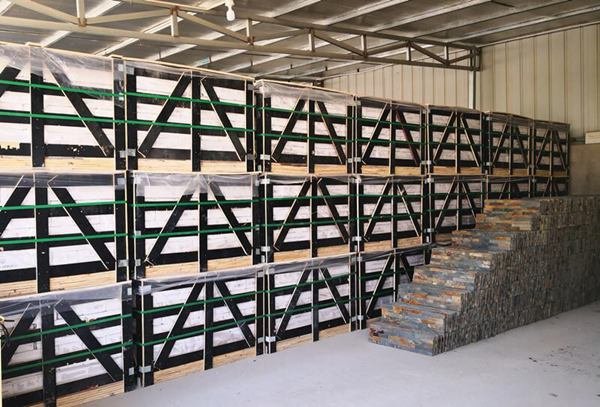
Natural stacked stone travels as a heavy, brittle, high-density cargo, and the packing that protects it is standardized across serious exporters for good reason. Panels are normally netted or boxed in bundles, cushioned with foam or corrugated sheet at every face, stood on edge rather than flat, and strapped to timber pallets or into timber crates built from fumigated, ISPM 15-stamped lumber. Corners get additional protection because corners are where impact concentrates. Inside a container, crates are braced so that no pallet can shift when the vessel rolls; a shift of even a few centimetres multiplies the load on the outer rows and begins the cracking process that no one sees until unpacking.
The two failure modes that matter are compression and shock. Compression comes from stacking: a container floor loaded to its weight limit puts tonnes through the bottom crates, and an underspecified pallet or a crate without vertical load paths lets the stone itself carry the weight. Shock comes from handling: forklift contacts, container drops during transfer, rail humping, and road vibration. Good packing addresses both, which is why buyers evaluating suppliers should look past the carton and ask about crate construction, internal bracing, and loading photos. Every exporter will say their packing is excellent; the ones who can prove it send photo sets of the loaded container as a matter of routine, and those photo sets later become evidence in exactly the kind of dispute this article is about.
What Breakage Percentage Is Actually Normal
Nobody ships natural stone with a promise of zero broken pieces, and a supplier who does promise that is telling you what you want to hear rather than how the trade works. What the industry works with is a breakage allowance: an agreed percentage of the order, commonly in the low single digits for well-packed Z-panels and mesh-backed panels on a full container, higher for fragile loose ledgestone and for LCL groupage shipments where the cargo is handled more often. The allowance exists because minor edge chips from handling are inevitable; the practical question is not whether any pieces arrive less than perfect, but how many unusable square metres you received versus how many you paid for.
The allowance belongs in the purchase order, as a number, before the deposit is paid. A workable clause reads: breakage up to and including X percent of the ordered quantity is absorbed by the buyer; breakage above X percent, documented per the inspection procedure below, is credited or replaced at the seller’s option in the next shipment or by refund. Without that number, every claim becomes a negotiation between your say-so and the factory’s doubt, and negotiation from the weaker side of an ocean is a poor position. Importers who set the number in advance spend claim meetings confirming arithmetic; importers who don’t spend them arguing about whether two percent is generous.
The Three Parties Who Can End Up Paying

When cartons look intact but panels inside are shattered, exactly one of three parties is responsible, and the evidence decides which.
The seller is responsible when the packing was inadequate for the voyage: crates too light for the stack height, no internal bracing, panels packed flat instead of on edge, pallets that crushed under load. This is the easiest scenario to prove and the hardest to argue against, because packing defects are visible in photos. It is also the scenario where sellers hide, which is why loading photos matter: if the factory’s own loading photos show proper crating and bracing, the inadequate-packing theory weakens, and the claim moves toward the carrier or the insurance.
The ocean carrier is responsible when goods were properly packed but damaged by the voyage, and this is where the law gets technical. Carriage of goods by sea is governed by the Hague-Visby Rules and national statutes built on them, such as the Carriage of Goods by Sea Act in the United States, which the Legal Information Institute publishes in full at law.cornell.edu/uscode/text/46/30701. These regimes give carriers defenses and, importantly for claim sizing, liability caps tied to package weight or value, with short time limits: notice of non-apparent damage must reach the carrier within days of delivery, typically three under Hague-Visby, and claims outside the window lose their footing. A stone importer who writes to the shipping line six weeks after delivery is not making a claim; they are making conversation.
The insurance policy is the third payer, and the one importers misread most often. Marine cargo insurance covers transit losses, but policies routinely exclude losses caused by inadequate packing, and concealed damage discovered after unpacking is exactly the loss an insurer will test hardest. The insurance trade’s own body, the International Union of Marine Insurance, publishes on claims practice and policy construction, and its site at iumi.com is a useful window into how insurers think. The practical translation: insurance pays when packing was sound, notification was timely and documentation is complete; insurance declines when any of those three is missing, and the decline letter will cite the packing.
Why “Cartons Look Fine” Breaks Claims
A clean carton proves only that the carton survived, not the cargo. But claims are built on timing, and the delivery receipt is where timing is fixed. When your driver signs a clean receipt at delivery, you have accepted the goods in apparent good order; any later damage claim becomes a concealed-damage claim, with a short clock and a heavier burden of proof. This is the mechanism that turns “the boxes were fine, the stone is dust” from a recoverable loss into a write-off, and it operates identically whether your Incoterm is FOB or CIF, because the delivery-receipt mechanics belong to the destination leg whoever arranged it.
The counter-move is procedural, and it belongs in the purchase order alongside the breakage allowance: a defined inspection window after delivery, unpack-and-photograph obligations for a sample from each pallet within that window, and immediate written notice to both seller and insurer when damage above the allowance is found. Photographs need to show the pallet as found, the carton exterior, the opened carton, and the broken contents, with the batch label visible. Ten minutes of photography per pallet on arrival day is the entire difference between a claim with a spine and a story with no ending.
A Claim Process That Actually Works
When breakage above the allowance is discovered, sequence matters. Notify the seller and the insurer in writing within the contract’s stated window, days not weeks, and attach the photo set and the quantity assessment. Ask the seller for its loading photos for the container; comparing them against your arrival photos is how inadequate-packing cases are won. If the carrier is the target, a surveyor’s report may be needed, and the notice must land inside the Hague-Visby-derived window to preserve the claim. Keep the damaged goods until the claim resolves, because insurers and carriers hold the right to inspect, and disposal before inspection is a classic reason for denial. Catching problems before the container even sails is cheaper still: the buyer-side walkthrough in the remote pre-shipment inspection guide shows which checks to run while there is still time to repack.
Then close the loop commercially. Whatever the claim outcome, the packing conversation with the factory should end in a change: heavier crate lumber, closer bracing centres, or edge protection added at specific points. A claim that produces a packing improvement has paid for itself even before the credit arrives; a claim that produces only a credit guarantees you will file the same claim again next season. Factories respond to specifics: “crate 3B arrived with two shattered rails; we believe the bracing spacing let the stack flex” gets engineering attention, while “lots of breakage again” gets sympathy.
Prevention Is Cheaper Than Recovery
Every mechanism in this article gets cheaper further upstream. Suppliers with engineered packing systems publish their crate specifications and their historical breakage experience, and those numbers belong in your supplier evaluation next to price per square metre. A supplier whose packing is marginally more expensive but whose breakage runs a point lower is usually the better buy once you price the claim process in hours, freight on replacements, and the project delays that broken panels cause your customers. The trade press for marine insurance and logistics, including the carrier-liability explainers from the International Union of Marine Insurance, returns to the same theme from the insurer’s side: losses concentrate where documentation and packing discipline are weakest. The factory side of that discipline, from crate construction through container loading, is laid out in the guide to shipping natural stone with breakage control.
For importers building this into their operation, the shortlist is short: agree the breakage allowance number, require loading photos as a shipping document, inspect and photograph within a defined window, and hold the claim deadlines as deadlines. None of it requires industry expertise beyond what this article covers, and all of it converts a trade-wide pain point into an operational edge that your competitors, still arguing with factories about percentages, have not built.
Frequently Asked Questions
Is some breakage on every stone container normal?
Yes. Minor edge chips and a small number of unusable pieces occur even in well-packed containers, which is why the breakage allowance exists. What is not normal is pallet-level shattering, and that is what the claim process is for.
Does cargo insurance always cover broken stone?
Only when the packing was adequate for the voyage and the claim is notified in time. Policies routinely exclude losses caused by insufficient packing, so the insurer will look at crate construction and loading evidence before paying.
How fast do I have to file a concealed damage claim?
Fast. Written notice for non-apparent damage must reach the carrier within about three days of delivery under Hague-Visby-based rules, and your purchase order should set a similarly short window for notifying the seller. Weeks-old claims rarely survive.
