

Sourcing specific stone types remains a high-risk procurement task where geological inconsistency often results in visible patchwork on commercial facades. Failure to secure same-vein material leads to costly installation delays and liquidated damages that erode profit margins.
We evaluate material performance against the same-batch quarry consistency standard. This analysis focuses on how CNC diamond-blade precision and interlocking Z-shape engineering mitigate structural gaps, providing your supply chain with 95% hue uniformity for high-volume architectural orders.
Understanding the Geology and Mineral Composition of Stacked Stone
Silicate minerals like quartz and feldspar provide structural hardness. Sourcing from specific quarry veins ensures mineral uniformity, preventing patchy color shifts in large-scale architectural installations.
The technical performance of Pietra naturale depends on its metamorphic and igneous origins. Different mineral structures dictate how a wall panel handles mechanical stress and environmental exposure. Understanding these components helps professional buyers select materials that match specific climate demands.
Primary Minerals and Their Role in Stone Durability
Geology determines the longevity of a facade. While aesthetics drive the initial selection, the mineral makeup ensures the stone remains intact under physical load.
- Slate: These panels rely on a fine-grained mixture of quartz, illite, and chlorite to maintain thin, durable layers.
- Quartzite: Provides extreme hardness (7 on the Mohs scale) and high resistance to mechanical wear due to its recrystallized quartz structure.
- Mica: Adds a natural sparkle to the surface, but we manage this in small quantities to prevent flaking or structural softening.
- Iron Oxides and Feldspar: These contribute to the natural color variations seen in specific styles like California Gold and Copper Canyon.
| Product Name | Best For | Key Feature | Verdict |
|---|---|---|---|
| Slate Stacked Stone | Modern and rustic ledger panels | Exceptional durability and aesthetic versatility | The most versatile and durable choice for long-term interior and exterior projects. |
| Quartzite Stacked Stone | Exterior, coastal, and high-UV applications | Superior salt resistance and fade-proof color | The ultimate choice for harsh climates, though it requires professional cutting tools. |
| Pietra impilata in marmo | High-end residential luxury feature walls | Natural veining and timeless elegance | A premium investment for increasing property value, requiring careful maintenance. |
| Limestone Stacked Stone | Traditional architectural cladding | Multiple finish profiles like ashlar and split-face | Best for achieving an authentic masonry look, provided moisture is managed. |
| Travertine Stacked Stone | Simplified modular panel installations | Distinctive pitted texture and earthy tones | Ideal for efficient DIY-friendly installations with a unique, organic feel. |

Same-Batch Quarry Sourcing for Geological Uniformity
Consistency in large-scale architecture requires controlling the supply chain at the source. Natural stone varies by nature, so we use specific extraction strategies to maintain the uniformity required for commercial projects.
- Hue Uniformity: Sourcing exclusively from the same quarry vein per order ensures 95% color consistency across large shipments.
- Freeze-Thaw Resistance: High mineral density results in natural weather resistance, meeting 2026 construction standards in the USA and Canada.
- UV Resistance: Mineral stability ensures 100% natural resistance to sunlight, preventing the fading common in pigmented “faux” stone alternatives.
- Environmental Protection: The dense mineral structure provides high salinity and humidity resistance, ideal for coastal regions and the Middle East.
Why Slate Remains the Industry Standard for Ledger Panels?
Slate leads the ledger market due to its metamorphic durability, low water absorption, and Class A fire rating, offering long-term structural stability for commercial and residential cladding.
Structural Performance and Safety Compliance
Slate is more than an aesthetic choice; it is a technical powerhouse for architectural cladding. Its metamorphic origin provides a natural defense against environmental stressors that typically degrade softer stones.
- Water Resistance: Low porosity makes slate ideal for exterior freeze-thaw cycles and high-humidity environments.
- Fire Safety: A Class A fire rating ensures compliance with strict commercial building codes for non-combustible materials.
- Surface Integrity: Natural slip-resistant textures and anti-fracture durability allow for decades of use with minimal maintenance.
Supply Chain Consistency and Visual Uniformity
For B2B distributors and large-scale contractors, the biggest risk is “patchwork” walls caused by inconsistent batches. Slate offers a level of predictability that simplifies project management and quality control.

- Batch Control: Sourcing from the same quarry vein maintains 95% hue uniformity across high-volume orders.
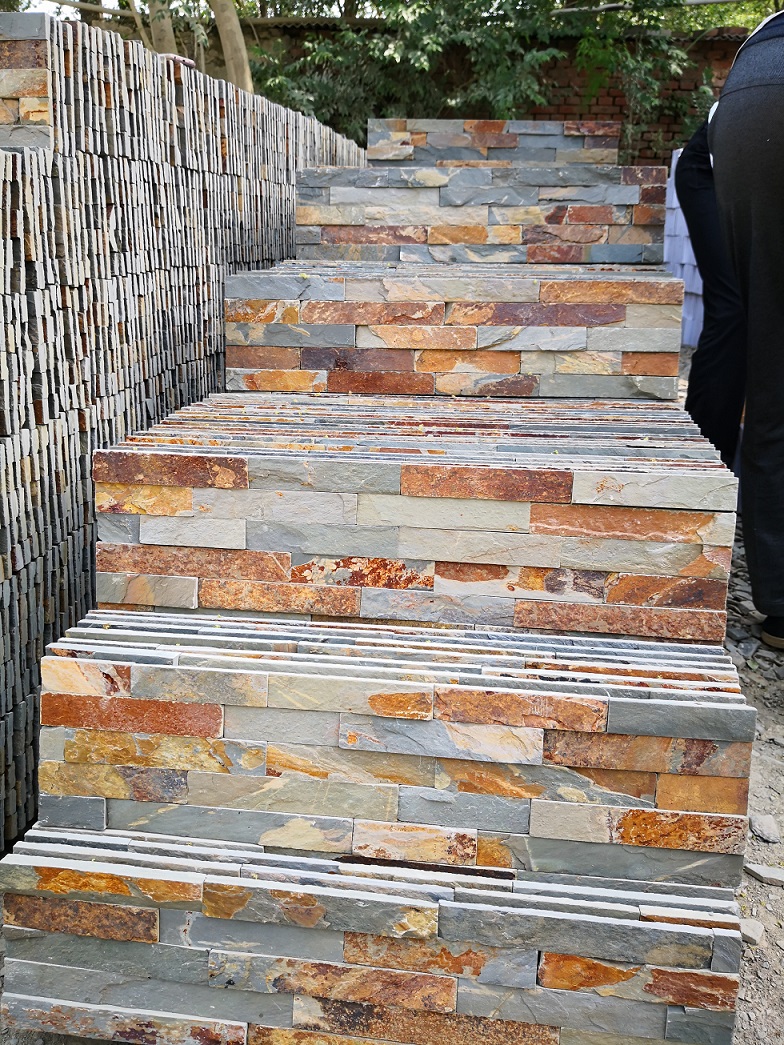
- Precision Engineering: CNC diamond-blade edges allow for a seamless interlock in Z-shape and S-shape panels, hiding vertical joints. To ensure a complete architectural solution, we provide pre-fabricated L-Corners for every stone model. These 90-degree components are cut from the same quarry vein as your flat panels, ensuring seamless texture synchronization at every wall transition and eliminating the need for complex on-site miter cuts.
- Inventory Reliability: High availability of core colors like Midnight Slate and California Gold ensures steady supply for wholesalers.
The combination of physical resilience and manufacturing precision keeps slate at the top of the specification list for modern architectural projects. It delivers the rugged look of hand-stacked stone with the efficiency of a modular, engineered system.
Premium Stacked Stone for Professional Projects
Quartzite vs. Marble: Which Material Offers Better Long-Term Durability?
Quartzite provides superior durability for high-traffic installations due to its Mohs 7 hardness and acid resistance, while marble remains a softer, decorative material prone to etching.
Choosing between these materials depends on the specific demands of the architectural environment. While both offer a high-end natural aesthetic, their geological compositions dictate how they will age and perform under daily stress.
Hardness Ratings and Resistance to Surface Etching
The physical endurance of a stone surface relies on its mineral structure. Quartzite is primarily composed of quartz, which provides a significantly denser and harder surface than the calcite found in marble.
- Mohs Hardness: Quartzite ranks at approximately 7, offering high resistance to scratches and abrasions. Marble ranks between 3 and 4, making it susceptible to damage from metal tools or heavy foot traffic.
- Acid Resistance: Marble reacts chemically with acidic substances like lemon juice or vinegar, causing permanent surface etching. Quartzite’s quartz-based composition resists these chemical reactions.
- Porosity: Quartzite naturally features lower porosity than marble. This density helps prevent deep-set staining and reduces the required frequency of maintenance cycles.
For B2B buyers managing high-use commercial projects or high-traffic residential kitchens, quartzite’s ability to maintain its surface integrity without constant intervention offers a better long-term ROI. We utilize CNC diamond-blade precision to ensure these hard materials are cut with tight tolerances for a professional finish.

UV Stability and ASTM Freeze-Thaw Performance
Exterior installations in 2026 require materials that can withstand environmental fluctuations without structural failure. Pietra sorgente superiore panels are sourced from specific quarry veins to ensure mineral consistency across large-scale façades.
- Mineral Stability: Our 100% natural quartzite and marble panels offer inherent UV stability. Unlike resin-based manufactured products, these stones do not fade or yellow when exposed to direct sunlight.
- Climate Testing: The stone meets ASTM-standard freeze-thaw resistance. This prevents cracking, flaking, or delamination during extreme temperature cycles in Northern climates like the US and Canada.
- Moisture Resistance: Natural quartzite provides high salinity and humidity resistance. This makes it particularly effective for coastal regions and high-moisture environments where softer stones might degrade.
We control the supply chain from the quarry to the crate to ensure that every panel, whether it is Glacier White Quartzite or premium marble, maintains 95% hue uniformity. This level of source control is vital for wholesalers and developers who need to avoid the patchy appearance often caused by mixing different stone layers.

Exploring the Unique Texture of Sandstone and Limestone Cladding
Sandstone offers a rugged, slip-resistant grain for organic designs, while limestone provides a refined, uniform surface for modern architectural consistency.
Defining the Contrast Between Granular Sandstone and Smooth Limestone
The tactile difference between these two materials stems from their geological formation. Sandstone is a clastic sedimentary rock, essentially a collection of minerals bound by pressure. This results in a surface that feels like coarse sandpaper, characterized by visible stratification and linear banding patterns that add significant visual weight to a facade.
Limestone presents a much more homogeneous profile. Because it consists largely of organic skeletal fragments or calcium carbonate precipitates, the grain is exceptionally fine. This creates a flatter, more consistent texture across large-scale wall surfaces, which is why architects select it for projects requiring polished elegance and minimal visual distraction.
- Slip Resistance: Sandstone’s inherent granular porosity provides a natural grip, making it the safer choice for wet-environment vertical cladding or pool-adjacent walls.
- Maintenance Profile: Limestone’s tighter, smoother grain facilitates easier cleaning, though it remains sensitive to acidic environmental exposure.
- Visual Grain: Sandstone displays distinct mineral layers; limestone offers a uniform, matte aesthetic.
Utilizing the Rough and Flat Series for Architectural Depth
Come a direct quarry source factory, we categorize these textures into specific performance series to help dealers match stone types to architectural intent. We process these materials using different engineering tolerances to emphasize their natural strengths.
The Rough Series is designed to maximize the “split-face” aesthetic. We calibrate our sandstone production for this series to achieve thicknesses of up to 3.5cm. This extra depth creates dramatic shadow lines and emphasizes the rugged profile of the Pietra naturale grains. Conversely, our Flat Series relies on CNC diamond-blade precision to maintain the refined, uniform aesthetic expected of premium limestone cladding.
- Precision Edging: We use CNC cutting for our Z-shape interlocking systems to ensure modular pieces fit tightly, camouflaging vertical joints.
- Shadow Profiles: The Rough Series (up to 3.5cm) creates deep texture, while the Flat Series (1cm – 2.5cm) focuses on linear modernism.
- Installation Integrity: Both series utilize a “male-female” connection system to conceal the installation substrate and eliminate visible “stepped” gaps.
- Quarry Consistency: We source from the same quarry vein per order to ensure hue uniformity remains at 95% or higher across the entire project.

How to Choose the Right Stone Type for Your Specific Project?
Match stone mineral properties to environmental stress. Prioritize quartzite for durability and slate for moisture resistance. Always verify same-batch quarry consistency to prevent visual patchwork on large-scale facades.
| Stone Type | Best Application | Technical Advantage |
|---|---|---|
| Quarzite | High-traffic commercial, kitchens | Mohs 7 hardness; acid/etch resistant |
| Ardesia | Poolsides, wet rooms, exterior walls | Low water absorption; naturally non-slip |
| Granito | Northern exterior cladding | Freeze-thaw stable; extreme density |
| Arenaria | Dry climates, warm aesthetic facades | Visible stratification; high friction grip |
Evaluating Environmental Stress and Usage Requirements
Selecting a stone requires a cold assessment of the installation environment. For exterior cladding in northern climates, we prioritize granite and slate. These materials handle freeze-thaw cycles without delaminating, protecting the building envelope from structural moisture damage.
Interior high-traffic zones like feature walls in hotels or corporate lobbies need surface hardness. Quartzite outperforms marble here because its mineral structure resists the micro-scratches and abrasions common in public spaces. In poolside or high-humidity regions, we focus on stones with low absorption rates to prevent mineral leaching and mold growth.
- Exterior Cladding: Use granite or slate for maximum UV and thermal stability.
- Wet Areas: Slate’s fine-grained, foliated structure provides inherent water resistance.
- Commercial Interiors: Quartzite offers the luxury of marble with the hardness of industrial granite.
Securing Aesthetic Integrity with Same-Batch Quarry Consistency
Large-scale commercial projects often fail visually due to “patchy” walls. This happens when stones come from different quarry veins. At Top Source Stone, we mitigate this by sourcing 100% of a project’s material from the same mineral vein. This ensures hue uniformity remains at approximately 95% across the entire installation.
For 2026 architectural standards, we utilize CNC diamond-blade edges on our Z-Shape and S-Shape interlocking panels. This precision creates a “male-female” connection that hides vertical joints. For professional transitions, we provide pre-fabricated L-Corners that match the specific vein of the flat panels, eliminating the need for awkward on-site miter cuts.
- The Big 10 Inventory: Access proven models like Alaska Gray or Carbon Black Slate for guaranteed UV stability.
- Seamless Finish: CNC precision edges eliminate visible “stepped” gaps between panels.
- Corner Integrity: Matching L-Corners ensure texture synchronization at 90-degree wall transitions.

Domande frequenti
What is the primary difference between natural and manufactured stacked stone?
Natural stacked stone consists of 100% quarried minerals like quartzite, slate, or marble. This composition ensures permanent UV stability and unique textures that do not fade. Manufactured stone is a concrete composite using added pigments; these frequently fade over time and lack the structural density and weather resistance of real stone.
Is quartzite more durable than slate for exterior applications?
Yes. Quartzite features a Mohs hardness of 7 and superior freeze-thaw resistance, making it the standard for outdoor walls in harsh climates. Slate has a lower hardness rating of 3-4 and works better for low-traffic interior environments where heavy weathering and temperature fluctuations are not factors.
How does the interlocking system create a seamless appearance?
Our Z-shape and S-shape panels utilize a precision-cut male-female connection system. This modular engineering camouflages vertical joints and hides the installation substrate. The precision edges ensure panels fit tightly, resulting in a continuous architectural finish without the visible “stepped” gaps found in lower-quality veneers.
Do stone veneer panels require additional structural support or footings?
Most panels weigh between 8 and 12 lbs per square foot, which allows for installation on structurally sound surfaces like cement board or masonry. This lightweight profile typically eliminates the need for the heavy concrete footers or wall ties required by full-thickness stone blocks.
How is color uniformity maintained in large-scale wholesale orders?
We source material exclusively from the same quarry vein for each batch to ensure 95% hue consistency. This strict control prevents the patchy or mismatched appearance that occurs when mixing stones from different quarry layers or separate production cycles.
How do you handle 90-degree transitions and corners?
We provide matching pre-fabricated L-shaped corners for every model. These units synchronize texture and color at wall transitions, eliminating the need for complex on-site miter cuts and reducing labor costs.
Are the panels fire-rated for commercial use?
Yes. Being 100% natural minerals (Quartzite, Slate, Marble), our stone is inherently non-combustible and carries a Class A fire rating, making it ideal for high-end fireplace surrounds and commercial building codes.
Final Thoughts
Sourcing 100% natural stone from a single quarry vein eliminates the risk of “patchwork” aesthetics and UV fading found in manufactured alternatives. This same-batch consistency ensures 95% hue uniformity, safeguarding your professional reputation and preventing costly project disputes. Our CNC diamond-blade precision provides a seamless interlocking fit that maintains structural integrity across large-scale commercial facades.
Request a professional sample kit to evaluate the density and finish of our “Big 10” inventory firsthand. We support your market expansion with 300-square-meter trial orders and private labeling options designed specifically for high-volume dealers. Contact our supply chain team today to review current production schedules and secure your next 20GP container loading slots.
We recognize the financial commitment of large-scale orders. To ensure total transparency, we implement a Pre-shipment Visual Verification protocol. Before the balance payment, our team provides high-definition video and photographic documentation of your actual finished crates, allowing you to confirm batch consistency and quality standards from your desk.
