
Specifying natural stone for Bathroom & Wet Areas demands a data-driven approach to prevent the moisture-driven structural decay that triggers costly warranty claims. Using porous materials without a professional moisture barrier leads to sub-surface rot, compromising both the building’s integrity and the contractor’s reputation.
Our manufacturing process addresses these failure points through CNC diamond-blade precision and Z-Shape interlocking technology that camouflages joints. By sourcing 100% natural minerals from a single quarry vein, we guarantee 95% hue uniformity across the 8-12 lbs/sq.ft panels needed for high-end spa environments.
Creating a Spa Experience: Designing with Natural Stone in Bathrooms.
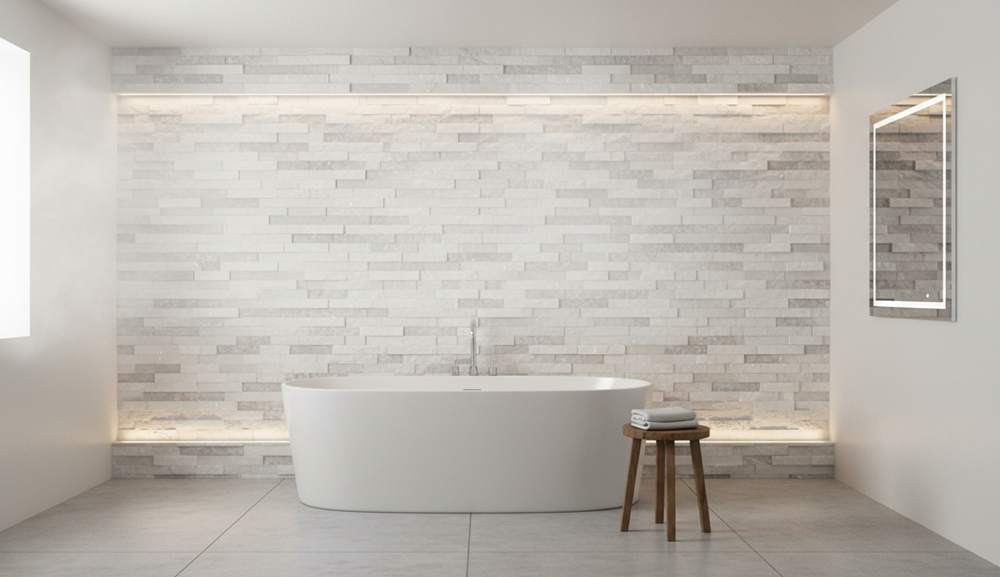
Natural stone builds restorative spa environments through organic textures and thermal properties. Designers prioritize authentic marble and quartzite for moisture-resilient, wellness-focused bathroom retreats.
Modern spa design shifts away from high-gloss, sterile finishes toward materials that engage the senses. Natural stone serves as the anchor for these wellness spaces, providing a permanent, moisture-resistant foundation that synthetic alternatives cannot replicate in depth or durability.
Atmospheric Design: Leveraging Texture and Tone for Wellness Spaces
Designers prioritize stone for its atmospheric versatility. The material dictates the psychological impact of the room, moving beyond mere decoration to create a sanctuary environment.
- Seamless Visuals: Utilizing large-format panels and interlocking designs reduces visible grout lines, which makes compact bathrooms feel expansive and more luxurious.
- Tactile Contrast: Integrating split-face and natural cleft textures creates an organic counterpoint to smooth fixtures like porcelain sinks or glass shower partitions.
- Material Moods: Slate offers a sleek, contemporary calm in dark tones, while quartzite provides sophisticated, light-reflecting properties for high-end luxury settings.
Elevating Luxury with the Marble Series and Seamless Interlocking Panels
Górny kamień źródłowy addresses the technical challenges of high-moisture stone installation through precision engineering. Our Marble Series focuses on technical consistency to protect the structural integrity and aesthetic vision of the project.
- Value Engineering: Specifying the Marble Series for feature walls provides an immediate property value upgrade through timeless veining that appeals to the B2B hospitality and premium residential sectors.
- Interlocking Technology: Our Z-Shape and S-Shape panels utilize CNC diamond-blade precision to create a “male-female” connection system. This camouflages vertical joints and eliminates the “stepped” look common in low-grade stone.
- Batch Uniformity: We source stone from the same quarry vein for every order, ensuring 95% hue uniformity across the entire installation to prevent patchy, inconsistent wall sections.
Managing Moisture: Why is Professional Sealing Non-Negotiable in Showers?
Professional sealing creates a durable moisture barrier that prevents structural decay and mold growth, ensuring natural stone panels remain hygienic and securely bonded in high-humidity zones.
Preventing Structural Decay and Mold Colonization
Water infiltration is the primary cause of failure in luxury shower installations. Even with 100% natural stone, moisture finds pathways through unsealed gaps and porous grout lines, eventually reaching the substrate. Once water sits behind the panels, it triggers structural rot that is often invisible until the damage requires a complete teardown.
Modern bathroom designs often prioritize aesthetics, but high humidity creates a breeding ground for biological growth if moisture remains trapped. Professional application prevents the common pitfalls of amateur work, such as sealant lines that crack or pull away over time.
- Structural Integrity: Eliminates hidden rot behind stone surfaces by sealing every potential entry point.
- Hygiene Control: Stops mold and bacteria from colonizing in trapped moisture pockets.
- Precision Finishing: Professional-grade silicone or epoxy sealant ensures perfectly smooth lines that resist cracking during building settle.
For dealers and wholesalers, emphasizing professional installation reduces warranty claims and protects the long-term reputation of the project.
Applying Impregnating Sealants with High-Strength Epoxy Adhesion
The longevity of a shower wall depends on the chemical bond between the stone and the wall. Top Source Stone panels utilize high-strength epoxy resin adhesives specifically formulated to maintain a permanent bond in wet conditions. This engineering ensures that even in high-heat and high-humidity environments, the panels do not delaminate.
While the natural stone itself is inherently waterproof, the pores of materials like quartzite and slate can still collect hard water deposits and stains. Professional-grade impregnating sealers act within the stone’s structure rather than just sitting on the surface.
- Bond Strength: Epoxy-based adhesives provide superior shear strength compared to standard thin-sets.
- Surface Protection: Impregnating sealants prevent deep-set stains from shampoo, oils, and minerals.
- Environmental Resistance: Enhances the stone’s natural resistance to high salinity and humidity, critical for coastal or high-use spa zones.
Using the right materials transforms a natural stone wall into a maintenance-free architectural feature. Choosing professional sealing isn’t just about the immediate look; it’s about ensuring the installation survives the rigors of daily moisture exposure for decades.
Premium Stacked Stone for Architectural Excellence
The Truth About Soap Scum and Hard Water Buildup on Rough Textures
Hard water minerals react with soap fats to create deposits. Rough stone crevices trap this residue, requiring impregnating sealers and liquid soap to prevent permanent buildup.
Mineral Adhesion on Natural Cleft and Split-Face Surfaces
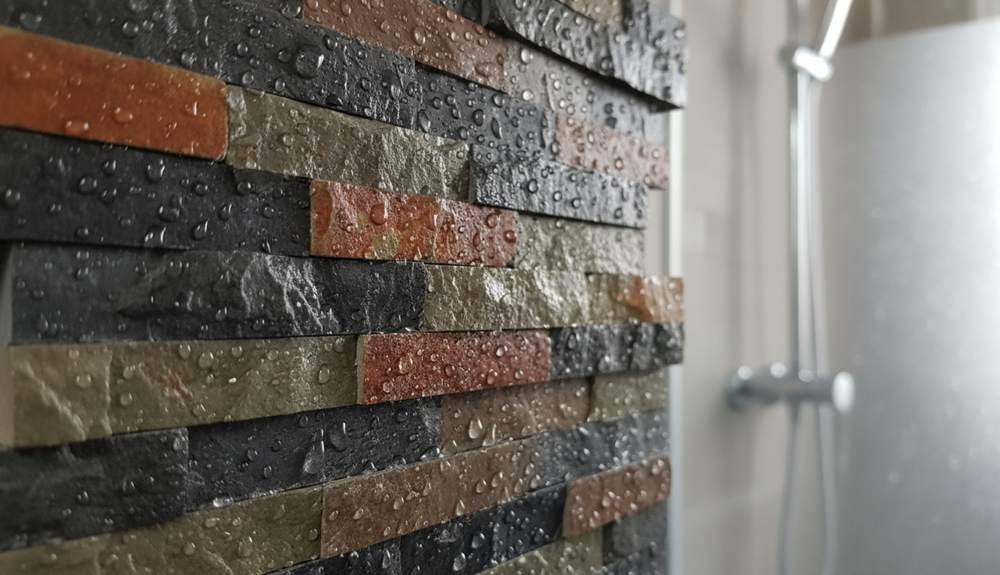
Hard water contains calcium and magnesium that bond with the fatty acids in traditional bar soaps. This chemical reaction creates an insoluble, chalky film. While smooth surfaces allow some of this to wash away, natural cleft and split-face textures act as a trap for these particles.
The physical profile of textured stone introduces several maintenance hurdles that standard flat tiles do not face:
- Recessed Shielding: Deep crevices in the stone surface shield soap scum from standard shower rinsing cycles, allowing it to settle and harden.
- Squeegee Failure: Irregular surface profiles prevent traditional squeegees from making contact with the stone, leaving moisture trapped in the texture.
- Concentrated Evaporation: Standing water in crevices evaporates slowly, leaving behind concentrated mineral deposits that bond to the stone over time.
- High Adhesion: The increased surface area of rough stone provides more “anchor points” for mineral scale to grip compared to polished marble or ceramic.
Maintenance Protocols for Rough Series Quartzite and Slate
For our B2B partners stocking the Top Source Stone rough series, we recommend specific maintenance protocols. High-texture 100% natural stone remains a premium choice for wet areas, but it requires a shift in how end-users manage the environment.
Effective prevention and cleaning for textured quartzite and slate involve these specific strategies:
- Impregnating Sealers: Apply high-quality penetrating sealers that fill microscopic pores. This prevents minerals from deep-bonding without altering the stone’s natural, rough aesthetic.
- Liquid Soap Transition: Switch from bar soaps to liquid cleaners or synthetic detergents. These lack the fatty acids responsible for the chemical reaction that forms soap scum.
- Mechanical Agitation: Use soft-bristled brushes paired with pH-neutral stone cleaners. This lifts deposits from deep recesses where cloths cannot reach.
- Water Softening: Install a water softener to remove the calcium and magnesium ions that drive mineral buildup at the source.
Regular maintenance prevents the need for aggressive acid-based cleaners, which can damage the integrity of natural minerals over long-term use. Keeping the stone dry and using the correct cleaning agents ensures the textured finish remains a highlight of the installation rather than a cleaning burden.
Waterproofing the Substrate: Integrating Liquid Membranes with Stone Panels.
Natural stacked stone is not waterproof. Liquid membranes create a continuous barrier that prevents substrate rot while isolating structural cracks up to 1/8 inch wide.
| Technical Metric | Performance Standard |
|---|---|
| Adhesion Strength | 500 PSI (Required for 8-13 lbs/sq.ft loads) |
| Flexibility (Elongation) | 1300% elongation to prevent delamination |
| Crack Bridging | Up to 3mm (1/8 inch) non-structural cracks |
| Moisture Mitigation | Reduces relative humidity penetration by 90% |
Natural stone panels allow water to migrate through joints and the porous texture of the rock. Without a dedicated barrier, this moisture seeps into the cement board or plywood substrate, leading to structural rot and mold. Liquid-applied membranes solve this by bonding directly to the wall, forming a flexible skin that moves with the building.
The Role of Elastomeric Barriers in Moisture Management
These barriers act as a secondary defense system. They bridge small shrinkage cracks that naturally occur in concrete and cement blocks, ensuring the waterproof seal remains unbroken even as the substrate settles.
- 1300% Elongation: This flexibility absorbs structural shifts, preventing the stone panels from popping or cracking during settlement.
- 500 PSI Bond: High adhesion strength is mandatory to support the 8-12 lbs/sq.ft weight of Top Source Stone quartzite and slate panels.
- Vapor Control: The monolithic seal blocks humidity, protecting the internal wall cavity from stagnant moisture.
- 3mm Coverage: The liquid spans substrate gaps up to 3mm, maintaining a continuous moisture-proof surface across different board joints.
Ensuring Freeze-Thaw and High-Salinity Resistance
Exterior facades in northern climates face intense thermal expansion and contraction. We recommend multi-coat systems to ensure Top Source Stone products maintain their bond through extreme weather cycles and coastal exposure.
- 2026 ASTM Standards: Multi-coat applications provide the durability needed for extreme northern freeze-thaw cycles.
- 60-Mil Specification: Fully submerged water features require three 20-mil coats with a 7-day cure time for long-term integrity.
- Salinity Protection: Specialized membranes protect the substrate from salt-water spray in coastal regions or pool-adjacent installations.
- UV Stability: These systems retain their structural bond and flexible properties even when exposed to high-heat exterior environments.

Slip Resistance and Safety Standards for Wet Room Feature Walls.
2026 wet room safety relies on DCOF 0.42+ and R10/R11 ratings. Top Source Stone’s natural cleft finishes ensure architectural grip and high humidity resistance for professional installations.
Global Safety Benchmarks: DCOF and R-Value Ratings
Standardizing safety in moisture-heavy environments requires adherence to specific friction metrics. While vertical feature walls do not experience foot traffic, the transition areas where walls meet floors must maintain continuity in slip resistance to prevent accidents in splashed zones.
- ANSI A137.1 Standard: Requires a minimum wet Dynamic Coefficient of Friction (DCOF) of 0.42 for level interior spaces expected to be walked upon when wet.
- European Ramp Ratings: Residential bathrooms typically require R10 or R11 ratings to provide adequate protection against water spills and high humidity.
- Pendulum Test Value (PTV): A benchmark score of 36 or higher ensures safety in public and commercial wet zones.
- Traction Capability: Smaller stone formats increase the frequency of grout lines, which act as treads to improve overall mechanical grip.
Safety Performance of Natural Cleft and Split-Face Finishes
Top Source Stone engineers products that go beyond simple aesthetics. Our natural stone panels utilize specific textures and precision cutting to maintain structural and surface integrity in hostile, wet environments.
- Mechanical Grip: Natural cleft and split-face finishes create organic surface variations that naturally increase friction and prevent the “aquaplaning” effect common on polished surfaces.
- Environmental Resistance: High salinity and humidity resistance ensure the stone texture stays intact without degrading or becoming slick in coastal or high-moisture areas.
- CNC Precision: We use CNC diamond-blade edges to create tight interlocking joints. This prevents uneven ledges or “lippage” that could create trip hazards or trap stagnant water.
- Material Stability: Inherent UV stability and ASTM-standard freeze-thaw resistance maintain the surface texture and prevent delamination over long-term use.
Choosing natural stone for wet room feature walls provides a safer alternative to synthetic materials. The 100% natural minerals in our Quartzite and Slate ranges offer superior structural integrity that resists the polished-down wear common in high-traffic wet areas.
Często zadawane pytania
Can I install stacked stone panels directly inside a shower stall?
You can, but a waterproofing membrane is non-negotiable. While Top Source Stone uses 100% natural minerals that resist water, the panel system itself does not act as a moisture barrier. You must install a liquid-applied or sheet membrane over the cement board substrate before applying the stone. This prevents water from reaching the wall cavity and causing structural damage.
How do I prevent mold from growing in the crevices of the stone?
Mold feeds on trapped moisture and organic residue like soap scum. Control this by running a high-efficiency exhaust fan during and after shower use to keep humidity levels below 50%. Regular cleaning with pH-neutral solutions is necessary to strip away the organic buildup that mold uses as a food source. Avoid bar soaps, which contribute heavily to scum accumulation in textured stone joints.
What type of sealer works best for bathroom stone walls?
Specify a penetrating (impregnating) sealer rather than a topical film. Penetrating sealers bond within the stone’s pores, allowing moisture vapor to escape while repelling liquid water. This prevents efflorescence and internal degradation. This choice is critical for maintaining the 95% hue uniformity of our same-batch quarry sourcing without creating a fake, plastic-looking surface sheen.
Will the stone pieces fall off due to high humidity?
No. Our panels utilize a high-strength, stone-specific epoxy resin engineered to survive high-salinity and high-humidity environments. This industrial-grade bond ensures that individual segments remain permanently attached to the mesh or substrate, even in the constant moisture cycles of a professional wet room or commercial spa installation.
How do I maintain the color of the stone in a wet environment?
Natural Quartzite and Slate are inherently UV stable and resistant to fading. To keep the aesthetic consistent, do not use harsh chemicals like bleach or ammonia, which etch the stone and dull its natural finish. A simple water rinse after each use and an annual water-bead test will indicate when the penetrating sealer needs reapplication to maintain the stone’s original depth of color.
Final Thoughts
Specifying low-grade stone for wet environments risks structural rot and “patchy” visuals that erode your professional reputation. We eliminate these variables by providing same-batch quarry consistency and CNC diamond-blade precision, ensuring 95% hue uniformity across every installation. Investing in these technical standards prevents expensive warranty claims and secures the long-term profitability of your premium residential and hospitality projects.
Verify our engineering by requesting a sample kit or exploring our “Big 10” inventory for immediate dispatch to your warehouse. We protect your cash flow with pre-shipment visual verification and strictly support our dealer network by refusing all direct-to-consumer sales. Contact our team today to finalize your inventory mix or discuss private label packaging for your specific market.
SEO
Title: Can You Use Ułożony kamień in Bathrooms and Showers? Pros, Cons, and Tips
Opis: Kamień naturalny for Bathrooms: Z-Shape interlocking panels with 95% hue uniformity. B2B manufacturer supply. Wholesale MOQ 300sqm.
URL: natural-stone-bathrooms
Keywords: Kamień naturalny for Bathrooms
