

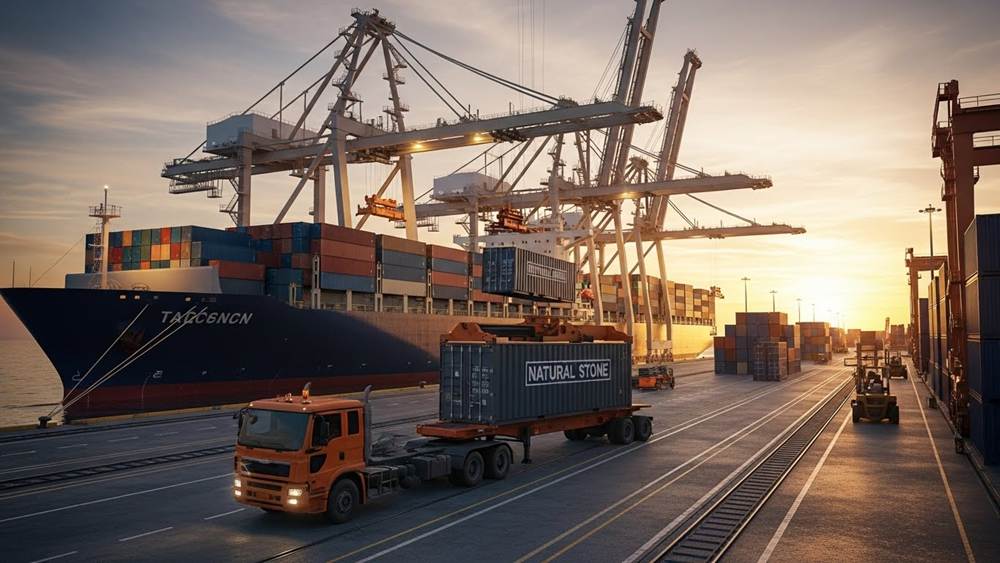
For B2B logistics managers and stone importers, the efficiency of a global supply chain is often won or lost in the final 100 miles. Moving high-density materials like marble and granite through the high-friction drayage process requires more than just standard transport; it demands a precise understanding of specialized equipment and port operations to avoid escalating detention fees and terminal congestion that can derail project margins.
This article provides a strategic blueprint for navigating the complexities of port logistics and trucking, offering a deep dive into the 15-30% transportation cost savings possible through Inland Container Depots (ICDs). We break down the technical requirements for handling 1-ton stone crates—including the necessity of lift-gates rated for 3,000–5,000 lbs—while providing a 2025 cost analysis of accessorial charges and the physical constraints that prevent 53-foot semi-trucks from reaching residential job sites.
From Dock to Door: The Drayage Process Explained
Drayage is the specialized short-haul transport of containerized cargo, typically covering distances under 100 miles. It serves as the critical ‘first mile’ link, moving heavy natural stone crates from port terminals to local warehouses or inland depots using specialized trucks and chassis to ensure rapid turnaround.
The Core Workflow: Short-Haul Logistics and Port Operations
Drayage serves as the specialized connective tissue within the stone supply chain, focusing exclusively on the transport of containerized cargo over short distances, typically capped at 100 miles. This segment of the logistics journey is vital for moving high-density materials like marble and granite from the point of entry to local distribution hubs. The operational workflow begins immediately after a vessel’s arrival, where cargo is unloaded at the port container yard and staged for pickup by specialized drayage trucks.
To maintain efficiency, services are categorized based on their specific terminal objectives. Pier drayage involves the direct movement of containers from the port to a nearby warehouse, while intermodal drayage facilitates the transition from ship to rail or long-haul truck. In larger facilities, shuttle drayage is utilized for intra-facility movement to alleviate terminal crowding. Each of these steps requires precise ‘last-mile’ coordination to transition heavy stone crates from international shipping environments to regional logistics centers without incurring storage penalties.
Container Specifications and Variable Cost Drivers
The technical requirements for stone drayage are dictated by the physical dimensions and weight of the cargo, utilizing standard 20-foot and 40-foot containers. While 20-foot units are frequently used for heavy stone loads to optimize weight distribution, 40-foot containers are common for larger slabs but generally incur higher handling costs. Because natural stone shipments are often overweight, they necessitate the use of specialized permits and reinforced chassis equipment to ensure road safety and structural integrity during the short-haul transit.
From a financial perspective, drayage costs are influenced by distance-based base rates, fuel surcharges, and various accessorial fees. Two of the most significant cost drivers are detention and demurrage, which are charges applied when containers are held beyond their allotted free time at the port or the warehouse. These fees can escalate quickly if the supply chain encounters friction, making timing a critical factor in cost engineering for importers.
Mitigating these logistics challenges requires proactive scheduling and the use of multi-carrier equipment pools to bypass port congestion and equipment shortages. By utilizing real-time tracking and pre-arranged pickup windows, stone distributors can minimize idle time at the terminal. This strategic approach ensures that the high-friction “first mile” of port logistics remains a fluid link, preventing bottlenecks that could otherwise delay the delivery of materials to fabricators and job sites.
Choosing Between a Port Terminal and an Inland Container Depot (ICD)
The choice depends on your proximity to the coast and budget constraints. Port terminals offer direct maritime access but suffer from high congestion and storage fees. In contrast, Inland Container Depots (ICDs) act as ‘dry ports,’ offering 15-30% transportation cost savings and integrated customs clearance closer to final delivery sites.
Defining Port Terminals vs. ICDs: Logistics and Customs Integration
Port terminals serve as the primary nodes for maritime unloading, functioning as the immediate point of entry for international stone shipments. While these facilities provide essential direct access to shipping vessels, they are frequently characterized by high land and labor costs. Due to limited space in coastal zones, port terminals often face significant congestion risks, leading to elevated storage fees and strict timelines that can complicate the logistics of heavy stone imports.
Inland Container Depots (ICDs) operate as “dry ports,” extending the functional reach of the seaport into the interior of the country. Unlike standard storage yards, ICDs provide comprehensive customs clearance services, including on-site documentation processing, cargo inspections, and duty payments. This allows importers to manage the legal requirements of their shipment closer to the final destination, effectively decentralizing the customs process and reducing the administrative burden typically found at major coastal hubs.
By shifting container storage and consolidation/de-consolidation tasks away from crowded coastal areas, ICDs significantly reduce seaport dwell times and the risk of demurrage charges. Modern ICD facilities are equipped with massive stacking yards capable of holding thousands of TEUs (Twenty-foot Equivalent Units), ensuring that large-scale inventory for major construction projects remains secure and accessible outside of the high-pressure port environment.
Cost-Efficiency and Multimodal Connectivity for Heavy Stone Shipments
For importers of natural stone, the use of an ICD can result in 15-30% transportation cost savings. These efficiencies are achieved through the reduction of long-haul trucking requirements, which minimizes fuel consumption and driver wages. By utilizing ICDs situated near major transport networks, businesses can optimize their supply chain to favor shorter last-mile deliveries, significantly lowering the overhead associated with transporting heavy stone panels over long distances.
The integration of multimodal transport is a primary advantage of the ICD model. These facilities often leverage rail connectivity, such as block trains, to move large volumes of heavy 1-ton stone crates more cost-effectively than traditional road transport. This flexibility provides a layer of resilience to the supply chain; by utilizing a mix of rail and road, importers can avoid the “cascade failures” and bottlenecks that often occur when port-side road networks become disrupted.
Technical handling is another critical factor where ICDs excel. Specialized equipment, including high-capacity reach stackers and cranes, is standard at these facilities to ensure the safe management of heavy containers. This infrastructure is purpose-built for the high-throughput requirements of the natural stone industry, ensuring that fragile yet heavy materials are handled with the precision necessary to prevent damage during the transition from rail or truck to the final delivery site.

Lift-Gate vs. Forklift: Equipment Needed for 1-Ton Stone Crates
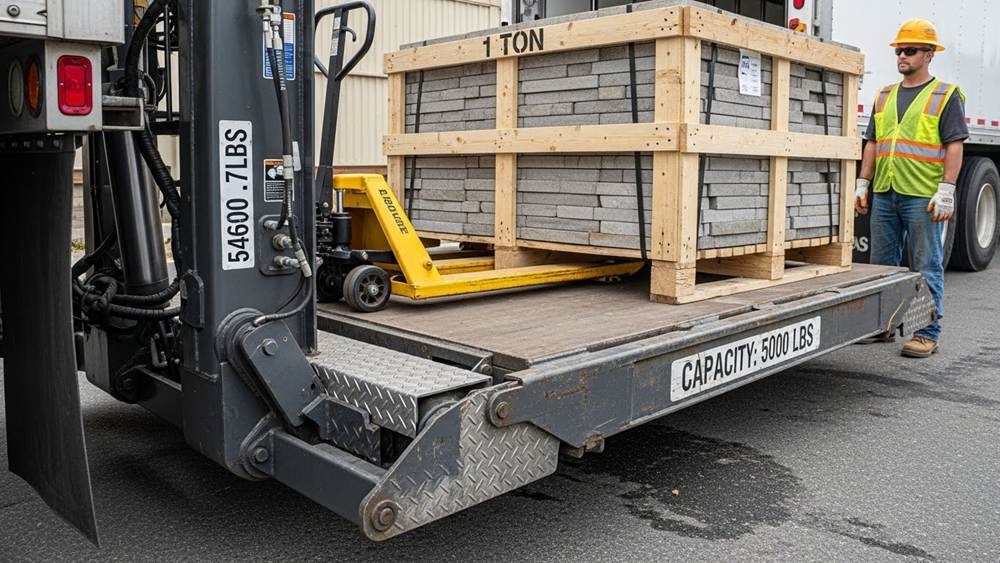
Unloading a 1-ton stone crate requires a heavy-duty rail or cantilever lift-gate with a minimum capacity of 3,000–5,000 lbs to safely account for the crate, pallet jack, and operator. While lift-gates bring the cargo to ground level, a forklift or truck-mounted (Moffett) system is required for moving the stone across job sites or to specific installation points.
| Equipment Type | Rated Capacity | Primary Delivery Use Case |
|---|---|---|
| Rail or Cantilever Lift-Gate | 3,000 – 5,000 lbs | Standard unloading of palletized stone to flat pavement. |
| Truck-Mounted Forklift (Moffett) | 3,000 – 5,500 lbs | Placing crates in driveways or yards on construction sites. |
| Standard Industrial Forklift | 5,000+ lbs | Unloading containers and managing stone slab storage racks. |
Heavy-Duty Lift-Gate Specs for Palletized Stone
A 1-ton stone crate (approximately 2,000 lbs) combined with a pallet jack and the weight of the operator typically totals between 2,400 and 2,800 lbs. To handle this safely, trucks must be equipped with rail or cantilever lift-gates rated for 3,000 to 5,000 lbs. These specific lift-gate types provide the large, level platforms required to stabilize palletized masonry during the descent from the truck bed to the ground.
Standard tuck-under lift-gates are generally insufficient for stone delivery, as they often have lower weight capacities—frequently capped at 2,000 to 2,500 lbs—and lack the platform depth to accommodate a full stone crate and a pallet jack simultaneously. Maintaining a high safety margin is critical in stone logistics, as operating a lift-gate at its maximum rated limit significantly increases the risk of hydraulic failure or platform tilting.
Forklifts and Truck-Mounted Systems for Site Maneuverability
While lift-gates provide the vertical transition to ground level, forklifts are the industry standard for the horizontal movement of stone slabs and crates. In distribution centers, forklifts are utilized to unload heavy stone products from shipping containers and organize them into specialized storage racks. For final delivery, truck-mounted forklifts (such as Moffett systems) are the superior choice, as they allow the driver to transport materials directly to an installation point where a 53-foot truck cannot enter.
The primary advantage of a forklift over a lift-gate is its ability to navigate the uneven terrain common at landscape and residential construction sites. While a lift-gate is limited to the pavement immediately behind the truck, a forklift can position stone crates in driveways or backyards. The operational standard for heavy masonry involves using a lift-gate for the initial carrier-side unload, followed by a site forklift or truck-mounted system for precision placement.
Premium Stacked Stone Ledger Panels: Direct from the Quarry

Accessorial Charges: Residential Delivery and Lift-Gate Fees
Accessorial charges are mandatory add-on fees for deliveries to non-commercial sites. In 2025, residential delivery fees for heavy LTL freight typically range from $75 to $170 minimum, while lift-gate service adds an additional $50 to $100. Small parcel residential surcharges average $6.50–$6.55 per package, plus potential area-based surcharges.
| Carrier / Service Type | Accessorial Charge Type | 2025 Rate / Minimum |
|---|---|---|
| FedEx (Small Parcel) | Residential Delivery Charge | $6.55 per package |
| UPS (Ground Parcel) | Residential Surcharge | $6.50 per package |
| Estes Express (LTL) | Item 751: Residential Pickup/Delivery | $8.50/CWT ($75.00 min) |
| XPO Logistics (LTL) | Item 224: Residential/Limited Access | $15.25/CWT ($170.50 min) |
| Standard LTL Freight | Lift-Gate Service | $50.00 – $100.00 average |
Defining Residential and Limited Access Surcharges
Carriers classify any location without a traditional loading dock or those situated within residential zones as “Residential” or “Limited Access.” This classification extends beyond private homes to include job-sites, churches, storage units, and schools. These fees are an operational necessity, covering the increased driver time and specialized equipment needed to navigate narrow residential streets, cul-de-sacs, and low-hanging trees that cannot accommodate standard freight equipment.
For natural stone projects involving 1-ton crates, these fees are almost universally triggered. Standard 53-foot trailers cannot safely maneuver in most neighborhoods, which often requires a “pup” truck transfer—moving the freight to a smaller 28-foot vehicle for the final mile. Furthermore, because residential locations lack docks, lift-gate services are mandatory for offloading heavy pallets, typically adding an incremental $50 to $100 per shipment to ensure the safety of both the driver and the materials.
2025 Fee Schedules: LTL vs. Small Parcel Rates
The 2025 tariff schedules provide specific data points for budgeting heavy freight shipments. Estes Express, under Item 751, bills residential delivery at $8.50 per CWT (hundredweight) with a $75.00 minimum and a $550.00 maximum. In contrast, XPO Logistics (Item 224) applies a more aggressive rate of $15.25 per CWT with a significantly higher minimum of $170.50. These CWT-based calculations mean that as the weight of the stone increases, the fee scales upward until reaching the carrier’s specified cap.
Small parcel networks such as FedEx and UPS follow a different surcharge logic. For 2025, the base FedEx Residential Delivery Charge is $6.55 per package, while UPS Ground Residential sits at $6.50. However, these are frequently combined with Delivery Area Surcharges (DAS) that range from $6.20 to $44.00 depending on the remoteness of the destination. For a standard LTL shipment of natural stone, project planners should anticipate a total accessorial uplift of $100–$250 over standard dock-to-dock rates to account for both the residential entry and the necessary lift-gate equipment.
Residential Delivery: Can a 53-Foot Semi-Truck Reach Your Site?
Typically, no. A standard 53-foot trailer combined with a tractor creates a 70–73 foot vehicle that exceeds the turning radius and vertical clearances (13.5–14 ft) of most residential streets. Local ordinances often restrict vehicles over 60 feet, necessitating the use of smaller 26–30 foot box trucks for final delivery.
Geometric and Physical Obstacles for Class 8 Vehicles
The primary physical constraint for heavy stone delivery via standard tractor-trailer is the total combination length. When a 53-foot trailer is paired with a tractor, the vehicle typically reaches 70–73 feet in total length. This footprint requires a swept path for turns that standard residential intersections, narrow streets, and cul-de-sacs cannot accommodate without risking property damage or total blockage of the roadway.
Vertical and structural constraints further limit access. A standard semi requires a vertical clearance of 13.5 to 14 feet, which is frequently obstructed in residential zones by low-hanging tree canopies, utility lines, and local bridge clearances often signed below the required threshold. Additionally, the 102-inch trailer width combined with an 80,000 lb maximum gross vehicle weight creates significant structural risks for residential asphalt, curbs, and driveways not engineered for Class 8 load distributions.
Regulatory Limits and the Box Truck Alternative
Beyond physical dimensions, local legal ordinances often bar full-sized semis from entering residential neighborhoods. Many jurisdictions restrict combination lengths on non-STAA network streets to 60 feet or less and enforce Kingpin-to-Rear-Axle (KPRA) limits of 38–40 feet. These regulations are designed to prevent long trailers from attempting maneuvers that exceed the geometric capacity of local infrastructure.
To overcome these limitations, the stone industry utilizes a “Last-Mile” pivot strategy. Because stone crates are exceptionally heavy (averaging 8–13 lbs per square foot), carriers frequently transload shipments at a local terminal from a 53-foot trailer into 26–30 foot straight trucks (box trucks). These smaller vehicles are specifically marketed for residential delivery, capable of handling 8–12 pallets, and can safely navigate the tight turns and vertical constraints of a job site or residential driveway.

Inspecting for Damage Before Signing the Proof of Delivery (POD)
The Proof of Delivery (POD) is a legal document confirming that freight was received complete and in good condition. Before signing, you must physically inspect all crates for damage and verify quantities; once signed ‘clean,’ any subsequent claims for visible damage are likely to be denied by the carrier.
The Legal Role of the POD in Freight Claims
The Proof of Delivery (POD) serves as a binding legal document that provides evidence that the recipient approved the condition of the cargo upon arrival. In the logistics industry, a “clean” signature—meaning a signature provided without any notations of damage or loss—creates a legal presumption that the freight was delivered in perfect condition according to the contract of carriage. This shift in liability makes it exceptionally difficult for a consignee to pursue a claim once the driver has departed.
LTL freight handling is strictly governed by carrier Rules Tariffs and the National Motor Freight Classification (NMFC), which define the liability standards for shortages and visible damage. These regulations place the onus on the receiver to verify the shipment at the point of transfer. Explicitly documenting exceptions such as “rejected,” “too damaged,” or “missing pieces” on the POD at the time of delivery is the only definitive way to preserve the right to a full freight claim and overcome the carrier’s defense of a clean delivery.
Systematic Inspection Steps and Documentation Procedures
Before allowing the delivery driver to depart, receivers must conduct a thorough physical walkthrough. This inspection should focus on identifying crushed pallets, punctured crates, or signs of moisture and impact, particularly on fragile materials like stone surfaces. It is essential to cross-check item descriptions, quantities, weights, and dimensions listed on the POD against the original packing list and purchase order to ensure the shipment is complete and accurate.
Modern logistics workflows often utilize ePOD or photo POD systems to enhance evidence collection. Receivers should capture barcodes, QR codes, and time-stamped images of any suspected damage as “solid evidence” for future disputes. Adherence to these procedures is critical due to the strict 5-day reporting window for concealed damage—damage discovered after the driver leaves. Without original notations on the POD, carriers often deny concealed damage claims, citing the standard NMFC guidelines that favor the carrier when the delivery was accepted without initial protest.
Final Thoughts
Successfully navigating the “last mile” of natural stone logistics requires a granular understanding of the transition from international maritime ports to the local job site. Whether optimizing costs through Inland Container Depots (ICDs) or ensuring the correct heavy-duty lift-gate is on-site for a 1-ton crate, every technical detail directly impacts the project’s bottom line. The complexity of moving high-density materials like marble and granite means that logistics is not just a secondary concern, but a core component of procurement that demands precise coordination and specialized equipment.
Ultimately, the efficiency of a stone supply chain hinges on proactive risk mitigation and clear documentation. By accounting for 2025 accessorial fee structures and the physical limitations of Class 8 vehicles in residential zones, importers can prevent costly delays and equipment failures. Most importantly, maintaining a rigorous inspection process at the point of delivery ensures that the legal protections of the Proof of Delivery (POD) work for the receiver, securing the investment from the moment the cargo leaves the port until it is safely placed at the farm-gate or construction site.
