

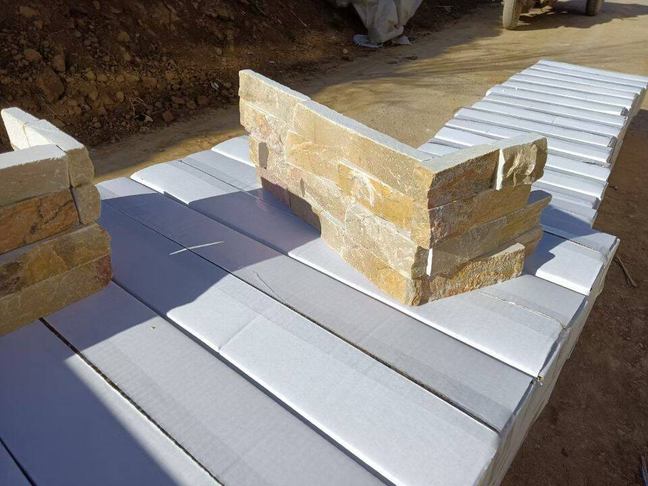
miter cuts vs l-corners is the first checkpoint buyers should lock before they approve a supplier, budget, or production slot. Every stone veneer installation manual tells you to miter corners on site—it’s the budget move, the practical call. A contractor in the Midwest swallowed that advice on a $50K commercial facade. The pre-production sample looked tight. The mass production run did not. Color bands showed at every outside corner, and the architect rejected it in one walkthrough. The miter cuts vs L-corners decision blew up on labor, not material price. He wasn’t wrong because he lacked skill; he was wrong because the math other articles feed you ignores three line items that actually rule an exterior stone P&L.
FOB pricing sheet comparisons treat a corner as a corner. They hide the 20% scrap rate a wet saw generates on quartzite ledger panels, the $75–120/hr master mason you need to pull off a clean 44.9° back-bevel, and the field mismatch when the cutoff exposes raw stone from a different quarry block. Batch-matched L-corners, machined with ±0.5 mm quality tolerance from the same quarry run as your field panels, eliminate the sample approval headache entirely. The unit cost looks higher until you subtract the breakage, rework, and callbacks—then the site-fabricated route costs 25% more on the installed square. That’s the gap most articles skip.

Miter Cuts vs L-Corners: Managing Capillary Paths and Frost Jacking Hidden Exterior Risks
You see corners first, and so does water.
Exterior cladding failures rarely start in the middle of a wall. Corners are where the system’s real quality shows — and where it fails first. A poorly executed outside edge exposes the thin veneer profile, immediately signaling to inspectors and architects that the cladding is a surface application rather than a solid masonry wall. Gentle-breaks concentrate stress, weather loading, and visual scrutiny all in one place.
This is why hand-mitered corners trigger so many warranty disasters. Internal factory data shows that exterior stone corner failures account for 30% of all warranty claims on veneer installations. The root cause isn’t bad stone — it’s water. Every millimeter of misalignment in a miter joint creates a capillary path that draws moisture straight into the wall assembly.
Corner Structural Failure Parameters:
- Capillary Moisture Path: A 1mm gap in a miter joint acts as an active water channel. In freeze-thaw zones, trapped moisture expands by 9% when it freezes, generating enough pressure to pry the corner apart.
- Frost Jacking Seam Ripping: Repeated freeze-thaw cycling lifts the stone corners fraction by fraction, widening the gap. This propagates vertically up the building envelope, splitting adjacent panels.
- Warranty Cascade Costs: A single failed mitered corner under 30°F conditions can cascade into a 20-linear-foot replacement job, completely destroying project profitability long after handover.
There’s a trick some masons try: cutting a 44.9° back-bevel instead of 45° to force the face edges together first. It works on a good day. But it doesn’t fix the batch-color mismatch, the scrap pile, or the hourly rate. For an exterior wall that has to look right and stay dry for a decade, factory L-corners aren’t an upgrade — they’re insurance.
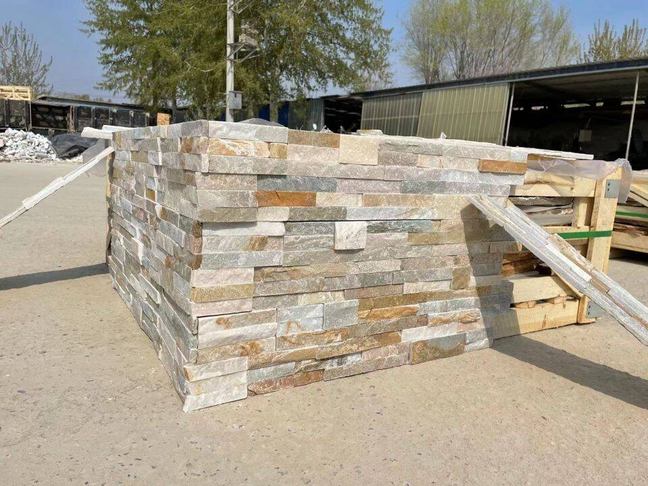
Real Total Installed Cost Matrix: Sourcing Labor, Waste Ratios, and Metamorphic Quartzite Material Scrap
Miter cuts bleed money on labor, scrap, and callbacks.
When you miter a natural stone corner on site, you’re not just cutting stone — you’re eating into margin. Every 6×24 corner you fabricate demands a master mason with a wet saw who understands back-bevel geometry. If they cut a standard 45°, the irregular cleft surface leaves a hairline gap at the show face. That gap becomes a capillary for water, and in freeze-thaw zones, it’s the fuse that lights the callback bomb. So on top of breakage, you’re paying for skill. Rates in North America run $75–120/hr for a mason who can reliably produce a usable miter. Meanwhile, your general install crew — the guys you pay $40–60/hr — stands idle waiting for stone.
Then there’s the material waste. Factory data from multiple high-volume cladding projects shows that fabricating miter corners on site burns through 10–15% of the stone in breakage alone. On quartzite, that number hits 20%. When the stone snaps along a vein 10 cuts in, you’ve just turned $8/lf material into $0/lf landfill. Factor in the time spent fetching replacement panels from the crate, and the scrap line item balloons to $2–5 per linear foot. None of this shows up on the per-panel invoice, but it compounds across a 400-lf commercial facade like interest on a bad loan.
Landed Financial Margin Overhead:
- Skilled Labor Burn Rates: Miter cutting locks a $75–120/hr mason into corner duty for 25% of total install hours. You’re paying premium rates for saw work instead of stone setting.
- Breakage & Waste Ratios: 10–15% field breakage adds $2–5/lf in waste. 20% on quartzite. Plus the 44.9° back-bevel trick that takes years to master — get it wrong, and the joint telegraphs.
- Callbacks & Rework Penalties: Misaligned miter joints create the zipper effect: 1 mm capillary gaps that freeze, expand, and peel stone. Warranty records show exterior corner failures trigger 30% of claims.
Now run the same corner count with pre-fabricated L-corners. Each unit arrives CNC-cut from the same quarry block as the field panels, with a 90° tolerance of ±0.5 mm. There’s no cutting, no adjusting, no back-beveling. A general installer grabs the piece, back-butters it, and presses it into the corner. The crew that used to spend hours nursing a wet saw through erratic stone now sets square footage at twice the pace. On a large exterior project, that shift alone cuts installation hours in half and pulls total labor expense down by 25% — not because the units are cheaper, but because you’re no longer burning skilled hours on material that fights back.
Scrap on L-corners? Essentially zero. The factory absorbs the cutting loss during production, not your site crew. The interlocking male-female profile eliminates the capillary path, so the zipper effect doesn’t get a seat at the table. And because each batch is pulled from the same block, you get 95% hue uniformity across the entire elevation. Architects don’t send rejection letters about a distinct vertical line where the corner transitions to field. That alone avoids an argument that can stall progress payments for weeks.
| Cost Factor | On-Site Miter Cuts | Factory L-Corners | Net Impact |
|---|---|---|---|
| Installation Labor | Master mason required: $75–120/hr. Cuts consume 25%+ of total install hours. | General installer $40–60/hr. No cutting; crews set stone immediately. 50% faster total install. | 25% lower total project labor cost with L-corners, even on large commercial facades. |
| Material Waste & Scrap | 10–15% breakage typical; quartzite up to 20%. Adds $2–5/linear ft in scrap alone. | Near-zero scrap. Units arrive finished, hand-checked, and ready to set directly from the crate. | 90% less material waste. Eliminates over-ordering buffer required for on-site cutting breakage. |
| Precision & Callback Risk | Manual tolerance ±3 mm. 1 mm misalignment triggers capillary water path and freeze-thaw spalling. | CNC diamond-blade tolerance ±0.5 mm. Interlocking profile blocks moisture migration at the show face. | Eliminates 30% of warranty claims caused by corner failures and the ‘zipper effect’. |
| Aesthetic Uniformity | Exposes unweathered stone facing; batch mismatch risks architect rejection. | Same-quarry sourcing as field panels; 95% hue uniformity across the full elevation. | No visual break between corner and field—prevents the #1 architectural rejection complaint. |
| Total Installed Cost Matrix | Labor + scrap inflates true cost 25% above material line-item price. | Higher unit price, but zero cutting labor and zero scrap deliver lower total installed cost. | L-corners are cheaper on the completed wall, not just on the pallet. |

CNC Precision vs. On-Site Wet Saw Cutting Sizing Tolerances and Aesthetics
A 0.5 mm tolerance keeps the prefabricated corner return seam completely invisible.
On-site miter cuts force you to expose fresh stone faces that haven’t weathered like the field panels. The result is a color mismatch that architects flag immediately. Factory L-corners are machined from the exact same quarry block as your field stone. CNC diamond-blade saws hold a ±0.5 mm tolerance on every 90° edge — manual cuts drift to ±3 mm. That gap matters. At 0.5 mm, the corner reads as solid full-bed stone; at 3 mm, it reads as a veneer corner that draws the eye for the wrong reasons.
Optical Alignment Control Indicators:
- Internal Tonal Core Exposure: Field mitering reveals unweathered interior mineral strata. Factory L-corners carry identical face oxidation, guaranteeing 95% hue uniformity across rows.
- Seam Tightness Parameters: CNC squared edges meet at 90° consistently. Manual 45° cuts create a stepped vertical line that turns into a capillary path for water.
- Lot Tracking Authentication: Pre-fab corners are cut, packed, and shipped with the same batch number and block ID as the field panels, preventing spot-drift anomalies.
Corners are the first to fail under freeze-thaw and salt spray because they catch driving rain from two directions. Interlocking factory L-corners close the joint mechanically — water can’t wick into a capillary gap the way it does on a mitered edge. Internal 5-year salt-spray data shows L-corner assemblies hold integrity through 100+ freeze-thaw cycles. Mitered corners start spalling at cycle 40–50. For coastal projects and northern climates, that delta translates directly to callback costs and warranty exposure.
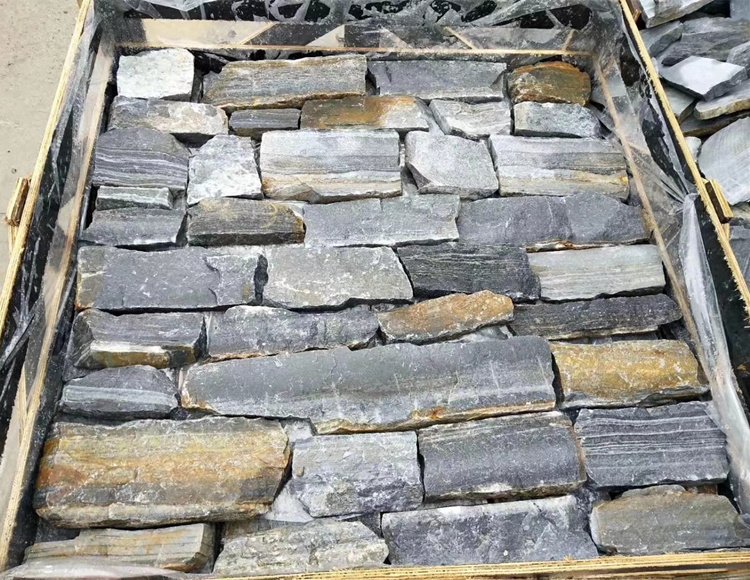
Specifying Pre-Assembled L-Corners for ASTM E84 Fire Testing and Drained Cavity Rainscreen System Integration
Fire ratings and cavity moisture resistance hang completely on the corner assembly detail, not just the panel field.
Spec sheets from cladding manufacturers list fire and moisture performance for the field of the wall. The corner is where the system gets tested. A field-mitered outside edge creates an open seam and a thin, exposed stone tongue that the test assembly never accounted for. If the inspector pulls the test report and sees the corner was site-modified, the rating is void.
ASTM E84 Class A flame spread indexes are assigned to the complete assembly—backer, mortar, and stone. When you grind a 45° bevel on site, you reduce the stone thickness at the edge to a few millimeters. That changes the heat transfer path and creates a line where flame can track behind the veneer. Factory L-corners, cut from the same block and affixed as a single unit, maintain the identical material cross-section the fire lab tested.
Commercial Submittal Compliance Benchmarks:
- ASTM E84 Class A Assembly: Non-combustible natural stone systems routinely achieve Class A flame spread below 25 and smoke developed under 450. Factory L-corners preserve this because they arrive as full-thickness interlocking units, not reduced-edge miter joints.
- EN 13501 Fire Reaction: European classifications (A1, A2-s1,d0) require the entire cladding, including corners, to pass testing. A hand-cut corner introduces an air gap and variable thickness that alters the thermal response. Pre-fab L-corners from a single production batch avoid this deviation.
- Field Modification Liabilities: On-site mitering changes the geometry that the fire test lab approved. Even if the stone itself is non-combustible, the assembly rating can be invalidated because the corner detail no longer matches the tested configuration.
Wet climate performance is the other non-negotiable on commercial jobs. When the project spec calls for a drained cavity rainscreen, the corner is the first place bulk water breaks through if the detail isn’t closed. A mitered corner with a 1 mm gap becomes a capillary intake in driving rain. Factory interlocking L-corners, with a tight 90° return and a back-bevel that sheds water outward, keep the cavity dry and the air gap functional.
In rainscreen assemblies, the L-corner should be set with a 10 mm continuous air cavity behind it, tied to the field cavity at the base corner flashing. This lets pressure equalize across the building facade layers. When water is driven into the joint, it drains down the back face of the L-corner and out the weep system, never reaching the sheathing. Site-mitered corners almost never achieve this because saw-cuts leave irregular surfaces that trap water rather than directing it downward.
Cavity Engineering Milestones:
- Drained Cavity Integration: Factory L-corners install over a consistent 10 mm air gap. Water that penetrates the joint flows along the stone back-face and out the base flashing. Mitered corners form a pinch point that blocks drainage.
- Cyclic Frost Resilience: Internal 5-year salt-spray test data shows interlocking L-corners survive over 100 freeze-thaw cycles without spalling. The same block-matching that eliminates color shifts also prevents moisture from finding a weak seam.
- Batch-Matched Moisture Expansion: When corners and field panels come from the identical quarry block, stone density and absorption rates stay uniform. This ensures expansion and contraction happen symmetrically across the entire elevation.
Conclusion
Before you close out your next exterior cladding bid, ask your supplier three questions. 1. Are your pre-fabricated corners cut from the same quarry block as my field panels? 2. Can you hold a ±0.5 mm CNC tolerance on the 90° angle? 3. Do your L-corners carry freeze-thaw test data past 100 cycles without failure? A “no” to any of these means your project carries the batch-mismatch, zipper-effect, or spalling risk that triggers 30% of warranty claims. Factory L-corners that clear all three eliminate the primary failure points no site miter saw can fix.
Review the factory’s current L-corner inventory and request a sample batch that matches your next spec sheet. Confirm the block match and tolerance data before the first panel goes up.
Frequently Asked Questions
What is a miter cut for stacked stone?
A miter cut is a 45-degree field cut on two flat stone panels so they meet at an outside corner. It’s done with a wet saw by a skilled mason. Requires a master mason and generates significant scrap material waste.
Why are pre-fabricated L-corners better than miter cutting?
L-corners reduce install time by half, slash scrap, and deliver 95% color uniformity. They also seal out moisture, preventing freeze-thaw callbacks that miter cuts often invite. Factory precision eliminates the zipper effect on exterior corners systematically.
Which corner method is cheaper for large exterior projects?
Pre-fabricated L-corners are cheaper on total installed cost. Field miter cuts inflate labor and waste, making finished corners about 25% more expensive despite lower unit prices. Factor in skilled mason rates and scrap metrics when comparing bids.
How to prevent the zipper effect on stone veneer corners?
Use factory L-corners with an interlocking profile layout. Manual miter cuts rarely close the vertical seam completely, letting water in and triggering frost jacking. Spec L-corners to stop the top cause of stone veneer warranty claims completely.
Can I use miter cuts for exterior stone cladding in freeze-thaw climates?
It’s risky. Field miter cuts often leave micro-gaps that trap moisture; freeze-thaw cycles force the stone apart over time. For freeze-thaw zones, pre-fabricated corners are the safer default engineering choice.
