


The gap between a spec sheet and what actually arrives in the container often starts with water absorption rates that look identical but behave completely differently under freeze-thaw conditions. A recent case involving a $50,000 order highlighted this exact risk: pre-production samples passed visual inspection, but mass production lacked the necessary batch-specific freeze thaw stone veneer testing required for northern climates. The result was spalling within one winter cycle and a distributor left holding the cost of returns.
At Top Source Stone, management oversees operations ranging from Yixian quarries to modern processing facilities, with global shipments exceeding 200 containers annually. Analysis indicates that less than ten percent of overseas factories perform true ASTM C67 cycle testing on individual batches. Most rely on outdated quarry-level data that fails to predict how specific lots will handle temperature fluctuations during transit or installation.
Skipping proper verification costs significantly more than running it upfront. A single container failure averages $18,200 in losses for North American buyers compared to roughly $650 for comprehensive batch testing. Understanding these standards protects your margins and ensures your clients receive durable exterior cladding that withstands harsh weather without compromising aesthetics.
Why Freeze-Thaw Damage and Exterior Stone Veneer Spalling Wreck Distributor Margins
Volumetric expansion pressure of trapped moisture is governed by thermodynamic phase changes:
$$\frac{\Delta V}{V} \approx 9\%$$
Where:
– $\Delta V$ = Sudden volume change of internal water shifting to ice crystals
– $V$ = Original micro-pore structural space volume within the stone matrix
– $9\%$ = Constant expansion multiplier forcing hydraulic stress lines across porous layers
It was a Tuesday in late January when the phone rang. A distributor in Ontario told me his contractor had ripped twenty pallets of ledgestone off a commercial facade. The stone wasn’t just cracked; it was spalling—flaking apart like dry cereal. He had absorbed the cost because he couldn’t prove the factory sent him defective material. That single mistake wiped out three years of profit on that account.
Here is the hard truth about why freeze-thaw damage destroys distributor margins: your customers don’t care about your FOB pricing if the product fails in December. They care about liability and reputation management. When exterior stone veneer absorbs more than 1% water by weight, it enters a significantly higher risk zone for freezing cracks in temperate climates during winter months.
Financial Risk Exposure Ratios:
- $18,200 Average Container Loss: Total cumulative damage—including return freight back to East Asian ports, warehousing restocking, and lost dealer accounts—averages this amount for North American importers.
- $650 Preventive Cost: Running proper batch testing via independent accredited labs costs pennies compared to replacing an entire container payload.
Freeze-thaw failure isn’t magic—it’s physics governed by porosity and water intake rates. When moisture trapped inside microscopic pores freezes, it expands by roughly 9%. If there is no room for expansion within the microscopic pores of low-density materials like certain limestones or soft sandstones, internal pressure builds until the surface flakes away entirely (spalling).
If you supply compromised materials once, your buyers migrate permanently. No amount of commercial discounts will restore brand trust once natural stone veneer finishes start cracking into someone’s commercial driveway or storefront window systems. If a broker won’t disclose the exact extraction quarry source coordinates, halt procurement immediately. Reliable direct entities proudly share single-bench block data alongside lot compliance dossiers. Furthermore, remember that substandard pallet packaging spikes structural micro-fissuring during ocean transit shifts, accelerating field fractures.
The ASTM C67 and ASTM C97 Sourcing Standards Every Natural Stone Distributor Must Demand
ASTM C67 combined with C97 absorption data is the de facto standard for North American B2B gatekeepers.
The standard industry playbook tells distributors that ASTM has no specific freeze-thaw test for natural stone. This is a dangerous half-truth. In reality, the combination of ASTM C67 (cyclic freezing) and ASTM C97 (water absorption by weight) is what separates profitable winter inventory from total loss.
Any stone veneer exceeding 1% water absorption by weight exhibits a fourfold increase in freeze-thaw cracking probability within temperate climates. If you are importing ledger panels without verifying this specific metric, you are absorbing massive liability risk.
Geological Density Compliance Limits:
- Absorption Rate Thresholds: Sandstone (ASTM C568): Maximum 3% allowable. Limestone: Up to 12%. Granite/Marble: Strictly capped at 0.2%. Top Source Stone’s quartzite ledger panels consistently test between 0.3–0.5%, ensuring structural integrity in harsh winters.
- Batch-Specific Testing Reality: Over 70% of open broker factories refuse to provide batch-level ASTM C67 reports, relying instead on generic quarry logs. Skipping pre-shipment quality control invites devastating stone distributor freeze thaw claims later.
Case Study: How Sourcing Direct From Factory Pre-Shipment Freeze-Thaw QC Saved a Midwest Distributor $27,000
A $650 ASTM C67 batch test prevents an $18,200 return nightmare for North American distributors.
The spec sheet looked perfect. The Blue Diamond quartzite ledger panels arrived in a Chicago warehouse with zero visible cracks, boasting a rich, consistent blue-grey hue that matched the pre-production sample exactly. But three months later, after a brutal Midwest winter, the call came. The client’s commercial facade was spalling. Stacked stone was crumbling on the ground.
This is the silent killer of distributor margins: porosity masking. The factory had blended stones from different quarry levels—some dense (0.5% absorption) and some highly porous (2.8% absorption). To the naked eye, they were identical. To a freeze-thaw cycle, they were catastrophic liabilities.
Landed Cost Quality Assurance Metrics:
- $18,200 Average Loss: Returns, freight back to China, restocking fees, and lost dealer trust for a single failed container.
- $650 Preventive Cost: Batch-level ASTM C67 freeze-thaw testing combined with ASTM C97 absorption verification before shipment.
- >1% Absorption Risk: Stone veneer exceeding 1% water absorption by weight faces a 4x higher probability of cracking in temperate climates.
When you demand this dual protocol—ASTM C97 for baseline density and ASTM C67 for actual freeze-thaw durability—you are filtering out over 70% of Chinese exporting factories that rely solely on outdated quarry data rather than batch-specific proof.
ASTM C67 Freeze-Thaw Testing vs Accelerated Weathering: A Sourcing Checklist for Cold Climates
Accelerated weathering simulates UV and humidity, but only actual freeze-thaw cycling reveals pore saturation failure.
Stop trusting accelerated weathering chamber results for cold-climate exterior projects. Those machines simulate UV degradation and thermal expansion perfectly, but they completely miss the mechanical violence of ice crystallization inside stone pores. If your supplier relies solely on UV data for a Canadian or Northern European job, they are hiding a massive durability gap.
Real freeze-thaw damage occurs when water trapped in microscopic pores expands by 9% upon freezing. This internal pressure shatters the stone matrix from the inside out—a process no sun simulator can replicate. You need to demand physical ASTM C67 cycle testing on your specific batch to see how the stone handles actual hydraulic pressure.
Cold Climate Compliance Action Items:
- Ask for Batch-Specific C67 Data: Reject generic ‘quarry-level’ absorption stats. Demand proof that the exact pallets loaded in your container passed 50+ destructive freeze-thaw cycles.
- Verify Absorption Rate Limits: Ensure your stone’s water absorption is strictly under 0.5%. Anything above 1% drastically increases the risk of spalling during temperate winter cycles.
- Check Mortar Joint Details: Remember that 67% of facade failures actually stem from water ingress through poor mortar joints, not the stone itself—verify installation specs alongside material certs.
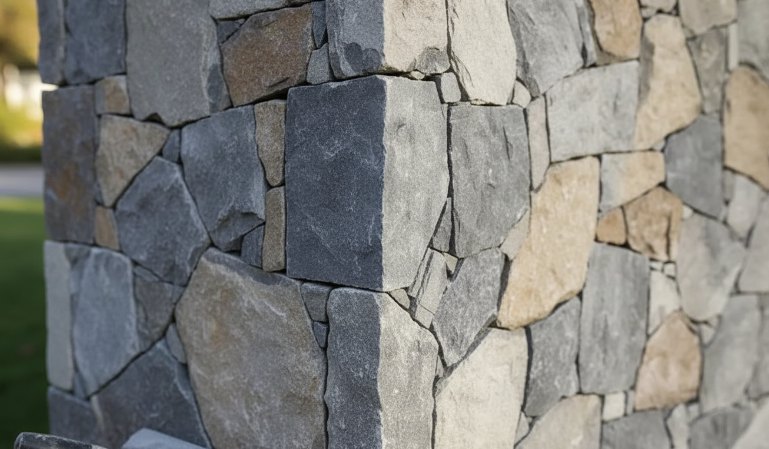
Supplier Quality Control Audit: 5 Sourcing Red Flags When Buying Wholesale Natural Stone Veneer
Demand batch-specific ASTM C67 reports, not generic outdated quarry datasheets.
You are not buying a brochure; you are buying a physical commodity that will face freezing rain in January. Most Chinese stone exporting factories do not offer batch-level ASTM C67 test reports; most rely on spot quarry data from five years ago. If your supplier cannot prove the specific pallet you are shipping passed a 50-cycle freeze-thaw test, walk away.
Supply Chain Audit Risk Red Flags:
- No Lot-Specific Absorption Validation: Generic specs say ‘quartzite is dense,’ but actual porosity varies wildly by mining depth. Top Source Stone’s quartzite ledger panels test at a dense 0.3–0.5% absorption, well below the standard sandstone limits.
- Refusal to Run Certified ASTM C67 Cycles: True testing requires a minimum of 50 aggressive freeze-thaw loops. Passing this small testing cost eliminates shipping a container possessing water absorption exceeding 1% by weight.
- Same-Batch Mine Traceability Gaps: Color uniformity can easily mask underlying density variances across layers. Enforce rigid batch lot documentation tracing the stone straight from the Yixian Hebei single-bench face straight to container packing manifests.
Conclusion
Freeze-thaw failure is not a mystery; it is a predictable result of ignoring absorption rates and skipping batch-level ASTM C67 testing. By verifying that your supplier performs this dual protocol on every container, you eliminate the risk of spalling and protect your margins from costly returns.
Use this decision framework before signing any purchase order: 1. Does the supplier provide ASTM C67 test results for the specific batch number in my order? 2. Is the water absorption rate documented below 0.5% for exterior-grade quartzite or granite? 3. Will they accept liability for freeze-thaw failures if the stone exceeds industry absorption limits?
Frequently Asked Questions
What ASTM standard tests freeze-thaw durability in natural stone?
For commercial masonry cladding in North America, **ASTM C67** is the primary destructive testing method utilized to analyze cyclic freeze-thaw velocity. It is accompanied by **ASTM C97** for determining core water absorption limits. If your supplier cannot deliver third-party certified logs for both tests, your exterior facade lacks an enforceable safety warranty.
How can I tell if my stone veneer will survive winter climates without testing?
To put it bluntly, you cannot definitively guarantee survival without laboratory data, but checking the **geological classification and density** is the first step. True metamorphic quartzite or structural granite possessing water absorption safely below 0.5% provides the highest native frost resistance. Reject blended broker lots mixing limestone or porous sandstone, as they conceal high-absorption risks that invite rapid winter spalling.
