


Meeting rigid commercial construction deadlines often depends on the speed of facade installation, yet traditional stone masonry remains one of the slowest phases on the critical path. Shifting to a modular Z shape stone panel system can compress project schedules by 25–40% by replacing individual units with factory-calibrated modules. These interlocking systems eliminate the need for artistic onsite masonry adjustments, allowing project managers to sequence trades with higher mathematical predictability and lower labor costs.
This guide evaluates the leading manufacturers providing high-precision stone solutions that maintain strict batch thickness tolerances of ±2 mm and usable material yields as high as 92%. We look at how digital laser templating and CNC machining ensure zero-seam visual continuity, while also reviewing essential load management requirements for the 50–80 kg/m² dead loads these panels impose on structural substrates. By selecting the right supplier, contractors can bypass common onsite cutting errors and recover time on delayed wall-cladding packages.
10 Leading Pre-Interlocking Z-Shape Stone Panel Manufacturers
Quick Comparison: Top Picks
| Manufacturer / Brand | Location | Core Strength | Verdict |
|---|---|---|---|
| Top Source Stone | China (Global Shipping) | Z-Shape Ledger Stone Panels (Flat, Rough, Pencil, and Marble) | Best for high-precision architectural projects requiring factory-direct scaling and premium natural stone. |
| Stonepanel (Cupa Group) | Spain / Europe Sourcing | Patented Interlocking Cement-Backed Z-Panels | The absolute global benchmark for multi-story exterior facades requiring mechanical safety anchors. |
| MSI Surfaces (Rockmount) | United States | Split-Face Natural Stone Interlocking Z-Modules | Ideal for North American contractors seeking rapid-install Z-formats with local warehouse stock. |
| ErthCoverings | Canada | Precision-Cut Natural Interlocking Z-Veneers | Excellent broad-spectrum provider for alpine climates and severe freeze-thaw project specifiers. |
| Tier Natural Stone | United Kingdom / Ireland | Fiber-Cement Reinforced Interlocking Z-Panels | Best for Western European commercial builds seeking completely hidden vertical joint layouts. |
| Eco Outdoor | Australia (National) | Premium Textured Z-Cladding & Walling Mats | Top recommendation for Australian builders seeking high-relief textures and coastal salt defense. |
| Eldorado Stone | United States | High-Density Calibrated Interlocking stone Facers | Best for ensuring shape uniformity and minimizing cut scrap across large multi-family tracts. |
| Canyon Stone Canada | Canada | Calibrated Z-Shape Facing Panels | Reliable source for highly consistent dimensional steps and cold storage envelope tasks. |
| Real Stone Cladding UK | United Kingdom | Rigid Mesh & Solid-Backed Interlocking Z-Panels | Technical choice for moisture-resilient wall protection grids in wet maritime zones. |
| Century Stone Systems | United Kingdom | Standardized Interlocking Ledger Modules | Reliable regional distribution partner for fast-track residential cladding packages. |
Top Source Stone
Top Source Stone operates as a specialized manufacturer, focusing on the production of high-performance Z-shape ledger stone panels for large-scale architectural projects. The company distinguishes itself by maintaining absolute authority over the entire supply chain, managing operations from their private quarries through to the final fabrication stage. This factory-direct model eliminates intermediaries, allowing contractors and designers to access premium natural stone materials while ensuring consistent raw material quality and pricing stability.
The technical execution of their product line relies on advanced infrared cutting technology to achieve the precision required for seamless, interlocking installations. By utilizing this machinery, the factory produces a variety of textures including flat, rough, pencil, and marble series that meet strict dimensional tolerances. This focus on technical accuracy reduces installation risks at the job site and ensures that the visual continuity of the stone cladding remains intact across expansive surface areas.
At a Glance:
- 📍 Location: China (Global Shipping)
- 🏭 Core Strength: Z-Shape Ledger Stone Panels (Flat, Rough, Pencil, and Marble Series), L-Shaped Corners
- 🌍 Key Markets: Global B2B Distributors, Large Contractors, and Commercial Architectural Designers
Why We Picked Them:
| ✅ The Wins | ⚠️ Trade-offs |
|---|---|
|
|
Stonepanel (Cupa Group)
Stonepanel, an engineering division under the prominent European multinational Cupa Group, stands as a top-tier technical solution for fast-track masonry. Each module features individual pieces of authentic quarried slate, limestone, or quartzite cast mechanically into a fiber-reinforced cement core during production. This advanced composite plate design allows decorative stone elements to achieve up to five times the flexural capacity of unbacked masonry blocks.
Their true technical edge lies in its patented embedded stainless steel anchor hooks, allowing architectural modules to pin directly to curtain-wall frameworks or cast concrete structures. This layout minimizes visual joints and eliminates the risk of stone delamination under intense air pressure differentials common at high altitudes. Carrying complete certifications (ETA), Stonepanel ensures seamless compliance for high-occupancy public infrastructure projects.
At a Glance:
- 📍 Location: Spain (Sourcing globally with Western Europe logistics centers)
- 🏭 Core Strength: Patented concrete-backed Z-panels, pre-installed mechanical anchor hooks, commercial structural facade ratings
- 🌍 Key Markets: European Union, United Kingdom commercial real estate, high-exposure building envelopes
Why We Picked Them:
| ✅ The Wins | ⚠️ Trade-offs |
|---|---|
|
|
MSI Surfaces (Rockmount)
MSI Surfaces commands an authoritative position across the North American building trade, managing large-scale import structures directly into regional hubs across the United States and Canada. They specialize in split-face modular stone panels configured in an exclusive interlocking Z-type format. By maintaining strict oversight over material grading, they provide a highly repeatable, consistent portfolio that eliminates erratic on-site depth variations.
Their operational layout focuses on rapid local fulfillment, allowing commercial contractors to access massive reserves without the delays common in direct overseas importing. Their interlocking Z-geometry allows general installation crews to line up large facade zones without visible straight vertical butt joints. This extensive supply chain network protects fast-track builders from unexpected project downtime or late-stage material gaps.
At a Glance:
- 📍 Location: United States (Nationwide Distribution Depots)
- 🏭 Core Strength: Split-face interlocking Z-modules, natural stone ledger facings, random linear slate series
- 🌍 Key Markets: North American residential construction, volume commercial wall cladding projects
Why We Picked Them:
| ✅ The Wins | ⚠️ Trade-offs |
|---|---|
|
|
ErthCoverings
ErthCoverings operates as an unshakeable local brand across Canada, delivering high-performance real stone options designed explicitly to stand up to severe sub-zero freeze cycles. Sourcing dense geologies like metamorphic slates and quartzites, they process their catalog into precise interlocking Z-sheets. Their factory operations emphasize strict dimensional tolerances, ensuring that panels interface cleanly to block wind-driven ice from trapping within joint seams.
The brand minimizes project delamination risks by monitoring raw material lots for low water porosity data. Their design-forward ranges allow architects to carry grand natural stone relief onto light-frame wall assemblies without creating heavy foundation dead loads. This responsive distribution grid ensures reliable material pipelines, helping high-volume contractors keep site installation paces optimized throughout the winter building season.
At a Glance:
- 📍 Location: Toronto, Ontario, Canada
- 🏭 Core Strength: Natural interlocking Z-veneers, 3D modular panels, calibrated low-absorption stone options
- 🌍 Key Markets: Canadian luxury ski resorts, high-end alpine residential estates, premium hospitality feature voids
Why We Picked Them:
| ✅ The Wins | ⚠️ Trade-offs |
|---|---|
|
|
Tier Natural Stone
Tier Natural Stone serves the UK and European commercial sectors, specializing in an industrialized panel system that bonds natural stone slips onto a reinforced concrete or cement base. Their manufacturing process utilizes a stepped Z-shape profile, allowing panels to interlock cleanly to speed up on-site installation and lower labor hours. This pre-assembled format ensures that the raw visual look of a dry-stone wall is preserved without the structural thickness of full-bed blocks.
The company addresses regional freeze-thaw challenges by verifying panel performance through independent laboratory testing. Their cement backing panels provide a stable bonding plane that prevents moisture accumulation behind the stone pieces, minimizing the risk of winter delamination. This technical approach makes them a reliable partner for large-scale housing developments and commercial projects where repeatable quality and long-term durability are primary drivers.
At a Glance:
- 📍 Location: United Kingdom / Ireland
- 🏭 Core Strength: Pre-assembled natural stone Z-panels, fiber-cement modular backing plates, rapid-install framing layouts
- 🌍 Key Markets: Western European commercial construction, multi-unit residential facades
Why We Picked Them:
| ✅ The Wins | ⚠️ Trade-offs |
|---|---|
|
|
Eco Outdoor
Eco Outdoor stands as a premier material design brand within the Australian architectural landscape, maintaining a notable showroom footprint across key capital cities like Sydney and Melbourne. They serve an upscale niche, specializing in natural stone wall claddings and pre-arranged interlocking ledger formats. By focusing on highly dimensional, rugged split-face surfaces, they provide landscape designers and luxury builders with a highly authentic material palette that eliminates the flat visual look of artificial alternatives.
The brand manages regional logistics by coordinating nationwide distribution channels that simplify the stone procurement sequence for multi-residential complexes. Their pre-fit stone sheets are heavily curated to handle Australia’s intensive UV and coastal salt-spray exposures, making them a favored specification for open-plan pavilions and beachfront estates. This localized infrastructure lowers project risk by providing accessible physical inventory and predictable local lead times.
At a Glance:
- 📍 Location: Sydney, NSW (With nationwide Australian showrooms)
- 🏭 Core Strength: High-relief interlocking real stone panels, random modular ledgestones, salt-resistant selections
- 🌍 Key Markets: High-end Australian residential real estate, premium hotels, luxury outdoor landscapes
Why We Picked Them:
| ✅ The Wins | ⚠️ Trade-offs |
|---|---|
|
|
Eldorado Stone
Eldorado Stone operates as an industrial leader in the manufactured masonry sector, focusing on the development of highly consistent interlocking panelized systems. Utilizing advanced molds cast from natural geological formations, they create concrete-and-cement composite matrices that replicate the depth of real stone. This precise factory control provides commercial builders with identical unit heights and interlocking edges, helping to accelerate installation programs on expansive real estate developments.
Sourcing from their extensive North American production lines helps developers reduce long-term material procurement risks and container arrival variations. Their interlocking ranges are engineered to meet strict fire-safety and frost-cycle requirements, ensuring performance on high-density multi-family structures. By providing pre-formed corner units and flat modules, the brand offers a highly repeatable supply solution that optimizes building schedules.
At a Glance:
- 📍 Location: United States
- 🏭 Core Strength: Pre-formed interlocking stone veneers, lightweight modular facades, predictable Aggregate casting
- 🌍 Key Markets: Large-scale North American commercial and multi-family infrastructure blocks
Why We Picked Them:
| ✅ The Wins | ⚠️ Trade-offs |
|---|---|
|
|
Canyon Stone Canada
Canyon Stone Canada serves as an essential supply point for regional builders who navigate the rigorous demands of sub-zero winter environments. Their technical focus centers on pre-interlocked veneer modules designed explicitly to limit water retention behind the panel face. By enforcing strict factory production controls, they ensure that their interlocking Z-panel series maintains tight joints, shielding backing systems from the moisture infiltration that drives frost-cracking.
Their organizational structure handles large-volume supply requirements for regional commercial complexes and urban housing partitions with high efficiency. Their panels are weight-optimized to meet lightweight construction definitions, making them easy to apply over standard cement sheets without constructing expensive concrete footings. This technical profile helps general contractors preserve project schedules while delivering a durable, classic stone appearance.
At a Glance:
- 📍 Location: Oshawa, Ontario, Canada
- 🏭 Core Strength: Lightweight modular stone facing, interlocking Z-panels, frost-certified lots
- 🌍 Key Markets: Canadian high-volume residential subdivisions, fast-track commercial retail envelopes
Why We Picked Them:
| ✅ The Wins | ⚠️ Trade-offs |
|---|---|
|
|
Real Stone Cladding UK
Real Stone Cladding UK focuses on providing high-performance modular surfacing materials for the British building sector. Sourcing premium quarried metamorphic slates and hard quartzites, they supply interlocking Z-panels engineered to resist intense wind-driven rain saturation. By supervising production bonding matrices at selected factory locations, they ensure that the stone modules maintain structural integrity across challenging building envelopes.
Their processing model resolves common on-site installation faults by providing flat, saw-cut panel backsides. This configuration ensures an optimal thin-set adhesive contact plane, reducing the un-bonded voids where water pools and expands during winter frost events. Their engineering support line helps project managers manage vertical moisture planes correctly, delivering consistent durability for large-scale development schemes.
At a Glance:
- 📍 Location: United Kingdom
- 🏭 Core Strength: Interlocking natural stone Z-panels, thin-cut stone wall modules, calibrated backers
- 🌍 Key Markets: UK and Irish urban housing developments, high-exposure commercial wall claddings
Why We Picked Them:
| ✅ The Wins | ⚠️ Trade-offs |
|---|---|
|
|
Century Stone
Century Stone functions as a key supplier for the regional building sector, focusing on natural and manufactured stone cladding options that survive intensive weathering. Their product catalog features modular Z-shaped sets and thin veneers designed to streamline field installation while maintaining structural safety. By sourcing from technologically advanced production plants, they ensure that each panel batch adheres to tight thickness and density metrics.
The company manages procurement risks for builders by checking material behavior against local European durability and freeze-thaw parameters. Their distribution infrastructure supports predictable lead times for master housing projects, providing a reliable supply of consistent stone looks. This localized technical support helps project managers integrate real stone textures into energy-efficient backup assemblies without incurring premium direct-import logistics overheads.
At a Glance:
- 📍 Location: United Kingdom
- 🏭 Core Strength: Calibrated modular facing stone, lightweight architectural veneers, cold-climate verified lines
- 🌍 Key Markets: UK Regional Housing Developments, Medium-scale Commercial renovations
Why We Picked Them:
| ✅ The Wins | ⚠️ Trade-offs |
|---|---|
|
|
Fast-Track Commercial Construction: Overcoming Rigid Deadlines with Modular Masonry
Modular Z-shape stone panels compress commercial facade schedules by 25–40% by replacing individual masonry units with factory-assembled modules. These systems utilize interlocking edges and standardized coverage rates of 0.09–0.12 m² per piece to eliminate on-site layout errors and allow project managers to sequence trades with high mathematical predictability.
Critical Path Path Compression with Pre-Sized Z-Shape Stone Panels
Factory-cut Z-shape stone ledger panels compress façade installation schedules by 25–40% compared to traditional hand-set masonry. By shifting the complexity of stone alignment from the job site to the fabrication facility, contractors can deploy smaller crews to achieve higher square-footage yields per shift without sacrificing aesthetic quality.
Modular predictability allows project managers to sequence crews and inspections with fewer unknowns, using standardized coverage rates of 0.09–0.12 m² per piece. This transparency in material consumption and labor speed helps large-scale developments meet rigid benchmarks, especially when weather windows or following trades like scaffolding removal impose hard finish dates.
Pre-interlocking edges bypass individual stone layout and on-site cutting, allowing contractors to recover time on delayed wall-cladding packages. The self-aligning nature of the Z-profile ensures that vertical seams are automatically hidden, reducing the need for artistic masonry adjustments that usually slow down high-volume commercial installations.
Substrate Validation and Load Management for Speed
Modular stone panels impose a dead load of 50–80 kg/m² (8-13 lbs/sqft), requiring structural substrates rather than standard drywall. Successful fast-track execution depends on verifying that the backing wall—whether concrete, brick, or structural metal studs—can support the combined mass of the stone, adhesive, and mesh backing without deflection.
工业 standards maintain speed by confirming structural backing early, such as 1/2 inch cement backer board fixed to framing, to avoid late-stage RFIs. Installing stone modules over non-compliant surfaces leads to bond failure or wall sagging, both of which require expensive demolition and rebuilding that can erase any schedule gains provided by the modular format.
Early design live/dead load checks per m² prevent the need for costly retrofitting that can erase schedule gains. By integrating these load calculations into the pre-construction phase, engineers ensure that the mechanical fixing systems, such as Z-clips or high-strength epoxy, are appropriately matched to the specific densities of the natural stone selected.
Quality Benchmarks and Procurement Ratios for Seamless Workflow
Strict batch thickness tolerance of ±2 mm prevents on-site shimming and reduces punch-list defects during high-speed installation. Flat-face continuity is vital for large elevations where grazing light would otherwise highlight minor deviations (lippage) between neighboring panels, leading to time-consuming field grinding.
Prevent site shortages by ordering precise ratios: one linear foot of L-shaped corner units for every vertical foot of outer corner. Accurately accounting for corner returns ensures that the interlocking Z-pattern wraps building edges without interruption, preventing the project from stalling while waiting for emergency shipments of matching specialty pieces.
Advanced infrared cutting equipment ensures stones interlock perfectly, while high-strength epoxy resin prevents stone de-bonding even under tight deadlines. These factory-controlled variables result in an installed yield of 88–92% usable area, significantly reducing the waste factor from the 15–20% typically associated with loose stone masonry.
Anatomy of a Zero-Seam Facade: How Precision Cut Z-Geometry Interlocks Flawlessly
Idela seamless stone facades require shifting from manual masonry to high-precision CNC fabrication. By utilizing Z-shaped interlocking geometries and digital laser templating, manufacturers reduce installation error from ±5 mm down to ±0.5 mm. This system relies on tight batch thickness tolerances of ±2 mm and specialized contour milling to ensure panels self-index, effectively concealing vertical joints and compressing installation schedules by up to 40%.
Digital Layout and Laser Templating for Sub-Millimeter Accuracy
Engineers have replaced traditional manual layouts and cardboard templates with digital laser templating to define the facade grid. This transition allows each interlocking leg, notch, and return to be mapped in CAD with sub-millimeter precision. By establishing a digital twin of the wall surface, geometric errors are reduced from the industry-standard ±3–5 mm down to approximately ±0.5 mm. This accuracy ensures that Z-shaped stone edges close tightly without visible gaps, and contractors avoid the delays associated with on-site trimming or re-measurement, as every panel matches the specific wall geometry on the first pass.
CNC Machining and High-Precision Tooling for Interlocking Profiles
The production of interlocking profiles depends on CNC bridge saws and waterjets capable of holding tolerances between ±0.5 mm and 0.13 mm. Fabricators apply specific contour and profile milling toolpaths to machine the vertical walls and stepped outlines of the Z-profiles at fixed depths. This creates a tongue-and-groove geometry that makes panels self-indexing during installation. Consistent monitoring of tool wear and the probing of key dimensions prevent cumulative errors across multi-panel runs. Such rigorous machining standards mean panels arrive site-ready, allowing for a clean dry-fit that eliminates the need for field edge grinding.
Material Stability and Thickness Control for Flush Surface Continuity
Even with perfect edge geometry, surface continuity fails if material thickness fluctuates. Procurement specifications for modular stone cladding strictly limit batch thickness variation to ±2 mm to ensure faces remain flush. This control allows interlocking legs to seat fully against the substrate without rocking or creating steps between neighboring panels. Thin stone veneer flats, typically sliced to 15–20 mm, maintain structural integrity while facilitating the mechanical interlock. To preserve this alignment long-term, factories deploy frost-resistant polyurethane or epoxy adhesives on backing meshes, preventing creep or distortion that could otherwise telegraph to the face and open the seams.
Elevate Your Projects with Premium Natural Stacked Stone
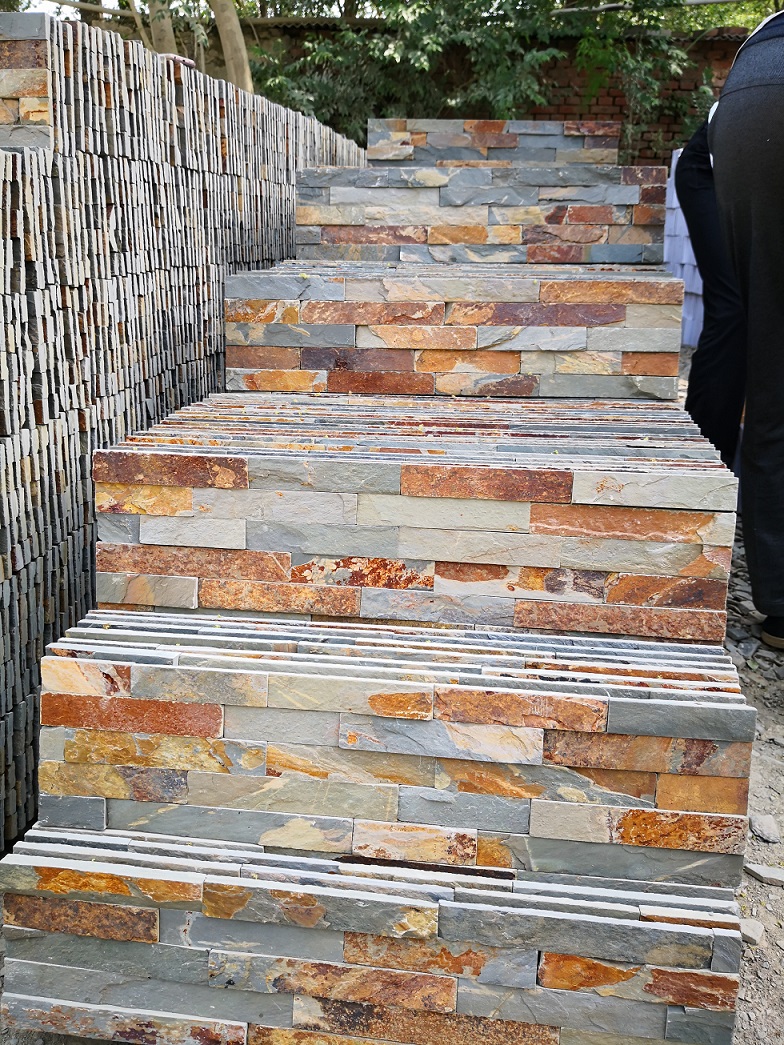
Minimizing Material Waste: The Financial Impact of Factory-Calibrated Interlocking Edges
Factory-calibrated Z-shape stone panels significantly reduce material overhead by lowering standard waste factors from 20% down to approximately 3–8%. By utilizing CNC-machined interlocking edges and digital nesting, projects achieve a usable area yield of 88–92%, directly decreasing procurement volumes, freight costs, and site-level scrap disposal.
Quantifying Yield Growth from Calibrated Z-Geometry
Precision-engineered Z-shape panels optimize the ratio of purchased material to installed surface area. While traditional loose stone masonry relies on manual sorting and heavy field trimming, factory-controlled interlocking edges allow for a usable yield of 88–92%. Digital nesting during the fabrication phase arranges parts on raw slabs to minimize kerf loss, ensuring that the repeatable geometry remains within strict dimensional tolerances.
This level of accuracy eliminates the need for aggressive on-site grinding to force alignment at joints. Because the Z-geometry is defined at the sub-millimeter level before the stone reaches the project site, more of the stone remains within tolerance throughout the installation process. Project managers can therefore plan procurement cycles with high confidence, ordering quantities that closely match the actual wall area rather than padding orders to compensate for unpredictable site loss.
Material Budget and Freight Savings in Procurement
The shift from conventional cladding to interlocking panels alters the financial profile of stone procurement. Standard stone masonry typically requires a 10–20% waste buffer to account for breakages, cutting errors, and misfits. In contrast, calibrated interlocking panels reduce this requirement to a 3–8% band. On a 1,000 m² commercial wall project, this efficiency allows material orders to drop from approximately 1,200 m² to just 1,050 m².
These reductions in total volume create a compounding effect on logistics. Lower purchase volumes result in fewer shipping containers and reduced freight weight, which is especially critical for global portfolios where transportation costs represent a significant portion of the total landed cost. By minimizing the amount of surplus material moved across the supply chain, developers realize direct savings in both product cost and administrative overhead.
Operational Efficiency through Reduced Remake Rates
Operational success in stone cladding depends on maintaining a low remake rate—the percentage of material that must be discarded due to dimensional or aesthetic defects. Factory calibration limits thickness variation to ±2 mm, preventing the excessive shimming that often leads to panel rejection. When interlocking faces are machined to match perfectly, installers encounter fewer misaligned joints, which stabilizes the installation pace and protects the labor budget.
A lower remake rate supports a higher on-time installation rate by removing the need for emergency re-cutting of scrap-generating rework. Eliminating fieldwork such as hand-mitering at corners or grinding vertical seams keeps the project site cleaner and prevents the waste of premium stone. By focusing on factory-controlled precision, contractors ensure that labor is spent on placement rather than corrective masonry, further securing the financial return of modular systems.
Top Source Stone: High-Speed Interlocking Z Panel Systems Built for Enterprise Timelines
Z-panel systems prioritize critical path compression by converting traditional stone masonry into a panelized operation, reducing façade installation schedules by 25–40%. Through infrared-calibrated CNC cutting and standardized interlocking geometries, enterprise projects achieve a 92% usable material yield and maintain thickness tolerances within ±2 mm to ensure flush, zero-seam visual continuity across large-scale developments.
Advanced Factory Calibration for Batch Consistency
Precision manufacturing is the foundation of high-speed cladding. TopSource Stone implements infrared cutting equipment to maintain a thickness variation within ±2 mm across large production lots, preventing the lippage and uneven courses that often stall commercial projects. Each batch undergoes three-stage quality inspection protocols covering post-cutting, post-assembly, and pre-packaging phases to ensure every module meets structural standards.
To secure these panels on high-rise facades, they utilize high-strength epoxy resin adhesives formulated specifically for natural stone. This specific bonding agent prevents stone fallout and resists degradation from thermal movement or environmental exposure, maintaining the integrity of the Z-geometry interlock over the building’s lifecycle.
Scaling Installation Velocity with Interlocking Z-Geometry
The transition from individual stone layout to a panelized operation utilizes 6×24 inch (15×60 cm) modular units. This geometry hides vertical joints by breaking up the seam profile, allowing crews to place significantly more surface area per shift compared to loose stone. The interlocking legs allow panels to self-index, which minimizes the need for on-site layout and manual adjustments.
Standardization of L-shaped corner pieces further accelerates production by eliminating time-consuming on-site miter cuts. They integrate lightweight panels weighing between 8-13 lbs/sqft, which often removes the requirement for specialized structural footings or heavy-duty brick ledges. This weight reduction simplifies the engineering requirements for the building envelope while maintaining the aesthetic of a solid masonry wall.
Logistics and OEM Capabilities for Global Enterprise Rollouts
International project timelines depend on reliable logistics. TopSource Stone’s strategic container loading uses reinforced fumigated wooden crate packaging designed for intensive international shipping standards, reducing breakage rates during transit. They provide full OEM and ODM support, including custom-printed branding for distributors and tailored panel formats designed for specific B2B contract requirements.
Accuracy in procurement prevents site shortages that endanger project milestones. They employ a streamlined ordering logic that separates flat field square footage from linear corner units. By calculating the precise ratio of corner pieces to field panels during the takeoff phase, project managers ensure zero-shortage delivery and avoid emergency air-freight costs for missing components.
Frequently Asked Questions
How does a Z-shape design hide vertical joint lines compared to square stone panels?
A Z-shape panel uses interlocking edges that overlap and lock into place, effectively concealing vertical seams. Unlike square panels that create visible straight gaps, the Z-geometry profile breaks up the joint line across a staggered path, allowing the eye to see a continuous stone face.
What are the dimensional cutting tolerances for factory-produced interlocking edges?
Commercial standards for Z-shape panels generally maintain a tolerance band of ±0.5 mm on the interlock geometry and ±1.0 mm on the overall module length and height. These tight tolerances ensure flush mating surfaces and prevent cumulative misalignment during large-scale wall cladding installations.
Are prefabricated matching corner units available for these systems?
Yes, most systems include factory-made L-shaped corner units designed to match the specific stone texture and module height of the flat panels. These units continue the staggered interlocking pattern around external and internal corners, eliminating the need for complex on-site mitering and ensuring a seamless visual finish.
Is natural stone cladding suitable for fireplace surrounds and high-heat areas?
Natural stone is inherently non-combustible, making it an ideal material for fireplace surrounds. While the stone itself handles heat efficiently, installers should follow local building codes and use high-strength, heat-resistant epoxy adhesives to ensure a permanent bond between the stone and the substrate.
Do Z-shape stone panels provide a waterproof barrier for exterior walls?
While the stone is naturally water-resistant, the interlocking panel system itself is not a waterproof barrier. For exterior applications or wet areas, a proper moisture barrier and flashing system must be installed behind the stone, and applying a high-quality natural stone sealer is recommended to prevent staining.
Final Thoughts
Adopting Z-shape stone panels represents a shift from traditional labor-intensive masonry to a systematic, engineering-led approach to facade construction. By utilizing factory-calibrated modules that prioritize dimensional accuracy and material yield, contractors can bypass the logistical bottlenecks of hand-set stone. These systems solve the tension between high-end aesthetic requirements and the aggressive scheduling demands of modern commercial developments, turning cladding into a predictable and repeatable process.
Choosing the right manufacturing partner ensures that these technical advantages translate into site-level savings. Precision in interlocking geometry, batch consistency, and strategic procurement of corner units are the factors that prevent project delays and material waste. As project managers look to compress timelines without increasing risk, interlocking stone systems offer a reliable path to finishing large-scale elevations ahead of schedule while maintaining the permanent durability of natural stone.
