

Specifying fireplace cladding for high-occupancy commercial projects or luxury residential interiors requires more than just an aesthetic choice; it demands materials that meet strict 2026 building codes for safety and air quality. Many synthetic stone substitutes begin to discolor or off-gas toxic VOCs at temperatures as low as 150°F, posing significant risks to indoor air quality and structural longevity. Project managers and architects now prioritize fire-rated stacked stone systems that can withstand the intense thermal stress of modern fireplace inserts without cracking or degrading over time.
This guide evaluates the leading manufacturers of 100% natural stone panels that carry a Class A fire rating, which requires a Flame Spread Index of 25 or less under ASTM E84 testing. You will find a detailed comparison of materials like slate and quartzite that tolerate temperatures up to 1200°F, alongside technical insights on preventing thermal shock through proper joint layout and thickness specification. We examine how these manufacturers balance precision engineering with the inorganic properties needed to eliminate urea-formaldehyde emissions in heated environments.
10 Leading Fire-Rated Stacked Stone Cladding Manufacturers (Global Review)
Quick Comparison: Top Picks
| Manufacturer / Brand | Location | Core Strength | Verdict |
|---|---|---|---|
| TopSource Stone (Stacked Stone Series) | China (Global Shipping) | Class A Fire-rated natural stone cladding & interlocking Z-panel systems | Best for B2B distributors seeking factory-direct pricing, zero-VOC profiles, and full OEM customization. |
| Norstone | Sydney, Australia / Global | High-density natural rock panels & luxury fireplace features | Top-tier choice for luxury hospitality projects and premium non-combustible resort interiors. |
| MSI Surfaces (Rockmount) | Orange, California, USA | Split-Face Genuine Stone Interlocking Z-Panels | Top pick for North American builders seeking immediate regional warehouse availability for volume contracts. |
| Stonepanel (Cupa Group) | Spain / Global Offices | Patented Cement-Backed Non-Combustible Stone Modules | The global benchmark for multi-story vertical applications demanding built-in safety anchors. |
| RealStone Systems | Northville, Michigan, USA | Fiber-cement backed 100% natural stone composites | Excellent broad-spectrum commercial provider with detailed thermal expansion testing logs. |
| ErthCoverings | Toronto, Canada | Precision-Cut Natural Interlocking Ledger Veneers | Premier choice for high-alpine installations requiring strict low-porosity mineral durability. |
| Tier Natural Stone | United Kingdom / Ireland | Fiber-Cement Reinforced Interlocking Z-Panels | Best for fast-track European commercial builds seeking completely hidden panel joint lines. |
| Knauf Aquapanel | Germany / Global Distribution | Class A1 Non-Combustible Facade Carrier Boards | Global technical standard for rigid, zero-combustion backup substrate sheets. |
| Sto Group USA | Atlanta, Georgia, USA | Ventilated Facade Assemblies & Carrier Stone Elements | Ideal for advanced commercial envelopes demanding integrated back-ventilation drainage layers. |
| LATICRETE International | Connecticut, USA | High-Heat Adhesives & Facade Mortar Systems | The industrial chemical standard for permanent stone panel adhesion in thermal zones. |
TopSource Stone (Stacked Stone Series)
TopSource Stone operates as a specialized manufacturer that manages the entire supply chain from their own quarries to the final product. Their focus on fire-rated natural materials is particularly relevant for large-scale construction where safety standards are non-negotiable. By supervising the raw material extraction of slate, quartzite, and marble, they maintain direct control over aesthetic consistency and structural integrity across every batch of stone veneer.
Manufacturing precision drives the success of their interlocking Z-panel systems, which utilize advanced infrared cutting technology to ensure tight seams and efficient installation. This factory-direct model significantly reduces procurement risks for B2B distributors and contractors by eliminating middlemen while offering deep customization through OEM and ODM services. Their ability to produce high-performance cladding for both residential fireplaces and heavy-duty commercial exteriors makes them a reliable partner for global infrastructure projects.
At a Glance:
- 📍 Location: China (Global Shipping)
- 🏭 Core Strength: Fire-rated ledger stone panels, natural stone veneer (Flat, Rough, Pencil, and Marble series), L-shaped corner units
- 🌍 Key Markets: B2B distributors, large-scale construction contractors, and interior designers globally
Why We Picked Them:
| ✅ The Wins | ⚠️ Trade-offs |
|---|---|
|
|
Norstone
Norstone operates as a premier manufacturer of natural stone cladding, specializing in high-density sedimentary rock and quartzites sourced for their structural integrity. By maintaining strict factory control over the calibration and assembly of their natural stone panels, the company ensures that each unit meets the precise tolerances required for seamless installation. Their product range, particularly the Aksent and Lynia series, caters to architects and developers who prioritize a sophisticated aesthetic combined with the rugged durability of genuine stone.
To reduce installation risk, Norstone subjects its products to rigorous fire-safety and freeze-thaw testing, making them suitable for demanding applications such as high-heat fireplace surrounds and commercial exterior facades. This focus on local execution and technical compliance allows project managers to specify these materials for luxury hospitality lobbies and high-end residential feature walls with confidence. The integrated finger-joint corner systems and mechanically fastened panels represent their commitment to engineering stone solutions that perform reliably in any climate.
At a Glance:
- 📍 Location: Sydney, Australia / Global Logistics Hubs
- 🏭 Core Strength: Natural stone veneer panels, Aksent and Lynia series, fireplace feature wall systems
- 🌍 Key Markets: High-end residential, premium hospitality lobbies, and commercial luxury configurations
Why We Picked Them:
| ✅ The Wins | ⚠️ Trade-offs |
|---|---|
|
|
MSI Surfaces (Rockmount)
MSI Surfaces coordinates an extensive supply network across North America, distributing natural stone ledger panels designed for both residential surrounds and commercial facades. By maintaining centralized parameters over product sorting at factory levels, they ensure that each panel batch adheres to tight dimensional boundaries, significantly mitigating on-site lippage risks or sudden texture variations during volume applications.
The company stands out through its focus on regional execution and immediate stock readiness. Their signature Rockmount ledger series utilizes real quarried slate and quartzite chunks engineered onto a modular mesh system, allowing contractors to complete fireplace accent facings with highly optimized laying speeds. Sourcing from their local domestic hubs avoids long maritime container lag times for fast-track builders.
At a Glance:
- 📍 Location: Orange, California, USA (National Depots)
- 🏭 Core Strength: Split-face genuine stone ledger panels, interlocking Z-veneers, calibrated quartzite panels
- 🌍 Key Markets: North American residential subdivisions, production housing, and commercial building supply chains
Why We Picked Them:
| ✅ The Wins | ⚠️ Trade-offs |
|---|---|
|
|
Stonepanel (Cupa Group)
Stonepanel, an engineering division under the prominent European multinational Cupa Group, represents a premier system-level solution for high-stakes installations. Each module features individual pieces of authentic quarried slate, limestone, or quartzite cast mechanically into a fiber-reinforced cement core during production. This advanced composite plate design allows decorative stone elements to achieve up to five times the flexural capacity of unbacked masonry blocks.
Their true technical edge lies in its patented embedded stainless steel anchor hooks, allowing architectural modules to pin directly to curtain-wall frameworks or cast concrete structures. This layout minimizes visual joints and eliminates the risk of stone delamination under intense air pressure differentials common at high altitudes. Carrying complete certifications (ETA), Stonepanel ensures seamless compliance for high-occupancy public infrastructure projects.
At a Glance:
- 📍 Location: Spain (Sourcing globally with Western Europe logistics centers)
- 🏭 Core Strength: Patented concrete-backed Z-panels, pre-installed mechanical anchor hooks, commercial structural facade ratings
- 🌍 Key Markets: European Union, United Kingdom commercial real estate, high-exposure building envelopes
Why We Picked Them:
| ✅ The Wins | ⚠️ Trade-offs |
|---|---|
|
|
RealStone Systems
RealStone Systems operates with a clear focus on local execution by providing North American builders with panelized natural stone solutions. Based in Northville, Michigan, the company maintains factory control over the bonding process, where genuine stone veneers are fused to specialized fire-resistant backers. This approach caters specifically to fireplace surrounds and feature walls, ensuring that the natural aesthetic of stone remains accessible without the labor-intensive requirements of traditional masonry.
The technical design of these composite panels significantly leads to risk reduction during the installation phase. By using fiber-cement backing, the system manages thermal expansion and fire safety requirements more effectively than standard thin-set applications. This factory-assembled kits approach streamlines the construction timeline, allowing residential renovation teams and commercial contractors to achieve high-end reception spaces with predictable results and reduced on-site waste.
At a Glance:
- 📍 Location: Northville, Michigan, USA
- 🏭 Core Strength: Natural stone composite panels, fiber-cement backed stone panels, fireplace wall kits
- 🌍 Key Markets: Residential interior renovations and commercial reception spaces across North America
Why We Picked Them:
| ✅ The Wins | ⚠️ Trade-offs |
|---|---|
|
|
ErthCoverings
ErthCoverings stands as a market-leading Canadian brand delivering real stone configurations built to endure intense seasonal freezing and moisture saturation. Sourcing high-density quartzites and metamorphic slates, they process their catalog into precise interlocking Z-panels. Their production lines prioritize geometric calibration, ensuring that every panel sheets tightly with adjoining pieces to remove visual seams and hide joints from water accumulation pathways.
The brand minimizes project delamination risks by vetting raw stone selection using strict water absorption indexes. Their design-forward ranges allow architects to specify natural stone cladding without creating heavy structural dead loads on building foundations. This localized supply network coordinates responsive fulfillment timelines across Ontario and Quebec showroom centers, helping developers manage high-wage crew scheduling effectively.
At a Glance:
- 📍 Location: Toronto, Ontario, Canada
- 🏭 Core Strength: Natural interlocking Z-veneers, 3D modular panels, calibrated low-absorption stone options
- 🌍 Key Markets: Canadian luxury alpine resorts, premium hospitality contracts, corporate interior feature voids
Why We Picked Them:
| ✅ The Wins | ⚠️ Trade-offs |
|---|---|
|
|
Tier Natural Stone
Tier Natural Stone serves the UK and European commercial sectors, specializing in an industrialized panel system that bonds natural stone slips onto a reinforced concrete or cement base. Their manufacturing process utilizes a stepped Z-shape profile, allowing panels to interlock cleanly to speed up on-site installation and lower labor hours. This pre-assembled format ensures that the raw visual look of a dry-stone wall is preserved without the structural thickness of full-bed blocks.
The company addresses regional freeze-thaw challenges by verifying panel performance through independent laboratory testing. Their cement backing panels provide a stable bonding plane that prevents moisture accumulation behind the stone pieces, minimizing the risk of winter delamination. This technical approach makes them a reliable partner for large-scale housing developments and commercial projects where repeatable quality and long-term durability are primary drivers.
At a Glance:
- 📍 Location: United Kingdom / Ireland
- 🏭 Core Strength: Pre-assembled natural stone Z-panels, fiber-cement modular backing plates, rapid-install framing layouts
- 🌍 Key Markets: Western European commercial construction, multi-unit residential facades
Why We Picked Them:
| ✅ The Wins | ⚠️ Trade-offs |
|---|---|
|
|
Knauf Aquapanel
Knauf Aquapanel, a prominent structural division of the German Knauf Group, manufactures the high-durability fiber-reinforced cementitious carrier sheets required to anchor heavy natural stones. Their automated aggregates form an unyielding exterior diaphragm plate that remains completely immune to freeze-thaw cycles and intense moisture accumulation. While they do not process raw stone blocks, they provide the code-certified carrier backing system that bonds monolithically with masonry mortars.
The company prioritizes safety and non-combustibility parameters across their global automated factories, delivering an exterior or interior backing board that matches Class A1 thermal constraints perfectly. For high-occupancy commercial structures or luxury fireplace features, pairing these rigid cement carriers with calibrated real stone layers ensures superior compliance with fire-code directives, preventing substrate-borne structural fatigue.
At a Glance:
- 📍 Location: Germany (Global Industrial Footprint serving North America)
- 🏭 Core Strength: 100% water-resistant cement board substrates, fiber-reinforced carrier plates, non-combustible systems
- 🌍 Key Markets: High-rise commercial envelopes, institutional public works, heavy facade backings
Why We Picked Them:
| ✅ The Wins | ⚠️ Trade-offs |
|---|---|
|
|
Sto Group USA
Sto Group USA stands as a leading provider of high-performance building skins, highly trusted for their continuous insulation and ventilated cladding designs. Their engineered carrier systems incorporate fiber-reinforced cementitious backers that serve as an unshakeable mounting plane for natural stone slips. Sto coordinates the subtle mechanics of moisture management, ensuring incidental condensation drains safely out of the system cavity.
The company reduces development risk by testing their entire external wall insulation assembly as a single integrated mechanism. Their technical infrastructure delivers detailed layout wind-load calculations and girt spacing coordinates, protecting multi-story buildings against high wind pressures and seismic movement. By matching airtight vapor sheets with a dense cement base, Sto preserves long-term bond cohesion lines.
At a Glance:
- 📍 Location: Atlanta, Georgia, USA (National Branch Matrix)
- 🏭 Core Strength: Ventilated rainscreen frameworks, moisture protection coatings, fully tested facade assemblies
- 🌍 Key Markets: Modern commercial facades, institutional envelopes, energy-efficient corporate properties
Why We Picked Them:
| ✅ The Wins | ⚠️ Trade-offs |
|---|---|
|
|
LATICRETE International
LATICRETE International, Inc. operates as a critical backbone for the global construction and masonry sectors, providing the specialized chemistry needed to secure heavy stone veneers and panels. By focusing on high-performance installation systems, the company ensures the structural integrity of complex architectural designs, particularly those involving high-heat masonry facade applications. Their materials act as the bonding agent that bridges the gap between raw stone cladding and the building’s substrate, maintaining safety and durability in diverse climates.
The company maintains rigorous factory control over its adhesive and mortar formulations, which reduces the operational risks often associated with onsite mixing and poor bond strength. Professionals rely on their systems for consistent results across global projects, benefiting from a supply chain that provides technical mortars and adhesives specifically designed for modern masonry requirements. This focus on chemical engineering and installation technology allows developers to implement stone paneling with confidence in the long-term stability of the facade.
At a Glance:
- 📍 Location: Connecticut, USA
- 🏭 Core Strength: Stone adhesives, thin-set mortars, MVIS masonry facade installation systems
- 🌍 Key Markets: North American tile and stone installation industries, high-load masonry facades
Why We Picked Them:
| ✅ The Wins | ⚠️ Trade-offs |
|---|---|
|
|
Fireplace Safety First: Understanding Zero-Combustion Class A Fire Ratings
A Class A fire rating represents the highest safety standard for surface burning, requiring a Flame Spread Index between 0 and 25 under ASTM E84 testing. While this classification ensures slow flame propagation across wall cladding, true fireplace safety relies on using inherently non-combustible materials like 100% natural stone to prevent structural degradation under high-heat exposure.
Defining Class A Flame Spread and ASTM E84 Standards
The ASTM E84 standard, often referred to as the Steiner Tunnel Test, evaluates how quickly flames travel across the surface of a material and the volume of smoke produced. To achieve a Class A rating, the material must demonstrate a Flame Spread Index (FSI) of 25 or less. Technical evaluations often pair this with a Smoke Developed Index (SDI) to ensure the material does not release excessive toxic fumes during a fire event. For architects and designers, specifying Class A materials is a baseline requirement for interior finishes in high-occupancy commercial zones and residential corridors near heat sources.
It is vital to recognize that a Class A surface-burning rating measures performance on the wall surface. It does not network mean the material is completely fireproof or that it provides a specific hourly fire-resistance rating for the entire wall assembly. Instead, it confirms that the cladding will not contribute significantly to the rapid spread of fire across an interior feature wall, providing critical time for evacuation and intervention.
Natural Stone vs. Synthetic Substitutes in High-Heat Zones
100% natural stone panels stand as a superior choice for fireplace surrounds because they are inorganic and inherently non-combustible. Unlike resin-based faux stone or engineered quartz, which contain polymer binders, natural stone can tolerate steady temperatures exceeding 1200°F without scorching. Synthetic substitutes or many resin-bonded products may begin to discolor, off-gas, or suffer micro-fractures at temperatures as low as 150°F to 300°F. When heat concentrates near an insert opening, these chemical binders can degrade, compromising the aesthetic and structural bond of the veneer.
Contemporary stacked stone panels utilize high-strength epoxy resins or cementitious backings to maintain structural integrity. Using these Class A rated natural stone systems ensures compliance with building codes, which increasingly focus on the fire performance of interior feature walls. By selecting dense stone products over resin-rich composites, builders avoid the risks of thermal shock—a phenomenon where rapid temperature cycling creates internal stresses that cause thinner or weaker materials to crack, flake, or debond from the substrate.
Thermal Shock Resistance: Preventing Stone Cracking Around High-Heat Inserts
Thermal shock occurs when stone around a fireplace insert expands and cools unevenly, creating internal stresses that lead to cracks or delamination. Preventing this damage requires selecting materials with low thermal expansion—such as natural stone or sintered stone—and implementing specific detailing like expansion joints, flexible buffer gaskets, and minimum stone thicknesses of 20-30 mm to distribute heat gradients effectively.
The Physics of Thermal Stress in Fireplace Surrounds
Thermal shock happens when the temperature across a stone panel changes too rapidly, causing different parts of the material to expand at different rates. This uneven expansion creates internal pressure that often exceeds the stone’s tensile strength, leading to visible fractures. These stresses typically concentrate at the edges of the metal firebox and sharp interior corners where heat is most intense.
Materials with high coefficients of thermal expansion (CTE) and low thermal conductivity are most at risk because they cannot dissipate heat quickly, trapping intense temperature gradients within the stone’s thickness. This imbalance triggers the flaking or “spalling” frequently seen in poorly specified fireplace claddings.
Material Performance: Natural Stone vs. Resin-Bonded Composites
Natural stone varieties like granite can withstand steady temperatures up to 650°C (1200°F), making them robust candidates for high-heat environments. However, sudden chilling or highly localized heating near small cut-outs can still trigger fractures even in these durable materials. In contrast, engineered quartz presents significant risks because the polymer resins used to bind the stone particles degrade at temperatures as low as 65°C to 150°C (150–300°F).
When resin-based materials are exposed to concentrated heat from an insert, they often suffer from scorching, permanent discoloration, and surface micro-cracks. Sintered stone provides a more stable alternative; because it is manufactured through high-pressure mineral fusion without resins, it offers superior tolerance for the repeated heating and cooling cycles required for safe fireplace operation.
Strategic Joint Layout and Expansion Detailing
Structural thickness serves as a vital thermal buffer. Specifying stone at 20-30 mm thickness provides more mass to distribute heat than thin veneers, which are prone to bowing or snapping when one side is rapidly heated. Effective design also avoids long, continuous stone runs that cross the entire header of a fireplace. Instead, designers should use staggered vertical joints and intentional movement gaps to allow the material to move independently.
Creating a “decoupled” assembly is essential for long-term integrity. This involves placing a flexible buffer layer, such as a high-temperature gasket or fire-rated elastomer, between the rigid metal firebox and the brittle stone cladding. This gap prevents the expanding metal frame from physically pushing against the stone and forcing a crack.
Maintenance Protocols for Long-Term Integrity
Operational habits are just as important as the initial installation. It is critical to avoid introducing water or cleaning chemicals to the stone while it is still hot. High-heat surfaces that are suddenly quenched can suffer from explosive spalling or fine web-like cracking. Owners should always wait until the surface is cool to the touch before performing maintenance.
Moisture management is another key factor for new installations. Any residual moisture in the stone or mortar can flash to steam when the fire is first lit, creating internal pressures that damage the facade. Implementing gradual temperature ramps, such as small staged fires for gas logs, helps the stone adjust to heat gradients without experiencing a sudden, destructive shock.
Indoor Air Quality: Eliminating Toxic VOC Off-Gassing from Faux Resin Stones
Faux resin stones can act as significant indoor pollution sources, releasing urea-formaldehyde and other volatile organic compounds for up to three years. Protecting indoor air quality requires specifying zero-VOC binders, enforcing multi-day ventilation periods post-installation, and verifying material safety through independent laboratory emissions chamber testing.
Risks of Resin-Bonded Composites and Chemical Off-Gassing
Faux resin stones often utilize synthetic binders that serve as high-volume indoor VOC sources. Unlike natural stone, these engineered materials can impact air quality for months or years after installation. Urea-formaldehyde and similar resin binders found in many engineered composites continue to release emissions for one to three years. This process accelerates significantly when materials face fireplace heat, as thermal exposure increases the release rate of airborne chemicals into occupied residential and commercial interiors.
Material Specification and Third-Party Emission Verification
Architects should prioritize zero-VOC or low-VOC resin systems supported by documented manufacturer testing rather than relying on marketing claims. Independent laboratory measurements and full-unit emissions chamber testing provide the only reliable data for projects sensitive to indoor air quality. Verifying material disclosure and emission classes helps ensure compliance with global wellness standards for interior finishes, preventing the introduction of long-term respiratory irritants into the building envelope.
Best Practices for Installation, Finishing, and Curing
Minimizing odor and chemical output during stone finishing requires specifying water-based penetrating sealers and polyurethanes instead of solvent-based lacquers. Installers should enforce a 48 to 72-hour peak emission window by implementing continuous cross-ventilation and controlled warm-air curing immediately following installation. It is vital to avoid heat overload during the initial six-week curing phase, as excessive heat can trigger a rapid, uncontrolled VOC release in newly renovated spaces that may otherwise have been avoided through gradual acclimation.
Elevate Your Architecture with Premium Stacked Stone
Topsource Stone: Non-Combustible 100% Natural Stone Panels for Safe Luxury Fireplaces
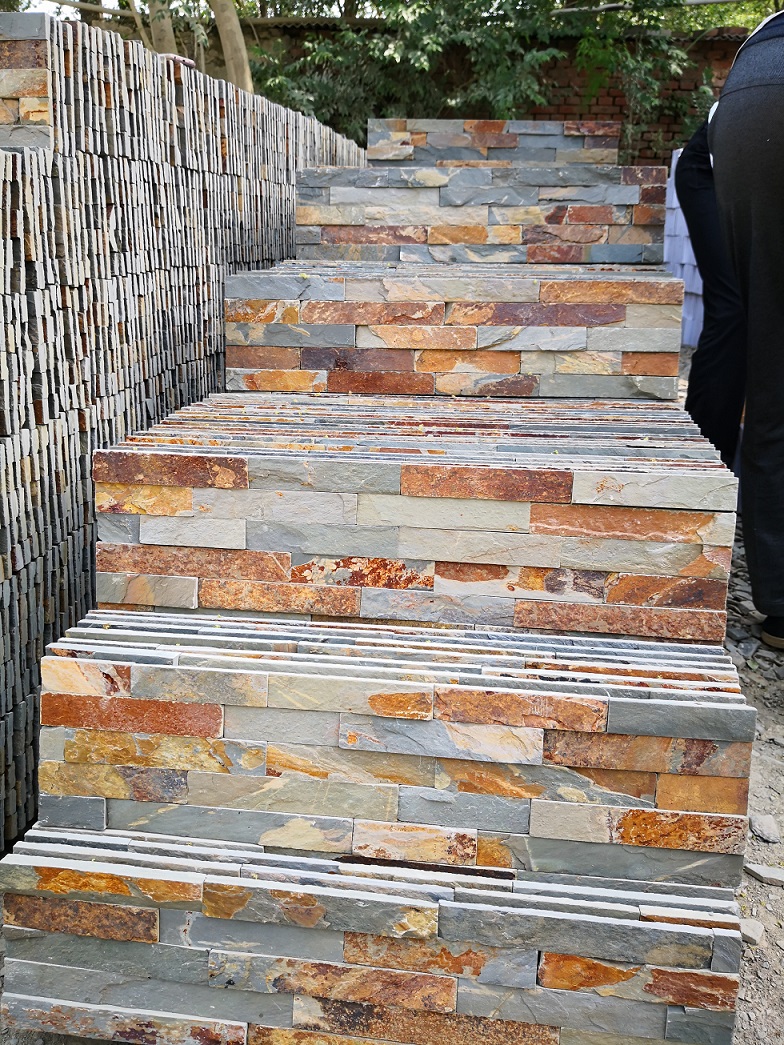
Topsource Stone provides Class A fire-rated cladding solutions using 100% natural quarried stone. These precision-engineered panels offer a non-combustible surface for zero-clearance fireplace surrounds, eliminating VOC off-gassing while maintaining thermal stability under extreme temperature fluctuations.
| Feature | Technical Specification | Safety/Performance Benefit |
|---|---|---|
| Material Composition | 100% Natural Slate, Quartzite, Marble | Inorganic, zero-VOC, non-combustible |
| Fire Rating | Class A (ASTM E84 Compliant) | Minimal flame spread and smoke development |
| Thermal Testing | High-heat epoxy resin bonding | Resists thermal shock cracking and debonding |
| Weight Profile | 8-13 lbs per square foot | Installs on cement board without footings |
Natural Stone Composition and Class A Fire Safety
Genuine natural stone minerals such as slate, quartzite, and marble are inherently non-combustible. Unlike resin-based faux stone products that rely on chemical binders, these 100% real stone materials do not contribute fuel to a fire or release toxic volatile organic compounds (VOCs) when heated. This inorganic profile makes the panels ideal for adhered, non-structural cladding on residential fireplace surrounds and commercial feature walls that must meet strict interior safety standards.
High-Heat Performance and Thermal Stability
To prevent the delamination common in lower-grade stone veneers, these panels utilize a high-strength epoxy resin specifically formulated for temperature fluctuations. The material thickness, ranging from 0.75 to 1.75 inches, provides the necessary mass to dissipate heat evenly, protecting the assembly from thermal shock cracking. This thermal stability ensures that the stone maintains its structural integrity and permanent color fastness even during repeated heating and cooling cycles from high-output fireplace inserts.
Precision Engineering for Seamless Fireplace Feature Walls
Using infrared cutting equipment, the stone is manufactured into an interlocking Z-shape system that masks vertical seams. The availability of matching L-shaped corner pieces removes the need for complex miter cuts on-site, which often create weak points susceptible to heat stress. Because the system is lightweight, it can be securely fastened to standard cement backer boards, allowing for a luxury stone finish without the requirement of additional structural footings or heavy masonry support.
Frequently Asked Questions
Do certified stacked stone panels carry an official Class A fire rating?
A Class A rating applies only if the product undergoes testing according to ASTM E84 or local equivalents. For high-stakes projects, designers should verify specific certificates for exact panel configurations, as ratings do not automatically transfer to full wall assemblies. Always request a third-party lab report for the precise stacked stone panel intended for installation.
Can these panels be installed directly behind a wood-burning stove?
No. Installation must follow the specific clearance diagram provided by the stove manufacturer. You should use a non-combustible backing system or fire-rated board rather than fixing panels directly to a combustible wall. Maintaining the required air gap is essential to ensure proper airflow and heat dissipation.
Do natural stone veneers release any VOCs when heated?
Natural stone veneers consist of inorganic mineral materials and are zero-VOC, meaning they do not release volatile organic compounds when heated. Potential air quality concerns usually arise from adjacent materials like resin-based faux stones or solvent-based adhesives. For a safe installation, pair natural stone with cement-based mortar and mineral backing boards.
Is it necessary to use a structural footing for stacked stone panel walls?
Most natural stone panels weigh between 8-13 lbs per square foot, which usually eliminates the need for a structural footing or brick ledge. They can be installed on most structurally sound surfaces, though internal drywall applications should be reinforced with cement-based backer boards to support the weight securely.
How do manufacturers ensure color consistency for large-scale commercial orders?
To maintain color harmony across large projects, raw stone is graded at the quarry before production. By ensuring that all panels for a single project are sourced from the same geological strata and processed in a consistent batch, factories minimize the natural variations inherent in quarried stone. Contractors should still verify that the batch numbers match during the staging process at the jobsite.
Final Thoughts
Selecting the right stacked stone cladding involves balancing aesthetic goals with rigorous safety requirements. While Class A fire ratings provide a necessary benchmark for flame spread, the choice between natural stone and synthetic alternatives significantly affects long-term durability. Identifying products that withstand thermal shock and prioritize indoor air quality ensures the fireplace remains a safe focal point rather than a maintenance burden or a source of chemical off-gassing.
As building codes evolve toward more stringent performance standards, using non-combustible natural materials offers the most reliable path for residential and commercial interiors. By focusing on verified technical specifications and proper installation techniques like expansion joints and decoupled assemblies, builders can achieve a high-end stone look that maintains its structural integrity and safety profile for years to come.
