


Mesh-Backed vs Cement-Backed Stacked Stone: Which Panel System Survives Freeze-Thaw on an Exterior Wall
Short answer: both mesh-backed quartzite panels and cement-backed Z-panels are used on exterior walls in cold climates, and both survive when three things are true: the stone itself has low absorption and high strength, the backing and adhesive system keeps water out of the bond line, and the panels have lab-tested freeze-thaw performance you can verify. Neither backing type wins by name alone. What you demand before paying is a product-specific freeze-thaw report with cycle counts and pass criteria, bond or shear strength data showing the backing stays attached, absorption figures for the stone, and written installation requirements matching the wall assembly. A factory that cannot produce those four items is selling you a look, not a tested system.
Buyers in Canada, the northern United States and mountain Europe ask this question every buying season, usually after seeing a failed wall: mesh-backed panels where the stone let go of the mesh, or cement-backed panels where the face spalled after three winters. The honest answer is that backing type changes the failure modes, not the odds by itself, and the specification you write determines which failure modes you actually meet. This article compares the two systems the way a buyer should: by how each one fails, what testing distinguishes a good panel from a fragile one, and what belongs in the purchase order before money moves.
How Each Backing System Is Built
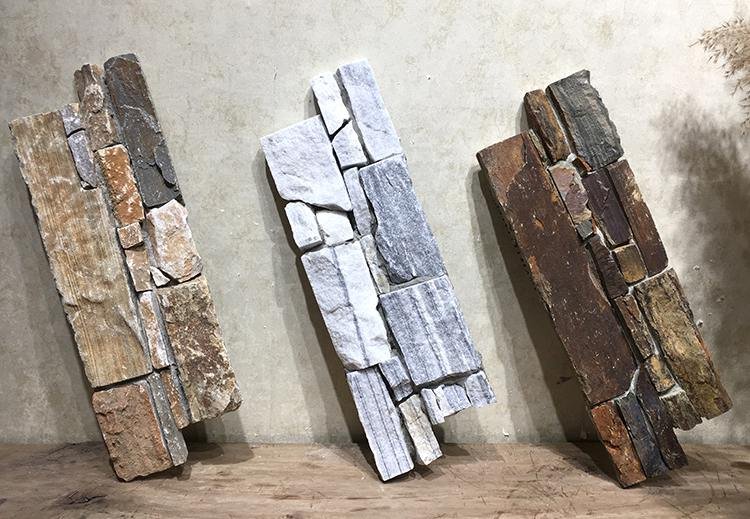
Mesh-backed panels are pieces of natural stone, typically quartzite or slate, glued at the factory onto a fiberglass mesh in the interlocking Z-shape that gives the finished wall its stacked look. The mesh is then buttered with adhesive or mortar on site, so the structural bond at installation is between the adhesive and the stone face, with the mesh glue line in between. Everything depends on two glue lines: the factory glue that holds stone to mesh, and the site adhesive that holds mesh to wall. If either was applied to a dusty or damp surface, or mixed wrong, the panel looks perfect on delivery and fails on the wall.
Cement-backed panels take the same interlocking geometry and cast the back in a layer of cement mortar, sometimes fiber-reinforced, which cures into a rigid mineral base. On site, the panels are bonded with cement-based adhesive or mortar, so the wall bond is mineral-to-mineral: cement to cement. The factory glue line that haunts mesh-backed systems does not exist here, and rigid backing spreads loads across the panel instead of concentrating them at glue points. The trade-off is weight and rigidity: cement-backed panels are heavier, need the substrate and adhesive rated for the load, and cost more to ship per square metre because you are freighted cement as well as stone.
What Freeze-Thaw Actually Does to a Panel
Freeze-thaw damage starts with water, not cold. Water enters the panel through pores, micro-cracks and the bond line; when it freezes it expands roughly nine percent, and the pressure works on the weakest interface nearby. Repeat that cycle hundreds of times over a winter and the weakest interface loses. Which interface is weakest is the entire question. In a dense, low-absorption stone with a sound bond line, water never accumulates enough to matter. In a porous stone, or behind a bond line with voids, every wet cycle loads the fracture, and the panel either sheds its face or spalls at the edge.
This is why the stone species matters as much as the backing. Quartzite is a metamorphosed sandstone with tightly interlocked quartz grains and very low absorption, which is why it is the standard choice for exterior cladding in cold regions. Slate splits thin and performs well when dense and properly selected, but variable material quality between quarries makes testing non-optional. The laboratory test built for exactly this mechanism is ASTM C666, rapid freeze-thaw cycling in water, and the wholesale buyer’s version of it is explained in the factory guide to ASTM C666 freeze-thaw testing for exterior stone. Panels that pass hundreds of cycles with minimal mass loss and no bond failure have demonstrated the property that matters; panels with no test history are asking you to run the experiment on your customer’s wall. Winter workmanship is the other half of cold-climate durability, and the protocols in the winter stone installation guide apply to both backing systems.
How Mesh-Backed Panels Fail, and When They Don’t
The characteristic mesh-backed failure is delamination: the stone separates from the mesh, or the mesh-and-stone separates from the wall, in areas where water reached the glue line. Sunlight and heat age the adhesive; repeated wetting loads it; and a panel installed with voids behind it gives freeze-thaw a place to work. None of this makes mesh-backed panels unsuitable for exteriors. It makes the factory’s glue process and the installer’s adhesive discipline the deciding variables. Buyers should ask mesh-backed suppliers three questions: what adhesive is used to bond stone to mesh and what is its rated service temperature range; what quality control catches panels with dry spots or insufficient glue coverage; and what site adhesive the manufacturer certifies the panels with, including coverage requirements.
When those answers are good, mesh-backed quartzite is a proven exterior product, lighter to ship and faster to install than cement-backed systems, which is why it dominates cladding on frame construction. The buying risk concentrates in one place you can test: the glue line. A simple site check on samples is to flex a corner panel and look for stone-mesh separation, and to weigh absorption by comparing dry and soaked sample weights; both checks take minutes and no laboratory.
How Cement-Backed Panels Fail, and When They Don’t
Cement-backed panels fail differently. Because the backing is rigid and mineral, the stone-to-backing bond rarely lets go if the casting process was sound; failures concentrate at the panel face and at the wall interface. Face spalling happens when the stone itself is absorptive or micro-cracked and freeze pressure finds the surface layer. Wall-interface failures happen when the adhesive or mortar is under-specified for the panel’s weight, or when the substrate was not dimensioned for the load, which is an installation-specification problem more than a product problem. The cement chemistry also brings its own weather consideration: the backing is alkaline and holds construction water while curing, so panels should be installed in conditions that let the system dry, and sealed or drained per the manufacturer’s system requirements.
What cement-backed construction buys you is a bond line that freeze-thaw cannot easily attack, because mineral-to-mineral cement bonding does not age like organic adhesive. That is why the engineering case for cement-backed systems in severe exposures is strong, and the factory-side explanation of the cement-backed stone structural engineering approach walks through the mineral bonding mechanics in detail. The buying risks are weight and verification: you need the panel’s installed weight, an adhesive system rated for it, and the same freeze-thaw evidence you would demand from any other panel, because cement backing does not improve porous stone.
The Test Reports to Demand Before You Pay
Four documents separate a tested exterior system from a decorative product wearing a technical vocabulary. First, product-specific freeze-thaw data: ASTM C666 or an equivalent national method, stating cycle count, pass criteria, and results for mass loss and strength retention, on the actual product, not on “quartzite” in general. Second, bond strength data: for mesh-backed panels, the stone-to-mesh shear or pull strength and the adhesive used; for cement-backed panels, the backing-to-stone bond and the recommended site adhesive with its rated coverage. Third, water absorption of the finished panel, which predicts freeze-thaw behavior more directly than any marketing claim. Fourth, written installation requirements: substrate types approved, adhesive specification, jointing and drainage expectations, and any sealing requirements, because a tested system is only tested as installed.
Ask for the test reports to identify the testing laboratory and the sample batch, for the same traceability reasons that apply to composition testing: a report without a batch reference cannot be tied to the pallets you are buying. A factory with real QC produces these quickly because it produces them for every commercial project; hesitation or generic PDFs are information too, and the cost of discovering which kind of supplier you have is one email before the deposit, not one failed wall after it. For installation-side standards, the Natural Stone Institute publishes the industry technical guidance for thin stone veneer work, and its resource library at naturalstoneinstitute.org is the reference most North American installers recognize.
Writing the Decision into Your Purchase Order
The specification clause that protects you is short: panels for exterior use shall demonstrate freeze-thaw resistance per ASTM C666 (or named equivalent) with results provided for the production batch; finished-panel water absorption shall not exceed the stated limit; the manufacturer’s installation system, including named adhesive, is a condition of warranty. Add that samples from the production batch will be retained and compared on arrival, and you have converted the entire mesh-versus-cement debate into checkable line items. Buyers who write the clause can buy either backing type with confidence, because the confidence lives in the documents, not the backing.
For the wall assembly itself, the same logic applies one level up: drainage, correct adhesive coverage and substrate prep matter more than panel brand, and the factory’s installation requirements are part of what you are buying. Importers who forward those requirements to their contractors, and insist the installation matches, keep warranty conversations short because everyone can see where the system was followed.
Which System Should You Actually Buy
Frame construction, speed of install and freight efficiency favor mesh-backed quartzite from a factory with verified glue-line QC and freeze-thaw data. Severe exposure, high-mass walls, commercial specs and long-warranty projects favor cement-backed systems, priced with the understanding that you are shipping and lifting more weight per square metre. Both are legitimate; neither is automatic. The buyer’s job is not to pick a side in the backing debate but to pick the supplier who can prove performance for the system you chose, which is why the test-report pack, not the backing type, is the real decision. For a wider shortlist of interlocking systems, the market guide to Z-panel stone cladding at wholesale covers the product family and its typical specifications.
If your market sits in a true freeze-thaw zone and your customers are builders who ask for documentation, the fastest path is to request the four documents from both quoting factories and let the responses make the decision. The factory that answers in days with batch-referenced reports is telling you how it will behave for the next five winters; the one that answers with brochures is telling you something too.
Frequently Asked Questions
Is mesh-backed stone suitable for exterior walls in cold climates?
Yes, when the stone is dense and low-absorption, the factory glue line is sound, the installation adhesive is applied at full coverage, and the product has freeze-thaw test data. Most mesh-backed exterior failures trace to one of those four conditions being missing, not to mesh backing itself.
Do cement-backed panels need sealing?
Follow the manufacturer’s system requirements: some cement-backed systems specify sealing for exposure management, others rely on drainage design. What matters for the buyer is that sealing or drainage is part of the written installation system you receive before purchase, not an installer’s improvised choice after.
What single test report matters most before paying?
The product-specific freeze-thaw report on the actual panel, with cycle count, pass criteria and batch traceability. Absorption and bond-strength data complete the picture, but freeze-thaw performance on the real product is the headline evidence for exterior durability.
