

White quartzite stacked stone cladding is a material choice that often triggers more questions than confidence for architects specifying their first commercial facade. Top Source Stone, a factory in Yixian, Hebei, has been quarrying and fabricating natural stone since 2005, shipping over 200 containers annually to six continents. They control the entire chain from quarry to container, which matters when you need batch consistency across a 5,000-square-foot lobby wall.
The problem with white quartzite is that most buyers don’t realize the color drift risk. 95% of color variation complaints trace back to multi-quarry blending or split batches. A direct factory like Top Source Stone assigns a batch number for every 200 square feet of ledger panels, making it possible to match color across an entire job. That level of traceability is rare in the US distribution channel, where rebranded imports often hide their source. For an architect, specifying from a known quarry eliminates the ugly surprise of yellowing or tonal shift three years after installation.
Why Most White Quartzite Facades Fail: Mitigating Iron Oxidation and Subsurface Staining Risks
Trace iron compounds exceeding 0.1% Fe2O3 oxidize under moisture infiltration, triggering permanent amber color shifts.
White quartzite’s natural beauty makes it a popular choice for modern facades, but many projects develop an amber or yellow discoloration within 1–3 years. The root cause is subsurface iron particles reacting with moisture. Quartzite is not fully inert; its porosity typically ranges from 0.5% to 1.5% by volume. This allows water vapor to penetrate the stone and oxidize iron compounds, creating a permanent stain.
Most imported white quartzite blocks contain trace iron oxides (Fe2O3) between 0.1% and 0.5%. When the stone is cut into thin veneer, the cut surface exposes these particles. A proper resin sealant can block moisture, but many factories use low-cost polyester resins that degrade under UV exposure and thermal cycling. Once the seal fails, the iron oxidation accelerates. The result: uneven yellowing that cannot be cleaned out.
Geological and Chemical Adhesion Thresholds:
- Iron Content Threshold: The critical level is 0.1% Fe2O3 by weight. Above that, visible yellowing becomes likely within 18–36 months in outdoor climates with regular rainfall. Top Source Stone selects quarry blocks that consistently test below 0.05% Fe2O3 for the Arctic White line.
- Resin Quality Standard: UV-stable epoxy resin is required for exterior white quartzite. Polyester resin is acceptable only for interior applications where UV exposure is zero. Request the supplier’s resin datasheet and verify UV resistance testing per ASTM D4329.
- ASTM C616 Code Compliance: This standard sets a maximum water absorption of 0.5% for quartzite dimension stone. The factory’s white quartzite ledger panels achieve 0.3% absorption, measured by ASTM C97. Any absorption above 0.5% increases moisture infiltration risk and voids the stone’s suitability for freeze-thaw climates.
- Verification Protocol: Before specifying white quartzite for a commercial facade, request a mill certificate showing Fe2O3 content, water absorption per ASTM C97, and a resin data sheet. Demand a 12-month accelerated weathering test (QUV) if the supplier claims UV stability.
The fix is not complicated: choose a low-iron quartzite (<0.1% Fe2O3) from a single quarry source that can provide batch-specific test reports. Combine it with a UV-stable epoxy resin applied under factory controlled conditions. That combination eliminates the chemical pathway for yellowing. Without those two controls, every white quartzite facade is a gamble.

Real Cost Breakdown of White Quartzite Cladding Per Square Foot: Factory Direct vs US Distributors
Factory-direct Arctic White quartzite starts at a baseline $8/sqft FOB pricing tier.
The total per‑square‑foot cost of white quartzite stacked stone cladding breaks into five layers: raw quarry block yield, gang‑saw processing and split‑face finishing, plywood crating and edge protection, ocean freight (FOB vs. CIF terms), and site installation (adhesive, labor, and accessories). On a factory‑direct FOB basis, premium Arctic White ledger panels run $8–$18/sqft. Logistics add another $2–$5/sqft depending on port distance and container load. Most US distributors then slap on a 40%+ markup — turning a $12/sqft factory price into $17–$25/sqft — without adding any quarry control or batch guarantees.
Compare that to faux stone alternatives: cultured veneer costs $6–$10/sqft landed, but it carries a Class C fire rating at best, fades in 5–8 years, and cannot be repaired. The real cost of faux shows up in replacement cycles and permit delays. Natural quartzite, specified correctly, outlasts faux by 3x and holds its Class A flame spread rating (0–25 per ASTM E84) for the life of the building. The math shifts in favor of natural stone the moment you factor in lifecycle cost and code compliance.
Procurement Overhead Matrix:
- Sample Approval Fee: Expect a $50–$150 charge for a pre‑production sample panel. This fee is fully refundable on the first order. Some suppliers waive it for large commercial projects; always ask before paying.
- Distributor Markup vs Factory Direct: US distributors like MSI rebrand imported quartzite (e.g., Arctic White XL) and cannot guarantee same‑batch color consistency for orders split across containers. A direct factory like Top Source Stone assigns a batch number for every 200 sqft, eliminating the color‑drift risk.
| Cost Component | Price Range (USD) | Notes |
|---|---|---|
| Factory-Direct Material Price (FOB) | $8 – $18 per sqft | For premium Arctic White quartzite ledger panels. Includes quarry block yield, processing, and packaging. |
| Logistics & Freight | $2 – $5 per sqft | Depends on port distance, container load, and shipping terms (FOB vs CIF). |
| Sample Approval Fee | $50 – $150 per sample | Refundable on first order. Ensures batch color match before full production. |
| Total Landed Cost (Estimated) | $10 – $23 per sqft | Material + logistics. Installation labor and accessories not included. Typical MOQ: 200 sqft. |
White Quartzite Ledger Panels vs. Faux White Stacked Stone: Performance Comparison
Natural quartzite mineral assemblies outlast cast concrete alternatives by more than 3x.
Specifying white stacked stone for a commercial facade means choosing between natural quartzite and faux (cultured) veneer. Faux stone wins on upfront cost — typically $4–$8/sqft material — and weight under 8 lbs/sqft. But those savings evaporate when the facade needs replacement in 5–8 years due to UV fading, chipping, or fire code rejection. Natural quartzite from a single quarry delivers 95%+ batch color consistency, split-face texture that never repeats, and a service life that often exceeds 20 years with proper installation.
Weathering and Structural Parameters:
- UV Resistance & Color Stability: Faux stone relies on surface pigments and coatings that degrade under direct sunlight, producing chalky patches. Natural white quartzite is through-colored; the low-iron structure eliminates discoloration pathways.
- Fire Rating Compliance: Faux stone is typically a cement or polymer composite — many products fail to achieve ASTM E84 Class A (flame spread 0–25). Natural quartzite is non-combustible, inherently meeting Class A code triggers for Type I–IV build structures over 40 ft.
- Repairability & Longevity: A cracked faux panel must be replaced — matching color across batches is impossible after 2 years. Quartzite can be patched with stone epoxy or replaced with a panel from the same batch.
- Corner Finish Quality: Distributors like Norstone rely heavily on staggered finger joints that expose visible seams under side lighting. Sourcing direct factory modules ensures precision mitered corners for a clean, flush corner return line.

How to Specify White Quartzite Ledger Panels for Commercial Building Permits
Batch traceability is the single most overlooked specification item in commercial white quartzite facades.
Start your specification with the mill certificate. This document proves the stone originated from a single quarry block, not a blend from multiple sites. Without it, you risk color drift across your facade. At Top Source Stone, every 200 sqft order receives a unique batch number that traces directly to the quarry face in Yixian, Hebei. Most distributors cannot offer this because they aggregate from multiple sources. Request a mill certificate before approving any sample.
Fire code compliance is non-negotiable. White quartzite is inherently non-combustible, but you need documented proof. Specify ASTM E84 Class A with a flame spread index between 0 and 25. Our thin veneer panels (0.75 to 1.5 in thickness) consistently achieve this rating. For buildings over 40 ft, verify NFPA 285 assembly testing as well. Faux stone alternatives often fail this requirement.
Mandatory Engineering Performance Submittals:
- Freeze-Thaw Requirement (ASTM C666): For exterior facades in cold climates, require ASTM C666 test results (300 cycles with zero structural degradation and water absorption strictly below 0.5% via ASTM C97 testing).
- Pre-Production Sample Panel (PSP): Mandate a 4 sqft pre-production lot coupon match extracted from the active batch run to verify exact cleft stone textures before releasing full terminal cargo slots.
- Mitered Corner Continuities: Enforce factory-cut mitered outside corner units within the specification sheets to eliminate amateur on-site saw chipping and visible side-lighting joints.
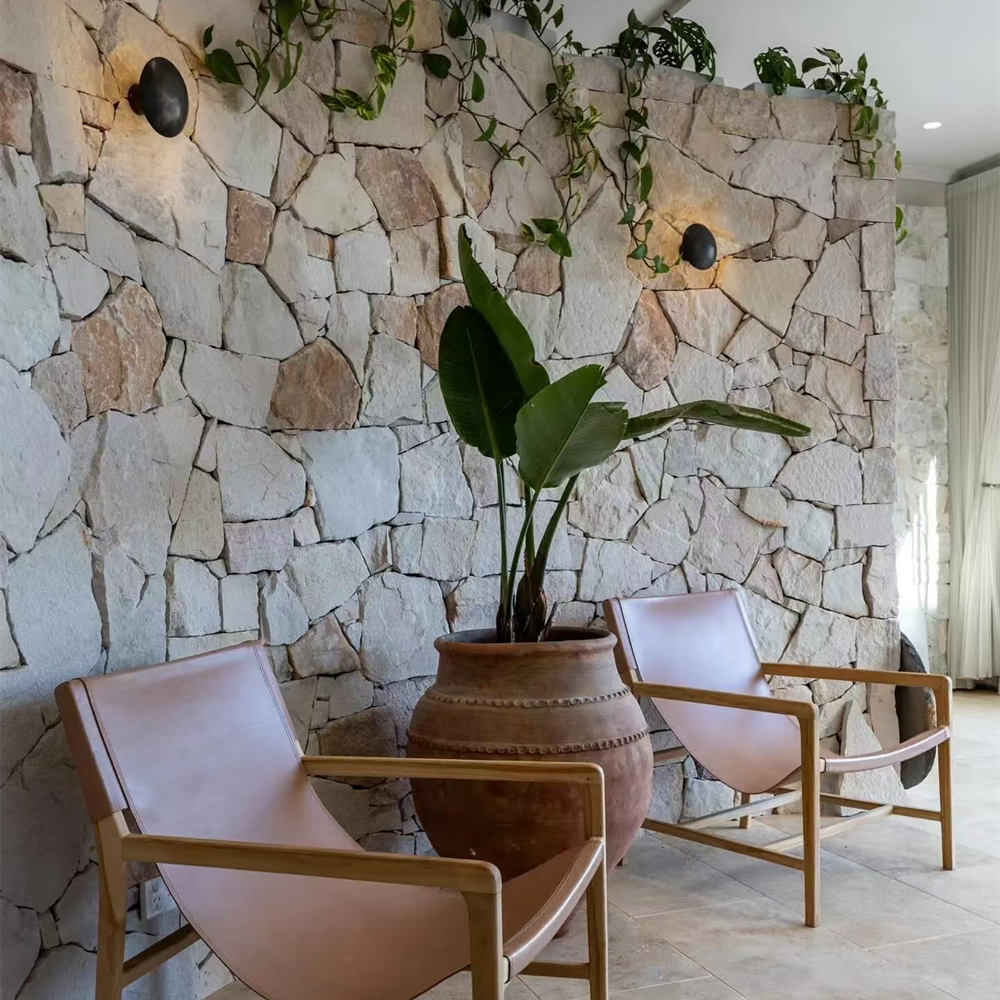
NFPA 285 Test Assembly Requirements and IBC Code Compliance for Quartzite Cladding
Natural quartzite is completely non-combustible per ASTM E136 testing benchmarks.
For commercial facades, fire rating isn’t optional — it’s on the permit checklist. White quartzite stacked stone cladding is inherently non-combustible, but the test data must be documented. Top Source Stone’s thin veneer ledger panels (0.75–1.5 in thickness) achieve a Class A fire rating per ASTM E84, with a flame spread index of 0–25. That places it in the same category as concrete and gypsum board. The thin profile reduces dead load to 12–15 lbs per square foot, which means you can install it over steel stud walls without additional structural reinforcement — a critical advantage over full-dimension stone that can exceed 30 lbs per square foot.
Where most spec sheets stop short is building code interaction. IBC 2018 requires compliance with NFPA 285 for exterior wall assemblies on buildings exceeding 40 feet in height. This is a full assembly test, not just a material test. A standalone Class A material rating does not automatically satisfy NFPA 285. The assembly — including insulation, air barrier, and stone cladding — must pass as a system. Your spec should require the cladding supplier to provide documentation of successful NFPA 285 assembly testing or a third-party engineering letter confirming the assembly meets the code. Top Source Stone’s thin veneer panels are designed to integrate with common commercial wall assemblies, and we can provide project-specific engineering support for your jurisdiction.
Regulatory Inspection Triggers:
- Test to Specify: ASTM E84 (flame spread 0–25). Demand a test report from the current production batch, not a generic certificate.
- Code Trigger Parameters: IBC 2018 Section 1405.12 and 2603.5.5 reference NFPA 285 for Type I–IV construction over 40 ft. Confirm your assembly meets the test.
- Traceability Safeguards: If a supplier cannot produce a batch-specific ASTM E84 report, assume the stone has not been tested. Reject generic claims — fire marshals routinely ask for traceable documentation.
Conclusion
Specifying white quartzite stacked stone for a commercial facade means locking in three things: batch color consistency, verifiable fire ratings, and single-quarry sourcing. Get them right, and the facade keeps its crisp look for decades. Get them wrong, and you are explaining yellowing or color drift to a client mid-project.
You might also consider comparing your current project specs against our standard batch sizes and test report templates. The commercial cladding page includes specification sheets, Arctic White Quartzite options, and a sample request button for your next review cycle.
Frequently Asked Questions
What is the typical MOQ for white quartzite ledger panels?
Typical MOQ for stock white quartzite ledger panels is 200–400 square feet per box, but custom sizes or color mixes may require a higher minimum. Confirm MOQ with the factory after you lock in the panel dimensions and finish.
Is white quartzite suitable for exterior use in freeze-thaw climates?
Yes, when sourced from a factory that tests to ASTM C666 standards for freeze-thaw durability, but only if you specify low-iron quartzite with proper sealing to prevent moisture infiltration and oxidation. Specify low-iron quartzite and request test reports for your climate zone.
Does white quartzite yellow over time?
Yes, if the stone contains iron impurities above 0.1%, moisture will oxidize them and cause a yellow or amber hue within a few years. Choosing low-iron quartzite with documented iron oxide content below the 0.05% threshold prevents the amber staining pathway entirely. Always verify iron content specifications before ordering white quartzite.
How do you clean white quartzite stacked stone?
Clean white quartzite with a pH-neutral stone cleaner and a soft brush, then rinse with water—never use acidic or abrasive cleaners that can etch the surface. Annual resealing helps protect the cleft surface joints from deep environmental scaling lines. Stick to pH-neutral products and reseal once a year for best results.
What is the weight per square foot of white quartzite cladding?
White quartzite stacked stone cladding typically weighs 12–15 pounds per square foot for standard 1- to 2-inch thick panels. Thicker panels or irregular split-face textures can push the weight higher. Request the specific weight for your panel thickness before calculating structural loads.
