


Removable Stacked Stone Walls for Leased Retail: How to Build a Feature Wall You Can Take With You
Short answer: yes, a leased store can have a real natural stone feature wall and still pass make-good, but only if the stone never touches the landlord’s wall. The method is a carrier wall: an independent framed wall or a set of bolted carrier boards that carries the stone, is attached to floor and ceiling rather than to the drywall, and unbolt in pieces when the lease ends. Adhered stone is, by industry standards, a permanent installation, and the industry’s own reference body, the Natural Stone Institute, documents it as a bonded system, not a removable one. So you design the removability into the substrate, not the stone. The two routes that work are a free-standing stud wall with cement board behind the stone, and modular stone-on-board panels hung on cleats. Both cost more than gluing; both return the deposit.
Retail brands want the stone look because it photographs well and reads as permanence, while their leases demand the opposite: bare walls at move-out. The result is a predictable mess. Stone glued to drywall comes off taking the paper face with it, the landlord bills the restoration, and the brand pays twice. This article is the build-out contractor’s version of the answer: how to detail a demountable stone wall, what the fixing choices cost in labor and freight, and how to write the lease language so nobody is surprised at move-out.
Why Glued Stone Cannot Come Off Cleanly
Thin-set mortar and construction adhesives cure into mechanical keys inside gypsum paper and joint compound. Removal is not peeling; it is demolition. The drywall face around fasteners, the paper skin, and often full board sections go with the stone, and make-good turns into a new wall. The alternative, peel-and-stick veneer, does come off, but it is a different product category with a different look and durability; the comparison is covered in our traditional versus peel-and-stone comparison. For a brand that wants real natural stone and real removability, the answer is neither: it is a carrier system that holds the stone and leaves the landlord’s wall untouched.
Route One: The Free-Standing Carrier Wall
Build a new stud wall a few centimetres in front of the existing wall, sheath it with cement board, and adhere the stone to that. The stud wall is fixed only at floor and ceiling with wedge anchors or screw-fixed tracks, never into the drywall behind. At move-out, you cut the track fixings, unbolt the base, and the whole wall comes out as a framed unit: studs, board and stone together. The stone work is conventional, so any mason can execute it, and the wall can be rebuilt in the next location with minimal repair to the back of the panels.
The design decisions that matter: keep the wall as light as the brand allows by specifying thin-veneer panels rather than full-bed stone, which is the subject of our lightweight panel guide; run the base track parallel to the slab joint so the anchors are findable when you return the space; and leave a service gap behind the wall for the electrical boxes that will otherwise fight the stone thickness. A wall that is 40 to 60 millimetres proud of the original surface clears most outlet boxes without relocating them, but every project should check its own boxes before ordering stone.
Route Two: Modular Stone-on-Board Panels
The second route treats the stone as millwork. The fabricator bonds stone to plywood or cement boards in workshop-sized modules, and the modules hang on cleats or a rail system anchored to the building at a few points. Removal is a two-person, one-afternoon job: lift each module off its cleat, and the wall is bare except for a few anchor holes that patch in minutes. This is how exhibition stands and restaurant groups that relocate seasonally handle heavy finishes, and it is the version of the idea the mechanical anchorage diagram below shows in section.
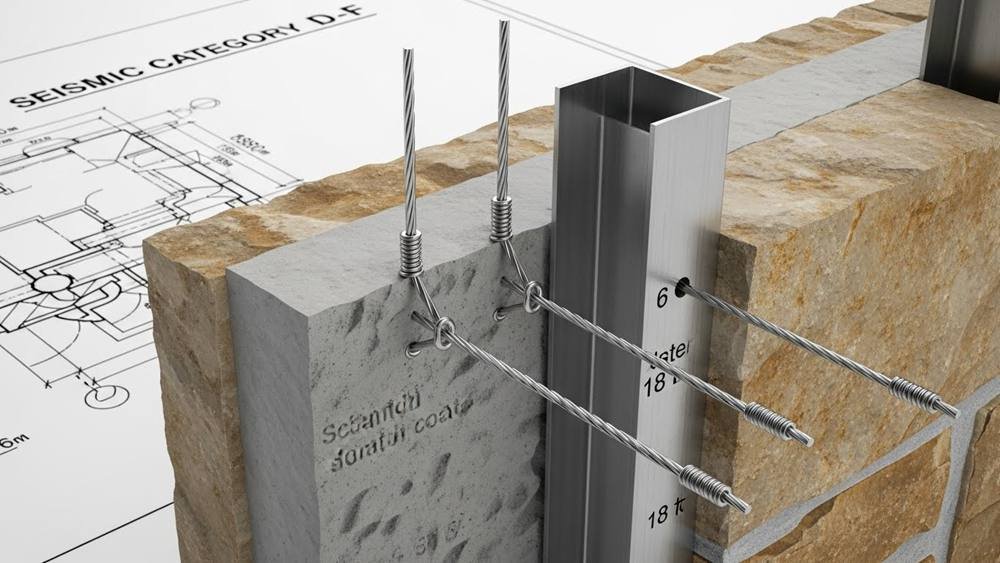
The trade-offs are real. Modular panels need precise shop drawings, the cleat lines must be level and plumb or the joints show, and the corners of transported panels take the abuse, so packing and transport become the project risk instead of the installation. For a brand opening six stores a year, that risk is manageable because the same module sizes repeat; for a one-off store, the free-standing wall is usually the safer build.
Weight, Freight and the Numbers That Decide the Route
Stone walls fail the removability test for physical reasons before legal ones: mass. A thin-veneer carrier wall is light enough for standard tracks and a small crew; a full-bed assembly on a freestanding frame becomes a structural conversation with the landlord about point loads on a raised or timber floor. Get the panel weight from the supplier’s product sheet, multiply by the carrier board and frame, and put the total in the landlord’s approval package before installation, not after. The same mass determines freight: a demountable wall ordered for store number one should ship with a spares allowance for store number two, because the batch that matched in the first store is the batch you will not be able to reorder in year three.
Removal and reinstallation are their own line items. Budget a crew day per wall to unbolt and crate, add transport, and add a stone repair pass at the new site, because corners chip in every move. Our guide to stone veneer removal and wall repair covers the repair side from the demolition end, which is the same skill in reverse.
What to Write in the Lease and the Submittal
The paperwork protects the deposit as much as the framing does. In the lease, get the landlord’s written approval of the specific carrier-wall detail, including the anchor pattern and the restoration scope at removal: patched anchor holes, repainted surfaces, and the right to leave tracks in place if the slab allows. In the submittal, include the build-up drawing, the panel weight, the fixing schedule, and photographs of the completed wall before handover, because a documented “before” is the only defense against an inflated “after.” Keep the supplier’s batch records with the store files; when the wall moves to the next location, the batch sheet is how you order the extension that matches.
Details That Decide Whether the Move Works
Three details separate a carrier wall that survives three store relocations from one that disintegrates on the first truck. First, corners: field-cut corner joints travel poorly, so specify factory-made L-corner units for external angles and keep the cut pieces on internal returns where a chipped edge hides. Second, the stone-to-board bond itself: on a modular system the panels flex slightly in transit, so the workshop adhesive must be a flexible, vibration-rated product, not the fastest-setting option; a rigid bond line cracks at the board within a year of shop-to-store movement. Third, the joint between the carrier wall and the surrounding finishes: a demountable wall should meet the existing floor and ceiling with a reveal or shadow gap rather than caulked trim, because a caulked joint reads as part of the landlord’s wall and makes the removal scope ambiguous at move-out. A shadow gap says, clearly and permanently, where your wall ends and the building begins.
Plan the crating before the first module is bonded. Stone travels best on edge in timber crates with the batch label visible on two faces, the same packing discipline exporters use for containers, and a demountable retail wall should ship between stores exactly the way it shipped from the factory. Brands that rotate stores every few years usually keep the original crate drawings with the wall’s as-built file; that folder is what lets a new franchisee in another city unbolt the wall without inventing a method at the site.
Conclusion: Permanence on the Inside, Removability on the Back
A leased retail space does not have to choose between the stone wall the brand wants and the bare wall the lease demands. The carrier-wall method gives the customer a permanent-feeling feature and gives the landlord back a clean wall, because the stone was never bonded to the building. Free-standing framed wall for one-off stores, modular cleated panels for repeat rollouts, thin veneer either way, and a spares batch ordered with the first container. The brands that get this right are not the ones with the best adhesive; they are the ones who designed the wall to come apart before it ever went up.
Frequently Asked Questions
Can stacked stone be glued to drywall and removed later?
No. Bonded stone systems are permanent by design, and removal takes the drywall face with it. Removability has to be built into the substrate: a carrier wall or cleated modules that never bond to the landlord’s surface.
Does a freestanding stone wall need landlord approval?
Yes. It anchors to the slab, adds dead load, and changes the space’s fire and egress drawings in some jurisdictions. Submit the build-up, weight and anchor pattern before installation and attach the approval to the lease file.
How much does a demountable stone wall cost versus a glued one?
Expect a meaningful premium for the framing, the engineering and the crating, and a matching saving on make-good. The honest comparison is against the landlord’s restoration bill, not against the glued wall’s price.
