

Professional surface preparation (pro) determines whether a stone veneer installation remains secure for decades or results in catastrophic bond failure that leads to expensive liability claims and structural property damage. Even high-grade masonry materials cannot compensate for a compromised substrate, and skipping steps during the base phase often triggers system-wide delamination under environmental stress. For installation crews, getting the foundation right serves as the primary defense against project delays and profit-killing callbacks.
This guide establishes a technical standard operating procedure for every stage of the substrate build. We detail the specific fastening patterns and overlap requirements for metal lath, the precise mixing ratios for high-strength scratch coats, and the curing timelines necessary to ensure a permanent bond. Following these protocols provides a repeatable framework to move from bare plywood or masonry to a finished stone application with the certainty that the assembly meets all structural requirements.
Why Surface Preparation is 90% of the Job
Substrate integrity dictates the lifespan of a stone facade; skipping mechanical profiling or moisture barriers leads to adhesive failure and structural displacement.
Establishing the Foundation for Maximum Adhesion
Installers must remove all dust, oil, and loose debris from the substrate to prevent bond interference. We prioritize a clean surface because high-strength epoxy adhesives require direct contact with a stable surface to achieve their rated tensile strength. Residual contaminants act as a bond-breaker, which eventually causes individual stones to detach under thermal expansion and contraction cycles.
Smooth surfaces often require mechanical scarification. This process creates a rough profile that significantly improves the mechanical grip of the mortar. Since Top Source Stone provides individually sawn-back pieces, the flat bonding surface maximizes contact area, but that contact only works if the substrate allows for deep mortar penetration.
Substrate Requirements for Vertical Stone Loads
Our thin stone veneer weighs approximately 65kg/m², creating a significant vertical dead load. Substrates must handle this weight without sagging or shifting. Approved surfaces include concrete, brick, and cement backer units (CBU) that meet 2026 structural weight-bearing standards. We do not recommend installing natural stone directly onto standard interior drywall without reinforcing the wall with metal lath or replacing it with cement-based boards.
- Contractors must check for substrate deflection to prevent visible cracking in the joints of the bespoke random-lay pattern.
- Cement-based boards provide the necessary rigidity for natural stone applications where traditional masonry is unavailable.
- Structural integrity checks ensure the wall remains seamless over decades of environmental exposure.
Moisture Management and Weatherproofing Protocols
While natural quartzite and granite resist water, the stone veneer system itself is not a waterproof barrier. Exterior installations require a dedicated moisture-resistant barrier (WRB) and proper flashing to redirect water away from the building envelope. We use drainage planes behind the stone to prevent hydrostatic pressure from weakening the adhesive bond over time.
Sealing the stone after installation provides an extra layer of protection against staining and environmental wear. High-exposure areas benefit from this “Climate-Tested Durability,” ensuring that the stone retains its color fastness and mineral integrity against harsh freeze-thaw cycles and UV exposure. Proper moisture management is the only way to avoid efflorescence—the unsightly white salt deposits that plague poorly prepared masonry.
Preventing Displacement and Structural Failure
Industry data shows that most stone failures result from improper substrate cleaning rather than the quality of the adhesive. Rigorous surface preparation eliminates the risk of stone fall-off and protects the long-term value of the project. A well-prepared surface reduces lifecycle costs by removing the need for spot repairs or complete re-installations caused by bond failure.
Pre-grading the stone and checking the substrate for levelness ensures the individually hand-laid pieces fit tightly. This attention to detail maintains the “Full-Depth Visual Integrity” of our veneer, making it indistinguishable from a traditional, heavy dry-stack wall. Starting with a level and clean substrate allows for a faster installation, reducing on-site labor costs by ensuring every sawn-back stone sits flush against the wall.
Metal Lath Installation: Fastening Standards and Overlaps
Precise lath attachment serves as the structural foundation for heavy stone veneer; modern 2026 standards prioritize rigid fastening intervals and specific nesting techniques to eliminate substrate sagging and delamination.
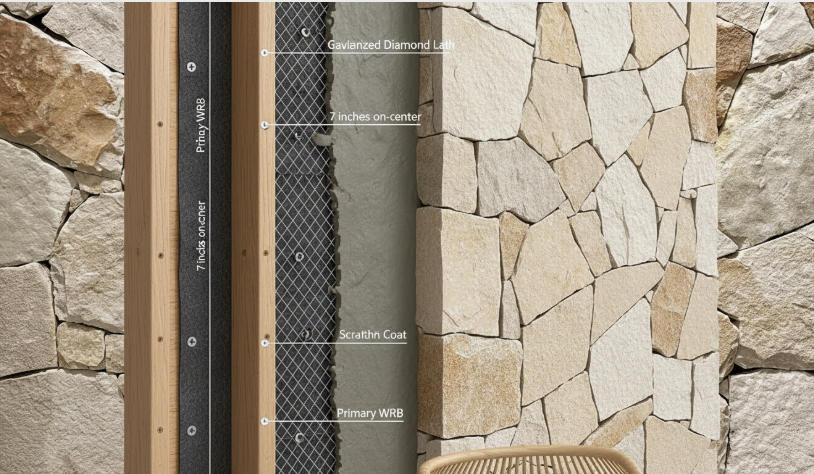
Professional stone installation begins with a rigid reinforcement layer. We follow ASTM C-1063 standards to ensure the metal lath provides a stable, non-moving base for the scratch coat. The most frequent failure point in the industry remains “blind fastening,” where installers secure lath only to the exterior sheathing rather than the structural framing. To prevent system-wide failure, every fastener must penetrate a structural member by at least one inch. This ensures the weight of the stone—which averages 65kg/m² for our natural quartzite and sandstone selections—transfers directly to the building’s skeleton rather than pulling on the weather-resistant barrier.
ASTM C-1063 Fastening Intervals
Standardized spacing varies depending on the substrate. For wood framing, installers must place fasteners every 7 inches on-center along the studs. When transitioning to concrete or masonry substrates, the requirement tightens to 6-inch vertical intervals. These spacing mandates prevent the lath from “pillowing” when the wet mortar is applied, which can create air pockets and weaken the mechanical bond.
- Fasten galvanized nails or screws every 7 inches on-center for wood studs.
- Maintain 6-inch vertical spacing for concrete or block installations using galvanized masonry pins.
- Confirm each fastener hits a structural stud; sheathing-only attachment cannot support the 30+ psf load of natural stone.
Lath Overlap and Nesting Requirements
Creating a continuous reinforcement layer requires more than just nailing sheets to a wall. We require a minimum 1-inch overlap on all side and end joints to maintain structural continuity. Proper “nesting” is equally vital: the lath must be installed so the diamond “cups” point upward. This orientation allows the scratch coat mortar to lock into the mesh, creating a mechanical key that holds the weight of the stone.
| Substrate Type | Fastening Spacing | Overlap / Corner Spec |
|---|---|---|
| Wood Framing (Studs) | 7″ On-Center (Vertical) | 1″ Min. Lap / 12″ Corner Wrap |
| Concrete / Masonry | 6″ Vertical / 16″ Horizontal | Self-Furring Lath Required |
| High-Load Wind Zones | Per Engineered Design | Double-Fastening Required |
Vertical joints must be offset between courses. Stacking vertical seams creates a continuous weak point that can lead to vertical cracking in the finished stone face. At corners, we mandate a continuous wrap of at least 12 inches. Never terminate a lath sheet at a corner; this ensures the “Authentic Masonry Corner Wrap” of our L-shaped stones remains structurally sound and visually indistinguishable from full-depth stone.
Wind Design and Load Compliance Standards
As we move through 2026, building envelopes in coastal or high-exposure regions face stricter wind design performance criteria. When the total system load—including the mortar and stone—exceeds 30 psf, standard fastening patterns may be insufficient. In these scenarios, project engineers must specify custom fastening densities to account for negative wind pressure (suction) that can pull cladding away from the substrate.
- Verify fastener penetration depth matches specific manufacturer requirements for heavy stone applications.
- Consult an engineer if local wind speeds or building heights exceed standard ICC-ES residential thresholds.
- Utilize corrosion-resistant, galvanized components (ASTM C847) to ensure lifetime durability in high-humidity environments.
Premium Natural Stone for Architectural Excellence
Mixing the Perfect Scratch Coat: Ratios and Consistency
Achieving a high-performance bond for natural thin stone veneer requires a precise Type S mortar mix that balances structural density with the flexibility to withstand thermal expansion.
Standard Ingredient Ratios for Type S Mortar
Current 2026 installation standards prioritize high-strength Type S mortar to support the heavy load of natural stone veneer, which typically averages 65kg/m². This density requires a mortar that can handle significant vertical weight without sagging. We recommend mixing one part Type S masonry cement with 2.5 to 3 parts clean, kiln-dried sand. If you are mixing from raw components at the job site, use a ratio of 1 part Portland cement, 1/2 part lime, and 3 parts sand to ensure the mix remains workable while achieving the necessary compressive strength.
| Mortar Composition | Standard Ratio | Performance Target |
|---|---|---|
| Pre-blended Type S | 1 Part Cement : 3 Parts Sand | High vertical grab for 25-40mm stones. |
| Site-Mixed (Raw) | 1 Portland : 0.5 Lime : 3 Sand | Optimized workability in dry climates. |
| Polymer-Enhanced | Varies (Liquid bonding agent) | Maximum shear bond for exterior walls. |
Maintain strict measurement across all batches to ensure uniform color and structural integrity throughout the project. Variations in sand moisture or lime ratios can cause inconsistent curing times and potential weak spots in the mechanical bond. Professionals often use calibrated buckets rather than shovels to keep ratios precise.
Identifying the Ideal Trowelable Consistency
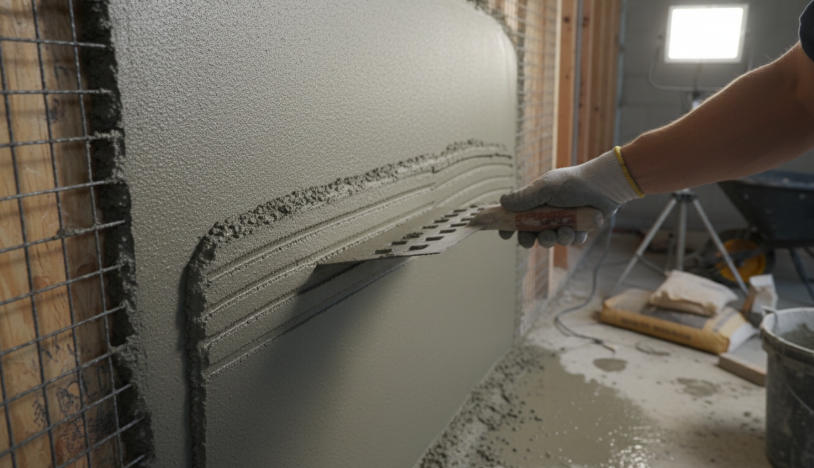
The texture of the scratch coat determines how well it grips the metal lath. Aim for a firm, “pudding-like” consistency that holds its shape on a tilted trowel without sliding. If the mix is too wet, it will slump off the lath; if it is too dry, it will not penetrate the mesh to create a proper mechanical key.
- Test the mix by pulling a notched trowel through it; the ridges should remain distinct and not slump back into the base.
- Avoid over-watering, as excessive moisture leads to shrinkage, cracking, and a weakened bond during the curing phase.
- The mortar must be stiff enough to support its own weight when applied at the recommended 1/2-inch thickness.
Improving Adhesion with Polymer Enhancements
Modern stacked stone applications often require polymer additives to ensure a permanent bond between the stone and the substrate. These additives replace a portion of the mixing water with a liquid bonding agent to increase shear bond strength. This is particularly important for exterior projects where the stone must accommodate thermal expansion and moisture resistance.
Select additives specifically formulated for natural stone to prevent mineral leaching or staining over time. Using polymer-modified mortars on exterior feature walls provides an extra layer of protection against freeze-thaw cycles that can otherwise cause stone delamination in traditional cement-only mixes.
Managing Batch Volume and Workability
Batch timing directly impacts the success of the mechanical bond. Mix only enough material that teams can apply and “scratch” within a 30-to-60-minute window. In the 2026 climate cycle, higher average temperatures accelerate the evaporation of necessary hydration water, making batch management more critical than ever.
- Discard any mortar that has begun to set; re-tempering with water destroys the chemical bond and reduces the final strength.
- Keep mixing equipment clean between batches to prevent old, cured mortar from contaminating new mixes.
- Account for humidity levels, as high heat rapidly pulls moisture from the scratch coat, potentially requiring a light misting of the substrate before application.
Curing Time: How long to wait before setting stone?
Substrate stability depends on achieving volumetric equilibrium; premature installation often leads to bond failure as the underlying cement matrix continues its primary shrinkage cycle.
Standard 28-Day Curing Benchmark for Substrate Stability
The 28-day industry standard remains the safest baseline for ensuring that concrete or masonry bases reach their full structural integrity. This period allows the cement matrix to complete the bulk of its hydration process, minimizing the internal stresses that occur as water is consumed and the material settles. For heavy, 100% natural stone installations like those sourced from Top Source Stone, this stability is non-negotiable to prevent future delamination.
- Full hydration of the cement matrix minimizes the risk of shrinkage cracks appearing after the stone is set.
- A stable substrate prevents the ledger panels or individual loose stones from shifting during the final settling phase.
- Adhering to the 28-day window remains the safest practice for 100% natural stone where weight loads are significant.
Accelerated Timelines with High-Performance Adhesives
Recent developments in polymer-modified mortars and uncoupling membranes have compressed traditional construction schedules. These high-performance materials are engineered to accommodate minor substrate movements that occur during the tail end of the curing process. By utilizing advanced adhesives, installers can often begin setting natural thin stone veneer as early as 14 days, provided the substrate meets specific moisture and rigidity requirements.
- Premium adhesives accommodate minor substrate movements, enabling stone setting earlier in the curing cycle.
- Polymer additives improve the bond strength to green concrete compared to traditional sand-and-cement mixes.
- Specialized membranes decouple the stone from the substrate, neutralizing stress caused by early-stage concrete shrinkage.
Environmental Variables Influencing Curing Speeds
Local climate conditions directly dictate the actual readiness of an installation surface. High temperatures and low humidity levels accelerate the evaporation of moisture, which can lead to faster surface drying but may also risk “flash drying” if the substrate is not properly managed. Conversely, high-moisture environments or cold weather can significantly stall the curing process, requiring contractors to rely on moisture meters rather than the calendar.
- Warm temperatures and low humidity accelerate moisture evaporation, potentially shortening the required wait time.
- Cold weather or high-humidity environments stall the curing process, requiring extended drying periods.
- Contractors should test surface moisture levels to confirm readiness regardless of the days elapsed since the pour.
Shrinkage Management and Moisture Mitigation
Managing the volume change of the substrate is essential for protecting the long-term aesthetic of natural stone. Sawn-back stone veneers provide a precision-cut surface for maximum adhesion, but they cannot compensate for a substrate that is still actively shrinking. Applying moisture-mitigating products can stabilize the surface earlier, meeting the high efficiency demands of 2026 workflows while preventing the entrapment of water that causes efflorescence.
- Premature installation on wet substrates leads to moisture entrapment, causing bond failure or mineral staining.
- Enhanced substrate preparation techniques reduce the impact of hydraulic pressure behind the stone panels.
- Moisture-mitigating primers stabilize the surface early, allowing for faster transition to the stone-setting phase.
Testing Substrate Bond Strength
Reliable stone installation requires a multi-modal testing framework that accounts for the 8-fold variance between shear, tensile, and push-out performance results.
Tensile and Shear Testing Protocols
In modern masonry engineering, we evaluate bond strength through two primary vectors: perpendicular pull and gravitational shear. Tensile pull-off tests determine the exact force required to detach the stone from the substrate, providing a baseline for chemical adhesion. Conversely, shear testing measures the system’s capacity to resist the downward sliding forces exerted by the 65kg/m² weight of natural stone veneer. Because different protocols can yield results that vary by a factor of eight, engineers must compare data across shear and push-out methods to confirm the assembly handles the constant gravitational load of high-density quartzite or granite.
| Bond Test Method | Force Direction | Industry Benchmark |
|---|---|---|
| Tensile Pull-Off | Perpendicular (Outward) | ANSI A118.4 Compliance |
| Shear Bond Test | Vertical (Downward) | > 50 psi (ASTM C482) |
| Push-Out Protocol | Parallel (Lateral) | Substrate-Specific Limits |
Substrate Surface Condition Variables
The physical state of the receiving wall dictates the final bond strength. We assess substrate roughness to confirm the scratch coat or thin-set has sufficient surface area for mechanical interlocking. If the surface is too smooth or contaminated with dust, the mortar cannot “bite” into the substrate, leading to premature delamination. Moisture state monitoring is equally critical; if a concrete or masonry wall is too dry, it wicks water away from the mortar prematurely, weakening the crystalline structure of the cement and compromising the bond.
ANSI Adhesion Standard Verification
Field tests verify that every installation meets or exceeds ANSI standards for natural stone application. By utilizing micro-testing methods, we obtain high-precision data on specific contact points within the stone assembly. This data ensures that the bond between the individual sawn-back stones and the mortar bed remains permanent, even under extreme thermal expansion or seismic vibration. Standardized protocols provide the empirical evidence required for commercial building certifications and long-term structural warranties.
Testing Bond Performance for Sawn-Back Stone
The interaction between the precision-sawn back of the stone and the field-applied mortar creates a unified structural system. Our technicians confirm that the mortar successfully adheres to the flat, sieved surface of the stone, which reduces on-site labor costs by providing a consistent bonding plane. We perform periodic inspections during the curing phase to identify any premature shrinkage or separation at the bond line. These load-bearing tests on various surfaces—including cement board and masonry—confirm that the “no-footing” weight advantage remains secure, allowing for massive visual impact without traditional structural footings.
- Technicians verify mortar penetration into the pores of the sawn-back natural stone.
- Shrinkage management protocols prevent bond-line fractures during the critical 48-hour set period.
- Load tests confirm that high-density quartzite maintains adhesion in high-UV and freeze-thaw environments.
Conclusion
Accurate substrate preparation secures the bond for thin stone veneer and prevents long-term structural failure. Adhering to lath installation standards and scratch coat consistency ensures the natural stone maintains its integrity and aesthetic quality over time. These technical steps protect the project while eliminating common moisture and adhesion issues.
Review current project requirements or contact our team for a technical catalog of individually sawn-back stones. We provide high-density quartzite and sandstone options for large-scale masonry projects across the United States, Canada, and Australia.
Frequently Asked Questions
How to install metal lath for stone veneer?
To install metal lath, start by wrapping the substrate with a weather-resistive barrier. Use 2.5lb or 3.4lb galvanized self-furring expanded metal lath, ensuring the “cups” or pockets point upward to catch the mortar. Overlap the seams by at least 1 inch on the sides and 2 inches at the ends. Secure the lath using galvanized nails or staples driven into the wall studs every 6 inches vertically and 16 inches horizontally. The lath should feel tight and not sag when pressed.
What is a scratch coat for stone?
A scratch coat is a foundation layer of Type N or Type S mortar applied directly over the metal lath. Its primary purpose is to encapsulate the lath and provide a rigid, textured surface for the stone veneer to bond to. Once the mortar is applied, it is “scratched” horizontally using a notched trowel or a metal comb to create grooves, which significantly increases the mechanical surface area for the final adhesive bond.
How long does scratch coat take to dry?
A scratch coat typically requires a minimum of 24 hours to cure before you can begin installing stone veneer. In high-humidity or cold environments, this window may extend to 48 hours. The coat should be firm to the touch and have turned a consistent light gray color. It is often recommended to lightly mist the scratch coat with water before applying the stone to prevent the dry mortar from sucking the moisture out of the fresh bond coat.
Do I need lath over plywood?
Yes, metal lath is mandatory when installing stone veneer over plywood or OSB. Mortar cannot bond directly to wood, as the wood will absorb moisture from the mortar, causing the bond to fail and the wood to rot. The industry standard requires a two-layer weather-resistive barrier (WRB) followed by galvanized metal lath to create a “drainage plane” and a mechanical surface for the mortar to grip.
Can I install stone over paint?
Direct installation of stone over paint is not recommended because the paint acts as a bond breaker, preventing the mortar from adhering to the underlying substrate. To install over a painted surface, you must either mechanically remove the paint (via sandblasting or grinding) or, more effectively, install a metal lath and scratch coat system over the painted area to provide the necessary mechanical attachment.
How thick should stone veneer scratch coat be?
An industry-standard scratch coat should be approximately 1/2 inch to 3/4 inch thick. The goal is to ensure the metal lath is completely embedded within the mortar with enough coverage to prevent any metal from showing through. This thickness provides the structural integrity needed to support the weight of the stone veneer while allowing for the necessary depth of the horizontal “scratch” grooves.
