

The stacked stone vs manufactured veneer decision for a commercial spec comes down to one question: can you defend the choice in year 20? Most architects start with the $/sq ft column. Natural stone runs $10-20 per square foot for material. Manufactured veneer lands at $5-10. That gap looks decisive until you factor in the structural load, the fire assembly cost, and the maintenance cycle. The real comparison is not upfront price. It is total cost per year of service.
Here is the data point that changes the math. Natural stone facades in Northern climates show less than a 5% failure rate over 50 years. Manufactured stone facades hit a 15-25% failure rate by year 30. The failures are not cosmetic — cracking, delamination, pigment loss. And pigment loss is the one nobody talks about. Manufactured stone uses iron oxide pigments suspended in a concrete matrix. After 10 years of UV exposure, those pigments degrade. Irreversibly. Natural stone cannot fade because its color is structural mineral content, not applied pigment. That alone kills the manufactured option for any south-facing exterior application in a commercial project.
Why Traditional Landed Cost Comparisons Mislead Commercial Architecture Specifiers
Standard $/sq ft comparisons ignore structural, fire, and color-remediation costs that can double the budget.
Most online cost comparisons stop at material price per square foot. For a commercial specifier, that number is almost useless. The real decision requires factoring in three hidden cost categories that routinely blow budgets: structural reinforcement for dead load, fire-rated assembly add-ons, and remediation when a batch of manufactured stone arrives with a different color recipe than the approved sample.
Hidden Financial Risk Vectors:
- Structural Loading Delta: Natural stone veneer adds 19–25 lbs/sq ft of dead load; manufactured veneer adds 8–12 lbs/sq ft. For a 500 sq ft facade, that’s 5,000–6,250 lbs vs 2,000–3,000 lbs. If the structural engineer didn’t account for the heavier load, foundation reinforcement runs $2,000–$5,000 — a cost never captured in the $/sq ft comparison.
- Fire-Rating Compliance Cost: Natural stone inherently meets ASTM E84 Class A (flame spread index 0–25) with no additional backing. Manufactured stone typically requires a 1/2-inch gypsum board backing to achieve Class A, adding $2–$4/sq ft to the assembly. For a commercial egress corridor, that’s a $1,000–$2,000 line item that the initial material quote hides.
- Color-Recipe Remediation: Industry standard for manufactured stone accepts ±15% chroma deviation across production lots. When a batch arrives 10% off from the approved sample on a 200-foot lobby wall, the architect faces a choice: accept the mismatch or order a replacement batch at full material and labor cost. Natural stone color is structural mineral content — it cannot drift between lots. Top Source Stone holds batch color deviation to under 5% through controlled quarry sourcing.
The $/sq ft trap is that it treats all stone as interchangeable commodities. It isn’t. The architect who presents a lifecycle cost analysis — including structural reinforcement, fire-rated assembly, and color-remediation risk — to the GC or client is the one who keeps the project on budget and the specification clean.
| Cost Factor | Typical Comparison | Hidden Reality |
|---|---|---|
| Material Price ($/sq ft) | Natural: $10-20 vs. Manufactured: $5-10 | Natural stone’s price includes inherent ASTM E84 Class A fire rating; manufactured requires $2-4/sq ft fire-rated backing for code compliance. |
| Installation Labor ($/sq ft) | Natural: $15-25 vs. Manufactured: $10-15 | Natural stone requires skilled masons, but manufactured’s lightweight matrix (8-12 lbs/sq ft) hides 3-4x higher water absorption, leading to freeze-thaw spalling and costly repairs by year 7. |
| Structural Load (500 sq ft) | Natural: 5,000-6,250 lbs vs. Manufactured: 2,000-3,000 lbs | Natural stone’s higher dead load may require $2,000-$5,000 in foundation reinforcement, but manufactured’s lower weight masks a 15-25% failure rate (cracking, delamination) by year 30. |
| Color Consistency | Both claim ‘consistent’ | Industry standard for manufactured stone accepts ±15% chroma deviation; Top Source Stone achieves <5% deviation through controlled quarry sourcing. Natural stone color is structural, not applied pigment. |
| Lifecycle Cost (50 years) | Natural: Higher upfront | Natural stone facades show <5% failure rate over 50 years vs. 15-25% for manufactured by year 30. Per year of service, natural stone can be 15-20% lower cost. |
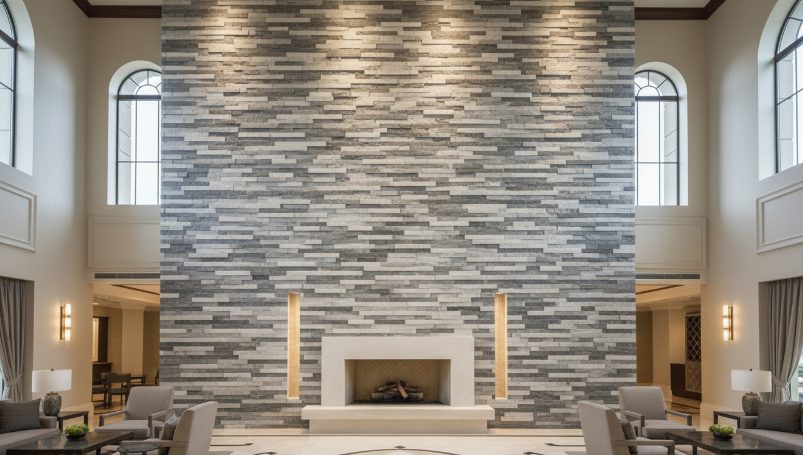
Real Cost Breakdown: Material Price Per Square Foot, Installation, and ASTM E84 Compliance
Natural stone meets ASTM E84 Class A inherently.
Natural stacked stone veneer (1–2 inches thick) runs $10–20 per square foot for material, but the real cost starts with the substrate. At 19–25 lbs per square foot, a 500 sq ft facade adds 5,000–6,250 lbs of dead load. That typically requires a structural engineer’s sign-off and potentially $2,000–$5,000 in foundation reinforcement. Installation labor for natural stone runs $15–25/sq ft because it demands experienced masons who can handle irregular pieces and proper anchoring per ASTM C1670-21.
Manufactured stone veneer costs $5–10/sq ft for material and weighs 8–12 lbs/sq ft — roughly half the dead load. Installation labor is $10–15/sq ft, and the lighter weight can eliminate the need for foundation upgrades on standard wood-frame construction. But the cost advantage narrows when you factor in code compliance. Natural stone achieves ASTM E84 Class A (flame spread index < 25) inherently because it’s mineral. Manufactured veneer typically requires a 1/2-inch gypsum board backing or a fire-resistant coating to reach Class A, adding $2–4/sq ft to the assembly cost.
Landed Lifecycle Cost Profiles:
- Natural Stone Installed Cost: $25–45/sq ft total (material + labor + substrate prep). No additional fire-rated backing needed for commercial egress per IBC Section 803.
- Manufactured Veneer Installed Cost: $15–25/sq ft total (material + labor). Add $2–4/sq ft if gypsum backing or fire-resistant coating is required to meet ASTM E84 Class A.
- Hidden Cost of Batch Replacement: Industry standard for manufactured stone accepts ±15% chroma deviation across lots. If a second batch arrives visibly lighter or darker, the GC may reject it. Rework and shipping delays can add $3,000–$8,000 to a mid-size project. Natural stone from a single quarry source — like Top Source Stone’s controlled sourcing — holds < 5% deviation, eliminating this risk.
- Lifecycle Cost Per Year Breakdown: Natural stone facades show < 5% failure rate over 50 years. Manufactured stone shows 15–25% failure rate (cracking, delamination, pigment loss) by year 30. At $40,000 installed for a 1,000 sq ft natural stone wall vs $22,000 for manufactured, the natural stone costs $0.80/sq ft/year vs $0.73/sq ft/year for manufactured — virtually identical, but natural stone avoids the 30-year replacement cycle.
| Cost Category | Natural Stacked Stone | Manufactured Veneer | ASTM Compliance Note |
|---|---|---|---|
| Material Cost ($/sq ft) | $10 – $20 | $5 – $10 | N/A |
| Installation Labor ($/sq ft) | $15 – $25 | $10 – $15 | N/A |
| Structural Load (lbs/sq ft) | 19 – 25 | 8 – 12 | Per IBC Chapter 14 |
| Fire Rating Assembly Cost Add ($/sq ft) | $0 (inherently Class A) | $2 – $4 (gypsum backing required) | ASTM E84 Class A (FSI < 25) |
| Freeze-Thaw Durability | Passes ASTM C666 (< 0.5% water absorption) | Fails after 5-7 winters (5-8% absorption) | ASTM C666 / ASTM C1670 |
| Batch Color Consistency (Chroma Deviation) | < 5% (quarry-sourced mineral color) | ±15% industry standard (pigment fade risk) | Visual inspection per project spec |
Analyzing Mechanical Failure Modes: ASTM C1670 Damage Paths in Manufactured Stone
Manufactured stone’s three hidden failure modes don’t appear in spec sheets.
Most architects compare natural and manufactured veneer based on upfront cost and weight. Those are the visible specs. The real risk lies in three failure modes that show up 5 to 15 years after installation — long after the warranty period. Here is what the marketing material omits:
- Moisture Entrapment & Freeze-Thaw Spalling: Manufactured stone veneer uses a lightweight concrete matrix with expanded shale or clay aggregates. That matrix has a water absorption rate of 5–8% — 10 to 16 times higher than natural stone’s sub-0.5% rate. In freeze-thaw climates, water trapped inside the concrete expands during freezing cycles. Internal micro-cracking begins, and surface spalling becomes visible after 5 to 7 winters. Natural stone’s micro-fracture structure allows vapor transmission, preventing trapped moisture. This is why exterior warranties for manufactured stone typically cap at 25 years, while natural stone facades show less than 5% failure over 50 years in Northern climates.
- Thermal Expansion Mismatch & Delamination: The concrete admixtures in manufactured veneer have a coefficient of thermal expansion roughly 2x higher than natural stone. On a south-facing commercial facade, daily temperature swings cause the manufactured stone to expand and contract at a different rate than the substrate or mortar bed. Over 5 to 10 years, this differential movement breaks the bond at the interface, causing delamination — the veneer literally peels away from the wall. Natural stone’s thermal expansion closely matches traditional masonry substrates, so this failure mode is virtually nonexistent in real stone installations.
- UV Degradation & Irreversible Pigment Fade: Manufactured stone gets its color from iron oxide pigments mixed into the concrete. Under direct UV exposure, those pigments break down. Competitor literature treats this as a minor maintenance issue. The reality: after 10 years of UV exposure, chroma loss can reach 40%, and the fade is irreversible — you cannot repaint or re-stain concrete to match the original color. Natural stone’s color is structural mineral content, not applied pigment. It cannot fade. For any south-facing exterior application, this is the single strongest specification argument for natural stone.
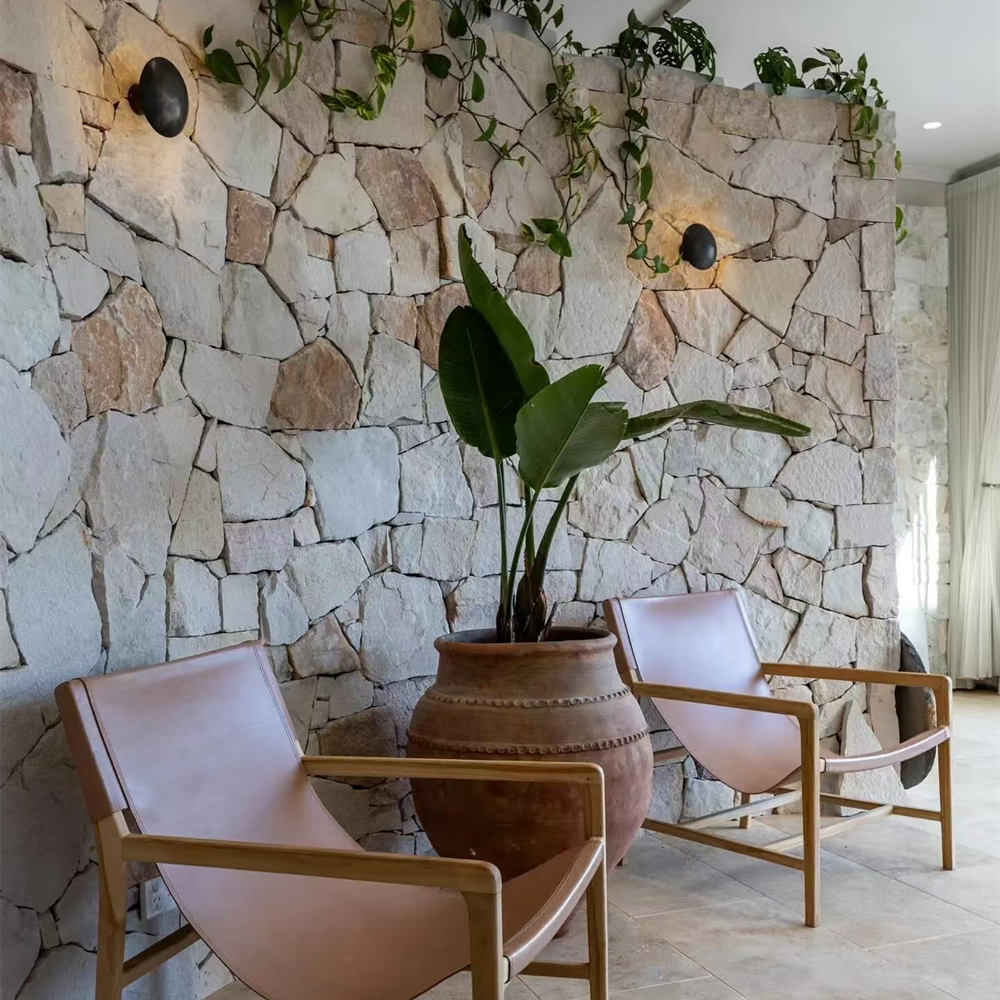
How to Specify Commercial Exterior Adhered Rainscreen Assemblies Under IBC Guidelines
Natural stone meets Class A fire rating inherently across dense interior configurations.
For commercial egress paths, IBC 2018 Section 803 requires ASTM E84 Class A with flame spread index under 25 and smoke developed index under 450. Natural stone (quartzite, slate) achieves this inherently — its mineral composition simply does not support flame spread. Manufactured stone veneer, being a cementitious product with organic pigments and lightweight aggregates, typically tests at FSI 25-75 (Class B) and requires a 1/2-inch gypsum board backing to reach Class A. That backing adds $2-4 per square foot to the assembly cost and introduces an additional inspection point for the AHJ.
Structural Engineering Parameters:
- ASTM C1670-21 Anchoring: This standard governs the mechanical attachment of thin stone veneer. For natural stone, the anchor system must account for the material’s density (19-25 lbs/sq ft) — typically requiring corrosion-resistant clips embedded in a reinforced mortar bed or metal stud framing. Manufactured veneer uses the same standard but at lower loads (8-12 lbs/sq ft). The risk: if the anchoring system is designed for manufactured weight but the spec switches to natural stone, the substrate may fail under dead load.
- ASTM C1363 Thermal Resistance (R-Value): Natural stone veneer at 1-2 inches thick provides an R-value of approximately 0.15-0.30 per inch — negligible for thermal envelope calculations. Manufactured stone veneer is similar (R-0.10-0.20 per inch). Neither material is a primary insulator. The compliance issue arises when the assembly’s overall R-value is calculated: if the spec relies on an air gap behind the stone, the gap must be continuous and free of thermal bridging. Missing this detail can fail an energy code review.
- Fire Test Report for Egress Corridors: The AHJ will request a fire test report showing FSI < 25 and SDI < 450 for any wall finish in an exit passageway. Natural stone suppliers can provide a generic material test report based on the stone type’s inherent properties. Manufactured stone suppliers must provide a specific assembly test report that includes the backing material and adhesive used. If the manufactured stone is installed without the exact backing specified in the test report, the assembly loses its fire rating. This is a common reason for plan rejection.
- Batch Color Consistency (95% Hue Uniformity): Industry standard for manufactured stone accepts ±15% chroma deviation across lots. For a 200-foot lobby wall, that means the stone delivered in week 2 can be visibly different from week 1’s lot. Natural stone from a single quarry face — like Top Source Stone’s controlled sourcing — achieves < 5% deviation because the color is structural mineral content, not applied pigment. Specify in the contract that each batch must be pre-sorted and accompanied by a digital color match report referenced to the approved sample.
For wind and seismic compliance, the critical factor is the veneer’s attachment to the structural substrate. IBC Chapter 14 requires the veneer to resist the design wind pressure for the building’s location and seismic forces per ASCE 7. Natural stone’s higher mass (19-25 lbs/sq ft) demands closer anchor spacing and potentially heavier gauge metal studs compared to manufactured veneer. A structural engineer must verify the substrate’s capacity before specifying. Requesting a pre-engineered attachment detail from the stone supplier — showing anchor type, spacing, and substrate requirements — saves weeks of back-and-forth during submittal review.
Conclusion
The choice between natural stacked stone and manufactured veneer for a commercial spec comes down to one question: do you need a 50-year facade or a 25-year finish? Natural stone delivers inherent ASTM E84 Class A compliance, zero pigment fade, and a failure rate under 5% across half a century. Manufactured veneer saves on upfront weight and material cost, but the hidden liabilities—UV degradation, freeze-thaw spalling, and batch color drift—shift the lifecycle math against it for any exterior application.
Review the fire-rated product line to see how a direct factory with quarry control solves the compliance and consistency problem before your next project meeting.
Frequently Asked Questions
What is the difference between stone veneer and stacked stone?
Stone veneer is a thin cladding layer cut from natural stone, while stacked stone refers to the installation pattern of rectangular pieces stacked in rows. At Top Source Stone, our calibrated 6×24 modular ledger systems pre-compress this field alignment variation safely. Choose stacked stone panels for speed, or loose veneer for design flexibility.
How much does manufactured stone veneer cost?
Manufactured stone veneer typically costs $5 to $10 per square foot for material alone, but that price excludes structural reinforcement and specialized labor. For a commercial facade, total installed cost often reaches $15 to $25 per square foot frame. Always compare total installed cost, not just material price.
Is manufactured stone cheaper than real stone?
Manufactured stone has a lower upfront material cost, but natural stone often delivers a 15-20% lower lifecycle cost per year of service when factoring in sealing, repainting, and replacement over 50 years. Run a 50-year lifecycle cost model before making that call.
What is the difference between ledgestone and stackstone?
Ledgestone refers to a specific profile with a long, linear, irregular face, while stackstone is a broader category of rectangular stones stacked in even courses. At Top Source Stone, our ledger profiles integrate full-depth split face depth parameters seamlessly. Confirm the profile and assembly method with your supplier before ordering.
Is stone veneer the same as manufactured stone?
No, stone veneer can be either natural or manufactured; natural veneer is a thin cut of real stone, while manufactured stone is a cast concrete product designed to mimic stone. Top Source Stone guarantees continuous quarry vein traceability to completely negate faux composition risks. Always verify whether the veneer is natural or manufactured before specifying.
