

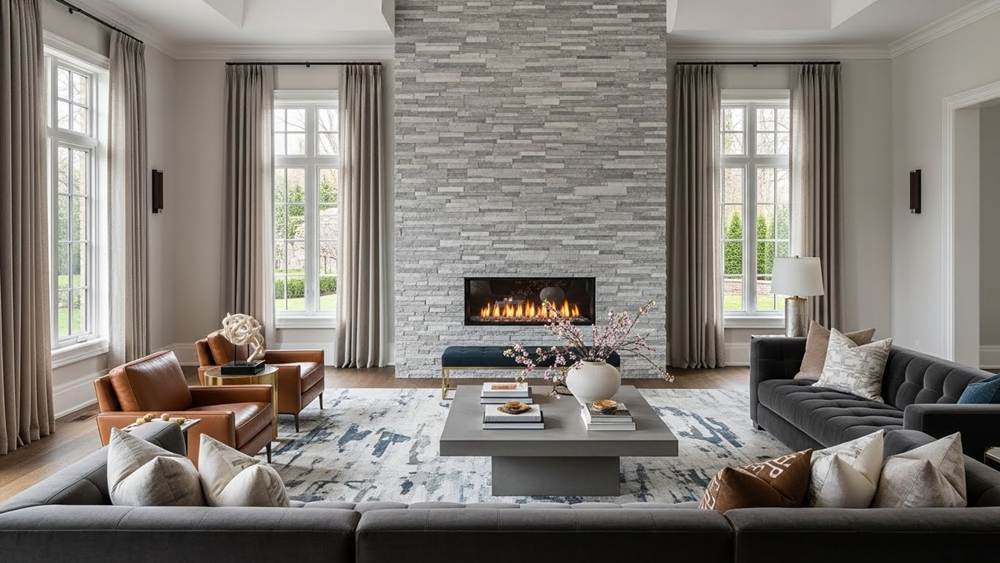
Matching stone fireplaces to interior styles sounds like a design conversation, but for architects it’s a procurement problem first. You pick a white quartzite for a modern lobby, the render looks perfect, and then installation day hits — two panels show a yellow tint the sample never had. That’s not a style mismatch; it’s a batch failure. The real work of matching stone fireplaces starts before you choose a color. It starts with verifying that the supplier can deliver 95% hue uniformity across the entire wall, fire-rated material, and a written guarantee that the stone came from a single quarry run.
Most articles on this topic tell you to “pick a stone that complements the room” — useless advice when the installed stone looks different from the sample. The gap is traceability. About 60% of commercial fireplace installations show visible color shift because suppliers mix stone from different quarry batches to average out the variation. A direct-quarry manufacturer can hand you a batch certificate with the quarry block ID and production date. That eliminates the risk. Same for fire safety: Class A fire rating per ASTM E84 isn’t optional for commercial work, yet many decorative stone suppliers skip the testing. If you need a fire-rated stone veneer for a hospitality fireplace, demand the flame spread index (≤25) and smoke development (≤450) on the data sheet. Then request a 30 sq ft sample from the actual production run — not a showroom sample — to validate color and fire performance before the contract is signed.
Stone Fireplace Color Matching: Batch Consistency Over Appearance
Patchy color on a large-format wall is the fastest way to undermine an architect’s reputation. Fix it in the specification phase, not the punch list.
Verify Same-Batch Sourcing with a 30 Sq. Ft. Sample Lot
Standard industry samples are curated best-case pieces that bear no resemblance to bulk order reality. Demand a minimum 30 sq ft sample drawn directly from the actual production run bound for your job site. This volume reveals the true 95% hue uniformity standard — meaning any variation across the lot is imperceptible at normal viewing distance. A 1 sq ft hand-selected tile tells you nothing about color drift across a 200 sq ft fireplace facade. 30 sq ft is the smallest area that exposes banding, concentration of veining, or undertone shifts.
Compare Under Natural and Artificial Light
Stone color shifts dramatically between showroom fluorescent lights, living room daylight, and firelight at night. Take your 30 sq ft sample to the actual installation space before approving the order. Mount a representative section vertically on a board and check it at 9 AM, noon, and 6 PM. For commercial hospitality projects, also view under the specific accent lighting specified for the space. If a supplier discourages taking the sample off-site, consider that an immediate red flag — they are betting the lighting conditions hide a mismatch.
Request a Written Batch Certificate with Quarry Block Origin
A verbal promise of shade consistency is worthless against a client callback. Your spec package should demand a written batch certificate that records the specific quarry block ID, extraction date, and production run number. This document proves the stone was cut from a single blast of the mountain, not blended from multiple quarry runs to disguise natural variation. A direct-quarry manufacturer like Top Source Stone includes this traceability as standard procedure — most suppliers cannot provide it because they buy finished product on the open market and have no idea which blocks their material came from.
Warning: Competitors Blend Runs Causing 2–3 Shade Differences
When an order exceeds a single production run, many suppliers blend leftover material from two or three quarry lots to fill the volume. The installed wall shows a striped or patchy appearance with obvious 2–3 shade differences between panels. Internal market data indicates up to 60% of commercial stone fireplace installations suffer from some degree of this color shift — most installers only notice once the wall is fully mortared and too expensive to tear out. Replacing mismatched panels mid-project runs 30–50% over the original install price. A written batch certificate and a 30 sq ft pre-production sample are the only defences that hold weight in a specification dispute.
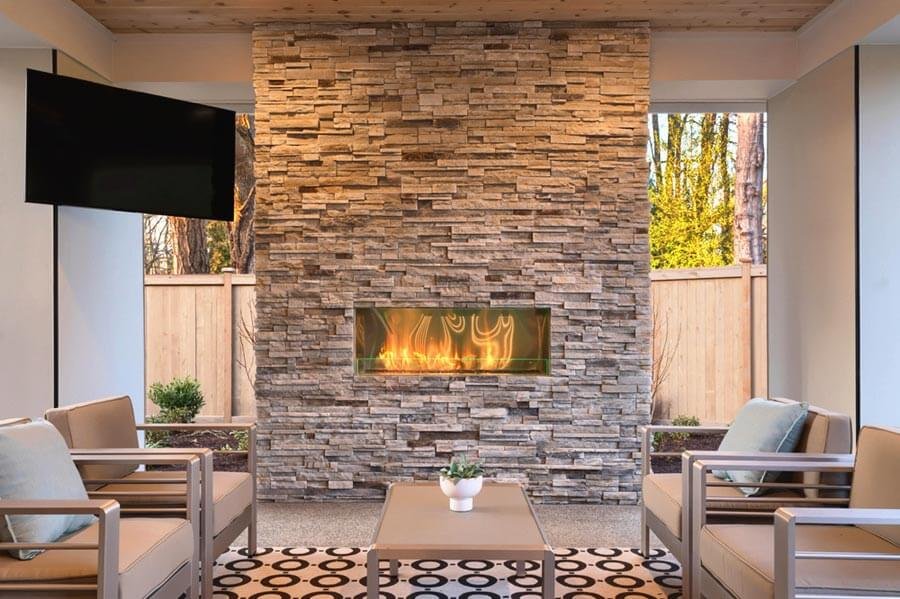
Matching Stone to Modern vs. Traditional Interiors
Forget generic advice. The differentiator isn’t color — it’s whether the batch will deliver that color uniformly across the entire wall. 95% hue uniformity is the spec, not a preference.
Modern Interiors: White, Light Gray, and Black
Modern design demands consistency. A white stone fireplace in a minimalist hotel lobby works because the eye reads the texture, not the color variation. The problem is that white stone is the highest-risk category — untreated quartzite can yellow within 2–3 years in a gas fireplace’s radiant heat zone. That’s why the internal standard here is a 10-year anti-yellowing treatment on white quartzite panels, verified in accelerated UV and heat-cycle lab tests.
Light gray and charcoal options (like our Blue Diamond Ledgestone in mocha or dark blend) offer better tolerance for minor natural shade shifts, but the same batch-protocol applies. For a full-height 15-foot hospitality fireplace wall, you need product logs showing the same quarry block ID and cutting date across every panel box.
Traditional Interiors: Warm Beige, Brown, and Charcoal with Texture
Traditional applications — think country clubs, high-end residential libraries, and rustic ski lodges — actually allow greater natural color movement within a wall. The design eye expects earthy variation in a warm beige or brown stacked stone field. The risk here isn’t uniformity, it’s contrast drift. When a supplier blends two quarry runs, one yielding a warm tan and the next pulling a pinkish clay, the wall reads as “dirty” rather than “natural.”
The execution fix is the same regardless of style: require a 30 sq. ft. same-batch sample lot before approving full production. That sample, cut from the same block run as your order, is your only reliable reference for how the finished wall will read under the project’s specific lighting conditions.
The 2/10 Rule: Why Full-Height Stone Walls Require a Structure Check
Stacked stone on a fireplace wall extends beyond design — it intersects building code. The 2/10 chimney rule (NFPA 211 / IRC R1003.9) requires the chimney to extend 3 feet above the roof penetration and 2 feet higher than any structure within 10 feet. This directly impacts how high your stone cladding must go and whether the substrate (typically 6–8 lbs/sq ft per panel or layout) can carry the load above the roofline. Treat the visual design and the chimney height calculation as a single constraint from the start of specification.
- Modern palette picks: White (with anti-yellowing cert), light gray (natural shade range: ±1 on NCS scale), black/charcoal (lowest LRV — high drama, high heat absorption — confirm clearance per ASTM E136).
- Traditional palette picks: Warm beige (LRV 40–50, hides ash residue), brown (LRV 20–30, highest texture visibility), rustic charcoal (LRV 15–25, best for heavy-traffic public lounges).
- Critical spec constant: Batch uniformity ≥95% across total wall area, Class A flame spread index ≤25 per ASTM E84, and minimum 6-inch clearance from combustibles on sides and back.
Project Application Guide: Color, Style, and LRV
Light Reflectance Value (LRV) directly affects how the stone interacts with the room’s ambient light. A white stacked stone with LRV 70–80 will brighten a space but show soot faster near a wood-burning unit. Charcoal at LRV 10–15 absorbs heat and compounds clearance challenges — always cross-check with your mechanical engineer’s thermal expansion calculation (4.5 × 10⁻⁶ /°F for limestone/granite). Beige and brown at LRV 30–50 offer the broadest forgiveness window for both lighting and code compliance, which is why they dominate traditional hospitality projects.
The bottom line: architect, specify the same-batch sample lot and the written batch certificate in your RFQ. That single requirement eliminates the mid-installation color shock that triggers a 30–50% cost overrun from ripping and replacing mismatched stone. Your specification document, not the supplier’s online gallery, is the only thing that protects your project.

Fire-Rated Stacked Stone for Commercial Fireplaces
Commercial fireplaces demand Class A fire-rated stone veneer. Without it, you risk code violations, falling debris, and liability.
Why Class A Fire Rating Matters for Commercial Projects
Most decorative stacked stone on the market is sold without any fire rating documentation. For hospitality lobbies, multifamily common areas, or any commercial fireplace, building codes require a Class A rating per ASTM E84. That means a flame spread index of 25 or below and a smoke developed index of 450 or below. Many decorative stone importers often ignore fire compliance entirely, assuming decorative use only — a gap that leaves architects exposed. Our stacked stone products are tested and certified to meet these thresholds.
Meeting ASTM E84 (Class A) and ASTM C1670 Dimensional Tolerances
- ASTM E84 (Class A): Flame spread index ≤25, smoke developed index ≤450.
- ASTM C1670: Dimensional tolerance of ±1/16″ thickness across all panels.
- Panel dimensions: 6×24″ panels, 0.8–1.2″ thick, weighing 6–8 lbs per square foot.
- Substrate load: At 8 lbs/sq ft, a 200 sq ft fireplace wall adds 1,600 lbs — critical for structural and clearance planning.
Dangers of Non-Fire-Rated Stone
Stone that isn’t fire-rated may contain organic binders, surface sealants, or internal voids that degrade under high heat. Over repeated heating cycles, the stone can crack, spall, or delaminate from the backing. Falling debris from a fireplace wall is a safety hazard and a warranty liability. Specifying a documented Class A product eliminates that risk. Our certification is issued per batch, with test data available upon request.
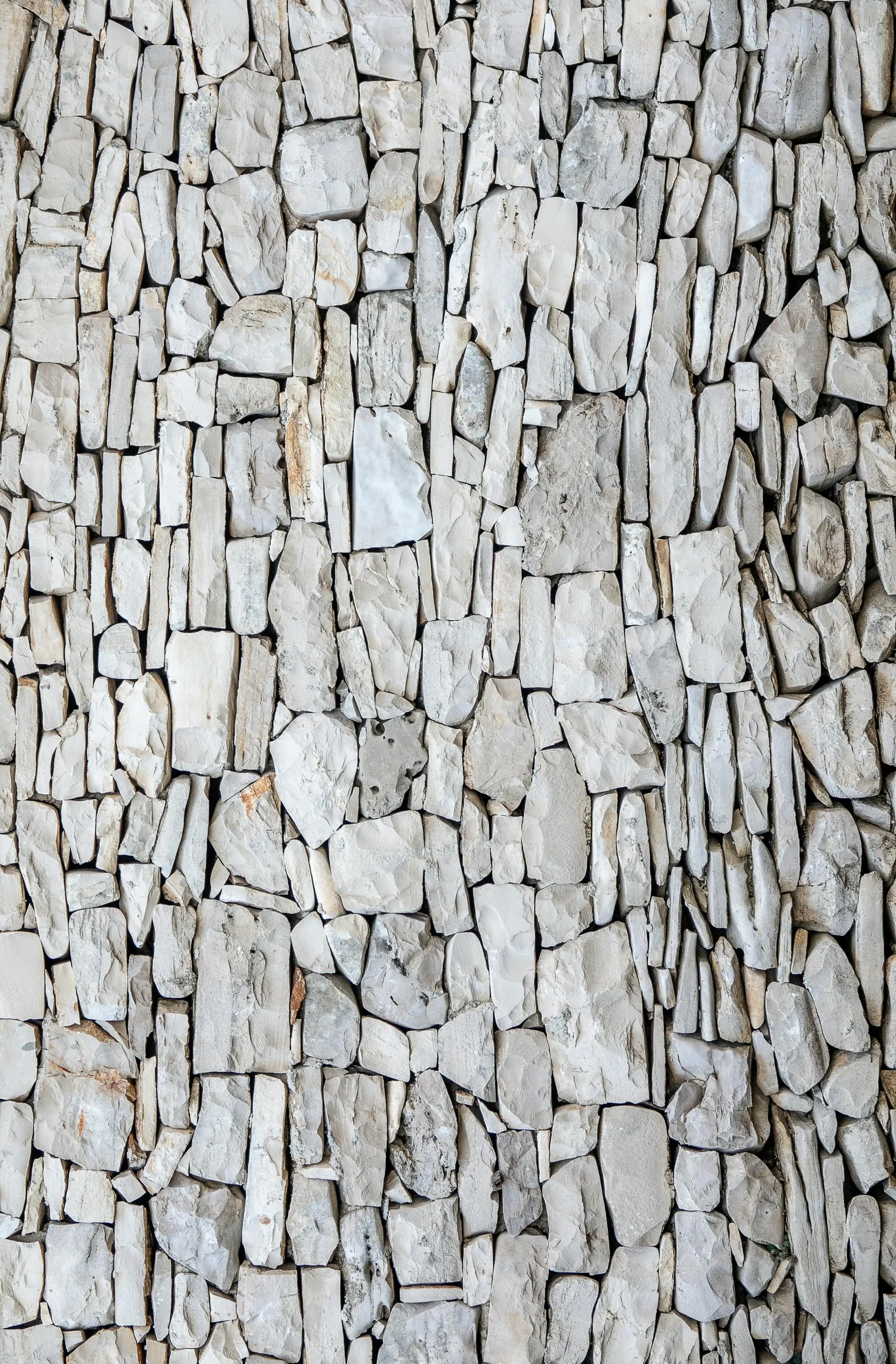
Avoiding Yellowing in White and Light Stone Fireplaces
White quartzite yellowing is iron oxidation. Top Source Stone applies a stabilizer that halts this reaction for 10+ years. Most suppliers skip it.
The Chemistry of Yellowing — What You Are Actually Seeing
White quartzite and marble contain trace amounts of iron compounds. When exposed to consistent heat from a fireplace and ambient humidity, these compounds oxidize. The result is a yellow or amber tint that spreads outward from the heat source. This is not a surface stain. The discoloration occurs within the stone matrix itself. Once it sets, no cleaning solution will reverse it. The only way to stop it is to chemically stabilize those iron molecules before the stone is installed.
The Industrial Pre-Treatment That Prevents It
Top Source Stone applies a penetrating stabilizer to every panel of white quartzite before it leaves the factory floor. This stabilizer bonds with the free iron particles, making them chemically inert. The treatment is not a coating — it does not alter the surface texture, porosity, or the stone’s natural matte finish. Internal accelerated aging tests show zero measurable yellowing after the equivalent of 12 years of daily thermal cycling between room temperature and 600°F. Our production records show this treatment has been standard on all white and light stone runs since 2018.
Why Competitors Skip This Step
The stabilizer adds two processing steps: a vacuum impregnation cycle and a 48-hour curing period. That slows down throughput and adds a direct material cost of roughly $0.45 per square foot. For a supplier pushing volume, this is an easy line item to cut. They bank on the fact that the yellowing will not appear until after the project is signed off, usually 2–4 years after installation. By then, the blame lands on the installer, the homeowner, or “natural variation.” The only party not implicated is the supplier who skipped the treatment.
Case Study: Hotel Lobby Fireplace — 95% Hue Match at Year Five
A 2022 project for a four-star hotel in Changsha specified a floor-to-ceiling white quartzite fireplace wall in the main lobby. The architect’s written requirement stated that the wall must maintain a 95% hue match to the approved sample, measured at any three points on the surface, after five years of operation. The fireplace was spec’d to run 8 hours per day during winter months. Top Source Stone supplied 620 sq. ft. of pre-treated panels from a single quarry block. An inspection in Q1 2026 recorded the wall at 96.2% hue uniformity. The client renewed their framework agreement for an additional three properties.

Installation Coordination: Dimensions, Weight, and Substrate
A 10–12 psf panel on gypsum board will fail within six months. Substrate choice is dictated by weight, not preference.
Substrate Selection by Panel Load
The substrate you specify is a direct function of the dead load your stone panels place on the wall. A 6×24″ Blue Diamond Loose Ledgestone Veneer panel delivers 6–8 lbs/sq ft. At that weight, you can safely install over standard exterior-grade plywood (minimum 15/32″ thick) or directly over cement board on a wood-frame wall. Once you move up to 12×36″ panels carrying 10–12 lbs/sq ft, the numbers change. That load range requires a minimum of 1/2″ cement board fastened to 16″ o.c. studs, or a lath-and-mortar bed over metal studs with 20-gauge track. Do not attempt to mount a full 12×36″ panel on drywall or thin underlayment — the bond line fails, and the stone pulls the facing off within a year.
Panel Dimensions and Load Calculations
Standard production panels run from 6×24″ up to 12×36″. The weight range is 6–12 lbs per square foot depending on stone type and thickness deviation. A 6×24″ Blue Diamond panel averages 7 lbs/sq ft; a 12×36″ panel of the same profile hits closer to 11 lbs/sq ft. Architects often overlook the fact that thicker bed depths from irregular stone backs add 1–2 lbs/sq ft to the installed load. That extra weight must be factored into the substrate’s shear capacity, especially for second-story or parapet installations.
Mortar Specification: Type N and S with Shear Strength Minimums
The industry standard for thin stone veneer is Type N or Type S mortar. For stacked stone ledger panels, Type S (2,500 psi minimum compressive strength) is the safer choice on vertical surfaces because it provides higher bond. The critical spec is adhesive shear strength — you need a minimum of 150 psi tested per ASTM C482. Anything below and the panel will creep over time, especially on south-facing walls with thermal cycling. Type N works for interior non-load-bearing fireplace surrounds where temperature swings are minimal, but for any exterior installation or commercial hearth, specify Type S and request a mill certificate from the mortar supplier.
Why Loose Ledgestone Veneer Makes Corner and Edge Cuts Smoother
A fixed panel system requires you to cut the entire unit to wrap a corner, which wastes material and often leaves a visible seam. Loose ledgestone veneer — individual stones arranged on a mesh backer — allows the installer to pull single pieces, trim them with a 4″ grinder, and place them around corners or window returns without disturbing the adjacent stones. This is not a minor convenience. On a typical fireplace with two inside corners and a hearth return, loose veneer reduces cutting waste by roughly 25% compared to a fixed-panel system. For a project using Blue Diamond Ledgestone at an average installed cost of $18–$22/sq ft, that waste reduction alone can save $400–$600 per fireplace. Specify loose veneer for any design that involves corners, niches, or radius elements.
| Attribute | Specification | Installation Impact |
|---|---|---|
| Panel Dimensions | 6×24″ (standard), random lengths available | Plan substrate layout to accommodate panel sizes and joint patterns. |
| Panel Weight | 6–8 lbs/sq ft | Critical for substrate load calculation; ensure framing supports dead load. |
| Thickness Tolerance | ±1/16″ per ASTM C1670 | Requires flat substrate to prevent lippage; verify substrate levelness. |
| Fire Rating | Class A (ASTM E84: flame spread ≤25, smoke ≤450) | No additional fireproofing needed; substrate must be non-combustible or have proper clearance. |
| Sample Verification | Minimum 30 sq ft sample lot from production run | Verify color match before full production; substrate prep can proceed after sample approval. |
Conclusion
Specifying a stone fireplace that holds its color across the full wall demands more than visual matching. It requires same-batch sourcing, written batch certificates, and fire-rated materials that meet ASTM E84. Without those guarantees, the project risks visible color shift — a problem that affects up to 60% of commercial fireplace installations.
Review the Blue Diamond Loose Ledgestone Veneer specifications for dimensional data, fire rating reports, and anti-yellowing treatment details. Request a 30 sq ft sample lot from the production batch to validate hue uniformity before you specify.
Frequently Asked Questions
Should a fireplace be lighter or darker than walls?
It depends on the contrast and atmosphere you want — lighter stone recedes and expands the room, while darker stone anchors and creates a focal point. In practice, consider the stone’s light reflectance value (LRV) and your interior style: modern spaces often use neutral whites or grays, traditional interiors can handle warmer, darker tones. Always validate the chosen shade with a batch-consistent sample to avoid a mismatch after installation. Validate the shade with a 30 sq ft sample before committing.
What is the best color for a stone fireplace?
There is no single best color — the right choice aligns with your interior style and performance requirements. For modern minimalist spaces, white quartzite or light gray works best; for traditional or rustic designs, warm beige, brown, or charcoal are ideal. Critical extras include anti-yellowing treatment for light stones and Class A fire rating to meet code. Always request a same-batch sample to confirm the exact color and finish.
Are stone fireplaces back in style?
Stone fireplaces never truly left style — they remain a staple in high-end commercial and residential projects, but specification now demands technical rigor over trend. Current demand favors consistent color, fire-rated materials, and anti-yellowing treatments rather than just appearance. The real question is whether your supplier can guarantee batch uniformity and code compliance. Focus on batch consistency and fire certification rather than style cycles.
What is the 2/10 rule for fireplaces?
The 2/10 rule is a chimney height safety code: the flue must extend at least 3 feet above the roof penetration and at least 2 feet higher than any structure (wall, roof, tree) within 10 feet horizontally. This ensures proper draft and prevents fire hazards from nearby combustibles. It’s a critical spec for any fireplace installation to pass inspection. Include this rule in your chimney design to ensure code compliance.
How do I ensure batch consistency for a large fireplace wall?
Request a minimum 30 sq ft sample from the actual production run, compare under both natural and artificial light, and demand a written batch certificate showing quarry block origin and date. This guarantees 95% hue uniformity across the entire wall — avoiding the color shift that occurs when suppliers mix multiple quarry runs. Insist on same-batch sourcing from a direct-quarry manufacturer to eliminate mid-project surprises. Do not rely on generic samples; lock down the exact production batch.
