

Following a DIY Fireplace Guide is the most direct path to recapturing the $2,000 labor premium typically pocketed by masonry contractors. Success relies on technical accuracy, as improper substrate prep or poor base leveling often causes structural shifts that ruin the entire natural stone investment.
Top Source Stone applies CNC diamond-blade precision to Z-shape interlocking panels to eliminate these common installation errors. By sourcing directly from our quarry, you access 100% natural stone weighing only 8-12 lbs per square foot and matching L-corners to produce a professional architectural finish without hiring specialized labor.
Is a DIY Stone Fireplace Project Right for You?
DIY stone fireplaces are achievable for those with basic construction skills and a diamond-blade wet saw, especially when using modular interlocking panels to bypass complex masonry requirements.
Evaluating Skill Requirements and Necessary Masonry Tools
Success starts with the substrate. You need a clean, stable surface like unpainted brick or concrete. For framed walls, the process requires installing metal lath and a moisture barrier to ensure the mortar bonds correctly to the wall.
- Precision Cutting: Operators must use a wet saw with a diamond blade to achieve the clean edges necessary for a professional appearance.
- Mortar Application: Use Type S or Type N mortar. Apply a scratch coat and use back-buttering techniques on each stone piece.
- Project Timeline: Allow a 24-hour cure period for the setting mortar before handling the stone or finishing joints.
- Safety Essentials: Wear safety glasses, gloves, and a dust mask to protect against stone debris and mortar dust.
Modular Interlocking Systems for Professional DIY Results
Engineered stone panels bridge the gap between amateur effort and master masonry. These systems remove the need for manual stone-shaping by providing pre-fitted components that align through a modular design.
- Interlocking Design: Z-Shape and S-Shape panels utilize a male-female connection system to camouflage vertical joints and eliminate visible gaps.
- CNC Precision: CNC diamond-blade edges ensure modular pieces fit tightly for a seamless architectural finish without specialized shaping tools.
- L-Corners: Pre-fabricated 90-degree corners remove the requirement for difficult miter cuts at wall transitions, speeding up on-site labor.
- Structural Weight: Lightweight panels (8-13 lbs/sq.ft) allow installation on most sound surfaces without the need for additional foundation footings.

Essential Tool List: What You Need vs. What You Can Rent
Own permanent maintenance kits for daily safety, but rent specialized wet saws and laser levels for the installation phase to ensure precision while reducing overhead.
Core Maintenance and Safety Gear to Purchase
Fireplace ownership requires a set of foundational tools for daily operation and safety. Dealers should prioritize stocking wrought iron or stainless steel equipment, as these materials offer the highest heat resistance and durability for end-users.
- Four-piece tool sets: These include a poker, tongs, shovel, and broom to manage log placement and ash debris.
- Industrial-grade materials: Wrought iron provides heavy-duty strength, while stainless steel prevents corrosion in high-humidity regions.
- Personal protection: Heat-resistant gloves and fire-retardant hearth rugs protect both the user and the surrounding flooring.
- Thermal monitoring: Fireplace thermometers allow owners to maintain optimal burning temperatures, preventing chimney damage.
These items represent a one-time investment. Because they face constant thermal stress, purchasing high-quality kits prevents the need for frequent replacements.

Installation Machinery for CNC-Precision Stone Panels
Top Source Stone panels utilize Z-shape and S-shape interlocking designs that require extreme alignment accuracy. While homeowners should own basic hand tools, renting specialized machinery ensures a professional finish without the high cost of purchasing industrial equipment for a single project.
- Wet saws with diamond blades: These replicate our factory CNC precision, allowing for clean cuts on thick quartzite and slate.
- Laser levels and notched trowels: Essential for maintaining horizontal alignment across the male-female interlocking connection system.
- High-strength stone adhesives: Use polymer-modified thinset specifically rated for the weight of natural stone panels to ensure permanent bonding.
- Rubber mallets: These secure the panels into the mortar bed without fracturing the natural split-face texture or cleft.
Renting a professional wet saw is the most cost-effective way to handle natural stone. Most standard tile nippers or manual cutters will fail against the 3.5cm thickness of our premium ledgestone series.
Premium Natural Stone for Efficient Installations
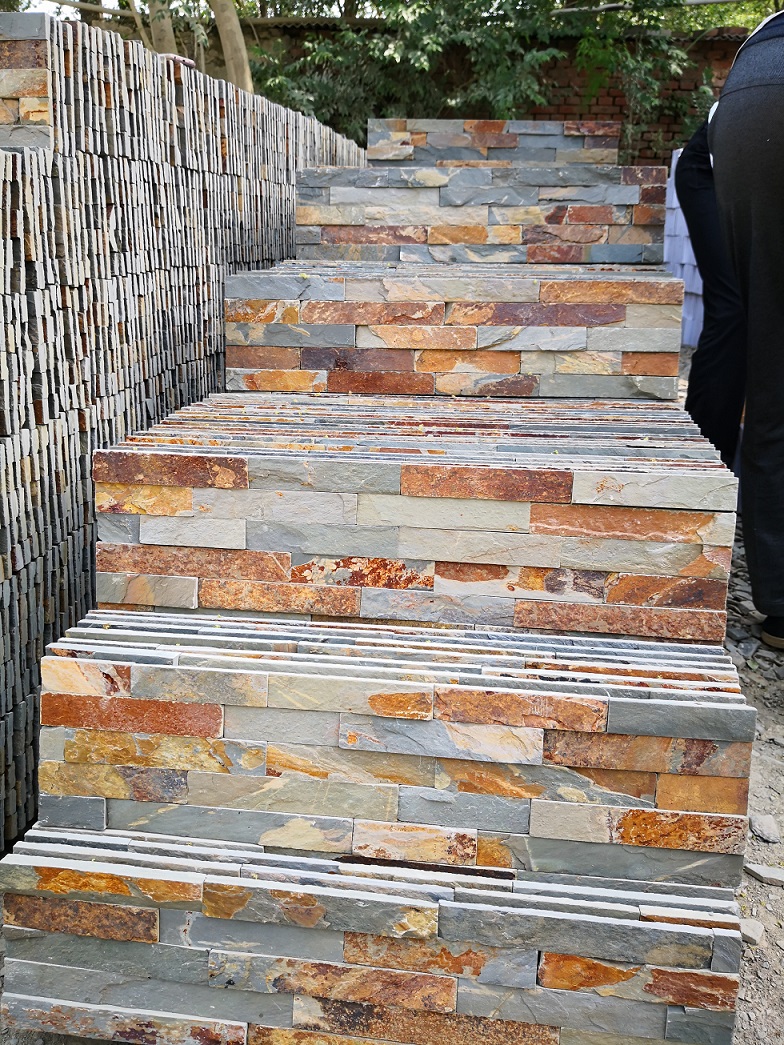
Avoiding the “Newbie” Mistakes: Leveling and Corner Management
Successful stone projects start with a level base and pre-fabricated corners. Using interlocking Z-shape panels and L-corners eliminates visible seams and cuts installation time in half.
Establishing a Level Foundation and Staggering Vertical Joints
Gravity is the primary enemy in stone masonry. Most beginners assume their floors are flat, but even a three-millimeter slope at the base creates massive gaps by the time the stone reaches the mantle. Setting the first row correctly prevents the entire project from leaning or showing “stair-step” gaps that are impossible to hide later.
- Foundation Prep: Use a laser level or a six-foot spirit level to install a temporary ledger board before placing the first row.
- Weight Distribution: Verify floor slope to ensure the 30-40kg/m² panel weight distributes evenly across the substrate.
- Visual Stagger: Offset each row by at least six inches to break up the installation grid and hide the modular nature of the stone.
- Plumb Checks: Verify vertical alignment every three rows to adjust for natural stone thickness variations before mortar sets.
Simplifying Transitions with Pre-fabricated L-Corners and Z-Shape Interlocking
Manual miter cuts often fail because natural stone is rarely perfectly square inside. Forcing two 45-degree cuts together usually results in a jagged, sharp edge that looks amateur. We solve this by using CNC-machined components that fit together like a puzzle, protecting the “Direct Quarry Source” aesthetic without the need for onsite masonry expertise.
- Pre-fabricated Corners: Use matching L-shaped corners from the Top Source Stone series to eliminate difficult onsite miter cuts.
- Precision Edges: CNC diamond-blade edges create a tight “male-female” connection that completely hides the wall behind the stone.
- Seam Camouflage: The Z-shape modular design removes continuous vertical lines, creating a monolithic look across flat spans.
- Batch Consistency: Source corners and flats from the same quarry vein to ensure 95% color uniformity at 90-degree transitions.
Focusing on these mechanical basics allows a standard crew or a diligent DIYer to produce a finish that looks like high-end custom masonry. It moves the project from a “cladded wall” to a structural architectural feature.

Budget Breakdown: Cost of Materials vs. Hiring a Mason
Professional masonry costs up to $47 per square foot. DIYers save by sourcing directly from the factory and using interlocking panels that eliminate expensive specialized labor and structural reinforcements.
| Project Element | Professional Masonry (2026) | DIY Factory-Direct Path |
|---|---|---|
| Labor Rate | $40 – $100 per hour | $0 (Self-installed) |
| Wall Installation | $34.37 – $47.11 /sq.ft. | Material cost only |
| Specialized Repairs | $120 per hour (Foundation) | Not required for light panels |
| Material Source | Retail markup (30% – 50%) | Direct Quarry Source (B2B Rates) |
| Permits | $100 – $250 (Fixed) | $100 – $250 (Fixed) |
Estimating Material Expenses and Professional Labor Rates for 2026
Hiring a professional for masonry work involves significant overhead. By 2026, skilled masons are expected to command hourly wages between $40 and $100. The complexity of the fireplace and regional demand dictate where a quote falls within that range. When calculating a full installation, average rates for masonry walls currently fluctuate between $34.37 and $47.11 per square foot.
Beyond standard labor, specialized tasks add weight to the budget. If a fireplace requires structural repairs or new foundation footings to support heavy full-bed stone, labor costs often spike to $120 per hour. Standard building permits for fireplace modifications also remain a fixed cost, typically adding $100 to $250 to the project total.
- Skilled Labor: $40 – $100/hr based on regional expertise.
- Standard Installation: $34.37 – $47.11 per square foot for wall surfaces.
- Permit Fees: $100 – $250 for local fireplace structural modifications.
- Structural Foundation Work: $120/hr for high-complexity reinforcement.
Lowering Project Totals with Interlocking Z-Shape Panels and L-Corners
The shift toward engineered natural stone panels allows dealers and wholesalers to offer professional-grade results without the traditional masonry price tag. Top Source Stone provides 100% natural slate and quartzite directly from the quarry, eliminating middleman markups. This ensures high-quality materials reach the project site at factory-direct rates.
Product engineering significantly reduces installation time. We use CNC diamond-blade precision to create Z-Shape panels with a male-female interlocking system. This design camouflages vertical joints, making it possible for installers to achieve a seamless finish without specialized stone-setting skills. Pre-fabricated 90-degree L-Corners further lower costs by removing the need for site-based mitering, which is notoriously time-consuming for masons.
- Factory Direct Pricing: Direct Quarry Sourcing removes retail and distributor markups.
- CNC Precision: Z-Shape panels ensure a tight fit and eliminate visible “stepped” gaps.
- Pre-fabricated L-Corners: Every series includes matching 90-degree corners to stop on-site cutting.
- Lightweight Engineering: Standard panels weigh only 8-13 lbs/sq.ft, avoiding the need for expensive structural footings.
Safety First: Managing Weight and Proper Adhesive Bonding
Natural stone panels weigh 8–12 lbs per square foot. Safety requires cement backer boards and polymer-modified adhesives to prevent structural failure or stone delamination over time.
Structural Weight Limits and Substrate Preparation
Natural stone carries a significant vertical load that standard interior surfaces cannot support without reinforcement. Installers must evaluate the wall’s shear strength before mounting panels to prevent sagging or substrate detachment.
- Standard Panel Weight: 30-40kg/m² (8-12 lbs/sq.ft).
- Rough/Premium Weight: Up to 55kg/m² for thicker, textured profiles.
- Mandatory Substrate: Cement backer board is required for any installation over interior drywall.
- Ideal Surfaces: Unpainted masonry, brick, and poured concrete offer the highest stability.
High-Strength Epoxy and Substrate Adhesion Standards
We utilize high-strength epoxy resin during factory assembly to ensure individual stone pieces remain permanently bonded within each panel. Field installation requires a similar focus on bonding technology to secure the panels to the wall.
- Adhesive Type: Use polymer-modified thin-set or stone-specific mortar that meets 2026 building safety standards.
- Mortar Coverage: Apply a 100% “back-butter” coat to each Z-shape or S-shape panel to eliminate air pockets.
- Interlocking System: CNC diamond-blade edges create a male-female connection that camouflages vertical joints.
- Environmental Rating: Choose freeze-thaw resistant adhesives for outdoor features or high-heat fireplace surrounds.
Frequently Asked Questions
Is installing natural stacked stone a manageable project for a DIYer?
It is a moderately challenging project that requires patience and basic construction skills. You must focus on surface preparation, such as installing wire lath or cement board, and ensuring the first row is perfectly level. Top Source Stone interlocking Z-shape panels use CNC diamond-blade precision to help you achieve a seamless look by hiding vertical joints automatically.
What are the must-have tools for a fireplace stone installation?
You need an angle grinder with a diamond blade or a wet saw for precise cuts. Essential application tools include a notched trowel for the scratch coat, a power drill with a mixing paddle for mortar, a rubber mallet to set the stone, and a level to maintain straight rows throughout the project.
Which adhesive works best for natural stone fireplace surrounds?
Natural stone requires polymer-modified thinset mortar rather than standard construction adhesive. Systems like Laticrete MVIS are engineered for high-heat environments and provide the necessary bond strength for vertical applications. These mortars ensure the stone remains securely attached during the heating and cooling cycles of the fireplace.
How much can I realistically save by doing the labor myself in 2026?
Labor savings typically range from $500 to $2,100 depending on the fireplace size and complexity. While you save on mason fees, you should account for tool rentals and specialized materials. Using pre-fabricated L-corners from Top Source Stone further reduces costs by eliminating the need for complex professional miter cuts.
Can I install stone panels directly over existing drywall?
Standard drywall cannot support the weight of natural stone, which averages 8-12 lbs per square foot. You must install a cement backer board or a metal lath and scratch coat system over the studs. This creates a rigid, non-combustible substrate that prevents the stone from sagging or pulling the wall surface away.
Final Thoughts
DIY labor savings only hold value if the installation remains seamless and structurally sound. Our CNC diamond-blade edges and Z-shape interlocking systems eliminate the “stepped” gaps that typically require expensive professional correction. Sourcing from a single quarry vein ensures 95% hue uniformity, protecting your project from the patchy, inconsistent appearance of retail-grade stone.
Verify our precision by requesting a physical sample kit to test the interlocking fitment and natural cleft finish firsthand. We provide high-definition pre-shipment visuals of every crate to guarantee quality and consistency before your balance payment. Contact our team to discuss a 300-square-meter trial order or private label packaging for your distribution hub.
