


If you are sourcing quartzite ledgestone veneer for your distribution lineup, the conversation usually starts with price per square foot. A veteran buyer knows the FOB number is just the entry fee. The real cost shows up six months later when a white quartzite installation starts yellowing or the next batch doesn’t match the first. That is where margins disappear and dealer relationships get tested.
This article breaks down the pros and cons of quartzite ledgestone veneer specifically for wholesale buyers who need to protect their brand reputation and avoid return claims. The analysis skips the marketing language and focuses on the data that matters: ASTM test results, batch consistency thresholds, and the hidden iron-oxide risk that competitors rarely mention. The goal is to provide a clear comparison against faux stone and limestone options so buyers can evaluate whether quartzite fits their supply chain without unpleasant surprises.
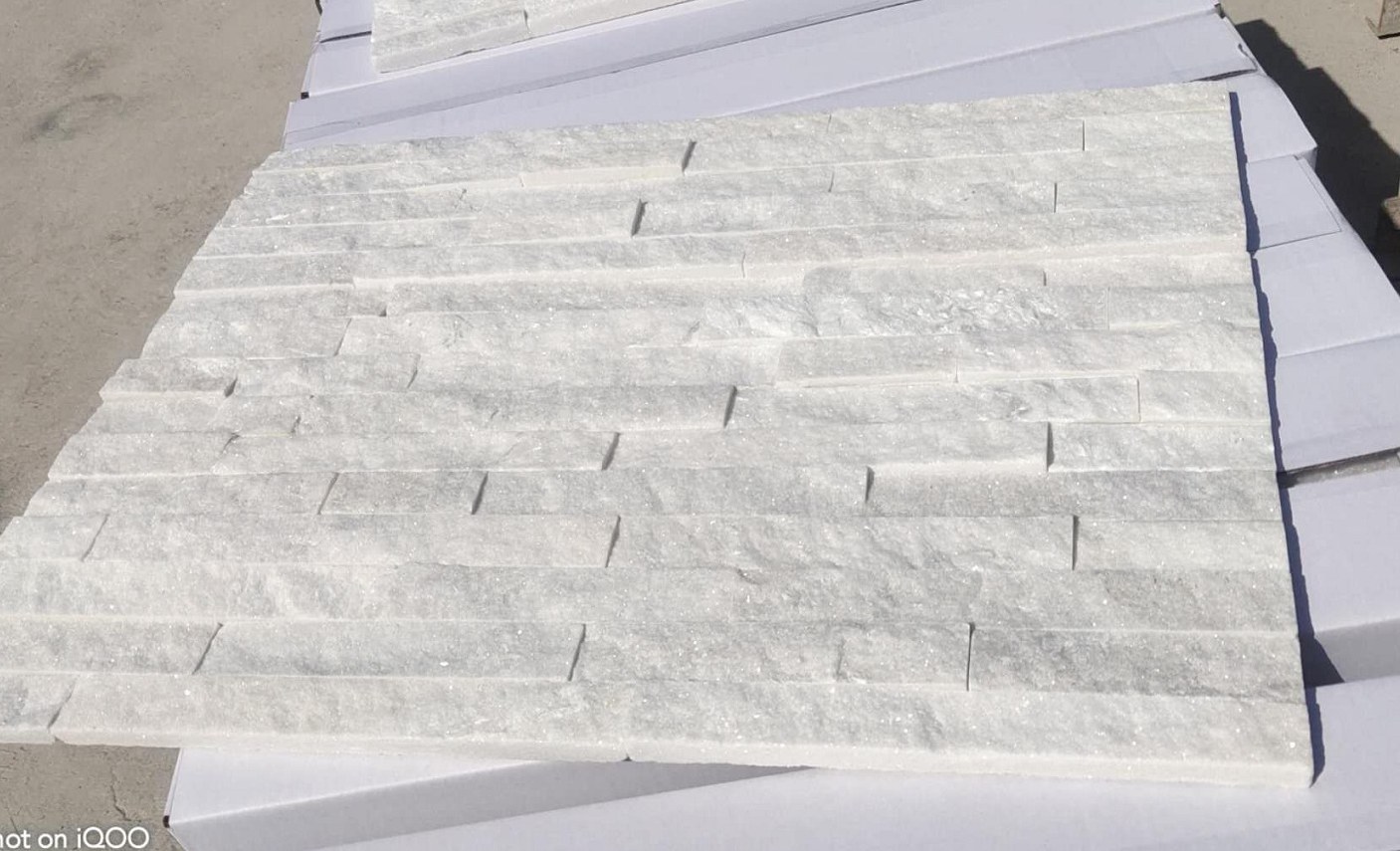
What Is Quartzite Ledgestone Veneer?
Quartzite ledgestone veneer is a natural, z-shaped panel product. 7 Mohs hardness. 6–7 lbs/sq.ft. Water absorption below 0.5%. Not manufactured stone. Not limestone.
If you are sourcing thin quartzite ledgestone weight per square foot for resale, here is the specification you need. Each panel ships at 3/4 to 1 inch thickness. Panel dimensions: 13.75 inches wide by 7.125 inches high. Weight runs 6 to 7 pounds per square foot for flats, identical for linear foot corners. That weight matters for two reasons: shipping cost per container and structural load calculations on commercial facades.
The defining differentiator is hardness. Quartzite registers a commanding 7 on the Mohs scale, whereas limestone sits at a soft 3–4, and manufactured cultured stone is softer still while absorbing 5–10% water by volume. For a distributor selling into high-traffic commercial projects — hotel lobbies, retail storefronts, multifamily common areas — that hardness delta translates directly into fewer callbacks. A 7 Mohs surface resists scratching from equipment, cart traffic, and cleaning abrasives without requiring repetitive post-installation sealing.
Here is the hidden risk competitors will not tell you: raw white quartzite blocks frequently contain subsurface iron-oxide deposits. After 6 to 12 months of environmental exposure, those hidden spots oxidize and turn into rusty yellow blotches. Industry data shows up to 35% of raw white quartzite blocks carry this defect. Most suppliers sort visually only, passing the underlying ticking time bomb directly onto your distributor margin sheet.
To eliminate this risk, Top Source Stone runs a strict dual-sort process: rigorous visual inspection plus chemical spot testing per ASTM C1670. This combination eliminates 98% of yellowing risk before the panels are packed. Furthermore, by securing spectrophotometer-based color matching, we ensure your dealer margin is protected against batch color drift from pallet to pallet, establishing a reliable pass/fail QC gate before the cargo leaves our facility.
Quartzite vs. Faux Stone vs. Limestone Ledgestone
Your exterior cladding spec lives or dies on water absorption. Quartzite at <0.5% outperforms limestone and faux stone by a factor of 10–20x. ASTM C1670 data confirms this baseline.
For a veteran distributor, the material choice for an exterior ledgestone project comes down to one number: water absorption. Everything else—color, texture, price—is secondary if the stone can’t survive freeze-thaw cycles without spalling. Here is the raw data on the three options you are evaluating for your next bulk order:
- Mohs Hardness: Quartzite: 7 | Limestone: 3–4 | Faux stone (manufactured): 3–5. Quartzite is the only option that resists scratching from environmental sand and grit in commercial high-traffic zones.
- Weight Per Square Foot: Quartzite and limestone both run 6–7 lbs/sq.ft. Faux stone is lighter at 4–5 lbs/sq.ft., but that weight savings comes with a major durability trade-off.
- Water Absorption Rates: Quartzite: <0.5% | Limestone: 5–10% | Faux stone: 5–8%. ASTM C1670 testing on Top Source Stone quartzite consistently shows 0.3–0.4% absorption. Limestone and manufactured products absorb 10–20x more water, leading to rapid freeze-thaw failure in cold climates.
- Price Baseline (FOB China): Quartzite: $6–$12/sq.ft. | Limestone: $4–$8/sq.ft. | Faux stone: $3–$6/sq.ft. The quartzite premium is balanced by risk elimination; a single failed limestone project fallback will wipe out your profit on multiple containers.
- Color Stability Risk: Quartzite carries an iron-oxide yellowing risk in unverified light shades. Limestone faces rapid etching from acid rain, while faux stone fades significantly from UV exposure within 3–5 years.
The water absorption gap is not academic. When a distributor sources limestone ledgestone for an exterior facade in a freeze-thaw climate, the stone absorbs moisture and delaminates during winter cycles. Quartzite at <0.5% absorption eliminates that risk path entirely. While competitors frequently hide their ASTM testing because their “quartzite” is actually mislabeled porous stone, Top Source Stone provides certified documentation with every bulk order.

Hidden Yellowing Risk in White Quartzite
35% of raw white quartzite blocks contain iron spots. After 6–12 months of exposure, they oxidize. You will get the return call, not the quarry.
White quartzite is geologically complex. During ancient metamorphosis, iron oxide (Fe₂O₃) particles get trapped as microscopic inclusions. In the quarry, the freshly split block looks flawlessly clean. However, after fabrication and field installation, the iron reacts with oxygen and atmospheric moisture. The result is unsightly rust-colored blotches appearing months later. For a distributor, this is a financial time bomb that triggers costly replacement claims and severe brand damage.
Most factories sort quartzite visually, which catches surface-level issues but completely misses sub-surface iron veins. That is why industry data tracks a 35% reject rate among non-tested white quartzites. To counter this, Top Source Stone utilizes a rigorous dual-sorting protocol on the production floor:
- Step 1 – Controlled Visual Audit: Every raw block is split open and evaluated under specialized high-CRI lighting to eliminate obvious iron veining.
- Step 2 – Chemical Reagent Spot Test: A specialized chemical reagent is applied to representative core samples from each block lot. If invisible iron compounds are present, the reagent triggers a distinct color change, and the entire block is immediately excluded from our premium white quartzite line.
If you are sourcing color stable white quartzite for ledgestone distributor inventory, this chemical oversight is vital. Competitors like StoneHardscapes and Canyon Stone rely on visual sorting alone, leaving you to carry the downstream liability. Demand a documented chemical iron-spot protocol before wire transfers are approved.
Batch Consistency: Why It Matters for Distributors
A 5% color drift across batches can wipe out your margin on an entire container. Here is how we prevent it and how most suppliers do not.
You already know the math: you supply a large commercial installation, order a secondary batch to finish a final wall section, and the colors fail to match. A single visible hue mismatch can force hefty discounts, material returns, and immense friction with your dealer network. The real cost isn’t the stone—it’s the secondary trucking, re-installation labor, and broken commercial trust.
The problem is widespread because traditional suppliers sort color purely by eye across fluctuating shifts. The human eye cannot accurately quantify slow hue drift across weeks of mass production. At Top Source Stone, we replace human subjectivity with digital precision. We implement a calibrated spectrophotometer to scan and verify every single production batch against an approved master reference panel.
Our Enforceable Color Uniformity Matrix Includes:
- The Target Threshold: A strict Delta E ≤2 tolerance across all production runs—the exact boundary where color shifts remain entirely invisible to the naked human eye.
- Guaranteed Uniformity: A proven 95% minimum hue consistency tracking across separate pallets within the same container shipment.
- Pallet Traceability: Every finished crate carries an individualized batch-traceable barcode label linking back to the precise spectrophotometer log and quarry stratum origin.
Glossy brochures from standard distributors don’t address these parameters. They don’t test for invisible iron deposits, nor do they track Delta E values. Their production lots can drift by 2 to 4 Delta E over a single month, guaranteeing field complaints. Treating batch consistency as an active margin protection tool is what separates an unvetted commodity from an engineered supply chain asset.

MOQ, Lead Time & Freight for Bulk Buyers
FOB China at $6–$12/sq.ft. with a 25-day production lead time. Direct single-quarry control yields a 40% time savings over standard domestic fabrication supply lines.
Let’s look at the operational data. For premium quartzite ledgestone veneer bulk wholesale orders, our factory FOB China price structure sits between $6 and $12 per square foot, depending on cut complexity and mineral grade. Our minimum order quantity (MOQ) is a accessible 1,000 square feet per color phase. Ocean freight and local port custom clearances typically add roughly $1.50 to $3.00 per square foot depending on destination port logistics. Compared against domestic fabricators wholesaling equivalent stone from $8 to $15/sq.ft., the direct factory margins yield clear double-digit cost advantages.
Lead times are where project deadlines are secured. We maintain a strict 25-to-30-day timeline from initial order confirmation to port loading at Tianjin. Because we own and control the raw extraction quarry in Yixian, Hebei, we do not suffer from the middleman slab delays that domestic US fabricators encounter. While domestic alternatives routinely stretch out to 8–12 weeks for custom architectural matching, our single-source extraction line keeps your client schedules moving safely.
Bulk Logistics and Crating Standards Overview:
- Wholesale Volume MOQ: 1,000 sq.ft. per color layer. Mixed container weight allocation is available for contract distributors.
- Fabrication Lead Times: 25–30 days for calibrated batch matching. Standard running stock colors load within 10–12 days.
- Ocean Freight Benchmarks: Standard shipping adds approx. $2.00–$2.50/sq.ft to West Coast ports (LA/Long Beach) and $1.50–$2.00/sq.ft via Gulf pathways (Houston).
- Industrial Export Packaging: Heavy-duty fumigated plywood crates equipped with high-density foam nested inserts. Every panel is isolated to prevent face scratching, achieving a proven 15% reduction in typical transport damage claims.
Installation Guide for Quartzite Ledgestone Veneer
Quartzite’s <0.5% water absorption eliminates the need for sealers—one less callback for your dealers.
To prevent installer callbacks within your distribution network, your technical team must enforce precise field application standards. Quartzite ledger installations live and die by substrate preparation and corner joinery execution.
- Adhesive Selection: Utilize standard Type S masonry mortar for normal dry interior walls. However, for all high-exposure exterior facades, commercial entryways, or heavy freeze-thaw zones, you must mandate polymer-modified thinsets or structural polyurethane adhesives. These compounds flex under thermal movement and establish a 200+ psi mechanical bond line that standard unmodified mortar cannot achieve. Never permit tile mastics on heavy vertical stone applications.
- Corner Execution: Utilizing modular Z-shaped panels is the only professional way to construct a 90-degree outside corner without revealing harsh vertical grout lines. Instruct field teams to dry-fit and pre-cut overlapping tabs to exactly 1.5 inches. Ensure the back of each corner unit receives a thorough butter coat of adhesive before it is pressed into place against the metal lath or cement board.
- Joint Tooling: If traditional joint grouting is specified, preserve a uniform joint width between 3/8 and 1/2 inch. Utilize a professional grout bag to deposit material directly into the deep channels without smearing the face of the stone. Tool the joints cleanly after 24 hours to prevent moisture pockets from settling behind the ledger matrix.
| Step | Specification | Risk Mitigation |
|---|---|---|
| Surface Preparation | Clean, dry, flat substrate. Remove dust, oil, or loose debris. Apply metal lath for non-structural surfaces. | Prevents delamination and cracking. ASTM C1780 compliant. |
| Adhesive Application | Use Type S mortar or polyurethane adhesive. Trowel notched to 1/2″ depth. Apply to both substrate and panel back. | Eliminates hollow spots. Ensures 200+ psi bond strength. |
| Panel Installation | Start from bottom corner. Interlock z-shaped edges. Stagger vertical seams by 6″ minimum. Use 3/8″ spacers. | Prevents visible seam lines. Maintains 95% color uniformity across panels. |
| Corner Fabrication | Use pre-cut 90° corner panels. Miter cut at 45° for custom angles. Apply adhesive to both mating surfaces. | Eliminates corner cracking. Maintains consistent 7 Mohs hardness at edges. |
| Grouting (Optional) | Use sanded grout for joints >1/8″. Apply with grout bag. Tool joints to 1/4″ depth. No sealing required for quartzite. | Reduces water ingress below 0.5% absorption. Eliminates callbacks for staining. |
| Curing & Inspection | Allow 48-hour cure at 50°F–90°F. Inspect for loose panels. Test bond with tap test. Document batch traceability codes. | Verifies ASTM C1670 compliance. Provides 15% reduction in freight damage claims. |
Conclusion
Quartzite ledgestone veneer offers a genuine material advantage—7 Mohs hardness and <0.5% water absorption—but the real margin killer for distributors isn’t performance. It’s the hidden yellowing in white quartzite that competitors won’t document. A supplier that publishes ASTM C1670 data and uses spectrophotometer batch matching (Delta E ≤2) eliminates the two biggest profit drains: color returns and mismatch claims.
Review the Blue Diamond Loose Ledgestone Veneer specs to see the batch-traceable labeling and chemical spot-test protocols that turn a commodity purchase into a risk-mitigation decision. Request bulk pricing and ASTM documentation before your next container order.
Frequently Asked Questions
What is the difference between stacked stone and ledgestone?
Stacked stone refers to the look of irregular, stacked layers, while ledgestone specifically describes the long, linear, ledge-like pieces used to create that look. In panel form, ledgestone is a type of stacked stone veneer. Choose ledgestone for a horizontal, linear aesthetic.
What are the disadvantages of stone veneer?
Natural stone veneer is heavy, typically 6–7 lbs/sq.ft., requiring a solid substrate and proper structural support. Color variation between batches is also a common issue, especially with natural materials, so ordering a single sample board to cover a multi-pallet project is a massive gamble. Always order full project quantity from one production batch.
What is the downside of quartzite?
The main downside is the hidden yellowing risk in white quartzite, as up to 35% of raw blocks contain iron spots that oxidize after 6–12 months of exposure. This requires pre-shipment iron-spot testing. Verify your supplier performs ASTM C1670 chemical spot testing before shipping.
What is the best stone veneer?
The best stone veneer depends on your project’s exposure and budget; quartzite ledgestone veneer is ideal for exterior cladding due to its <0.5% water absorption and 7 Mohs hardness. For interior applications with low structural budgets, manufactured faux stone veneer can suffice. Match the veneer type to your specific exposure and budget requirements.
Does ledgestone require grout?
No, ledgestone veneer panels are designed for a dry-stack installation and do not require grout between the stones. However, you must seal the seams between panels with a color-matched caulk or mortar. Use color-matched caulk at panel seams, not grout between stones.
