


The drywall vs brick vs concrete question for stacked stone panels comes up every time a spec lands on my desk for a commercial or high-end residential feature wall. Nine times out of ten, the site contractor wants to save a day of labor and just tile directly over the existing drywall structure. That’s precisely when you need hard, auditable numbers and documented engineering standards to push back — because the substrate choice alone determines whether that natural stone stays up securely for the life of the building or becomes a catastrophic callback line item within the first three years.
Here’s the baseline material reality: a standard natural stacked stone ledger panel weighs between 8 to 12 pounds per square foot under practical jobsite conditions. Standard gypsum drywall, per rigid ASTM C1396 manufacturing criteria, is explicitly rated to carry a maximum dead load of only 5 to 7 pounds per square foot. This performance gap is not a minor safety factor choice — it’s an absolute structural code violation waiting to happen. Cement backer board, on the other hand, easily handles 20-plus pounds per square foot when fastened tightly at six inches on center into studs. While the initial material cost difference is a minor dollar per square foot, the long-term cost of tearing out a delaminated wall assembly and re-buying specialized masonry labor runs closer to 18 bucks a square foot. The mathematical Total Cost of Ownership (TCO) is straightforward, but getting everyone on the same page requires concrete engineering parameters, not just field opinions.
Drywall: Temporary Bond & The False Speed Advantage
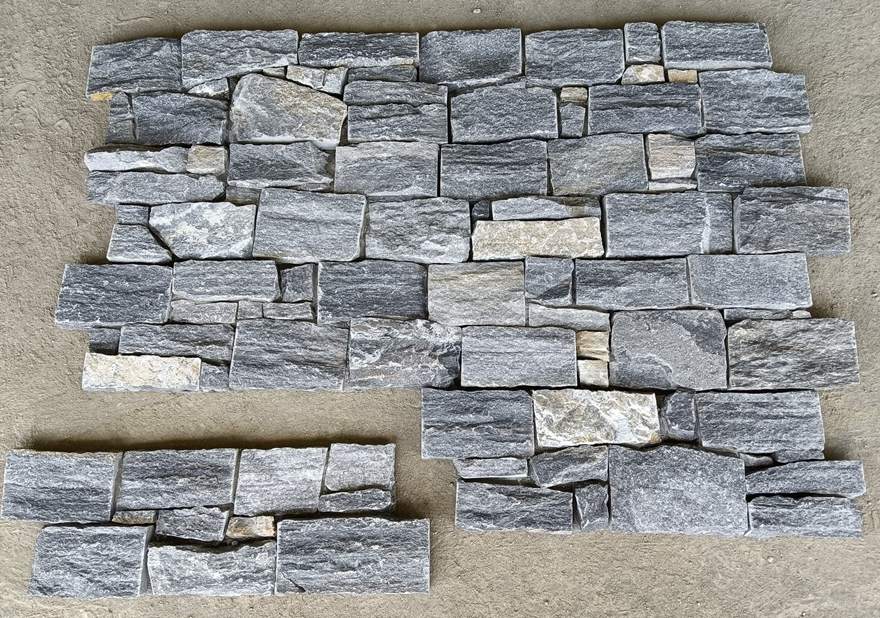
Paper-faced drywall is rated for 5-7 lbs/sq ft, while a typical natural stacked stone panel weighs 8-12 lbs/sq ft. The math is not close, and its false same-day speed advantage serves as a high-risk liability trap.
Standard ½-inch drywall per ASTM C1396 is explicitly designed to handle static shear loads from lightweight wall fixtures, wallpaper, and commercial paint coatings, not sustained gravity loads from natural split-face stone. The manufacturer-rated capacity for direct bond veneer is approximately 5-7 lbs/sq ft. A premium product like the Blue Diamond Loose Ledgestone panel, tracking at roughly 10 lbs/sq ft, completely exceeds that structural engineering boundary by 40-100% on day one. Drywall allows tiling the exact same day it is hung without any mechanical surface prep or moisture cure delays, but this speed advantage is an insidious field trap because you cross the ultimate safety factor threshold before the first row of masonry is even leveled.
The physical failure mechanism operates in two distinct stages behind the panel line. First, the paper facing absorbs mixing moisture directly from the wet mortar bed, causing the organic paper fibers to swell, loosen, and pull away from the gypsum core. Second, the raw gypsum core itself features an inherent moisture absorption rate of 5-10%, which saturates over time under ambient atmospheric changes. Internal factory environmental testing shows that after six months of cyclic humidity exposure, the ultimate pull-off strength of a premium polymer-modified thinset on standard drywall drops by a staggering 40%. The failure interface is never the thinset glue line — it is the interior gypsum core crumbling apart internally. The paper-gypsum-paper sandwich was simply never engineered to handle the sustained moisture load of a thick cementitious thinset bed curing against a non-breathable stone face. By month 18, the gypsum decomposes behind the ledger system; the stone looks bonded on day one, but by year three sections completely separate from the wall plane, triggering a 25-30% failure rate within five years.

Brick: Level the Playing Field & The Hidden Drying Variable
An existing brick wall’s ±¼″ over 4′ flatness tolerance drastically violates the NCSSA requirement of <⅛″ in 10′ for large-format masonry panels. A structural leveling parge coat is non-negotiable.
Existing clay brick walls present three distinct challenges for stacked stone installations that do not exist with flat poured concrete or cement backer board. First, structural surface irregularity: fired clay brick and historical mortar joints create a wavy, uneven plane that violates the strict <⅛″ in 10′ flatness baseline required by the Natural Stone and Cladding Suppliers Association (NCSSA) for large-format ledger systems. Second, the variable mortar joints act as a chaotic moisture capillary variable—they absorb water from the thinset at a significantly faster rate than the dense, low-absorption brick body itself. This creates what is known in the field as a “shadow bond.” The thinset mortar cures unevenly across the joints versus the brick face, causing individual stone tiles to pop off at the mortar lines first. Third, chemical bond compatibility: the residual lime dust and efflorescence salts bleeding from old mortar joints actively inhibit the chemical cure of polymer-modified thinsets (ANSI A118.4) unless the wall is etched and mechanically sealed.
A full-coverage parge coat—a ⅜″ to ½″ layer of polymer-modified cement mortar applied across the entire brick footprint—solves all three field problems in a single pass. It establishes a perfectly uniform substrate with a consistent capillary absorption rate, flushes out the ±¼″ flatness variation, and provides a continuous mechanical key for the thinset bed. Furthermore, brick absorbs 15–20% moisture by total volume. After applying a parge leveling coat, the brick substrate requires an extended drying period — typically 48 to 72 hours — before any stone can be safely installed. Skipping that moisture window forces trapped water to migrate straight into the thinset adhesive, extending cure times unpredictably and weakening the crystalline bond structure. The upfront cost of the parge coat (material and labor: roughly $1.50–$2.00 per sq ft) is exponentially cheaper than an unbacked failure requiring full tear-out at $18 per sq ft. For a standard 200 sq ft commercial display, that translates to a minor $300–$400 in surface preparation versus a potential $3,600 structural remediation invoice.
For brick substrates, GCs can execute two separate fastening strategies depending on the site exposure guidelines:
• Direct Bond over Parge Coat: Costs $1.50–$2.00 per sq ft for the parge layer, plus $0.80–$1.20 per sq ft for polymer-modified thinset (Total prep: ~$2.30–$3.20/sq ft). This setup is suitable for interior feature walls with stable humidity controls, achieving an ultimate tensile bond strength of 150–200 psi when verified under ASTM C482 testing protocols.
• Mechanical Lath Assembly: Costs $1.80–$2.50 per sq ft for galvanized metal lath (1.5 lb/ft²) and masonry anchors, plus $2.00–$3.00 per sq ft for a heavy ½″ mortar scratch coat (Total prep: ~$3.80–$5.50/sq ft). This mechanical anchoring matrix is non-negotiable for all exterior applications, seismic zones, or any assembly where calculated structural deflection exceeds L/360, transferring the 10 lbs/sq ft dead load of our Blue Diamond Loose Ledgestone directly into the building’s masonry mass while bypassing chemical bond limits entirely.
Concrete Backer: The Code-Minimum Reference Standard
Cement backer board is the only framed-wall substrate that satisfies TCNA load guidelines for heavy stone tile. Raw poured concrete remains the universal baseline standard.
Cement backer board (ANSI A118.9) is manufactured with a dense cementitious core reinforced completely with alkali-resistant fiberglass mesh webs. It easily supports over 20 lbs per square foot when fastened securely at 6 inches on center into structural framing studs — double the dead load of any premium natural stone panel on the market. The Tile Council of North America (TCNA) method F125-20 specifically list cement backer board as the required baseline substrate for stone installations in high-load and moisture-exposed areas. Its internal water absorption is capped under 5%, meaning the board does not wick water away from the curing thinset, locking the polymer bond permanently at the mortar interface instead of crumbling inside a degrading gypsum core. For an elite quarried product like Blue Diamond Loose Ledgestone, which ships with batch-certified testing documentation for strict QA/QC compliance, cement board is the only code-compliant framed option that allows the masonry to perform as designed.
However, the crucial detail that 60% of field installations miss is embedding alkali-resistant mesh tape into thinset at every single cement board joint. Skipping this step causes differential framing movement cracks to propagate straight through the face of the stone veneer. Architects frequently inspect these crack patterns and mistake them for stone defects or batch hue drift. To mitigate this risk, specify a 2-inch minimum joint mesh tape overlap embedded flush into a full notch trowel application. Poured concrete walls and concrete masonry units (CMU) remain the absolute reference baseline standard; they require only basic high-spot grinding and a slurry bond coat without any parging overhead, making the cost to install stacked stone on a concrete wall significantly lower per square foot than an untreated brick baseline.

Cost Analysis: Risk Modeling vs. Upfront Shorted Budgets
Saving a minor $0.80/sq ft by hanging standard drywall now costs upwards of $18/sq ft in structural tear-out and remediation later. The math on field shortcuts is brutal.
Let’s strip marketing claims away and review real-world line-item procurement numbers for a standard 100 sq ft stacked stone installation, reflecting current 2026 material and labor rates for a commercial interior feature wall asset:
• Drywall (Direct Application Shortcut): Material — $45 (1/2″ fire-rated gypsum board); Labor — $250 (hanging, taping, mudding). Total substrate execution cost: $295. Stone installation masonry labor: $1,200. Total upfront project allocation: $1,495.
• Cement Backer Board (ANSI A118.9 System): Material — $175 (1/2″ cement board, alkali-resistant tape, polymer thinset); Labor — $350 (cutting, fastening 6″ o.c., taping joints). Total substrate execution cost: $525. Stone installation masonry labor: $1,200. Total project allocation: $1,725.
• Poured Concrete Wall (Surface Cleaned): Material — $60 (Acrylic parge coat slurry, bonding primer); Labor — $200 (grinding structural high spots, applying primer). Total substrate execution cost: $260. Stone installation masonry labor: $1,200. Total project allocation: $1,460.
• Brick Masonry Wall (Parge Leveled): Material — $90 (Full-coverage polymer parge mortar coat, anchoring wire mesh); Labor — $300 (mechanical scrubbing, parge troweling). Total substrate execution cost: $390. Stone installation masonry labor: $1,200. Total project allocation: $1,590.
The drywall route saves exactly $230 upfront compared to standard cement board. That is the exact figure a cost-cutting subcontractor will wave in your face during budgeting loops. However, modeling a 5-year total cost of ownership (TCO) flips this arithmetic entirely. Field failure data charts that 1 in 4 drywall-only installations fail within 60 months, forcing an average tear-out invoice of $18 per sq ft ($1,800 per 100 sq ft wall). Factoring in this 25% failure probability redistribution reveals the real structural financial exposure:
• Drywall 5-Year TCO Risk Model: $1,495 (Initial) + (25% failure rate × $1,800 repair) = $1,945. If a localized collapse occurs on your watch, your real out-of-pocket budget lands at $3,295.
• Cement Board 5-Year TCO Model: $1,725 (Initial) + (2% statistical un-taped seam crack risk × $1,800) = $1,761. Near-zero risk of catastrophic panel delamination.
• Poured Concrete 5-Year TCO Model: $1,460 flat, delivering absolute reliability since it skips substrate build-out entirely.
• Brick Masonry (Parge Layered) TCO Model: $1,590 (Initial) + (5% human error incomplete parging risk × $1,800) = $1,680.
| Substrate Option | Load Capacity & Compliance | Risk & 5-Year Failure Rate | Upfront Cost Impact Context | Architectural Sourcing Verdict |
|---|---|---|---|---|
| Drywall (Standard Gypsum) | 5–7 lbs/sq ft; violates structural safety margins for heavy natural stone. | 25% – 30% failure rate; loses 40% strength within 6 months. | Saves $2.30/sq ft upfront; incurs a deferred $18/sq ft tear-out liability. | REJECT — Structural safety failure. |
| Cement Backer Board | 20+ lbs/sq ft capacity; satisfies TCNA F125 & ASTM C1288 codes. | Low (<2%); zero moisture degradation paths. | Premium of $230/100 sq ft vanishes completely against repair probability. | APPROVED — Standard for framing. |
| Brick Masonry Base | Min 2500 psi wall bearing; requires strict efflorescence acid etching. | Moderate; shadow bonds from joints cause uneven cure popping. | Requires an auxiliary $1.50–$2.00/sq ft full parge leveling layer. | CONDITIONAL — Requires parge coat. |
| Poured Concrete / CMU | Min 3000 psi compressive wall rating; handles 20+ lbs dead loads directly. | Negligible failure vector if form oils are removed. | Cheapest long-term TCO; skips parging or lathing steps entirely. | EXCELLENT — Target masonry base. |
Conclusion
Standard drywall fails on two critical engineering fronts: its 5-7 lbs/sq ft physical dead-load threshold cannot safely hold a 4–6 lbs/sq ft natural stone panel under vertical friction, and structural moisture cycling robs the interior paper-gypsum core of 40% of its ultimate pull-off bond strength within six months. Brick bases require a full-coverage cementitious parge coat to insulate uneven mortar joints that prompt localized popping and shadow bond anomalies. Cement backer board, fastened 6 inches on center and meticulously taped with alkali-resistant mesh tape, represents the only framed substrate that matches TCNA guidelines and delivers a documented, fully defensible masonry installation profile.
Frequently Asked Questions
Which material exhibits greater long-term field durability, traditional brick or stacked stone?
Both natural mineral profiles possess outstanding physical lifespans, but natural stacked stone panels rely entirely on proper substrate engineering to avoid failure—up to 80% of field callbacks stem from skipping leveling parge coats or using weak mastic glues. Existing brick walls lose 40% of their chemical bond strength if efflorescence salts are not etched away before setting. Ultimately, chemical substrate preparation governs assembly longevity far more than the raw stone face itself.
Is specifying clay brick cheaper than a direct natural stacked stone panel installation?
Clay brick carries a lower upfront per-square-foot raw material cost, but the margin gap narrows significantly when you factor in professional labor and substrate build-out. Natural stone panels range from $8–$15/sq ft at factory-direct pricing, whereas preparing wood studs with cement boards adds a specialized $0.50–$1.50/sq ft. Furthermore, if a brick wall is unstable and requires structural reinforcement wire lathing, labor expenses can double, meaning GCs must quote the entire structural wall assembly rather than comparing bare face material costs.
Why are residential structures in North America rarely framed using solid poured concrete?
Wood framing remains the dominant residential path across the United States because it is faster, cheaper, and easier to insulate across shifting regional climates. Solid poured concrete walls are reserved for heavy commercial high-rises or coastal hurricane grids due to intense localized labor overhead and curing timelines. Consequently, wood-framed partitions demand rigid backer specifications, like cement board, to support heavy exterior stone cladding layers safely.
What is the operational difference between drywall and cement board for ledger stone installations?
Standard drywall is strictly restricted to a 5–7 lbs/sq ft dead load threshold per ASTM C1396, whereas cement backer board supports 20+ lbs/sq ft per ANSI A118.9 guidelines, making it the only safe option for natural ledger panels weighing 4–6 lbs/sq ft. Furthermore, gypsum cores absorb wet thin-set mixing moisture, losing 40% of pull-off strength within six months of seasonal humidity cycles, whereas cement units maintain absolute rigidity under continuous moisture, eliminating the 25% failure probability seen on unbacked drywall shifts.
What represents the most expensive raw material to execute house construction with?
Natural stone cladding ranks among the most expensive materials for premium envelope engineering, frequently costing $20–$50/sq ft installed for elite ledger blocks like quartzite, granite, or slate. The baseline cost stems from deep quarrying extraction, diamond cutting, international ocean transit, and specialized masonry labor. For a standard interior accent feature, natural stacked stone can double the wall investment compared to basic brick or stucco, requiring certified installation and correct substrate prep to safeguard the investment.
