


Sourcing Slate Ledger Panels requires precise technical control to prevent the margin-eroding costs of project delamination and color rejection. While secondary market stones often vary in density, high-grade metamorphic slate ensures the structural integrity necessary to avoid expensive warranty claims and dissatisfied contractors.
We stabilize supply chains through same-batch quarry sourcing and S1-rated water absorption to guarantee 95% hue uniformity. By leveraging HS Code 6803.00.90 and direct factory logistics, we provide wholesalers with ASTM-compliant inventory that lowers landed costs and maximizes long-term profit protection.
Why Slate is Regarded as the Global Benchmark for Stacked Stone?
Slate defines the standard for interior ledger panels through exceptional thermal stability, a lightweight 8-12 lbs/sq.ft profile, and a natural split-face texture that minimizes maintenance.
Inherent Thermal Stability and Lightweight Versatility
Slate holds its position as the preferred material for interior feature walls and fireplace surrounds because it handles heat better than most natural alternatives. Its metamorphic composition allows it to withstand high temperatures without cracking, making it a reliable safety layer for indoor heat-sensitive zones.
- Hardness: Mohs 3-4 (Provides impact resistance while remaining easy to cut and shape with standard diamond blades).
- Weight Profile: 8-12 lbs/sq.ft (Allows installation on standard substrates without expensive structural reinforcement).
- Fire Resistance: Class A non-combustible material (Ideal for residential and commercial fireplace cladding).
- HS Code: 6803.00.90 (Specific tax avoidance/clearance classification for international importers).
Same-Batch Quarry Consistency and Low-Maintenance Finishes
For large-scale commercial distributors, visual uniformity across thousands of square feet is the primary challenge. Top Source Stone solves this by sourcing raw material from the same quarry vein per order. This process ensures that large architectural surfaces maintain a professional, cohesive look rather than a patchy, disjointed appearance.
The natural matte texture of slate offers a practical advantage in high-traffic environments like hotel lobbies or office corridors. Unlike polished stone, slate’s split-face surface effectively hides dust, fingerprints, and minor scuffs, which drastically reduces the long-term cleaning overhead for facility managers.
- Hue Uniformity: 95% consistency achieved through same-batch quarry sourcing.
- Surface Integrity: High-density mineral layers prevent the fading often seen in manufactured “faux” stone products.
- UV Stability: 100% natural minerals ensure the stone maintains color depth even in areas with significant sunlight exposure.

Exploring Color Variations: Black, Rusty, Gray, and California Gold
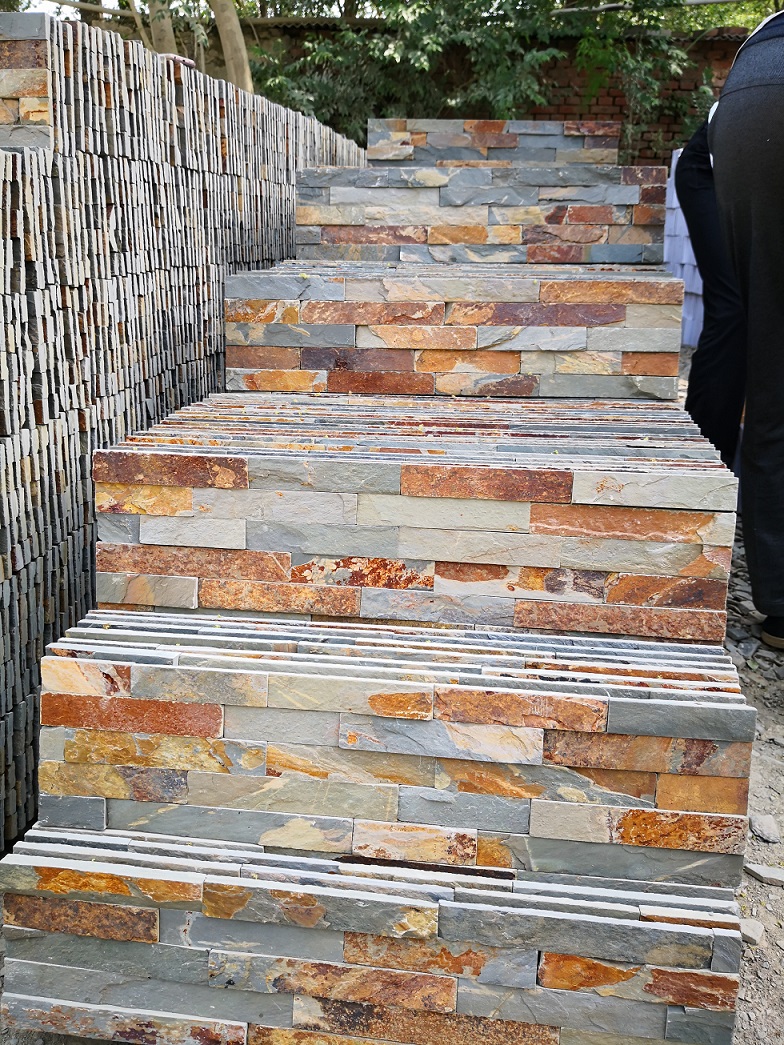
Slate ledger panels range from deep Carbon Black to warm California Gold, utilizing same-batch quarry sourcing to ensure 95% hue uniformity for architectural consistency.
Visual Characteristics of Monochromatic and Neutral Slate Variations
Designers often choose monochromatic slate to anchor modern commercial spaces. These stones provide a stable visual foundation that doesn’t compete with other architectural elements while offering the depth only natural minerals can provide.
- Carbon Black / Midnight Slate Stacked Stone : Features a deep, matte finish. This stone creates high-contrast feature walls and remains color-stable under intense UV exposure.
- Alaska Gray Stacked Stone: A cool-toned option with natural cleft textures. It fits industrial and minimalist designs better than synthetic alternatives.
- Charcoal Slate Stacked Stone: Provides a sophisticated dark gray palette with rough, textured finishes that add significant dimension to vertical surfaces.
The natural mineral composition of these stones prevents the fading common in manufactured “faux” stone. We use CNC diamond-blade edges to ensure these panels fit tightly, hiding the substrate and creating a seamless aesthetic.

Leveraging Same-Batch Quarry Consistency for Multicolored Projects
High-variation colors like Rusty and California Gold present a challenge for large-scale installations. Without strict source control, a project can end up looking patchy or disjointed once the various crates are opened on-site.
We solve this by sourcing material from the same quarry vein per order. This direct quarry source control allows us to maintain the 95% hue uniformity required for high-end distribution and professional architectural work.
- California Gold Stacked Stone: Mixes warm golds, browns, and grays. It is a staple for outdoor kitchens and garden walls where a natural, earthy look is required.
- Copper Canyon Stacked Stone: Features rich rusty oranges and earthy browns, ideal for traditional landscape projects and rustic fireplace surrounds.
- Hue Uniformity: Each batch maintains consistent color shifts, preventing the “checkered” effect caused by mixing different quarry layers.
By controlling the supply chain from the mountain to the crate, we ensure that even the most vibrant multicolored panels arrive with a predictable, professional finish. Dealers receive product that installs faster and looks exactly like the samples provided to their clients.
Premium Natural Stone Panels for Professionals
Is Slate Cladding Durable Enough for High-Freeze Exterior Environments?
High-grade slate is exceptionally durable for freeze-prone regions. Its metamorphic density prevents water absorption and expansion, ensuring structural integrity through repeated sub-zero winter cycles.
Exterior facades in Northern climates face a brutal cycle of freezing and thawing that can shatter lesser materials. While many contractors worry about stone cracking, high-quality slate panels like our Carbon Black or Midnight Slate series offer a natural defense that porous stones cannot match.
Low Water Absorption and Moisture Defense
The primary cause of stone failure in winter is water infiltration. When moisture enters the pores of a material and freezes, it expands by roughly 9%, creating internal pressure that leads to spalling. Slate’s metamorphic composition effectively blocks this process at the mineral level.
- S1-Rated Absorption: High-grade slate absorbs less than 0.0025% of its weight, making it virtually impervious to water.
- Internal Pressure Prevention: Because water cannot penetrate the surface, there is no internal ice expansion to force the stone layers apart.
- Metamorphic Density: This rock structure provides higher structural integrity than sedimentary alternatives like sandstone.
- Natural Cleft Surface: The split-face texture helps snow and ice slide off the facade, reducing the risk of ice damming.
ASTM Standard Freeze-Thaw Resistant Engineering
At Top Source Stone, we engineer our ledger panels to survive the extreme temperature shifts found in the US and Canada. We focus on technical consistency so that every panel on a project reacts to thermal stress in the same way, preventing the buckling often seen in mixed-source materials.
- ASTM Standards: Our panels meet rigorous freeze-thaw resistance metrics to guarantee no cracking or delamination.
- Same-Batch Quarry Consistency: We source from the same quarry vein to ensure a uniform thermal expansion coefficient across the entire wall.
- UV Stability: 100% natural minerals maintain their color and structural form despite hundreds of rapid temperature fluctuations.
- Pre-fabricated L-corners: These specialized pieces protect wall transitions where moisture typically gathers and freezes in traditional masonry.
By choosing high-density slate over manufactured imitations, dealers provide their clients with a material that actually lasts the lifetime of the building. The structural density of natural slate ensures it remains a stable, low-maintenance choice for even the most aggressive winter environments.

The Financial ROI of Sourcing Slate Directly from China Factories
Direct China factory sourcing cuts 15-40% of manufacturing costs by removing middlemen, while integrated clusters and B2B-only logistics protect wholesale margins for global dealers.
| Performance Metric | Direct Factory Standard | B2B Financial Impact |
|---|---|---|
| Manufacturing Cost | Ex-Factory (Direct Quarry) | 15-40% reduction in markup fees |
| Container Capacity | 750 – 860 m² (Standard Panels) | Lowest per-unit landed cost |
| Logistics Load | 25 – 30 Pallets per 20GP | Maximized weight/volume efficiency |
| Export HS Code | Slate: 6803.00.90 | Correct tax/clearance classification |
Direct Sourcing Economics and Supply Chain Cost Compression
Middlemen and trading companies often add 15-40% to the final price without improving the stone quality. Moving to a direct factory model removes these markups and service fees, placing that margin back into the buyer’s balance sheet. By controlling the supply chain from the mountain to the crate, we eliminate the hidden costs typical of indirect procurement.
- Integrated Clusters: Our facilities in Jiangxi and Fujian lower internal transportation costs by operating within specialized industrial hubs.
- Industrial Automation: High-level robotics and CNC diamond-blade cutting improve production speed and maintain competitive pricing in the 2026 market.
- Quarry-Level Scaling: Buying raw materials at the source allows us to lower costs for high-volume B2B orders while maintaining 95% hue uniformity.
- Labor Efficiency: Competitive pricing is maintained through high skill levels and automated precision, offsetting rising global labor trends.
B2B Profit Protection and Logistics Optimization Specs
Financial ROI isn’t just about the purchase price; it is about protecting the local market and optimizing the shipment. We exclusively serve the B2B sector, which means we never compete with our own clients in the retail space. This commitment safeguards the margins and territory of our dealers and wholesalers.
- Profit Protection Policy: Top Source Stone strictly refuses direct-to-consumer sales to ensure our dealers maintain total market control.
- Container Maximization: Logistics teams fit 750-860 square meters of standard panels into a single 20GP container to lower the landed cost per square foot.
- Visual Verification: We provide high-definition photos and videos of finished crates before the 70% balance payment, reducing the risk of quality disputes.
- Reinforced Packaging: Every order uses 5-ply reinforced export-grade cartons and fumigation-free plywood crates to prevent transit damage.

Professional Techniques for Precision Cutting and Installing Slate Panels
Precision cutting requires wet saws with continuous diamond blades. Factory Z-shape panels with CNC edges ensure a seamless interlock, hiding joints and reducing on-site labor.
Wet Saw Calibration and Natural Stone Handling
Natural slate possesses a layered metamorphic structure that requires specific mechanical handling to avoid delamination. Because standard panels weigh 30-40kg/m², installers must utilize a fully supported, level work surface to prevent structural stress cracks during deep longitudinal cuts. Stable handling ensures the integrity of the natural cleft surface throughout the installation process.
- Blade Selection: Use only continuous rim diamond blades paired with constant water flow to suppress dust and prevent the slate from flaking or splitting.
- Weight Support: Secure panels weighing 30-40kg/m² (8-12 lbs/sq.ft) on industrial-grade work surfaces to ensure the material remains level during the cut.
- Scoring Technique: Score the back of the slate panel before completing the full pass to protect the face from edge chipping.
CNC Diamond-Blade Precision and Z-Shape Interlocking
Factory-engineered panels eliminate the guesswork associated with traditional dry-stacking. By applying CNC diamond-blade precision to the edges, we achieve a 95% uniformity rate across batch orders. This technical consistency allows for tight, modular fitting that effectively hides the installation substrate and provides a professional finish without excessive manual adjustment.
- Interlocking System: Apply Z-shape or S-shape panels to utilize the “male-female” connection system, which camouflages vertical joints.
- Edge Alignment: Precision-cut edges eliminate visible “stepped” gaps between panels, ensuring a tight architectural fit.
- Corner Solutions: Integrate pre-fabricated 90-degree L-corners to maintain texture and color synchronization at wall transitions, removing the need for complex on-site miter cuts.
Frequently Asked Questions
Is natural slate suitable for exterior wall cladding in 2026?
Natural slate remains a top choice for exterior applications because of its inherent weather resistance and low maintenance requirements. It provides a non-combustible, water-resistant barrier that protects the building envelope from UV exposure and heavy rain. While initial costs are higher than manufactured alternatives, its long-term durability and energy-efficient thermal properties offer better value over the lifespan of the property.
Does natural slate stacked stone fade over time with sun exposure?
Natural slate is highly resistant to fading because its color is part of its geological makeup rather than an applied pigment. While manufactured stone veneers often show noticeable color loss within 8 to 10 years, natural slate maintains its structural and aesthetic integrity for 20 years or more. This UV stability makes it ideal for harsh sun environments and coastal regions with high salt spray.
What causes slate stone to flake or delaminate, and how can it be prevented?
Flaking, or spalling, is usually caused by moisture penetration and freeze-thaw cycles where expanding ice forces the stone layers apart. Salt ingress and poor ventilation behind the panels also contribute to surface degradation. To prevent this, install proper moisture barriers and use high-quality sealants once the stone is completely dry to block water absorption.
How much should I budget for slate ledger panels in large-scale projects?
Prices generally range from $5.75 to $35.94 per square foot depending on the specific finish, such as natural cleft or split-face. Sourcing directly from a quarry factory helps reduce costs for B2B buyers. Budgeting should also account for matching L-corners and reinforced export-grade packaging to ensure the material arrives without breakage during international transit.
Is slate as durable as quartzite for high-traffic or exterior walls?
Quartzite is technically harder, with a Mohs scale rating of 6-7 compared to slate’s 3-4, making quartzite more resistant to heavy abrasion and chips. Slate is preferred for its superior heat resistance and specific aesthetic textures. For 2026 architectural standards, quartzite is often chosen for extreme freeze-thaw environments, while slate is the benchmark for fireproof wall features.
What is the advantage of Z-shape interlocking slate panels?
The Z-shape interlocking system utilizes a male-female connection designed to camouflage vertical joints. CNC diamond-blade precision ensures that modular pieces fit tightly together, creating a seamless architectural finish that hides the installation substrate. This system significantly reduces labor time compared to traditional dry-stack methods.
