


Commercial entryways require materials that resist environmental fatigue to prevent the high costs of facade failure and aesthetic degradation. Using inconsistent stone batches creates patchy walls that ruin luxury branding and increase long-term maintenance liabilities for property owners.
Our manufacturing standard ensures 95% hue uniformity by sourcing from the same quarry vein per order. We leverage CNC diamond-blade cutting and ASTM-certified freeze-thaw resistance to provide a non-combustible, Class A finish that protects both architectural integrity and project budgets.
First Impressions: Why Do Luxury Hotels Specify Natural Stacked Stone?
Luxury hotels use natural stone to project permanence and quality. Same-batch quarrying and precision-cut seams eliminate the unsightly installation gaps that ruin high-end hospitality aesthetics.
Establishing Architectural Grandeur Through Authentic Mineral Texture
Lobbies and reception areas serve as the primary physical touchpoint for guests. Natural stone creates an immediate sense of grandeur that signals quality before the first interaction. While synthetic materials often look repetitive, natural marble, quartzite, and slate offer unique veining and mineral depth that signals authenticity.
Earthy tones from quartzite and granite provide a grounded, welcoming atmosphere in high-traffic zones. The dimensional surface of stacked stone creates shadows and depth that turn simple transitional entryways into architectural focal points.
Achieving Visual Seamlessness with Same-Batch Quarry Consistency
High-end hospitality aesthetics fail if the wall looks patchy or disconnected. Top Source Stone solves this by sourcing material from the same quarry vein for every commercial order. This ensures 95% hue uniformity across large-scale surfaces, which is critical for massive 2026 hospitality projects.
Precision manufacturing defines the final professional finish. CNC diamond-blade cutting allows for tighter tolerances and cleaner lines than manual sorting. This engineering approach ensures that the modular panels fit tightly, hiding the installation substrate completely.
- Hue Uniformity: We maintain 95% consistency by pulling from the same quarry vein per batch.
- Interlocking Design: Z-shape and S-shape panels utilize a male-female connection system to camouflage vertical joints.
- Edge Precision: CNC diamond-blade edges eliminate the “stepped” gaps often found in lower-grade stone.
- Corner Solutions: Matching pre-fabricated L-corners ensure color and texture synchronization at 90-degree wall transitions.
By focusing on these technical standards, designers achieve a wall that looks like a custom-carved installation rather than a series of individual panels. This level of detail is exactly what separates luxury boutique environments from standard commercial builds.

Durability Requirements for High-Traffic Commercial Building Entrances.
Commercial entryways require ASTM-certified natural stone to resist de-icing salts and weather cycles, ensuring structural integrity and fade-resistance without the high maintenance costs of faux alternatives.
Managing Environmental Stress and Traffic Fatigue
Commercial entry zones face a brutal mix of mechanical vibration and chemical exposure. Traditional cladding often fails in these high-volume areas because de-icing salts penetrate the surface, causing internal corrosion and eventual finish failure. Architects prioritize materials that can withstand these stressors without requiring frequent replacement.
- Low-Porosity Selection: We specify high-density stone to mitigate water infiltration, which prevents the damage caused by seasonal expansion and contraction.
- Chemical Resilience: Natural stone surfaces resist the corrosive effects of de-icing salts better than synthetic or painted “faux” alternatives.
- Substrate Integrity: Integrated drainage systems and moisture-resistant substrates are essential at the wall base to prevent localized structural weakening.
Implementing ASTM Freeze-Thaw and Salinity Resistance
Durability for commercial projects relies on verifiable benchmarks. For upcoming winter cycles, building envelopes must maintain structural stability through extreme temperature fluctuations. Top Source Stone provides factory-direct materials engineered to meet these specific architectural demands.
- ASTM Standards: Our stacked stone panels meet ASTM freeze-thaw requirements, guaranteeing the stone won’t delaminate or crack during rapid temperature shifts.
- Environmental Adaptability: Natural quartzite and slate offer high salinity and humidity resistance, making them suitable for coastal regions and high-moisture lobbies.
- UV Stability: Because we use 100% natural minerals, our panels offer permanent color consistency. The stone does not fade under direct sun exposure, regardless of the intensity.
- Precision Engineering: We use CNC diamond-blade cutting to ensure a tight, seamless fit that protects the installation substrate from the elements.
By sourcing from the same quarry vein per order, we ensure that the physical properties—not just the color—remain consistent across large-scale commercial facades. This uniformity is critical for maintaining the structural load-bearing expectations of high-traffic entryways.
Premium Ledger Panels for High-Margin Projects
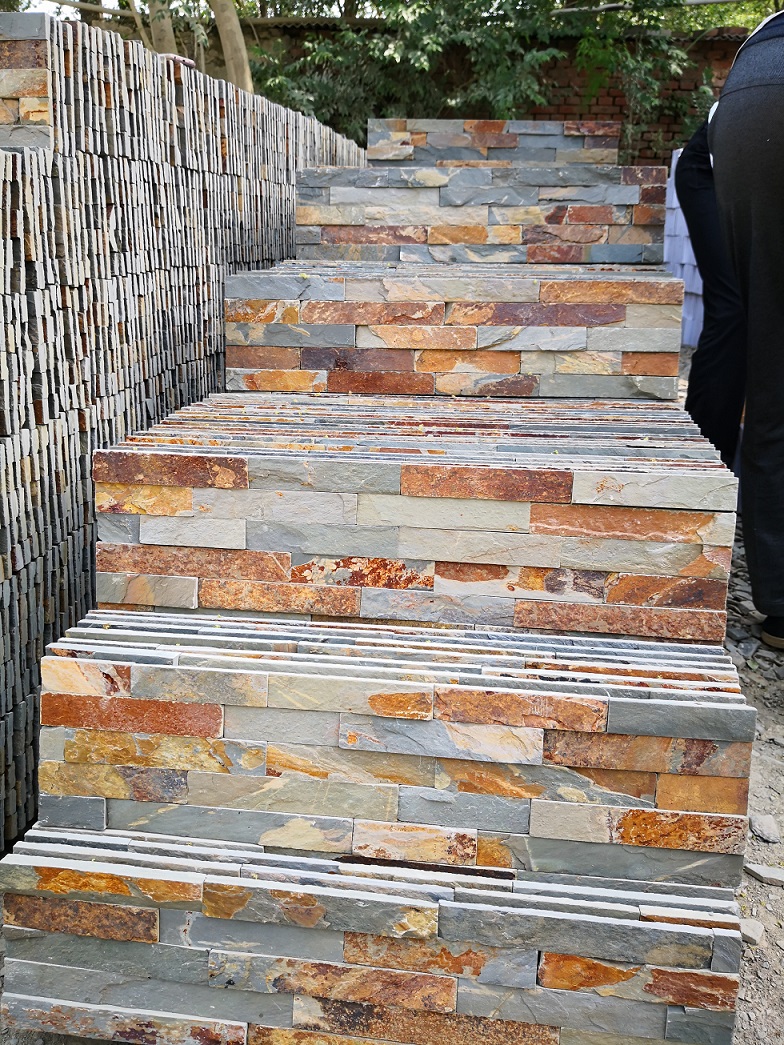
Acoustic Benefits: How Does Stone Texture Diffuse Sound in Large Lobbies?
Textured stone diffuses sound waves by scattering them across irregular surfaces, effectively reducing echoes and reverberation in high-volume commercial lobbies.
Natural stone textures improve lobby acoustics through diffusion. Polished surfaces like marble act as acoustic mirrors, reflecting sound in sharp, directional patterns that amplify noise. Stone with a natural cleft or split-face finish features irregular geometry that scatters sound waves in multiple directions. This process breaks up concentrated echoes and reduces reverberation, making large commercial spaces feel quieter and more professional.
Surface Irregularity and the Physics of Sound Diffusion
Acoustic performance depends on surface variation. When sound hits a flat, hard wall, it bounces back with nearly equal intensity. Textured stone utilizes physical depth to disrupt this path, converting a single loud reflection into many smaller, weaker reflections.
- Wave Disruption: Irregular geometry on split-face and natural cleft surfaces scatters sound energy across a wider area.
- Mirror Effect Mitigation: Textured finishes prevent the direct reflection path common in polished granite or marble.
- Echo Control: Uneven stone surfaces reduce flutter echo, a frequent issue in lobbies with parallel walls.
- Ambient Comfort: Scattering sound into softer tones helps maintain private conversation levels in high-traffic reception areas.
Acoustic Performance of High-Mass Rough Series Panels
Material density and panel thickness dictate how well a wall manages sound vibration. Dense minerals like Quartzite and Slate reflect approximately 98% of sound, making the surface texture the primary factor in controlling reverberation. Our engineering focus on panel depth enhances this diffusion effect.
- Surface Depth: The Top Source Stone Rough Series features thickness variations up to 3.5cm, providing the depth necessary for effective wave disruption.
- Vibration Damping: Panels with a weight of 55kg/m² offer superior sound isolation compared to lightweight faux alternatives.
- Z-Shape Interlocking: Precision-cut interlocking designs create a continuous textured surface that eliminates flat gaps where sound reflects cleanly.
- Material Integrity: High-density natural stone maintains its acoustic properties without the resonance issues found in hollow-backed synthetic panels.

Maintenance Budgets: Comparing Real Stone vs. Periodic Faux Stone Repair
Natural stone offers a lower total cost of ownership by 2026. While faux stone saves upfront, its 20-year lifespan and repair needs drive cumulative expenses higher than natural materials.
Lifecycle Cost Analysis of Natural vs. Manufactured Veneers
Natural stone maintenance follows a predictable, preventive schedule. Most commercial facilities only need a simple pH-neutral cleaning routine and a professional seal every one to three years. This maintains the stone’s luster without requiring structural interventions or aesthetic “patching.”
Faux stone budgets are often reactive. Since manufactured stone uses surface-level pigments on a concrete core, any impact or chip reveals the gray cement underneath. These repairs are highly visible and difficult to match, often forcing managers into premature wall replacements to maintain the building’s professional appearance.
- Preventive Care: Simple pH-neutral cleaning keeps natural stone intact for decades.
- Repair Liability: Faux stone chips reveal concrete cores, necessitating frequent, costly cosmetic repairs.
- Traffic Resistance: Natural thin stone veneers handle high-traffic friction without losing their texture or integrity.
- Longevity: Real stone eliminates the total facility reinvestment costs that occur when manufactured products fail after 20 years.
UV Stability and Freeze-Thaw Resistance in Natural Quartzite
Top Source Stone provides 100% natural minerals that carry inherent UV stability. Unlike pigmented manufactured products that fade after a few seasons of sun exposure, natural stone retains its original hue. This stability protects the long-term value of the architectural investment.
For commercial properties in northern climates, ASTM-standard freeze-thaw resistance is a budget protector. Natural stone panels do not crack or delaminate during extreme seasonal temperature shifts. This structural stability reduces the risk of emergency repairs and moisture-related damage to the building envelope.
- Same-Batch Consistency: We source from the same quarry vein to ensure any spot additions match the existing wall perfectly, even years later.
- Moisture Performance: High salinity and humidity resistance make natural stone ideal for coastal entries without the risk of efflorescence.
- Precision Engineering: CNC diamond-blade edges create a tight interlock that minimizes moisture penetration points.
- Chemical Stability: Natural minerals do not react with de-icing salts that typically corrode the finishes of manufactured alternatives.
Choosing natural stone allows wholesalers and developers to offer a “set it and forget it” solution. While faux stone looks similar in a showroom, the real-world operational costs of concrete-based products quickly erode any initial savings. Real stone remains the only choice for projects prioritizing permanence over temporary aesthetics.

Complying with Commercial Building and Fire Safety Codes for Public Spaces
Natural stacked stone simplifies 2026 fire code compliance. Slate and quartzite provide inherently non-combustible Class A finishes for commercial lobbies without toxic smoke risks or structural degradation.
| Compliance Factor | Natural Stacked Stone (Top Source Stone) | Faux/Manufactured Stone |
|---|---|---|
| Fire Rating (IBC/NFPA 101) | Class A (Non-combustible) | Varies (Often requires additives) |
| Resin & Polymer Content | 0% (Pure Minerals) | Significant (Combustible binders) |
| Toxic Smoke Emission | None | Potential for toxic off-gassing |
| Structural Integrity at Heat | High (Heat-stable) | Low (Prone to cracking/melting) |
Adhering to NFPA 101 and International Building Code Standards
Commercial entryways must utilize Class A fire-rated materials for wall finishes to satisfy NFPA 101 Life Safety Code requirements. Regulations for 2026 mandate that high-occupancy structures over 5,000 square feet maintain unobstructed egress paths with fire-resistant surfaces. Natural stone wall cladding supports fire suppression efforts by failing to contribute fuel to internal building fires. Local fire departments require formal material documentation to verify smoke development and flame spread indices during annual inspections.
- Standard Compliance: IBC Section 803 interior wall and ceiling finishes.
- Life Safety: NFPA 101 requirements for emergency exit paths and high-traffic corridors.
- Fire Suppression: Non-combustible surfaces prevent the “chimney effect” in vertical structures.
- Verification: ASTM E119 and ASTM E84 testing documentation for flame spread and smoke density.
Non-Combustible Performance of Natural Quartzite and Slate Panels
Top Source Stone utilizes 100% natural minerals including slate and quartzite, which are naturally non-combustible and heat-stable. Our panels contain zero artificial resins or polymers, ensuring no toxic fumes or thick smoke release during extreme temperature exposure. Natural stone panels remain structurally sound in high-heat zones, making them suitable for commercial fireplace surrounds and elevator lobbies. ASTM-tested durability ensures that the stone provides a permanent fire-safe barrier that does not degrade or lose integrity over time.
- Material Purity: 100% natural slate, quartzite, and granite with no petroleum-based binders.
- Smoke Index: Zero smoke development rating under high-intensity heat.
- Application Zones: Ideal for elevator lobbies, commercial kitchens, and fireplace feature walls.
- Longevity: Permanent fire barrier performance that withstands decades of building inspections.
Frequently Asked Questions
Which natural stone is best for high-traffic commercial lobbies?
Granite and quartzite are the most practical choices for busy entryways. Granite offers high scratch resistance and an absorption rate below 0.4%, while quartzite provides a luxury marble aesthetic with superior mineral hardness and stain resistance.
Why do architects prefer real stacked stone over manufactured faux panels?
Real stone provides UV stability that prevents fading, whereas cement-based faux stone often loses color after several seasons. Natural stone also offers unique textures and color consistency throughout the material, so chips or scratches remain nearly invisible.
Is natural stacked stone compliant with commercial fire safety codes?
Yes. Natural stone is inherently incombustible and meets ASTM E119 standards. It acts as a thermal barrier and does not emit toxic gases or volatile organic compounds (VOCs) when exposed to high temperatures.
How do you ensure color consistency across large-scale wall projects?
We control the supply chain by sourcing material from the same quarry vein for each specific order. This process ensures 95% hue uniformity across the batch, preventing the patchy appearance often seen with mixed-source inventory.
What are the maintenance requirements for stone in high-traffic zones?
Maintenance staff should use daily dry mopping to remove grit and damp mop with pH-neutral cleaners. We recommend professional sealing every 6 to 12 months in heavy-footfall areas to maintain the protective barrier against stains.
Do stacked stone panels require additional structural footings?
Standard panels weigh between 8 and 12 lbs per square foot, which is light enough for installation on most structurally sound masonry, concrete, or cement board surfaces without requiring extra footings or wall reinforcements.
Final Thoughts
Selecting manufactured veneers creates a long-term liability of color fading and structural failure that compromises commercial project value. We eliminate this risk by providing 95% hue uniformity sourced from a single quarry vein per order. Utilizing CNC diamond-blade precision ensures a seamless fit that protects your architectural reputation and long-term facility maintenance budget.
Request a sample kit to test our interlocking precision and mineral depth against your current inventory standards. We provide high-definition visual verification of your finished goods before balance payment to guarantee quality. Reach out to our engineering team to discuss private label options or to secure a trial order from our “Big 10” best-selling inventory.
