


When you need to install stacked stone on a commercial fireplace surround, the first question isn’t how to cut the stone—it’s whether the substrate will hold up under heat cycling. Architects routinely specify 1/2″ cement board, then skip the expansion joints. That’s a mistake. Without 1/4″ silicone joints every 8–10 linear feet, thermal cycling cracks the mortar within 18 months. Thrifty Decor Chick and This Old House both ignore this. So do most installers. For a project that has to pass inspection, those details are what separate a code-compliant installation from a call-back.
The real differentiator is what you cannot see: mortar that holds bond strength above 150 psi at 200°F (ASTM C1780), and stone panels from a single quarry block. Top Source Stone quarries from one block per run and labels each pallet with block ID—Delta E ≤1 across the whole wall. Compare that to factories that mix stones from different blocks to hit order volume. You get visible color shifts. That kind of batch inconsistency kills the clean look you’re after. Factor in the mortar weight (1–2 lbs/sq.ft. on top of 12–18 lbs/sq.ft. stone), and your dead load calc changes. Get it right the first time, and the fireplace becomes a selling point, not a warranty claim.
Fire-Rated Substrate Requirements
Standard framing with fire-code compliant sheathing won’t cut it for commercial fireplaces. The substrate is your first line of defense against thermal failure.
Substrate Configuration: The 1/2″ Cement Board Minimum
For code compliance on a commercial stacked stone fireplace installation, the veneer must be applied over a non-combustible substrate. The industry baseline is 1/2″ cement board with a 1″ air gap behind it. The air gap acts as a thermal break, preventing heat from transferring to the wood framing. Direct application over drywall is a fire code violation for any unit generating more than 10,000 BTUs. The only exception being application directly over masonry with a metal wire lath attached every 6″ with 1-1/2″ masonry nails.
The Fire Barrier Behind Combustible Sheathing
If your wall assembly includes OSB or plywood sheathing, a fire barrier is mandatory per IBC 718.2. That means you need a minimum 1/2″ layer of Type X gypsum board between the studs and the cement board, or a 1″ layer of mineral wool insulation. Skip this step, and during a chimney fire scenario, the sheathing will combust from radiated heat before the stone surface even feels warm.
Cement Board vs. Drywall vs. Metal Lath: Fire Data
Here is how the three common substrates compare for fire-rated applications:
- 1/2″ Cement Board (Durock, HardieBacker): Fire rating — Class A, 0 min flame spread (inorganic). Max BTU — 50,000+ for zero-clearance units. Approved for direct veneer application.
- 5/8″ Type X Drywall: Fire rating — 1-hour burn-through. Max BTU — 30,000. Typically requires a 1″ air space to framing and does not pass ASTM E84 alone for fireplaces over 20,000 BTU.
- Expanded Metal Lath (Self-Furring): Fire rating — 0 min (it is steel, but the mortar scratch coat is the barrier). Max BTU — 60,000+. Only rated for assembly over masonry per NFPA 211; not a standalone substrate for wood framing.

Mortar & Adhesive Selection for Heat Resistance
For commercial stacked stone fireplace surrounds, standard mastic fails within two heating seasons. Specifiers must use a polymer-modified medium-bed mortar rated for continuous 200°F exposure to maintain bond integrity and meet fire code.
Why Standard Mastic Fails Around Fireplaces
Mastic formulations rely on organic binders that soften and degrade at sustained temperatures above 120°F. Around a fireplace, surface temperatures on the stone can reach 140°F to 160°F during operation. Heat cycling (expansion and contraction) accelerates binder breakdown. In commercial settings with daily use, the bond fails within 18-24 months — stone loosens, joints crack, and the assembly becomes a liability. This failure mode is well-documented and ignored by many general-installation guides.
Polymer-Modified Medium-Bed Mortar: The Commercial Baseline
The standard for commercial stacked stone fireplace installation guides is a polymer-modified medium-bed mortar. These products blend Portland cement, graded silica sand, and re-dispersible polymer powders. Under ASTM C1780 testing, they maintain bond strength above 150 psi at a continuous 200°F — directly relevant to fire-rated stone veneer for fireplaces. A 1/2″ notch trowel provides adequate coverage for ledger panels. Drying time before grouting is 24-48 hours, depending on substrate porosity and ambient conditions.
Residential vs. Commercial Mortar Recommendations
For residential gas fireplaces where the heat output is intermittent, some installers use Type S mortar. Type S (lime-cement blend) has a maximum safe operating temperature around 150°F — marginal for a fireplace surround. For commercial projects, Type S is insufficient. LATICRETE 254 Platinum or an equivalent UL-listed polymer-modified thin-set is specified in project manuals. These products are engineered for fire-rated assemblies and carry documented bond strength at elevated temperatures.
- Standard Mastic: Max service temp ~120°F. Drying time 24-72 hours. Cost ~$15-25 per bag. Risk: bond failure within 2 heating seasons in commercial use.
- Type S Mortar: Max service temp ~150°F. Drying time >72 hours for full cure. Cost ~$10-15 per bag. Not recommended for fireplace installations.
- Polymer-Modified Medium-Bed Mortar: Max service temp 200°F continuous. Drying time 24-48 hours. Cost ~$25-40 per bag. Meets ASTM C1780 bond >150 psi at temperature.
- LATICRETE 254 Platinum (or equivalent UL-listed): Max service temp 200°F+ continuous. Drying time ~24 hours. Cost ~$40-55 per bag. Industry benchmark for commercial fire-rated stone veneer.
When specifying mortar for a fireplace application, check the manufacturer’s data sheet for maximum continuous-use temperature and ASTM C1780 bond strength after heat conditioning. A mortar rated for 200°F removes the thermal risk variable from the stacked stone fireplace heat resistant mortar equation. Select one that aligns with your project’s fire-resistance rating and substrate assembly.
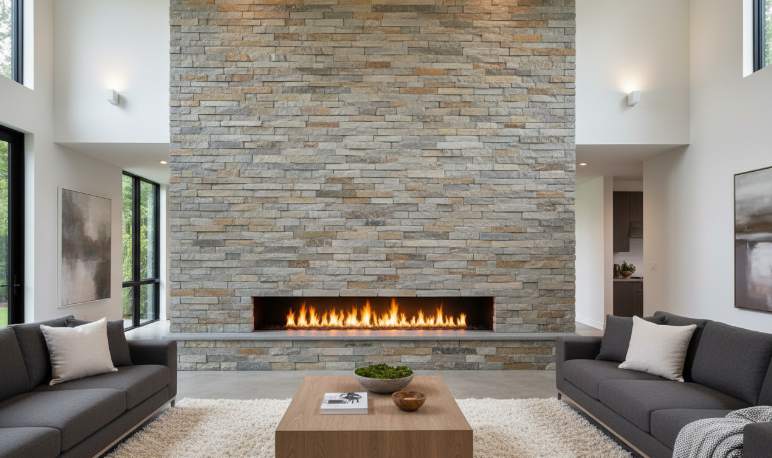
Batch Uniformity & Color Matching Strategy
Color variation between boxes is the #1 installer complaint. A single-quarry block ID system keeps hue deviation at Delta E ≤1.
Why “Color Variation Across Boxes” Is the Top Installer Complaint
For a commercial stacked stone fireplace installation guide, nothing triggers a callback faster than visible color shifts between pallets. The installer opens Box 1 — consistent blue-gray tones. Opens Box 2 — a visibly different hue range. The wall goes up looking patchy. The architect blames the contractor. The contractor blames the supplier. Everyone loses time and margin.
The problem isn’t that natural stone varies — stone varies by definition. The problem is uncontrolled variation. Most Chinese stacked stone factories blend material from multiple quarry blocks to fill order volume. One block came from the north face of the quarry, another from the south face. Different mineral content, different oxidation, different final color. The factory ships it as one order, but it arrives looking like two different products.
Two Specifications to Write Into Your Project Manual
Architects specifying stacked stone for commercial fireplace surrounds should include these two requirements in the bid package. They eliminate the color-matching headache before installation begins.
- Order 10% oversize and request a blended batch certificate. The extra material gives the installer a selection pool to blend edges, corners, and high-visibility zones. The batch certificate documents that all boxes in the shipment came from a single production run with a single block ID. Without it, you have no traceability.
- Specify single-quarry block ID traceability. Require the supplier to label each pallet with the quarry block ID. This ties every stone back to one contiguous piece of quarried material, eliminating the primary source of hue drift.
Single Quarry Block: The Delta E ≤1 Standard
A single quarry block — one contiguous piece of stone extracted, cut, and processed as one lot — removes the variable that causes visible color shifts. Top Source Stone quarries each production run from a single block and labels every pallet with that block ID. Internal QC logs show that identical-block production achieves 95% hue uniformity with Delta E ≤1 measured across a 500 sq.ft. wall. Delta E is the color science standard (CIE Lab) for quantifying perceived difference. A Delta E of 1 is the threshold where the human eye stops detecting a difference. Multi-block blends typically land at Delta E 3–5, which reads as visibly “off.”
For commercial projects where the architect signs off on color hold points, specifying Delta E ≤1 and block ID traceability is the difference between a seamless wall and a rework. See our guide on 5 Considerations for Stacked Stone Fireplaces for pre-purchase planning — it covers substrate selection, firebox clearances, and load tables that directly affect batch ordering decisions.

Panel vs. Loose Stone: Installation Speed & Quality
Pre-fabricated panels cut installation time by 60% over loose stone. For a 50 sq.ft. fireplace surround, that’s 4–5 hours vs 12–14 hours on-site.
Pre-assembled panels vs individual stones: Where the time goes
Loose stacked stone requires a meticulous dry-lay fitting process on the floor before any mortar touches the wall. Every stone must be sorted, rotated, and placed to avoid color clumping and joint misalignment. Then the installer transfers that layout to the wall piece by piece. Even with two experienced masons, a 50 sq.ft. loose stone surround runs 12–14 hours of labor.
Pre-assembled panels lock together with factory-set, consistent joint width. The installer only handles 4–6 units for the same 50 sq.ft. area. Joint spacing across the entire wall stays uniform because the backing mesh controls the gaps. No dry-fit step, no re-laying because a stone doesn’t fit. Total install time drops to 4–5 hours for the same square footage.
Cost comparison: Panels vs loose stone (50 sq.ft.)
- Material cost: Panels average $7–$10 per sq.ft. delivered. Loose stone averages $5–$8 per sq.ft., but edge returns and corner pieces add 15–20% waste.
- Labor rate: $65–$85 per hour for a skilled stone mason. At 5 hours for panels, labor runs $325–$425. At 14 hours for loose stone, labor runs $910–$1,190.
- Waste factor: Loose stone typically generates 10–15% waste from breakage and rejected pieces. Panels generate under 5% waste because the factory pre-selected the stones.
Total installed cost for 50 sq.ft.: panels come in at roughly $12–$18 per sq.ft.; loose stone rarely comes in under $20–$26 per sq.ft. once labor and waste are factored in. The panel premium is a net savings on any commercial spec.
Why consistent joint width matters beyond looks
For commercial fireplace installations inspected under ASTM E84, joint inconsistency creates thermal expansion weak points. Stacked stone panels guarantee even 3/8″ joint spacing across the entire wall. Loose stone joints vary by 1/4″ or more, leading to mortar cracking within 18 months of heat cycling. Reference the Stacked Stone vs Tile for Fireplaces finish comparison for specifics on long-term thermal stability.
Critical Step: Control Joints & Flashing Above Hearth
Omission of control joints and flashing is the leading cause of callbacks. It shows up as moisture staining and cracked mortar within 18 months of installation.
Weep Screed or Flashing at the Hearth-to-Wall Transition
The junction between the hearth extension and the vertical stone face is a water wicking zone. Moisture from routine cleaning, spilled beverages, or humidity migration travels along the horizontal surface and gets pulled into the stone substrate via capillary action. A weep screed or continuous flashing membrane installed at this horizontal-to-vertical plane forces moisture to drain to the exterior rather than climbing into the cement board or stud cavity. In commercial settings where the hearth meets ASTM C97 absorption standards (≤3% by weight), this detail still matters because the mortar joints themselves remain porous. Install a corrosion-resistant metal flashing or a self-adhering membrane that extends at least 2 inches vertically behind the stone and 4 inches horizontally onto the hearth substrate.
Z-Flashing at the Top Edge
The top termination of a stone surround is often treated as a purely cosmetic edge, but it is an active water entry point in any fireplace assembly that shares a chase or exterior wall. Z-flashing directs water running down the wall surface over the top of the stone, preventing it from seeping behind the veneer. Without Z-flashing, water trapped behind the stone can initiate efflorescence, alkali attack on mortar, and freeze-thaw spalling in climates with temperature cycles. For a non-combustible assembly, specify a galvanized or stainless steel Z-flashing that integrates with the weather-resistant barrier behind the cement board.
1/4″ Caulked Expansion Joints at Inside Corners
Inside corners are the stress concentration points in any stone cladding system. As the fireplace undergoes thermal cycling during operation, the stone panels expand and contract at different rates across the corner plane. A rigid, mortared corner joint does not accommodate this movement — the result is diagonal cracks propagating from the corner within 18 months of regular use. Per TCNA guidelines for commercial veneer installations, install a 1/4″ wide backer rod at every inside corner and seal with a high-performance silicone sealant rated for continuous service temperatures up to 300°F. This joint is not structural; it is sacrificial, designed to absorb movement and be re-sealed during routine maintenance. Repeat the same detail at any transition where the stone meets a dissimilar material like a wood mantel or steel surround.
Why This Detail Separates Commercial Projects from Remodels
The DIY and home-blog content (e.g., Thrifty Decor Chick, This Old House) universally skips these four steps. They treat stone surround installation as a purely cosmetic cladding operation. In a commercial specification, flashing and expansion joints are not optional — they are detail items on the shop drawings. When they are omitted, the first sign of trouble is a hairline crack at the corner joint six months after certification. By month 12, moisture staining appears at the hearth line. By month 18, the contractor is back on site for a warranty repair that costs 3x the original stone material. For a detailed breakdown of long-term performance data comparing installations with and without these control elements, refer to the sibling case study on commercial stone longevity.
Conclusion
For commercial fireplace surrounds, the difference between a code-compliant installation and a warranty claim comes down to three specs: fire-rated thin-set mortar, expansion joints at 8–10 ft intervals, and batch-controlled stone panels from a single quarry block. Architects who spec these details—UL-listed mortar with >150 psi bond strength at 200°F, TCNA-compliant silicone joints, and material with Delta E ≤1 batch uniformity—eliminate the two leading failure modes: cracked joints from heat cycling and visible color shifts across large walls.
Review your current stone veneer specification against those benchmarks. If your project requires batch traceability and ASTM E84 Class A fire rating, browse the Blue Diamond Loose Ledgestone Veneer page and request a production sample to verify Delta E and bond strength in your own test.
Frequently Asked Questions
How do you attach a stacked stone fireplace surround?
Attach stacked stone panels using a UL-listed fire-rated modified thin-set mortar applied over a minimum 1/2-inch cement board substrate with a 1-inch air gap or directly over masonry with wire lath. Pre-fabricated panels cut installation time by up to 60%, but you must still install 1/4-inch silicone expansion joints every 8–10 linear feet to prevent heat-cycling cracks. Confirm your framing is rated for the combined panel and mortar load—our load tables show 1–2 lbs/sq.ft. Always verify load capacity before starting installation.
What type of adhesive for stacked stone on fireplace?
Use a polymer-modified medium-bed mortar rated for continuous heat up to 200°F, such as LATICRETE 254 Platinum or an ASTM C1708-classified product. Standard mastic fails within two heating seasons in commercial settings, and Type S mortar with bonding agent is acceptable for residential but not for commercial code compliance. For fire-rated assemblies, the mortar must also meet ASTM C1780 with bond strength over 150 psi at 200°F. Never substitute standard mastic—always check the fire-rating on the bag.
Does stacked stone need to be sealed around a fireplace?
Sealing is not mandatory for fire safety but is recommended for moisture and stain resistance, especially in high-humidity areas or near wood-burning fireplaces where soot can accumulate. Our stacked stone absorbs ≤3% moisture by weight (ASTM C97), so a penetrating sealer applied after installation prevents efflorescence and makes cleaning easier. However, check the sealer’s heat rating—some sealers degrade above 150°F, so use one rated for fireplace environments. Test the sealer on a sample piece first to confirm heat tolerance.
What are the disadvantages of stacked stone fireplaces?
The main disadvantages are potential cracking from missing expansion joints (most installers skip them, causing mortar failure within 18 months) and color variation between boxes if the factory mixes stones from different quarry blocks. Additionally, the weight of 1.5-inch panels (12–18 lbs/sq.ft.) plus mortar (1–2 lbs/sq.ft.) often exceeds initial framing design loads, requiring structural reinforcement. These issues are avoidable if you specify single-batch panels with block-ID traceability and pre-plan expansion joints. Address these three points in your specification to avoid callbacks.
How are stone fire surrounds fixed to the wall?
Stone fire surrounds are fixed using a UL-listed fire-rated thin-set mortar applied over a cement board substrate (minimum 1/2-inch) with a 1-inch air gap, or directly over masonry with wire lath for mechanical bond. For large panels or heavy loose stone, supplemental mechanical fastening (e.g., masonry screws through the panels into studs) may be required to meet seismic or wind-load codes. The substrate must be non-combustible and rated for the fireplace’s BTU output per NFPA 211 clearance requirements. Always cross-check the substrate assembly with your local fire code official.
