


Stone veneer weight limits are the first thing I check when a spec lands on my desk for a commercial feature wall. I don’t care how good the stone looks if it exceeds the 15 lbs per square foot vertical load cap that the IBC and IRC set for adhered veneer. That number is the hard ceiling, and it separates a straightforward install from a project that needs a structural engineer and a backup wall system.
The problem is that most natural stone panels land in the 8 to 15 lbs per square foot range, which means you are already working close to the limit. A panel that averages 12 lbs per square foot sounds safe until you account for the mortar, the lath, and the cement board substrate. Drywall alone supports roughly 2.5 psf. That is not a typo. You need the full assembly—cement board, metal lath, and a proper scratch coat—to hold the 15 psf that code allows. Get the substrate wrong and the liability lands on your firm.
This is where precision in manufacturing becomes a structural factor, not just an aesthetic one. Most mills cut stone from multiple quarry blocks, which introduces thickness variation across the pallet. A panel that varies by a quarter inch can shift the weight by 2 to 3 lbs per square foot. Over a 200-sq-ft wall, that variance compounds and pushes the total load past the substrate’s safe capacity. CNC diamond-blade saws that hold a ±0.02-inch thickness tolerance across the entire pallet eliminate that variable. Every panel weighs the same, which means the load calculation on your submittal documents is accurate from the first square foot to the last.
Understanding IBC Code and Substrate Assembly for Stone Veneer Weight Limits
The IBC caps adhered veneer at 15 psf. Most natural stone panels flirt with that limit; our CNC-cut quartzite and slate panels sit at 8.5–10 psf, giving you a 33% safety buffer.
The hard number for any spec is 15 lbs per square foot. That is the vertical load limit under IBC and IRC for adhered veneer. Exceed it, and you are no longer in veneer territory—you need a structural backup system and a footing. Natural thin stone veneer panels typically land between 8 and 15 psf. The problem is that “up to 15” means some panels hit the ceiling, leaving zero margin for error in adhesive bond or substrate deflection.
Here is where precision manufacturing changes the math. Our stacked stone ledger panels (Model TS‑LQP‑S) are cut with CNC diamond blades that hold a ±0.02-inch thickness tolerance across an entire pallet. That consistency translates directly to weight: our quartzite and slate panels average 8.5–10 lbs per sq. ft, with a ±0.5 lb variation. For a 200-sq-ft wall, that means the total load is predictable within 100 lbs. Compare that to panels from multi-source quarries where thickness can drift by ¼ inch between batches, adding 2–3 psf unpredictably.
To avoid structural failures, the underlying backup structure requires engineering precision. As established, common drywall alone provides zero structural help for thin stone panels. Instead, a code-compliant substrate of cement board over metal lath must be securely anchored back to the framing to handle the full 15 psf limit. Furthermore, for brittle finishes like natural stone, you must specify a deflection limit of L/720 minimum. For walls over 10 feet in height, we recommend L/900. While stiffer than standard trade practice, this prevents the hairline tracking and micro-cracking that lead to structural callbacks.
One hidden factor that specifiers miss: moisture absorption. Unsealed natural stone can absorb water and gain 1–2 lbs per sq. ft in humid climates or exterior applications. That extra weight pushes a 14-psf panel past the code limit on a rainy day. We apply a penetrating chemical sealant during production, which stops that absorption and protects the adhesive bond line. It is a pre-treatment you cannot replicate in the field without days of drying time.
For context on other options: full-bed stone weighs 35–50 psf and requires a structural footing. Manufactured stone veneer runs 8–12 psf but lacks the natural cleft texture and hue depth that architects specify for high-end commercial work. Our ledger panels split the difference—natural stone aesthetics at a weight that stays code-compliant on standard veneer assemblies.
B2B Procurement and Freight of Factory-Direct Stacked Stone Ledger Panels
Factory-direct pricing from a Chinese quarry eliminates 2-3 layers of distribution, yielding a 25-35% cost advantage over US-sourced manufactured stone of the same visual grade — even after factoring in ocean freight and customs clearance.
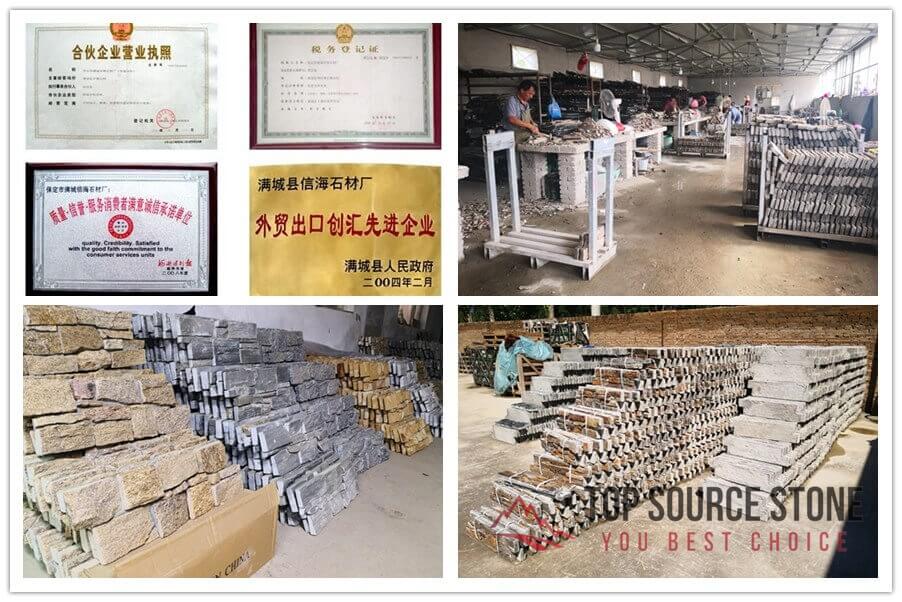
The cost gap between a Chinese quarry-direct stacked stone panel and a comparable US-manufactured product isn’t complicated. It comes down to how many hands touch the material before it reaches your jobsite. A typical US supply chain runs through the quarry, a processor, a regional distributor, and a dealer. Each of those stops adds a markup. By cutting directly from our own quarry in Yixian, Hebei, we remove the processor and the regional distributor from that chain entirely.
Here is the math that matters for a specifier or distributor: a US-manufactured thin stone veneer panel at 8-12 lbs/sq. ft typically retails at a price that reflects those middleman margins. Our CNC-cut natural stone ledger panels — which weigh 8.5-10 lbs/sq. ft for quartzite or slate — land at a delivered cost 25-35% lower for the same visual appearance. That is not a promotional discount; it is the structural result of owning the raw material source and controlling the fabrication from block to pallet.
The common objection is freight. A container from Tianjin to Los Angeles runs roughly $2,500-$4,000 depending on the season, plus customs and inland trucking. Even with those costs added, the landed price per square foot still undercuts the US wholesale price by the margins stated above. The reason is straightforward: a cubic meter of stacked stone ledger panels has a high value-to-weight ratio. The freight cost per square foot is low enough that the production-side savings dominate the total.
There is a catch that most architects and contractors miss. The savings only hold if the supplier delivers consistent panel dimensions and weight. If every panel varies in thickness by 0.25 inches, you are paying for excess stone weight that you cannot use, and the structural load calculations you submitted to the engineer become inaccurate. Our CNC diamond-blade saws hold a strict ±0.02-inch thickness tolerance across the entire pallet. That means every panel of Model TS-LQP-S at 6″×24″ modular weighs within ±0.5 lb of the next. When you are calculating load over a 200-sq-ft wall, that precision turns into a real cost certainty.
| Cost Factor | Specification | Impact on Project |
|---|---|---|
| Factory-Direct Pricing | 25–35% savings vs. US-sourced manufactured stone | Eliminates middleman markups; improves budget adherence |
| Weight Consistency | 8.5–10 lbs/sq. ft (±0.5 lb tolerance) | Simplifies structural load calculations; reduces engineering rework |
| Single-Quarry Sourcing | 95% hue uniformity from one block | Prevents costly re-installation due to patchy color variation |
| Pre-Sealed Panels | Chemical sealant pre-treatment applied | Eliminates on-site sealing costs; prevents moisture-related weight gain |
| Lead Time & MOQ | 4–6 weeks FOB Tianjin; MOQ 1,000 sq. ft | Predictable delivery window; viable for commercial-scale orders |
Eliminating Structural Risk: CNC Precision vs. Multi-Source Quarry Thickness Variance
Single-quarry sourcing eliminates the 1–3 lb/sq. ft weight variance and color drift that multi-source blends introduce into your load calculations.
Most suppliers source stone from multiple quarries to fill orders. This introduces a hidden variable into your stacked stone panel weight per square foot calculations. One block may yield panels at 9 lbs/sq. ft while another from a different pit yields 11 lbs/sq. ft for the same stone type. Over a 200‑sq‑ft wall, that 2‑lb variance adds 400 lbs of unaccounted vertical load — enough to push an adhered veneer assembly past the IBC’s 15 lbs/sq. ft limit on a marginal substrate.
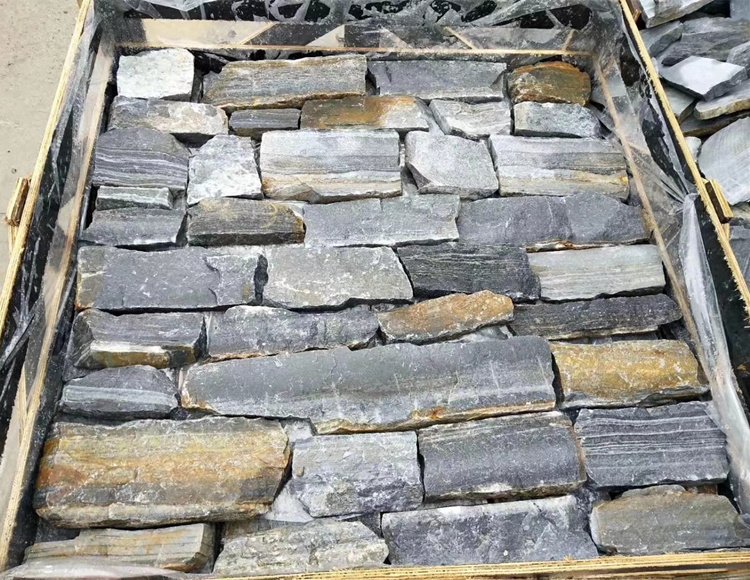
We cut every panel in a single production run from one quarry block. Our CNC diamond‑blade saws hold thickness to ±0.02 inches, so every panel in the pallet weighs within 0.5 lbs of its neighbor. For a 1,000‑sq‑ft order, the total weight deviation is under 50 lbs — negligible for structural engineering sign‑off. This precision also locks in hue uniformity above 95%, eliminating the patchwork appearance that occurs when stones from different geological layers are blended.
The engineering consequence is predictable load distribution. When you specify our Model TS‑LQP‑S at 8.5–10 lbs/sq. ft, that range holds across the entire installation. Your structural engineer can size the substrate and fasteners to a tight tolerance rather than padding the design for worst‑case variance. For commercial wall cladding weight restrictions where every psf counts, single‑quarry sourcing is the difference between a clean submittal and a redesign.
Conclusion
Specifying stone veneer within code limits protects your project from structural failure and liability. A panel weight of 8.5–10 lbs/sq. ft, combined with proper substrate assembly, keeps you safely under the 15 psf IBC cap. Consistent weight and hue from a single quarry source removes the risk of a patchy installation.
Review the product specifications for the TS‑LQP‑S panel to confirm it meets your project’s load and fire-code requirements. Compare the weight tolerance and color uniformity data against your next bid package.
Frequently Asked Questions
What is the difference between stone veneer and stacked stone?
Stone veneer is a general term for thin stone cladding, while stacked stone is a specific style of veneer that uses rectangular pieces arranged in a staggered, dry-stack pattern. The main difference is that stacked stone is typically pre-assembled into modular ledger panels for faster installation. Choose stacked stone for a clean, modern ledger panel look.
How strong is stone veneer?
Natural stone veneer is strong enough for most vertical applications, with adhered systems typically rated for up to 15 lbs per square foot under IBC codes. The real strength comes from the bond. Always verify substrate strength and adhesive specs before installation.
How much do stone veneer panels weigh?
Natural stone veneer panels typically weigh between 8 and 15 pounds per square foot, depending on the stone type and thickness. Stacked stone ledger panels from a single quarry with a strict ±0.02-inch thickness control will maintain a stable weight of 8.5–10 psf. Confirm the exact weight per panel with your supplier before engineering.
What are the disadvantages of stone veneer?
The main disadvantage is weight: natural stone veneer can push the 15 psf code limit, requiring careful engineering and a strong substrate. Also, multi-source stone can have color and thickness variation, making installation trickier. Single-quarry sourcing eliminates most of these quality headaches.
How long does a stacked stone last?
A properly installed stacked stone veneer will last 50 years or more, often outlasting the building itself. The lifespan depends on the quality of the stone, the installation method, and whether it’s properly protected from freeze-thaw cycles. Use a breathable sealer and proper flashing to maximize longevity.
